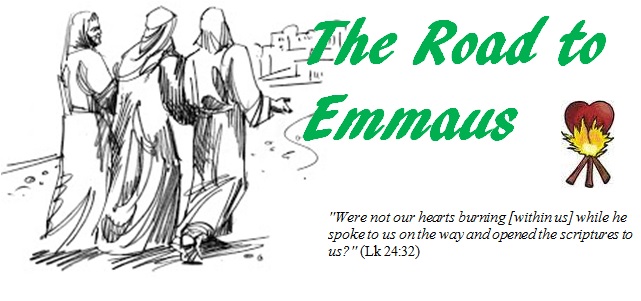
When he was at table with them, he took the bread. He blessed the bread, and broke it, and gave it to them. And their eyes were opened and they recognized him!(Luke 24:13-35)

Tuesday, January 8, 2013

Love>Fear


Fear and Love are two of the most intense emotions in many peoples’ lives. If you’re like me, you might be a little taken aback by St. John’s statement, “one who fears is not yet perfect in love.” (1 John 4:11-18) We all fear something. Fear is a common emotion innate to every single animal on the face of this earth. I’m afraid of rats (there, I said it!), Lily is afraid of a vacuum cleaner, etc.  So how can it be considered that fear is the opposite of love and therefore God?

I don’t think St. John is stating that the emotion itself is the opposite of love. In Mark’s gospel (Mark 6:45-52) we hear of the Apostles terrified of a storm. In the garden of Gethsemane, Jesus Himself sweated blood when He was praying in fear about His upcoming crucifixion. (Mt 26: 36-46; Lk 22: 40-46; Mk 14: 32-42) The emotion of fear is human. What I think St. John is getting at is that crippling fear, fear that leads us to inaction, is the opposite of love. Love is action. It physically connects us with both others and God. As St. John states, “love is brought to perfection in us… love is brought to perfection among us.” Love is not letting fears keep us stagnant and isolated. Love addresses the emotion of fear but does not give into it, even when our life is on the line. While Jesus did fear the crucifixion, He didn’t let it cripple Him from performing the ultimate act of love.

The psychologists tell us that there are two ways of coping.  Flight (quit, copout, run for cover) or Fight (attack the cause of your fear head on, conquer it, and eliminate it by proving you are superior to it.)

St. John gives us a third and better way of coping.  He says: “Love casts out fear.”  He begins with the love of God.  Not the romantic form of love.  Rather he means the total giving of oneself to the other, surrendering oneself to the other, making the others' well-being the greatest goal of our life. After all, the greatest cause of fear is our self-concern.  I’m afraid I might fail, I might get hurt and maybe I’ll be humiliated.  On and on it goes.  Fear is the product of our self-interest.

If we find ourselves fearful and worried in the crises of life we have a third valuable solution for banishing our fears and worries by turning them over to Christ.  To do this we have to develop our total love for the Lord, by putting on the will of Christ not just in words but in all of our actions.

Consider Mark’s gospel again.  The Apostles who really loved the Lord should have figured He didn’t call them to be “fishers of men” if they were to drown without the opportunity to answer His call. They should have recognized that anybody walking on the water had to be Jesus, the Son of God, not a ghost who would simply swallow them up in the waves. Nor should they have doubted that the man who miraculously fed the 5000 would be unable to calm the winds and the waves.  Had they genuine love for the Lord they would have surrendered their wills to the will of their Lord and with confidence believed that being all powerful He would rescue them even from the elements. (Of course we know that the Apostles did come to love the Lord in this way—they were just a little slow—as we all are!)

So as we go about our days, let’s take some time to address those main fears that hinder us from ACTING with love. Maybe you’re afraid of being insulted. Maybe you’re afraid of offending someone. Maybe you’re afraid that you will be hurt – socially, emotionally, or maybe even physically. Maybe if we take today to address and pray to the Holy Spirit about our fears, maybe we will be able to recognize and overcome them the next time they arise. Maybe we can learn to live into a more perfect love.

Oh! And don’t forget that we have someone to help us along the way!  It’s quite natural to cling to your mother when you’re fearful.  The Mother of God is the perfect mother!

Saturday, January 5, 2013

Have you thanked your priest today?


I frequently get into discussions with those of my generation who refuse to get Facebook or Twitter accounts because “nobody needs to know my every move!  I have to have privacy!”  In the wrong hands, this could and does happen.  There are those who seem addicted to these services and the cure is simple; stop following them!  But both of those modern methods of instant communication can be used for great good and evangelization as well.  Even the basic internet e-mail is a tool to building a stronger faith—for instance, I am being sent several paragraphs of the Catechism of the Catholic Church each morning to read and study as my commitment to this Year of Faith as proclaimed by the Holy Father.

Pope Benedict sees the value in Twitter, as evidenced by his entry into “tweeting”.  I am finding his “tweets” both thought-provoking and uplifting.  There are also about a dozen Catholic apologists I follow on Twitter and/or Facebook that give me plenty of ideas for spiritual growth.  It feels at times as though I have several spiritual directors.  It helps that they all teach the same truths about our Catholic faith, albeit at different levels of scholarship. 

I love that I get links to great articles by priests, religious and devout lay men and women who have great insights into the faith and can help me steer clear of fuzzy or heretical teachers. 

Now that I’ve laid the groundwork, I have to share a link to an article written by Fr. Mike Schmitz titled “My Side of the Confessional: What Is It Like for a Priest? “

We all know the best thing about priests is that they alone can “confect” the bread and wine at Mass into the Body, Blood, Soul and Divinity of Christ.  But coming up a close 2nd (I would argue that it is tied for 1st place) is that they can hear our confessions and by the power of Christ absolve us of our sins.

After reading the piece by Fr. Schmitz I am even more in awe of priests.  I have heard before that priests are given a special grace by their ordination that allows them to forget individual confessions just as God forgets sins once He’s forgiven them.  But what I didn’t know was that the Catechism teaches that the priest must do penance for all those who come to him for Confession! (ccc1448) It made my heart sick when I read that! It brought home the fact that because the priest is in personae Christi, and he actually does my penance alongside me, my sins are affecting not only my soul, but the soul of the priest and the Holy Soul of Jesus Himself!  That point was brought home by Fr. Schmitz's analogy of the Blood of Christ dripping from the fingers of the priest as he holds his hands above the penitent's head during absolution. It’s so humbling, I want to cry.  Better yet, I think I’ll actually thank my confessor more sincerely from now on when I exit the confessional cleansed of the stain of sin.  Maybe even today!

Friday, January 4, 2013

Come out from under the fig tree!


 It’s such a simple command, yet it is all we have to do in order to become saints.  “Follow me” Jesus says.  All of Christianity comes down to this: follow Jesus.

It is so simple, yet so confusing at the same time.  Follow Jesus where?  Follow Jesus when?  Am I already following Jesus?  Or am I walking down my own path?  Will He let me know if I’m not following Him?  Who or what do I have to leave to follow Him?  So often we can find ourselves asking God these questions in prayer but He never seems to provide us with the answers.
But that’s what truly tests our faith: whether we are willing to follow Jesus without having these questions answered for us.

In John’s Gospel (John 1:43-51), Phillip doesn’t seek Jesus out and ask Him a bunch of questions.  Instead, Jesus comes to Phillip.  The Gospel says, “Jesus decided to go to Galilee, and he found Phillip.”  I know it sounds crazy but try inserting your own name and location into this story.   For example, “Jesus decided to go to Stockton, and he found Steve.”  Just as Jesus found Phillip, so also will Jesus find you and me, and He will call us to follow Him.  Phillip’s response is to tell Nathanael, who immediately upon hearing Phillip speak of Jesus, questions him.

I think our challenge today is to open ourselves to Jesus; to stop asking the questions and seeking the answer like Nathanael does, and to let Jesus find us where we are—at home, in our workplace, in church, wherever we may be, whatever our state in life is—and to follow Him.  Jesus will come to meet us like He does Phillip and Nathanael, often in ways we do not expect, and will call us to follow Him.  Will our response be to question Jesus when He does call, or will it be to have faith and to just go where He leads?

Thursday, January 3, 2013

I was just reminded!

Happy Feast Day, St. Genevieve!  Please pray for my Aunt Jenny today!  Click here for details.

Posturing to be an Apostle of Christ


John the Baptist said of Jesus, "Behold the Lamb of God." (John 1:35-42)

Upon hearing those words, Andrew, one of John's disciples decided to spend some time with Jesus to find out what would make a credible person like John the Baptist say such a thing.

We hear the same words, at every Mass during the Liturgy of the Eucharist when the priest elevates the Sacred Host. The question for us is, Do we drop our ordinary ways and, like Andrew, follow Him and never again be the same?

Let me back up a couple of steps, if I may.  Just before the celebrant elevates the Host we have either recited or sung the “Agnus Dei” prayer.  In the Fresno Diocese where I attend most of my daily masses, we kneel right after this and so are in a reverent posture to “behold the Lamb of God!” then to reply to the priest’s invitation to the “supper of the Lamb” with the words of the centurion; “Lord, I am not worthy that you should enter under my roof, but only say the word and my soul shall be healed.”

But in my home diocese of Stockton, the bishop has asked us to stand for the Ecce Angnus Dei prayer and continue standing throughout the Communion Rite until the last communicant has received our Lord, at which time we can either sit or kneel in reflection until the closing prayer.  I have always felt uncomfortable standing in the presence of Jesus Christ.  There is something in my “spiritual make-up” that tells me this is a time to be kneeling. But I do stand out of obedience to his Eminence.  After all, he is a successor to the Apostles--perhaps even Andrew himself!

So back to my original question:  "How does hearing the words “Behold the Lamb of God” affect us?"  

Perhaps we are all called to be like Andrew, in regards to his introducing of Peter to Jesus, and bring people closer to God through our simple actions, such as obedience to the Bishop out of love for Jesus no matter how uncomfortable it may seem.  Perhaps one simple act of kindness or love today will move someone closer to God tomorrow.  Just like Andrew, we may never know the true value of our deeds, but we must always remain cognizant of the potential importance of our actions in the lives of others, while constantly trying to remember that God is present even in the smallest of endeavors.

Please Lord, let it be so.

Tuesday, January 1, 2013

A New Year's Resolution


This time of year is so full of hope and promise.

I think most of us get a boost of energy from new beginnings... a new month, a new semester, a new fiscal year (with or without “cliffs”), and the ultimate new beginning is the New Year.  With the new we are bombarded with top ten lists and suggestions for the best resolutions.  And I readily jump in to the excitement.

My default mode is gratitude and reflecting upon blessings I have received during the past year.  Yet I have barely taken my spiritual and emotional inventory before I jump into the resolution fray by enthusiastically developing ambitious plans about how I can be a better person, a better family member, a better member of community… eat less sugary treats, exercise more, pray more deeply, let others know how much they mean to me.  What good are these inspirations without exploring who I am?

John’s gospel (John 1:19-28) offers an opportunity to appreciate John the Baptist’s sense of self.  As we contemplate the scene described we should feel a sense of calm resolve from John.  He is not trying to convince anyone about who he is or what he is trying to do.  He answers the questions from the priests and the Levites calmly and resolutely.   John does not explain away his behavior nor does he need invented resolutions which focus on how he can love and serve Jesus.
John is a powerful model of knowing who he is and how he focuses.

We can use John as a touchstone to help us explore the times we are influenced by the questions or assumptions of others in defining us.  As I reflect upon this upcoming year I can gain insights by asking myself the questions John heard from the priests and Levites.  How will I respond this year when people ask me directly or metaphorically “what do you have to say for yourself?”   

1 John 2:22-28 offers a wonderful reminder that we have been given all we need to love and serve God by having been given the truth.  “Let what you heard in the beginning remain in you.”

In His mercy, God has shaped salvation history to bring His people to the awareness that without Him they could never achieve inner peace, that they themselves are powerless to save themselves or build lives pleasing to Him. John the Baptist was sent to announce that their long-awaited Savior had come in the person of Jesus Christ and to prepare them to receive Him by acknowledging their sins, repenting and turning to their Messiah.

It is God Himself who made straight our path to salvation, first through holy men and prophets and finally in Christ His only Son. Jerusalem, the Holy City, is our destination, our oasis in the desert. The way is perilous, difficult and demanding; many turns entice us from our goal. Our only assurance of arrival is to follow Christ closely, shoulder the cross with Him, look ahead with hope, and never look back lest we fall by the wayside.

“Remain in him” is the only New Year’s resolution we need.

Sunday, December 30, 2012

Lost and Found


Every year, the Church celebrates the Feast of the Holy Family of Jesus, Mary, and Joseph on the Sunday within the Octave of Christmas.

So, we call Jesus and Mary and Joseph the Holy Family; paintings always place a halo over their heads. In order for us to see how this family encountered problems just like other families, the Gospel chosen for this Sunday is about Jesus' boyhood years. Joseph is by now a carpenter in Nazareth, and Mary is a busy housewife and mother of a teenager! As parents, Mary and Joseph are well aware of their responsibilities. Being God's divine Son does not prevent Jesus, however, from acting with all the inexperience and spontaneous behavior of any normal twelve-year-old. What an exciting experience for a boy from a small town to travel to Jerusalem for the Feast!

Fascinated with the learned teachers He found in the Temple, He loses track of time and, like most teenagers, doesn't think about the terror that a missing child can cause for parents. After three frantic days of searching, they find Him, only to hear Jesus rather naively ask, "Didn't you realize I had to be in my Father's house?" No, they don't understand, but they tucked it away in their hearts, along with a lot of other unanswered questions.

Mary and Joseph, like millions of other parents, were acting as good, responsible caregivers who were having difficulty understanding their son. So what else is new? Teenagers don't understand themselves either. Was Jesus just carried away with impatience to start His ministry? For Joseph and Mary, the fact that Jesus was divine made His actions all the more mystifying to them.

What Jesus did after that is really the great lesson for all families -- He humbly bowed to their authority. When He saw how upset they were, He promptly left the Temple, and went back obediently to Nazareth where He "advanced in age and grace and wisdom."

As I write this, I am not so sure Jesus’ question “Didn't you realize I had to be in my Father's house?" was so much naïve as it was profound.  After all, if you think about it He wasn’t lost—He knew exactly where He was.  I would never disparage Mary or Joseph, but the fact of the matter is they lost sight of their son.  So Jesus’ response to His mother for me is more of a gentle reminder that when we lose sight of Jesus, it’s not through His fault, but our own and we will always know where to find Him—at work doing the Will of God and inviting us to follow.   

What makes a family "holy"? Is it all so simple? Just to love, communicate with, and forgive one another, and keep the commandments! Of course, simple answers like that are the hardest to accept! John says we must believe in the Son and keep His commandments. Joseph was totally committed to heading this "holy family" because the Angel told him to do it. Mary, at the risk of her reputation, gave birth to Jesus, and was a faithful, protective mother because God wanted it. And Jesus was a faithful son, subservient to human parents because His heavenly Father willed it so!

Our families would find their disagreements, stressful relationships, and resentments that spoil the joy of family harmony so much easier to solve by imitating the faith and loving trust of the Holy Family.

Today marks the end of 2012 and tomorrow the dawn of 2013. What a powerful gospel reading the Church has chosen for the occasion! It serves as a statement of who we are as Christians, the gifts we have been given and where we are headed, to our promised destiny.

St. John reminds us that in the beginning was the Word. He speaks of creation, our salvation, the role of St. John the Baptist and our gift as Christians. What more could we be given than that which is described by St. John:

But to those who did accept Him He gave power to become children of God. (John 1:12a)

Yes, we can choose to join the millions who make trivial New Year's resolutions which fade away in days or weeks. But how much more beneficial to embrace again today, the gifts God has already given us? Let us resolve to remain open to the graces of God in 2013 and respond even more generously to His endless Love.

Friday, December 28, 2012

Hold on tight!


If we keep our heads about us and don’t let the frenzy of the season intrude too deeply, the anticipation of Advent followed by the blessings of Christmas fill us with joy.  It’s a time of family and remembrances and thankfulness for all that we have been given, with the ultimate gift being the birth of Jesus.  Our thoughts of that first Christmas are filled with the sweetness of the child in the manger and of Mary as the perfect embodiment of motherhood. 

Perhaps because this experience of happiness is so fresh in our hearts, thinking about today’s Gospel (Matthew 2:13-18) is so beyond understanding.   Sometime within two years after Jesus’s birth, Joseph and Mary, still not fully comprehending the miracle that they have been given, are warned that Herod wants to murder their child.  In a state of panic and fear, they leave Bethlehem for Egypt giving up all that they know and all whom they love so that they might save their child.  Then, while they find safety, Herod is so infuriated that he calls for the murder of all the young boys in Bethlehem. 

Mary and Joseph could not disassociate themselves from the horror they were leaving behind.  Their act of protecting their child’s safety results in tragedy for other mothers and fathers.  We don’t know of a sadder line than that from today’s Gospel, “Rachel would not be consoled since her children were no more.”  As this nation has come to know through the events a couple of weeks ago in Connecticut, we all feel the pain when we learn that someone has lost a child.  There is no grief as deep; there is no touch that can lessen the hurt.  We hold our own children tightly and give thanks for their safety and we pray that nothing will ever harm them.

Of course, we don’t know what Mary thought but it is so difficult to accept that someone could so hate a small child that he would call for the child’s death.  This was no doubt a foretelling to Mary of what she might have to experience in the future, a constant fear that she would come to live with.  And what of her thoughts of her neighbors and friends in Bethlehem who suffered such a great loss?  If she could, how would she reach out to them and what would she say?

I think that she would echo a reading from the first letter of John (1 John 1:5--2:2).  This reading gives me hope for a world that seems surrounded by darkness.  Hope because there is light in the world that brightens the darkness.  For all the evil acts that blacken the world around us there is God’s light shining through people who stand for justice, truth and love.  These are regular people like you and me, coming from all faiths and cultures; people who brighten the dark places of the world.  We brighten the world because we stand up against injustices, pursue God’s truth, and reflect the love that God has for each one of us.  We are not saints, but we are people who care, we have been touched by God’s love and want to share the gift.  By sharing God’s love we are lighting up the world.  As we celebrate the Christmas season and the birth of God among us, we can be confident that the light we bring to the world is making a difference.  Even those small daily acts of love, truth, and justice shared with family, friends, and strangers are sending sparks of light into the world.  We can’t undo the horrors of yesterday, but we can bring light in the world today.  The world needs us to bring God’s love, hope and light into every situation we encounter. 

But our thoughts today go to Rachel and all the other mothers lost in their grief.  How do we reach out to them and what should we say?  We don’t know, so we hold our children tightly.
 

Sunday, December 23, 2012

Might as well make it memorable


One way to make a meal more pleasant is to begin it with a special prayer of thanksgiving and praise to God. For a lot of people, family gatherings during holidays are the only time a grace before meals is said.  So you might as well make it memorable!  Maybe not as memorable as this.....


..but memorable, nonetheless.
Many Spirit-filled individuals I’ve known over the years have been able to come up with dinner prayers “off-the-cuff” that are truly outstanding.  I tend to muddle those up, no matter how sincere I am in the attempt.  So I usually resort to researching prayers already written for the occasion and “editing” them to be more personal.  I have posted the top 3 I found over the last week.  I will be using one of them.  I will probably write the blessing that I use on a separate sheet of paper and read it before the meal.  Another great idea I read is to place a small portion of each prayer on a separate card and have a different person at the table each read one.  Whichever way you choose to say your grace, remember that it is the most important part of the meal!

======================================== 

1.  Heavenly Father, we give thanks for the birth of your Son and the celebration of His life. Help us to remember that this festive day is set aside to celebrate all He has done for us. We give thanks for our family and friends and for the blessing that you have given us so we can plan and enjoy a Christmas meal together. We thank you for your provision of a home, a kitchen, for loving hands and for the abundance of food upon this table.  Please help us to remember that there are those who have no families, no place at a table, and no one with whom to share a Christmas dinner.  Help us to listen to your wee small voice and to obey that wee small voice so we can reach out and help their Christmas be a merrier one. We ask that you would bless those around this Christmas table and we ask you to bless our food.  Allow our hearts and attitudes, our actions and our lives to be blessings to you. Through Jesus Christ, Your Son, we pray. Amen


2.  Eternal God, this joyful day is radiant with the brilliance of your one true light. May that light illuminate our hearts and shine in our words and deeds. May the hope, the peace, the joy, and the love represented by the birth in Bethlehem fill our lives and become part of all that we say and do.  Allow us to share the divine life of your son Jesus Christ, even as he humbled himself to share our humanity.  Bless us and the feast that You have provided for us, let us be thankful for the true gift of Christmas, your Son Jesus Christ. Amen.

This third prayer was written especially to remember the tragedy of the Connecticut school shootings:

3.  Father, we thank you for our family and friends. We are so grateful for each and every person around this table and we thank you for the gifts of compassion, love, strength and encouragement they have been.  Although it's been a painful time in our country recently, and we share in the grief of those parents whose children were taken from them too soon, we know that You are always with us. Your promises are true. You will never leave us nor forsake us. Thank you for the love that holds us together and for always comforting us. Thank you for the gift of your Son, whose very life reminds us that you are a father of compassion and one acquainted with grief in the midst of joy and joy in the midst of suffering. Help us to hold each other close and to treasure each other this day and all the days to come. We present this prayer in Jesus' name, Amen."