The good thing about not being able to sleep is that I can catch up on some news stories. I am particularly elated by this story. Way to go, Arizona!
Then, how about the storm that occurred during one of Pope Benedict XVI's speeches to the crowds at World Youth Day in Madrid? Hats off to the young people who know their priorities and have a faith that can change the world. Hats off too, to 84-year-old B16 for hanging in there despite the storm and setting an example of prayer for the faithful.
I am moved to comment on the disparity between comments made from the perspective of people who were actully there and those who want to bad-mouth religion in general and the Catholic Church in particular on the secular on-line "news sites", which are actually nothing more than oceans of gossip and calumny where trolls who are in the grip of Satan abound. Just type 'storm dampens WYD' into your search engine and you'll find out what I mean. Pray for the world. Start with the Divine Mercy Chaplet.
Some may think I'm being paranoid about negative comments about Christianity and Catholicism, but compare the comments in the secular media regarding the storm at WYD to the earthquake that struck the Eastern US (Washington DC included). No mention of God's wrath at Washington politicians who support abortion (with millions dead already and the future of our country in the balance), but plenty of swipes at one of the most holy persons on Earth for his "failure" to handle the priests involved in the sex-abuse scandals! Which, by the way he has apologized for and actually been instrumental in forming new guidelines for handling the wayward men who have damaged the priesthood and Christ's Church so badly. But some people are so blinded by hate and greed that they will not be happy until the Body of Christ has been decapitated. Take heart though, fellow Catholics, and remember His promise--"the gates of Hell shall not prevail against it!"
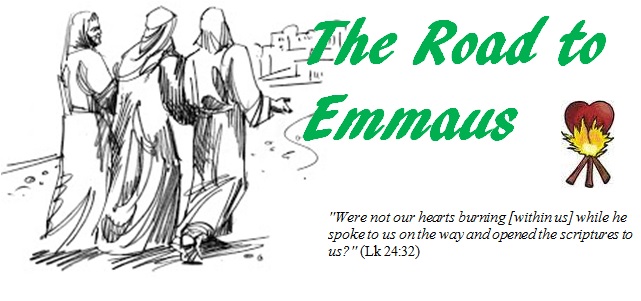
When he was at table with them, he took the bread. He blessed the bread, and broke it, and gave it to them. And their eyes were opened and they recognized him!(Luke 24:13-35)
Wednesday, August 24, 2011
Tuesday, August 23, 2011
Keeping things simple is hard
Prayer for the Day
Dear Lord, give me the grace I need today to see clearly. Simplify my heart. Restore in me a new innocence. Let me ask simple questions about the choices before me - where they will lead. And, help me purify my desiring. Heal my lust for more things, more comfort, more respect, or more power. Let me know Your love and Your grace, and I will be rich enough, and ask for nothing more.
Reflection
Sometimes I wish I could be as simple with my faith as Bartholomew. I would really like to know why Nathaniel (Bartholomew) was convinced that Jesus was “the Son of God, the King of Israel" simply because Jesus said, “I saw you under the fig tree.” (John 1:45-51)
I’m thinking that Nathaniel was rather young at the time that this event occurred: he shows the sort of cynicism that is usually associated with young men in their late teens at the same time as being rather pure or "free from guile”; again, something associated with a young man trying to be innocent and pure of heart. I don’t think that Jesus is being sarcastic in what He says; this is just part of the exchange of names and titles at the heart of this particular reading.
What happened under the fig tree is never going to be completely clear to us on this side of eternity. From what Jesus says and from Nathaniel's reaction we can surmise that it was a very private and personal matter, one in which Nathaniel struggled (and won) in what was primarily a matter of honesty or straightforwardness, maybe of interior fidelity to God's love. Jesus's next words are a matter of encouragement, a calling of the young man to great deeds. Jesus will later go on to expand the "angels ascending and descending" to say that "no one has gone up to heaven except the One who has come down from heaven" (John 3:13) and to say "I am the way" (that leads to the Father) (John 14:6).
I think that we too are called to struggle with our devils, especially internally, so as to be pure of heart before God even more than before other people. We need to review our values, our excuses, the things that we wish to hide from, and the things that we repeat to ourselves about our judgments of other people, their motives, why we have trouble with them, etc. This is the fig tree where we wrestle with ourselves to become truly gentle and loving, without guile.
This past couple of months, I’ve been “sitting under a fig tree” of my own. We have a relatively new “bigwig” in our company who has ruffled more than a few feathers (including my own) by his management methods. My (and others’) inability to come to terms with this management “style” has resulted in some not so Christian epithets for him. I know that instead of being angry and resentful for some of the unkind and—I might add—unwarranted remarks he has made about me and some of my friends I should be praying for him, but it is really difficult. Just when I think I’ve “forgiven those who trespass against me”, he comes up with something new for me to brood about.
Actually, I should be grateful for the struggle, because internal struggle opens the door to the Lord, letting Him reveal Himself to us as our Way to God.
His coming to us will still be unexpected: we know not the day nor the hour, not the situation nor the messenger --- and it just might be one of those people from Nazareth that we have been spurning...although I’m pretty sure we can rule out Harold Camping.
Get through the "noise" to what truly matters
Prayer for the Day
Heavenly Father, through Your Son, please allow me to get through the mundane “noise” today and show me what really matters to you. Help me to love You with my whole heart, mind, soul and strength and to use that strength to reflect Your image to others. Amen
Reflection
Have you ever noticed how we are often scrupulous about minor matters and neglect the greater ones? We are often more concerned about appearances and opinions of others than what is in our heart and the purity of our thoughts and intentions. I think that’s what Jesus was telling the Pharisees in the verses where He begins “Woe to you!” (Mt 23:23-26)
We are made in God’s image. Anything and everything that is good about us--in our nature, our natural personality--IS a gift from God. We are a reflection of God. Our natural abilities are natural only because God put them within us by design and choice, as a reflection of God’s nature for our benefit and for the benefit of the world.
And all of that true nature is only true because it's a gift from our Creator. Everything that's natural -- everything we were born with -- because if God hadn't chosen to give it to us, we wouldn't have it. THAT is the definition of "gift."
It’s been said, “The only way to preserve any gift of God is to give it away.” Each of us has God given gifts that we are asked to share with others. Paul received the great gifts of knowledge, understanding and discourse from God and he lived his life by giving those gifts to others. Jesus took on human existence so he could give his life for us. What an awesome gift!
At the end of each Mass the celebrant says “Go now to love and serve the Lord.” That is a declaration to go out and share our gifts with others. What we do for others might not reverberate around the world, but even the simplest undertaking, such as smiling at the bank clerk, is a gift. Everything we do is extremely worthwhile and important to the ones we serve.
So I guess my advice would be to “Go now to love and serve the Lord” …by loving and serving each other.
Thursday, August 18, 2011
The whole law and the prophets depend on these two commandments
Prayer for the Day
O God, help us choose those values which will unite this world's people. Make us of one mind and heart to end our conflicts and bring us true peace and joy. Amen.
Reflection
A few days ago I was not in a very good mood. Nothing has gone well at work this week as far as the plans I had made and I was getting frustrated. As I was coming out of Hometown Buffet after dinner, I noticed a young man (probably in his mid-20’s) coming straight at me. “Uh-oh”, I thought, “here it comes!” My standard line for avoiding pan-handlers is “I’m so sorry, but I don’t carry cash on me, ever since I was robbed at gunpoint.” It’s a true statement, but in today’s society one doesn’t really have to carry cash to get just about anything one needs. There are a few holdouts who charge exorbitant fees for credit cards or who are cash only establishments, but generally, just about everybody takes credit or debit cards, so my excuse to those in need is more self-serving than Christian.
That being said, this guy walked up and asked for a few dollars to get something to eat. I thought to myself, “Why not? I’ll pay for his dinner then leave. It’s only about 10 bucks. Maybe he won’t bother anyone else if I help him.” Again, that was a self-serving excuse to talk myself into doing something I ought to do. So I turned around and opened the door for him saying, “After you, sir.” He thanked me and we walked up to the counter to pay for his meal.
The girl behind the counter smiled at me (she was the same girl who had rung my dinner up earlier), excused herself, and got on the intercom to call the manager. When the manager arrived, he didn’t greet me but gave me the once-over and said to my guest, “I told you you’re not allowed in here! Please leave!” Then the manager, without even acknowledging me went back to wherever he was when he was called.
The girl then turned to me and said, “I’m sorry, but he was caught in her just a little while ago trying to steal some food.” I was very tempted to point out that the reason he was stealing food was probably because he was hungry and broke, but I didn’t. I don’t know why I didn’t stick up for the guy (Yes I do. It’s because I was embarrassed at that point.) Jesus would have told a parable or something to make it a teaching moment for the manager. All I did was turn around as he was leaving and said, “Is there somewhere else in this shopping center where we can get you a meal?”
He smiled and said he didn’t know. So I perused the shopping center quickly and saw a couple of restaurant-looking businesses on the opposite corner from where we were. I asked him if he would mind if I bought him a dinner at one of those places. Obviously, he never heard the expression “beggars can’t be choosers”. He said, “I was hoping for a Mexican meal.” I replied that we might get lucky, but I was a little pressed for time, so it would have to be whatever we found. I started walking towards the restaurants. He asked me, “You want to walk over there?” I may have felt generous, but not stupid. Giving a car ride to a total stranger who you know has recently tried to steal and might have the smell of alcohol on his breath is not a prudent decision. I said, “Yeah. I need to walk off my dinner.” He replied that he understood, although I could tell that he didn’t.
He asked my name. I told him my first name. He introduced himself, but I can’t remember it. He touched my shoulder and said something about giving me positive energy or something and asking me if I felt it. I wondered if I had bitten off more than I could chew with this “dinner guest.” Pun intended.
He asked if I was religious. I replied that I am Catholic. He grew silent for a few minutes until we got into the restaurant. I don’t remember which one it was, but it was a chain fast-food joint. I didn’t recognize the menu, so I must not eat there a lot. He asked the clerk if they had any Mexican food. “Nope, just hamburgers and chicken sandwiches, French fries and drinks,” came the reply. He asked me what he should order. I told him he could get whatever he wanted. He said, “You’re the only person who has talked to me like a human being or helped me in a long time, and you didn’t hesitate to use your credit card.” He pulled out an obviously used VCR tape and said he would like to give it to me. I thanked him and said, “I’m just glad I could help”. He ordered a value meal of some sort, and I paid for it with my credit card. He asked me if I had a business card with my name and phone number on it. I decided to give him one of my homemade “business cards” that has only my blog address on it. He said he would check it out. I told him good-bye and left for home. For some reason I couldn’t put my finger on, I felt much less frustrated and angry than I was when I went to dinner.
I really didn’t think much about the episode again until I read the Gospel passage for Friday this week (Mt 22:34-40).
What is the greatest commandment of the Lord? Love God with all that you are. And love your neighbor as you love yourself. Jesus goes so far as to say that the whole of the law is summed up in these two laws. Between the two, everything is encompassed - soul, mind, spirit.
But what we often forget is that Jesus has commanded us to love our neighbors as ourselves. That is, we are commanded to love ourselves. Not to worship ourselves, but to love ourselves - being kind to ourselves, being aware of our strengths and weaknesses - asking the Lord for the opportunity to use the former and praying for help in places where we are weak.
Loving ourselves is often difficult because we don't feel loveable. But God loves each one of us as if we were the only person on Earth. We are loved as an only child is loved, and it is that love that we are supposed to bring into the world and express to all our brothers and sisters. But we must first feel it for ourselves or we cannot help others to feel it.
Love God with everything you are, and everything follows from that. When we love God, we can look upon ourselves as special creatures that God loves deeply and completely. In that light, we become capable of loving others as God would have us do.
“You shall love your neighbor as yourself.” THAT’S why I felt better after helping a complete stranger to have something to eat. In retrospect, I think Jesus was “rewarding” my actions by taking a little bit of the stress from me. Praise be to God; in the Name of the Father, and of the Son, and of the Holy Spirit. Amen
Tuesday, August 16, 2011
More Than We Can Measure
Prayer for the Day
Loving and Just Father,
In Your kingdom we are worth more than can be imagined. Greater even than the scales of justice is the gift You bestow on us. Help us to consider Your call to each of us and to all of us as a country as we approach the time to select candidates for leadership in the United States of America. AmenReflection
In case my nieces and nephew read my blog yesterday, I thought I might continue with a similar theme today.
How do we recognize and raise up leaders in our midst? Is it because we see talents and gifts which can truly lead, guide, direct , and show the way to our community as a whole? Or do we choose them in less than good faith, hoping to further our own agenda, perhaps to the detriment of the greater community? In the United States we continuously have the opportunity to raise up, support and elect our leaders. With what kind of discerning do we weigh our choices?
Perhaps one way to discern the leadership abilities of potential leaders is to consider the parable of the vineyard owner, who hires laborers at various hours of the day… encouraging them to use their ability to work. (Matthew 20:1-16) He empowers anyone who wishes to respond to his invitation. At day’s end, the workers are paid, not according to a measured amount per hour of work, but for an honest effort to work. Each and every laborer receives a day’s wages. For some, this approach may not work in our economics today, but I think that the owner represents God’s presence to each of us. We are invited to use our time and talents. God holds us accountable to respond to the call to be all that we are created to be rather than measuring each of us according to how much we accomplish.
Do our leaders (and do we) serve as guides, giving inspiration and showing the way to others so that all can use their gifts and talents to realize their vocations in life? Or do they (we) get in the way of others by trying to put personal agendas ahead of the needs of others – of the community as a whole?
Monday, August 15, 2011
The Lord Himself will give His benefits
Prayer for the Day
I will hear what God proclaims; the LORD -- for he proclaims peace
To his people, and to his faithful ones,
and to those who put in him their hope.
Truth shall spring out of the earth,
and justice shall look down from heaven.
Justice shall walk before him,
and salvation, along the way of his steps.
To his people, and to his faithful ones,
and to those who put in him their hope.
Kindness and truth shall meet;
justice and peace shall kiss.Truth shall spring out of the earth,
and justice shall look down from heaven.
The LORD himself will give his benefits;
our land shall yield its increase.Justice shall walk before him,
and salvation, along the way of his steps.
Psalm 85
Reflection
Two Tuesdays ago, we learned that the great leader of Israel, Moses, "was by far the meekest man on the face of the earth." (Numbers 12:1-13) Last Tuesday our Lord told us, "Whoever becomes humble like this child is the greatest in the kingdom of heaven." (Matthew 18:1-5, 10, 12-14) Today, we hear about the calling of Gideon, who responds to the Lord, "Please, my lord, how can I save Israel? My family is the lowliest in Manasseh, and I am the most insignificant in my father's house." (Judges 6:11-24a)
Our latest novels, movies and television programs do not show us great leaders who are meek, humble and who recognize their relative insignificance. Rather, our modern world says that leaders should be fearless, brash, arrogant and proud, just to name a few traits; with an emphasis on arrogant.
A discussion of young people at my house this past Sunday led one of them to ask the others if they were registered to vote. “No way!” one of them replied. I have to admit I was incensed at the vehemence with which she replied. I asked her, “Why not?” Her answer, with a couple of her cousins nodding in agreement was “because they’re all crooks!” I explained that if everyone felt the way she does, things will never get better! I reminded her that if she took the time to study the issues and the candidates, she could weed out the “crooks” and maybe even change the world for the better!
Her body language told me she was uncomfortable with my advice. I took that as a hopeful sign; it indicated to me that she knows, somewhere in that worldly mind of hers that I’m right. And that she just might take it as a dare to do something about it. Only time will tell.
According to the US census, 218 million people in the US were eligible to vote in 2010. Only 90 million people voted. That means the decision of only 41% of those eligible to vote set the course that the rest of the country will have to live with at least until 2012. Our total US population is 306 million people. When only 29% of the population of a country controls how the country is run, the rest of the populace get what they deserve for their apathy, and at the same time, they give up their right to complain.
As I reflected on this today, I decided to include in my daily prayer petitions a request to our Lord to help the US find more leaders who share the virtues of Moses, Jeremiah, and Gideon—because, to be quite frank about it, we’re going to need help of Biblical proportions; no, strike that, I’m thinking too small. We’re going to need Jesus Himself to get this country back to what it used to be and can be again—a beacon for the world to follow.
Sunday, August 14, 2011
Joyful Hope
Prayer for the Day
Deliver us, Lord, from every evil, and grant us peace in our day. In your mercy keep us free from sin and protect us from all anxiety as we wait in joyful hope for the coming of our Savior, Jesus Christ.
Reflection
The Assumption of the Blessed Virgin Mary into heaven, the fourth Glorious Mystery of the Rosary, reminds me that our Virgin Mother, though most blessed of all women, had a difficult life.
Think about it! Even she, who was conceived without sin so she could bear the Son of God, had to be infinitely patient as the events of her life unfolded. Her Son was “lost” in the temple as a child, then later, when He was a grown man He was wrongly accused, tortured and killed right in front of her! For a few brief days after the Resurrection until the Ascension she got to see Him, but then she was separated from Him once again, and like all of us, had to wait for that time when at last she would be united with Him in heaven.
I can’t begin to tell you how much I miss Marilyn, Alicia, and Lily when I’m out of town for just a week! Who knows how old Mary was when she “fell asleep”! But however long she waited her longings must have been tremendous, because she faced a “double whammy” of anxiousness; not only was Jesus her son, but her Savior as well! Can you imagine that feeling—one of inconsolable sorrow at the loss of a child tempered with an indescribable joy at the certainty of salvation? Wow.
Like Mary, we all have to be patient, and let the chapters of our lives play out.
How do we do it; with reluctance and tepidity? Or do we follow the lead of Our Mother, who meditated on the Word, was faithful to it and supported and encouraged others to do the same?
As I reflect on this morning’s Mass, the words "joyful hope" said in the prayer after the Pater Noster are the words that, for me, characterize Mary and show me what kind of attitude I should cultivate as I await the time when at last the veil is broken and no more obstacles obstruct the view of our final and most longed-for destiny - to eternally dwell in the presence of the Lord.
Holy Mary, Mother of God, pray for us sinners, now, and at the hour of our death. Amen.
Friday, August 12, 2011
Let God go where God Will.
Prayer for the Day
As for me and my household, we will serve the LORD." (Jos 24)
Reflection
St. Paul reminds us that we Christians have been made one in Christ and therefore should live in a way that befits our corporate identity. (1Cor 12) We live in Christ and Christ lives in us. The very structure of Christian faith proclaims unity—one Lord, one faith, one baptism, one God, one Father of us all. Hence we have a responsibility to mediate God’s presence to those around us, not to obstruct God’s movements. You never know who your actions touch, for better or worse. Jesus can, and does, take the life that you distribute to others and with His grace influences them in ways we do not know.
We all know there are many people in our day-to-day world who need our healing touch, kind words, encouragement and love. God works through us, so let God do God’s business. Do not get in God’s way, even for the most benign and well- intended intentions.
In Matthew’s Gospel some children were brought to Jesus so he might bless them, but the disciples tried to stop them. They were so possessive of the Lord’s attention; they tried to keep others from him. There were “institutional” barriers to Jesus, even then. Yet Jesus beckoned the little ones forward and laid hands on them and proclaimed, “The kingdom of heaven belongs to such as these.” (Mt 19:13-15)
For us who seek the Lord there are barriers to be overcome. We are all made for God. And we can attain the love of God if we “do what is right and just.” (Jer 22:3) To be a woman or man who acts justly is to be close to God. Act with justice and “create for yourself a new heart and a new spirit and return to me and live,” says the Lord God (Psalm 51). So that is what we must be about: transforming heart and spirit. We must become loving, compassionate and attentive to the needs of others. We must create a free, happy and joy-filled spirit as we attempt to live a life based on Gospel values.
Artificial and man-made barriers that keep us from God fade in the presence of a clear conscience, a contrite heart, and a humble, yet, joy-filled spirit. Such was the disposition of the “children” brought to Jesus. And the kingdom of God belongs to them.
Jesus waits for us to come to him; the Lord waits to embrace us. The Lord waits to say to each of us, “The kingdom belongs to such as you!”
Wednesday, August 10, 2011
A Matter of the Heart, aided by God's Grace
Prayer for the Day
Our Father, Who art in heaven, hallowed be Thy name. Thy Kingdom come, Thy Will be done, on earth as it is in Heaven. Give us this day our daily bread. And forgive us our trespasses, as we forgive those who trespass against us. And lead us not into temptation, but deliver us from evil. Amen.
Reflection
To forgive is a matter of the heart, according to Our Lord (Mt 18: 21-35). I’m talking about the kind of forgiveness required when someone has really hurt you, especially when the hurt lingers. It is a hard thing to forgive a thing like that. Such a hurt often engenders a grudge. Sometimes it can make you want revenge. It makes you tense and puts your insides in turmoil when you meet or even think of the person who did the hurt.
To forgive hurts like these requires God’s help. It’s a grace. And it makes sense for a person who suffers them to pray for the grace to forgive when the pain from hurt, turmoil, holding a grudge, or desire for revenge lingers.
We have powerful ways and means to pray for the grace to forgive; the sacrament of Reconciliation and Penance (Confession) and the Our Father (“Forgive us our trespasses as we forgive those who trespass against us”). We hear it in the words “. . . for the forgiveness of sins” when our wine is consecrated at Mass. And lest we forget, Christ bears witness to it from the cross, saying “Father forgive them. They do not know what they are doing.”
The whole of salvation history climaxes with the Incarnation and Pascal Mystery whose essence is love in the form of forgiveness.
When we find it impossible to forgive, the one thing we know will help is God’s grace. A grace is a specific act of God’s love for us personally. It is specified to affect us where we need help, light, guidance, strength, courage, and even the desire to speak or act in real situations where it would be best in God’s eyes and in our own to do so. Asking for the grace to forgive a particularly deep hurt, where doing so seems impossible, is a perfect case in point. Nothing is impossible for God, and God wants to be there, in our hearts, helping us when we cannot alone bring ourselves to forgive those who hurt us.
No one can expect to go through life without being hurt by others. We wish we could. We wish our children could. But we are all vulnerable to being used or abused, neglected or abandoned by others when they become greedy, ambitious or arrogant. When that happens, we are all called to be forgivers. When it’s hard to forgive, we ask for the grace to do so. As we mature in our Faith, the grace abides. This in turn enables us to become men and women with the gift, rooted in experience, to help others who have been hurt: to become apostles of reconciliation. This is an enormously important mission, given the great need for reconciliation throughout our world, in any and every place the Lord may place us.
I only wish I were as good at practicing forgiveness as I am at “preaching” it.
Monday, August 8, 2011
Learning from Children
Prayer for the Day
Jesus, You often exhorted Your disciples to come away with You to a quiet place and pray. Help me to find that “quiet place” in the midst of all the noise in the world no matter where I am throughout the day where my prayers will be most effective. Amen
Reflection
I have been richly blessed my entire life and one of my greatest blessings is my family. The youngest is my 2 ½ -year-old granddaughter, Lily, who is a complete joy. Jesus tells us that to become the greatest in the kingdom one must become like a child. (Matthew 18:1-5, 10, 12-14) What does this mean?
Lily seems far from humble as she is a very active and inquisitive toddler. In other words, she is in the midst of what is aptly named the “terrible twos”. But in reality she is totally and completely reliant on the adults in her life for everything; food, clothing, shelter, warmth and love. Without adults, she could not survive, despite what she thinks.
I have to wonder; am I like that when it comes to my relationship with God? Do I rely on Him for everything, or am I just another overly proud human who thinks he can do it all for himself? Jesus may have meant many things when He spoke of becoming like a child, but for me I think He was pointing out my complete dependence on God.
On the other hand, I think He wants me to keep increasing my knowledge of Him as I stay child-like. Again, I think of several observations I made of Lily last week while I was on vacation. She is showing signs of being very reflective in her learning. There were many times that she was just sitting quietly, playing with this toy or that but at the same time you could see her mouthing words silently, or using subtle hand gestures she had seen others make throughout the day. She wanted me to sing the ABC’s to her so many times that Marilyn and Alicia at one point begged me to stop, because it was so redundant! I replied that as long as she is learning, what difference does it make how many times she wants to repeat it?
It emphasized to me how important it is to simply stop and think about what we are doing, why we are doing it and where we are going. Today’s culture does not encourage reflection. Go, go, go! Every waking hour has to be filled. If the page does not come up in five seconds, click on to the next. I don’t have time to talk, so I’ll just text. The disciples are classic examples of this. They wanted to know how to be the greatest. No time to pray for guidance. Just give it to us. How many do we have to heal? Tell us in 20 words or less. Jesus, time and again, has to tell the disciples to come away with Him to a quiet place. It is very good advice. There is absolutely nothing more peaceful than going to Adoration and just listening to what Jesus wants to tell me.
Sunday, August 7, 2011
It takes a certain courage to have faith
Prayer for the Day
“Lord, be true to Your Covenant; forget not the life of Your poor ones forever.” (Ps. 74, 20)
Reflection
Several times in my life I have worried myself sick over some deadline - a report that was due, an inspection of my work, tough decisions about my future - only to wonder the next day why I was so upset and jittery. I got worried over nothing, and for what? It only robbed me of sleep and peace of mind, and didn’t ever really change the situation.
I think this must be how the disciples must have felt after Jesus calmed the storm. Of course they must have felt relieved, but probably a bit foolish, too! Jesus had chided them, "O you of little faith!" (Matthew 14:22-33) That had to be embarrassing! Now, to tell the truth, trusting in God is easier said than done. When the doctor tells us we might have a tumor, or the boss tells us our job may be terminated, there's reason for concern. But if we fall to pieces over the news, then there's something out of balance - namely, courage and confidence in God! Is God in charge, or is He not?
Look at Elijah. His whole challenge to the prophets of Baal (1Kings 18) took immense courage. Some would label it foolhardy. He told the King to set up two sacrifices, one to Baal, and one to the God of Israel. Then, he was to wait all day to see which deity would send down fire from heaven to consume the sacrifices. To make it more difficult, Elijah dumped water on his offering. What a risk he took! After all, what if God didn't go for that kind of challenge - to set on fire some soaked oblations sitting on top of some sodden wood!
Of course, God did meet the challenge. And Jezebel was furious, as Elijah knew she would be. As a result of his smashing success, Elijah put to death the four hundred false prophets, and then had to run for his life. Jezebel had put a contract out on his life! Several days and many miles later, he dropped to the ground exhausted. Elijah was so discouraged that he wanted to die! And what did God do? He whispered to him! (1 Kings 19:9a, 11-13a) That’s all it took to calm him down. In effect, God said to him, "Elijah, don't sweat the small stuff."
Discouragement saps our strength and weakens us. And then, a word from a friend, a pat on the back, or eating something we like, energizes us in the twinkling of an eye, and suddenly we feel wonderful! People, prayer and especially God, can provide us with fast "soul food." The best soul food is the Eucharist.
God tells us over and over again. "Come to me, all you who are weary, and I will refresh you." When we have been strengthened by the Body and Blood of Jesus, we can take a fresh look at the problems we face. They often shrink into nothing. The next time we start to panic, we should let God know our fears right away.
Saturday, August 6, 2011
If you can't believe God the Father, Who can you believe?
Prayer for the Day
O Lord God, You revealed the true radiance of Christ in the glory of His Transfiguration. May the food we receive from heaven change us into His image. Amen.
(from the Prayer After Communion – Feast of the Transfiguration)
Reflection
Doesn't it seem that at those times when something unique, unexpected and unexplainable happens, the temptation to run off and tell people about it is an extremely hard urge to repress? Especially when it is something that will affect the lives of others, as well?
Those who followed Jesus (especially His inner circle) must have had plenty of opportunities to see unexpected and unexplainable things. But the Transfiguration of Jesus (Matthew 17:1-9) must have been beyond it all!
Peter saying, "Lord, it is good that we are here. . . ." is an understatement and a revelation. He is speaking for us and to us.
If anyone had his life transformed by meeting Jesus, it was surely St. Peter, who left his fishing boat and nets to follow a prophet who offered to make him a fisher of men. Peter is our surrogate witness at the Transfiguration.
Jesus knew what He was doing in choosing Peter; a tough, practical, and no-nonsense guy. Peter was a man like my dad, and many others of his generation who never went anywhere without their pocket knife, just in case it was needed. Someone who had been there, done that; and who could be trusted to always tell it like it is.
Peter’s first thought on seeing Jesus, Moses and Elijah together was to offer to build three tents. What else would be more useful? He was probably already looking around to see what he could find to work with and halfway annoyed when God interrupted to say: “This is my beloved Son with whom I am well pleased. Listen to him.” Right in the middle of starting a project! Darn!
Years later Peter must have been thinking of the Transfiguration when he told the early Christians that “we possess the prophetic message that is altogether reliable. You will do well to be attentive to it.” (2 Peter 1:16-19) Peter could state that Jesus’ message was “altogether reliable” because he had been at the Transfiguration, had heard the voice of God and had seen what happened with his own two skeptical eyes. This was no myth that he had picked up from some otherworldly dreamer and Peter knew that his audience knew this.
Jesus is always there for us as He was there for Peter, James and John. If we seek the truth, which is Jesus, we can and will be brought to our knees! He will then touch us in our need and say, "Rise, and do not be afraid." (Matthew 17:7)
Only when we believe, in the depths of our being, that Jesus is truly the Son of Man and that He has been raised from the dead for the salvation of the world and is the only way to everlasting life, then our faith will not be contained by doubt, but rather will live a new life that will urge us to tell this vision to one and all.
Friday, August 5, 2011
Reflections on a First Friday
Prayer for the Day
Dear Jesus, Knowing that to take up my cross means that by faith and through grace I will be given a new life each and every day, I ask that taking up my cross also gives me the strength and virtue to follow You, love my neighbors, care for the sick and the poor, and to share the Gospel message. Amen
Reflection
If we wish to serve the Lord, we must take up our cross (Matthew 16:24-28) and go to our own Golgotha. This cross is specially designed for us - it straightens where straightening is required, it bends where bending is required. We cannot take up the cross of another and hope that it will have the healing effect of our own. Because we are each individuals, the particular cross that is ours will fit no one else, nor will we be able to take up the cross of another and benefit from it.
That is not to say that we could not or should not help shoulder the burden of someone else's cross. We can help anyone carry their cross; but it is not ours, and it is our own cross--and our cross alone--upon which we will lose what we think our life is for Jesus and be transformed into new creatures. If we wish to preserve the status quo, "to save our lives," we will and must lose that life because it is a shadow life - it is an illusion we have formed of our lives.
The real life is the life that Jesus gives. It is the life that comes from accepting that we cannot change the life we are in - only He can do so - and only His transformation of it is meaningful. So, take up the cross that is the burden of life and carry it. Jesus will transform the cross into new life and give us the only life that matters.
After I wrote this entry, I got an email from both my brother and my mom with a video link. And although I have previously groused about email messages of this sort, I thought the timing is strictly from the Holy Spirit, as it ties in nicely with my reflection for this First Friday of August.
Wednesday, August 3, 2011
How is God present to us today? Hint: The Sacraments!
Prayer for the Day
O Lord, thank You for every priest who has ever been a channel of Your grace for me; for the one who baptized me, the priest who heard my first confession and all of them since, the one who presented me with Your Body and Blood for the first time.
Thank You for the bishop who confirmed me. Thank You for the priest who witnessed my wedding vows and the one who has anointed me with the Sacrament of the Sick.
Give me the grace to speak only good about them. For it is through them that You touch me, make me whole, nourish me, and bring me to Yourself. Amen.
Reflection
Despite the Israelites’ constant (and persistent) grumbling throughout their 40 years wandering in the desert, the truth is that God was with them in a wonderfully intimate way in their desert ramblings. There is a closeness and familiarity with God that was a high point in their collective faith. God was with them as their guide and leader. He “tented” with them: the “meeting tent” was where God resided and communicated to the journeying people through Moses. Aaron and Moses went to the “meeting tent” and God appeared to them to solve the people’s thirst issues with the miraculous gush of water from a rock no less.
Moses and Aaron go to the “meeting tent” and prostrate themselves. God appears to them and tells Moses to take his staff and, with Aaron, to “order the rock to yield its waters.” The brothers go to the rock and Moses strikes the rock two times and water gushed out of the rock so the people could slake their thirst and their cattle drink.
The next words that God speaks to Moses and Aaron is a word of condemnation: “because you were not faithful to me in showing forth my sanctity before the children of Israel, you shall not lead them into the land I will give them.”
Thus Moses and his siblings, Miriam and Aaron, will not cross over into the Promised Land. The whole generation of the people led into and through the desert by the Hand of God had to pass away before the land planned for them could be occupied. The historic wandering in the desert was coming to an end and the promise of the Lord was soon to be fulfilled; but Moses and his contemporaries would not be with the people in that part of their venture. (Numbers 20:1-13)
It makes me want to consider how God is present to us today. Where or how is God “tenting” with us today? Can we open ourselves, without (or with) grumbling, and recognize the intimate relationship that God wants with us, with me? How difficult it is to give over the reins to God – Moses had to strike the rock twice; God had said to “command” water to come from the rock. How do we do likewise and in doing likewise trust in our own power instead of the wondrous privilege of acknowledging God’s beauty and wisdom working in, around and through us?
Where is the thirst in my life: a thirst that leads me to a deeper and deeper relationship with the One who slakes all thirsts? God never stops being present to us and He continues to invite us to seek Him lovingly and faithfully – the way He cares for and treats us each moment of our lives.
In the Gospel, Peter makes the stunning proclamation that Jesus is "the Christ, the Son of the living God." (Matthew 16:13-23) His dead-on clarity, Jesus says, is divinely inspired by "my heavenly Father."
Yet, shortly after, when Jesus foretells His suffering and death, Peter blurts out, "God forbid!" To this, Jesus retorts, "You are thinking not as God does, but as human beings do."
First, Peter "gets it," then soon after, he doesn't "get it." The mixture of divine inspiration and human thinking is a combination that belongs not only to Peter, but to all priests.
Each ordained Catholic priest has the power to forgive sins (to bind or to loosen) (Mat 16:19, Mat 18:18, John 20:22,23) and to confect the Eucharist (Vatican Council II, Lumen Gentium, 10, 17, 26, 28; Sacrosanctum Concilium, 7; Christus Dominus, 15; Presbyterorum Ordinis, 2, 3). Yet, each priest is also a weak and sinful human being. Nonetheless, God works through imperfect human beings, including priests.
Today, on the feast of St. John Vianney, the patron of parish priests, it’s good to remember that although some priests you know may have many human faults and failings, God still works through them - to forgive, to nourish, and to guide His people –every one of us!
Yet, shortly after, when Jesus foretells His suffering and death, Peter blurts out, "God forbid!" To this, Jesus retorts, "You are thinking not as God does, but as human beings do."
First, Peter "gets it," then soon after, he doesn't "get it." The mixture of divine inspiration and human thinking is a combination that belongs not only to Peter, but to all priests.
Each ordained Catholic priest has the power to forgive sins (to bind or to loosen) (Mat 16:19, Mat 18:18, John 20:22,23) and to confect the Eucharist (Vatican Council II, Lumen Gentium, 10, 17, 26, 28; Sacrosanctum Concilium, 7; Christus Dominus, 15; Presbyterorum Ordinis, 2, 3). Yet, each priest is also a weak and sinful human being. Nonetheless, God works through imperfect human beings, including priests.
Today, on the feast of St. John Vianney, the patron of parish priests, it’s good to remember that although some priests you know may have many human faults and failings, God still works through them - to forgive, to nourish, and to guide His people –every one of us!
Tuesday, August 2, 2011
Christ shows compassion through and because of our prayers
Prayer for the Day
O God, our Father, You have blessed us with Christ in numerous ways, but most deeply touching is Your compassion toward all who suffer. May we too express this to our brothers and sisters in His name. Amen
Reflection
Scripture is the Word of God, and we must approach it with intelligence and that sort of suspicion which will help us to seek out the hidden treasure which it contains. The story of the Canaanite woman seeking a cure for her daughter (Matthew 15:21-28) seems to be clear and have several levels of meaning: the priority of Jewish claims on God's beneficence and the value of persistence in prayer are two. And we can see that this latter point is supported by what Jesus has to say about the man seeking bread in the middle of the night (Luke 11:3-13) or about the widow and the unjust judge (Luke 18:1-8).
One tool of critical importance in our understanding of a passage like this is our personal experience, because when we confront our own experience of asking God for something and the seeming silence our request is met with we might and often do wonder whether God is listening or even whether the value of persistence in prayer is a hoax; which leads us, or at least should lead us, to a personal conversation with God about the problem.
Some possible points to consider in this situation: maybe we are asking for something that is not good for us or for others and maybe instead God is taking seriously our petition in the "Our Father" that asks that God's will, not ours, be done. Or maybe God is willing but the people we are asking him to influence are actively turning a deaf ear to his voice. Or the changes we are asking for cannot happen in a moment: ocean liners are not as maneuverable as bicycles, and we human beings have a lot of history and momentum to overcome.
Or maybe Scripture is not simply God's word to us but a place where, in the Spirit, we have a privileged place to exchange words with God, a place where we cooperate in his teaching our hearts and his helping us to grow in understanding, wisdom, patience, gratitude, and love.
Subscribe to:
Posts (Atom)


