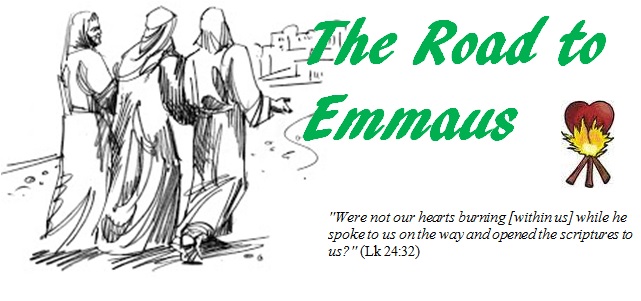
When he was at table with them, he took the bread. He blessed the bread, and broke it, and gave it to them. And their eyes were opened and they recognized him!(Luke 24:13-35)

Thursday, November 7, 2019

It Is Good (Genesis 1)


The dishonest steward (Luke 16:1-8) is accused of squandering his master’s property.  It makes me think of how I choose to make use of what the Lord has given me.  It makes me wonder:  Do I give appropriate care to the things that have been entrusted to me?

What about my wife and children; my granddaughters; my brother?  They are beautiful and they love me.  Do they get the time and the attention they deserve, or do I squander time I could be spending with them? 

What about my faith life?  Do I take time each day – more than a few minutes—for prayer and meditation?  Or am I just too overwhelmed with tasks to worry about such things?  Focusing on my busy-ness to the exclusion of my relationship with Jesus could be construed as wasting my life.

For those who are not retired, don’t forget about your work.  Do you honor in your heart and in your deeds your pact with your employer?  Do you make full use of the talents and abilities that have been given to you?  Do you honestly, cheerfully and responsibly carry out your assigned duties?  Failing to do so is dishonest and erodes your spiritual health.

I wonder about my interactions with other people.  Do they receive from me appropriate care, regard, and respect?  Or do I discriminate, backstab, or ignore individuals based on whether they happen to be useful or attractive to me?

Am I driven to fill every minute of the day with “productive” activity, or do I spend time enjoying the poetry, beautiful music or good companionship that the Lord has provided in such abundance?

As I wonder about all of this, I realize I’ve made plenty of mistakes in my life that I sometimes wish I could do over again and get right this time.

When we err, when we do what is less than perfect, when we do things that we feel like kicking ourselves for, it is good to remember what Paul wrote to the community at Rome (Romans 15:14-21).  It is a reminder of where we stand, and it is supported by both scripture and long practice.

To understand, we need to go all the way back to the book of Genesis, in which we find that God created humankind and "it was good."  Both the act of creation and the created being are good.  Catholics believe that humanity is essentially good; that we are fallen and broken and wounded, but that we are essentially good. Some others believe that humanity is totally depraved and that it is essentially bad - to say it another way, they believe humanity is bad in essence; bad to the very foundation.

That’s just not so!  Over and over, we are reminded of our fallen nature, but we are also reminded that we are Children of God, and by that designation, we are good.  Additionally, I said that Paul's statement is true in scripture and in practice.  Following the adage “you are what you eat” –if we consume the flesh and blood of Our Savior, then we incorporate Him into ourselves—He is ALL goodness.  And so, by partaking of the Eucharist, we are "full of goodness" because Christ fills us each time that we receive Him.

The next time you are down about yourself, remember this essential truth; You are flawed, you will fail if you rely upon yourself, but you are good at the start, and you are filled with God's own goodness each time you attend Mass and partake of the Lord's perfect gift to us.

Wednesday, November 6, 2019

Is there a doctor in the house?


The Doctors of the Church are great saints known for their defense and explanation of the truths of the Catholic Faith. The original eight Doctors of the Church—four Western (Saint Ambrose, Saint Augustine, Pope Saint Gregory the Great, and Saint Jerome) and four Eastern (Saint Athanasius, Saint Basil the Great, St. Gregory Nazianzen, and St. John Chrysostom)—were named by acclamation or common acknowledgment; the rest have been named by various popes, starting with the addition of St. Thomas Aquinas to the list by Pope Saint Pius V in 1568.

Today, there are 35 officially recognized Doctors of the Church:

St. Albertus Magnus (1200-80)Added by Pope Pius XI in 1931

St. Alphonsus Liguori (1696-1787)Added by Blessed Pope Pius IX in 1871

Saint Ambrose (340-97)One of the original four Doctors of the Latin Church

Saint Anselm of Canterbury (1033-1109)Added by Pope Clement XI in 1720

Saint Anthony of Padua (1195-1231)Added by Pope Pius XII in 1946

Saint Athanasius (297-373)One of the original four Doctors of the Eastern Church

Saint Augustine of Hippo (354-430)One of the original four Doctors of the Latin Church

Saint Basil the Great (329-379)One of the original four Doctors of the Eastern Church

Saint Bede the Venerable (673-735)Added by Pope Leo XIII in 1899

Saint Bernard of Clairvaux (1090-1153)Added by Pope Pius VIII in 1830

Saint Bonaventure (1217-74)Added by Pope Sixtus V in 1588

Saint Catherine of Siena (1347-80)Added by Pope Paul VI in 1970

Saint Cyril of Alexandria (376-444)Added by Pope Leo XIII in 1883

Saint Cyril of Jerusalem (315-87)Added by Pope Leo XIII in 1883

Saint Ephrem the Syrian (306-73)Added by Pope Benedict XV in 1920

St. Francis de Sales (1567-1622)Added by Blessed Pope Pius IX in 1877

Pope Saint Gregory the Great (540-604)One of the original four Doctors of the Latin Church

St. Gregory Nazianzen (330-90)One of the original four Doctors of the Eastern Church

Saint Hilary of Poitiers (315-68)Added by Blessed Pope Pius IX in 1851

Saint Hildegard of Bingen (1098-1179)Added by Pope Benedict XVI in 2012

Saint Isidore of Seville (560-636)Added by Pope Innocent XIII in 1722

Saint Jerome (343-420)One of the original four Doctors of the Latin Church

St. John Chrysostom (347-407)One of the original four Doctors of the Eastern Church

St. John Damascene (675-749)Added by Pope Leo XIII in 1883

Saint John of Avila (1500-69)Added by Pope Benedict XVI in 2012

Saint John of the Cross (1542-91)Added by Pope Pius XI in 1926

Saint Lawrence of Brindisi (1559-1619)Added by Blessed Pope John XXIII in 1959

Pope Saint Leo the Great (400-61)Added by Pope Benedict XIV in 1754

St. Peter Canisius (1521-97)Added by Pope Pius XI in 1925

St. Peter Chrysologus (400-50)Added by Pope Benedict XIII in 1729

St. Peter Damian (1007-72)Added by Pope Leo XII in 1828

St. Robert Bellarmine (1542-1621)Added by Pope Pius XI in 1931

Saint Teresa of Avila (1515-82)Added by Pope Paul VI in 1970

Saint Therese of Lisieux (1873-97)Added by Pope John Paul II in 1997

St. Thomas Aquinas (1225-74)Added by Pope Saint Pius V in 1568

An examination of conscience and an affirmation


On Facebook this week, there was a link to a story about mobile showers being provided to the homeless, and disabled.  The showers would make it easier for not only the homeless to gain a little self-respect through a hot shower, but the disabled as well, who can’t navigate some of the facilities presently available. 

Above the link was the sentiment of one of my Facebook ‘friends’ that said simply, “Let’s just enable them more!”

As close as I am to this ‘friend’ and out of respect I am not divulging who it is.  But I felt I had to respond to their sentiment, as I completely disagree.  I wrote, “Showing compassion must never be mistaken for enabling.  Now, if they were handing out drugs or booze as they entered the showers, then they’d be enabling.”

My friend responded, “I guess you would have to do some of the cleanup’s that the homeless leave behind.  Destruction, thievery, stealing, and using the bathroom all over no matter where they’re at.  They are menace here in my city, and they don’t want any help!  Most are druggies and/or have ‘mental issues!  There’s plenty of help here for them but that would mean they would have to follow some rules and that doesn’t work.”

I do have loads of experience in cleaning up destruction and human waste left all over everything by apparently homeless people.  I have been the victim of some of the theft and other crimes committed by drug addicts and poor souls with ‘mental’ issues, but I have also been a witness to some very kind acts of compassion and holiness by drug addicts and poor souls with ‘mental’ issues.  It is, in my opinion, a grave sin to judge any or all of a segment of society with a broad brush, so I answered my friend’s concerns with the following reply:

“Maybe the perception is that “they” don’t want help, or “they” don’t want to follow rules because of a very visible relatively few who do fit those categories.  I just prefer to see Christ in “them” even if it’s just a ‘whisper’.   Who knows what caused their misfortunes?   If we can make just one feel a little better about himself [by providing showers], isn’t that what Jesus asks us to do?”

At this point another follower of my friend joined in the conversation:

“Seems to me it is just another judgement from God for throwing him out of our society and living like the devil.”

I responded with, “I respectfully disagree.  God is always waiting for us and waiting for our return.  It is we who keep our distance from Him, not the other way around.  God is not vengeful, only just.”

Note that I had not quoted Scripture once in any of my remarks.  I had merely stated my understanding of a God who is kind and merciful.  But this third party evidently didn’t agree with my understanding, because he wrote, “I think you have picked a couple verses u like and threw out the rest of the bible.”

I didn’t respond any further because he got me wondering: “Do I do what he accused me of?”  I was actually very concerned that I was doing exactly what I advise others not to do—make decisions and judgments using Scripture verses out of context.  As I was examining my conscience tonight, I believe I can answer truthfully that, while I may occasionally err, for the most part my meditations and blog posts and my very journey towards (hopefully) sainthood are based on the teachings of Scripture, Tradition, and the Catechism of the Catholic Church.

And, as a bonus to my meditations tonight, the Scripture readings for tomorrow’s Mass reinforce my opinions on the showers for the homeless and disabled, the sinful ‘labeling’ of individuals as a class of people to be despised, and my disagreement with the notion of a vengeful God.

 In the first from Romans (Rom 14:7-12), we are reminded that whether alive or dead, whether on earth or in heaven, Jesus claims possession of us.  And we must recognize that all around us are the brothers and sisters of the Lord.  We are all His precious sheep whom He claims as His dearly beloved.

Some of these are 'the other sheep' whom we look down on.  We forget that sometimes, we are 'the other sheep'.  We must never despise those who have strayed from the faith, or even on those who ridicule the Church.  God may change their hearts, and they may far surpass us in holiness and service.  Someday we will stand beside them at the final judgment.

Perhaps we have not sinned as grievously, but almost certainly we have strayed through sin, through our indifference, through our pride.

We should humbly accept the Lord's ownership of our lives, and let Him nourish us, forgive our foolish ways, and let His mercy embrace us closely to His Heart.

The Gospel presents my favorite image of the Lord in the Gospels: The Good Shepherd (Lk 15:1-10).   How consoling to realize that our God cares for us personally as individuals and not only as part of a community of believers.   And even more consoling is the realization that our shepherd does not abandon and reject us when we go astray but goes out of His way to bring us back, “What man among you having a hundred sheep and losing one of them would not leave the ninety-nine in the desert and go after the lost one until he finds it?”

How sad that so many Christians imagine God and Jesus so differently.  We imagine the Lord primarily as king, ruler or judge meticulously keeping a heavenly scorecard of our good and bad actions.  Further we imagine the Lord as abandoning and rejecting and perhaps even punishing us when we go astray.  We think that we must earn God’s love by fulfilling religious obligations.

But God’s love for us is unconditional and constant.  Like the love of the good shepherd, God’s love seeks us out when we stray desiring only that we return home so there may be even more rejoicing, “Rejoice with me because I have found my lost sheep.”

Tuesday, November 5, 2019

Thanks for clearing that up!


The saints who live in heaven pray for people on earth.  They're watching the earthly lives of those who reach out to them and talking with God about how they can help encourage people and answer their prayers.  This is called ‘intercession’.   Every saint in the afterlife hopes that every person who dies will join them to experience heavenly joy. These quotes from saints describe what heaven is like:

St. Alphonsus Liguouri

"In heaven, the soul is certain that she loves God, and that he loves her. She sees that the Lord embraces her with infinite love, and that this love will not be dissolved for all eternity."

St. Basil the Great

"At present we have a human body but in the future we will have a celestial one, because there are human bodies and celestial bodies. There is a human splendor and a celestial splendor. The splendor that can be attained on earth is temporary and limited, while that of heaven last forever, which will be shown when the corruptible becomes incorruptible and the mortal immortal."

St. Therese of Lisieux

"Life is passing. Eternity draws closer; soon we will live the very life of God. After having drunk deep at the fountain of bitterness, our thirst will be quenched at the very source of all sweetness."

St. Francis de Sales

"Do not imagine then, my dear souls, that our spirit will be dulled or drowsy by the abundance and joys of eternal happiness. Quite the contrary! It will be very alert and agile in its various activities."

St. Peter of Alcantara

"And what can one say of the other blessings of heaven [besides living with God]? There will be health, and no sickness; liberty, and no servitude; beauty, and no ugliness; immortality, and no decay; abundance, and no want; repose, and no cares; security, and no dread; knowledge, and no error; satiety, and no feelings of revulsion; joy, and no sorrow; honor, and no contention."

St. Josemaria Escriva

"I am every day more convinced that happiness in heaven is for those who know how to be happy on earth."

St. Bernard of Clairvaux

"For it is right that the those who are not satisfied by the present should be sustained by the thought of the future, and that the contemplation of eternal happiness should solace those who scorn to drink from the river of transitory joys."

St. Isaac of Ninevah

"Enter eagerly into the treasure house that lies within you, and so you will see the treasure house of heaven -- for the two are one and the same, and there is but one single entry into them both. The ladder that leads to the kingdom is hidden within you, and is found in in your own soul. Dive into yourself and in your soul you will discover the rungs by which to ascend."

St. Faustina Kowalska

"Today I was in heaven, in spirit, and I saw its inconceivable beauties and the happiness that awaits us after death. I saw how all creatures give ceaseless praise and glory to God. I saw how great is happiness in God, which spreads to all creatures, making them happy, and then all the glory and praise which springs from this happiness returns to its source. They enter into the depths of God, contemplating that inner life of God, the Father, the Son, and the Holy Spirit, whom they will never comprehend or fathom."

St. Augustine

"[In heaven] it belongs to the intellect to know all at once, not in part, not in a dark manner, not through a glass, but as a whole, in plain sight, face to face, not this thing now and that thing then, but, as has been said, it knows all at once, without any passage of time."

St. Robert Bellarmine

"But, my soul, if your faith is strong and vigilant, you cannot deny that after this life, which flits away like a shadow, if you remain firm in faith, hope, and love, you will see God clearly and truly as he is in himself and you will possess him and enjoy him far better and more intimately than you now enjoy created things."

Jesus was NAILED to His cross!


I must admit sometimes there are verses in Holy Scripture that make me so on edge that I don't want to read on for even one more word.  Yet, I just can't slam The Book closed and say, "This isn't doing anything for me," and go do something else, like surf the web.  The Bible is, after all, the Word of God.

So, what do I do?  I go to God as I am, with all my questions, misgivings and emotions, and ask His help. After all, it's His Word; Who is better to help than the Author of it all?

So I move on and what do I find, just one verse away?  The words of God I need to hear and think about right now—but I wouldn't have thrown my arms around them like a drowning man unless I had been moved by my love of God to read beyond words like: "If anyone comes to me without hating his father and mother, wife and children, brothers and sisters. . . " ( Luke 14:26)

Here they are, the words I need for right now.  "Whoever does not carry his own cross and come after me cannot be my disciple." (Luke 14:27)

Did Jesus really mean we should hate our parents, in contradiction with the laws of Moses?  Did Jesus really mean that we should hate our lives, while He loved every life he encountered?  Perhaps, but I feel the message is much deeper than this.  Jesus wanted His followers to realize that the reward–the pearl of great price–was of such value that we must be willing to sacrifice all for it.  He also wants His followers to realize that their lives are in constant need of change and conversion and we should hate our sinful selves and strive for holiness.  Finally, He knows that material belongings can quickly become idols, drawing our attention away from Him.

The demands are great, but so is the ending.  Jesus was very up front in saying that following Him was not easy, but nothing that is worth having is gained without sacrifice.

This passage may contain some of the most difficult words that Jesus shared with us.  Hating father and mother, carrying crosses, renouncing possessions--what does it all mean, what sense can we make of it?  There is such richness here it's impossible to encompass it all, but what I hear almost every time I go back is "whoever does not carry his cross and come after me cannot be my disciple."  And I am always encouraged to remember that crosses are not "one size fits all."

Sometimes we look at others and wonder, "Why is it so easy for them?  What cross are they carrying?"   It does us well to remember that what is a cross for one may not be a cross for another.   Crosses are not one-size-fits-all.  They are individually tailored to the person we are, and they are excruciating (literally) precisely because they are designed to straighten out what we have made crooked; they are designed to rectify what we have corrupted through our poor choices.  Sometimes they are to help others bear their own burdens because we all participate in the economy of salvation; what another cannot carry, we help to bear so that we all advance together.

We must always bear in mind that, like Simon of Cyrene (Luke 23:26, Matthew 27:32, Mark 15:21), we do bear the cross, but we bear it for the One who takes away all sin, the One who makes the crooked straight and the lame walk.  Jesus doesn't say we need to be nailed to it in the way He was.  Rather, He tells us that our job, like that of Simon, is to bear part of the burden for all of humanity.  We carry our crosses, but ultimately it was and is Jesus who is nailed to it.  We bring the burden of sin--He takes it all away.

Don't give up on God; He won't give up on you.  Don't slam closed The Book.  It is the Word of Eternal Life.

Real Superheroes for real life


I was thinking today about the ‘Fourteen Holy Helpers’, a group of saints who, although they had their own feast days, they also shared a feast day.  At least until the feast was dropped and suppressed in the 1969 reform of the calendar.  Their intercession was sought because they were the patron saints of the various maladies associated with the Black Plague in the 14th century.  They reminded me of a group of superheroes that are all the rage in the movies these days.

While the Black Plague is a distant memory, we could certainly use the saints’ help with the plagues of the current world, and I think we’re going to need a lot of intercessory prayers.  I thought it would be fun (and maybe even necessary) to ask a new set of Fourteen Holy Helpers to intercede for us so that we may grow closer to God through Jesus Christ and the Holy Spirit. 

In no particular order, these are the problems of the world as I see them:  Abortion, euthanasia, atheism, cancer, the attack on sacramental marriage between a man and a woman, the idolatry attached to technology, wars over religion or ideology, the attack on the priesthood (especially from within the clergy itself!), a lack of respect for one another, poverty, injustice to immigrants, the apparent assault on religious freedom and beliefs, and addictions to drugs, alcohol and pornography.  This is not by any means an exhaustive list, but I do think these are the battles most affecting us today.

1.    As I assemble my list of ‘Heavenly Helpers’, St. Mary, the Mother of God and our Blessed Mother must head that list for obvious reasons.  There is no problem in the world that we can’t ask her to bring before Jesus for a resolution.  The rest of the group are:

2.    St. Joseph, the blessed spouse of Mary, and the patron of all fathers, as well as injustices to immigrants.

3.    St. Peter, the first Pope, who was chosen by Jesus to be the Rock upon which His Church is built.

4.    St. John, the Beloved Disciple, who was entrusted by Jesus to take care of Mary at the foot of the Cross.

5.    St. Stephen, the first Martyr, who teaches us that we must endure in our faith, even under violent threat of death.

6.    St. Gianna Beretta Molla, a pediatrician in the 20th century who refused both an abortion and a hysterectomy while pregnant with her fourth child despite knowing that continuing the refusal could result in her own death which later occurred.

7.    St. Peregrine, who is the patron saint against cancer.  A victim of a spreading cancer in his foot, Peregrine was scheduled for an amputation.  He spent the night before the operation in prayer; he received a vision of Christ who touched the diseased area. The next morning, Peregrine found his cancer completely healed.

8.    St. John Vianney, the patron saint of priests, who was known to work 16-18 hours a day working in the confessional, administering the Sacrament of Penance, or Reconciliation (Confession).

9.    St. Gabriel the Archangel, the Messenger of God, who we can turn to for helping us to recognize truth and justice in today’s world of manufactured news and gossip.

10.   St. Gerard Majella, whose prayers are sought for children, unborn children, women in childbirth, mothers, expectant mothers, motherhood, falsely accused people, and good confessions.  His intercession was sought by both my grandfather when my grandmother was in danger of death while pregnant with my mother, and by my mother, after having several miscarriages before my own birth.

11. St. Michael the Archangel, the leader of all angels and of the army of God. This is what the title "Archangel" means, that he is above all the others in rank.  St. Michael has four main responsibilities, as we know from scripture and Christian tradition.  The first is to combat Satan.  The second is to escort the faithful to heaven at their hour of death.  The third is to be a champion of all Christians, and the Church itself.  And the fourth is to call men from life on Earth to their heavenly judgment.

12. St. Kateri Tekakwitha, the patroness of ecology and the environment, and the saint my daughter Alicia chose as her Confirmation saint.  She was known as the “Lily of the Mohawks”.  Alicia’s daughter is Liliana, ‘Lily’ for short.  I believe it was Providence in her choice of names.

13. Joachim and

14. Anne, the parents of Mary and the grandparents of Jesus. 

O, Heavenly Helpers, you have all attained the reward of a life lived in the service of God and of others.  Please help us in our endeavors to imitate your virtues so we may join you in singing eternal praise to God at the foot of His throne.  Amen.

On being Christ's hands and heart on this planet


Paul's letter to the Romans (Romans 12:5-16) compares believers in Christ to the different members of His holy body in this world, His Church.  He is its head; the One who guides, teaches and empowers us to live in God's love and truth, that together they may show humanity how we can live united in mind and heart, in peace and joy.

Each member contributes his unique talents to assuring the health and strength of Christ's Church.  Paul exhorts them to conquer sin through His grace and to work diligently to practice living in God's virtues, His loving traits.  Only in this manner can evil ever be defeated on this earth.

As members of the Body of Christ our primary vocation is extending Christ’s presence: we are Christ’s hands and hearts on this planet.  God depends on us to touch our neighbor as Christ would if Christ were here.

The basic question we should be asking is always: “What does my neighbor need from me today?”  But how often do we find ourselves selfishly reversing the question to: “What do I need from my neighbor?”

I’m so proud of my daughter Sarah, and her work on behalf of God’s children who are caught up in the web created by those who ask the selfish second question, above, and take advantage of the former to further their own agendas.  And I’m very proud of Alicia, who looks for every opportunity to help the poor and needy through donations of time, talents and treasures.  And both of my daughters do these things in addition to being full-time mothers to their children, teaching them how to become productive members of the Body of Christ.

Through our baptisms and confirmations we all receive the graces we need to be able to ask, “What does my neighbor (mother, son, daughter, father, friend, co-worker, etc.) need from me today?” and “How can I accommodate that need?”  Our “job” as baptized Christians is to become the face of Christ to others.  Let’s thank God for giving us the Spirit of Christ in baptism and ask God to be open to this Spirit so we might truly be Christ’s presence for others.

Jesus' parable (Luke 14:15-24) defines God's universal call to man.  He begins by inviting to His heavenly banquet those who outwardly appear enlightened and faithful to Him.  But each, in turn, refused the invitation by citing some worldly concern, relatively trivial matters they saw of more importance than God's call.

Their loss, however, was gain for those whom the world sees as outcasts, the poor, crippled, blind and defective.  It is such as these in dire need, who hunger for acceptance and loving care, who value most God's invitation.  In contrast, the perfect and privileged felt comfortable, self-made and self-satisfied, too immersed in worldly concerns to honor God Who is the source of all the "good" they enjoy.

Think of the line from St. Paul's letter (Romans 12:16), "Do not be haughty but associate with the lowly." The man who gave the great dinner desired many to come to the feast, and servants were dispatched to bring in the poor and the crippled when those who had attachments delayed or refused.

O, Blessed Redeemer, keep us ever mindful that blessed are the poor in spirit (the humble), for theirs is the kingdom of God.  Amen

Sunday, November 3, 2019

The Sisterhood of Saints

Here is a link to an article about some very special women in history. 


Love and serve without cost or judgment


As we move towards our holiday celebrations of Thanksgiving and Christmas, Jesus gives us an example of what He means by service.  He speaks of the poor, the crippled, the lame, and the blind (Luke 14:12-14).  These are the people that Jesus sought out during His travels in Galilee and Judea.  He constantly sought to be of service to them and to teach them by His words and His example.  Even when Jesus spent time with leading citizens like the Pharisee on this occasion, He didn’t go to relax and enjoy Himself, but rather to teach them that they too should follow His example and find ways to serve others.

And that’s what Jesus is still asking of you and me today, in the 21st century, as we read once again the story of Jesus’ visit to the home of the Pharisee.  He asks that we look for people who could use our help.  He asks us to find ways to help them without seeking anything in return.  He asks us to follow His example and to learn from Him.  And as Jesus tells us, the reward for our service will come not from those we serve and help, but from God who will repay us with that heavenly reward to which all of us aspire. 

Perhaps if we learn to serve others after the example of Jesus, we will also learn to better understand what Saint Paul means in his letter to the Romans when he writes of the riches and wisdom and knowledge of God, and of the inscrutability of His judgments and the unsearchableness of His ways (Romans 11:29-36).  As St. Paul so aptly states in his letter: “To God be glory forever!”

Saturday, November 2, 2019

Obscure Patron Saints


There are plenty of saints that cater to modern-day issues if you know where to look, and you are willing to accept some pretty flimsy correlations to the saints’ lives.

The Patron Saint of Phantom Cell Phone Vibrations - Gabriel the Archangel

You’ve been there: the panicky moments pawing through your purse or stuffed coat pockets for your vibrating phone, only to finally locate it and realize that you had completely hallucinated the entire thing.  To ensure that such a minor irritant never happens again, dial up Gabriel the Archangel, the patron saint of telephones and telecommunications.  He’s the saint of these things thanks to his role as messenger from God to humans, which is either way easier or a whole lot harder now that we have text messaging.  I wonder if he’s the go-to guy for ‘butt-dialing’, as well?

The Patron Saint of Cracked iPhone Screens - Clare of Assisi

Turn to Clare when your iPhone has just landed face down on the concrete thanks to your toddler’s fit of rage over that Frozen app you ‘accidentally’ deleted.  Clare is the saint of all things TV-related because she once saw and heard Christmas mass even though it was taking place miles away from the bed she was confined to.  Clare’s prowess over all things screen-related may just mean your glass will be intact when you retrieve Siri from the ground.

The Patron Saint of Wikipedia - St. Isidore of Seville

If you’re reading something on Wikipedia that you’re pretty sure is completely false (although I can’t imagine how that can be), turn to Isidore of Seville for guidance.  Not only is he the patron saint of the Internet, he was named so because of his prolific writings, including a dictionary, an encyclopedia, a history of Goths and a history of the world beginning with creation.  I’m pretty sure an archiver like that wouldn’t stand for Wikipedia shenanigans.

The Patron Saint of Oversleeping - St. Vitus

Do you have the tendency to sleep through your alarm?  Did the time change throw you for a loop?  Give a nod to St. Vitus, though his tie to oversleeping is both thin and disturbing.  

St. Vitus was a Sicilian who was converted from paganism to Christianity by his tutor and his nurse at the age of 12.  Because of Vitus' conversion, his father had the three arrested and whipped at the stake.

Angels freed them from prison, and they fled to Rome where Vitus exorcised the devil from the emperor's son.  Because Vitus refused to give thanks to the pagan gods for the devil's departure, Vitus was tortured and condemned to death and thrown to the lions.

The lions refused to touch Vitus, so both Vitus and a rooster were thrown into boiling oil.  Because of the rooster's early morning crowing, Saint Vitus became known as the Patron Saint Against Oversleeping.  Like I said, thin and disturbing.

Come down out of that tree! Quickly!


We all have handicaps—prejudices, misconceptions, bad training, spiritual laziness, fears and doubts, and so on—which obstruct our view of Jesus.  And we all have short stature; we are much smaller than God and cannot see the goodness that He sees in and beyond our hardships.  In our short-sightedness, we conclude that Jesus has abandoned us, and we feel so very alone.

Instead, we should be like Zacchaeus (Luke 19:1-10).  In our desire to see Jesus fully, as He really is, we should do everything possible to find a way around all obstacles and overcome all spiritual handicaps.

Once Zacchaeus climbed the tree, Jesus zeroed in on him and gave him personal attention and affirmation.  How did Zacchaeus respond?  He quickly descended from the tree and welcomed Jesus with delight.  He had so much enthusiasm that he wanted to quadruple the penance for his sins!

The encounter between Jesus and Zacchaeus can seem to imply that conversion and change is a one-time event.  There can be dramatic events in our lives with regards to our spiritual life, but the process of conversion and change is ongoing.  The more we share God’s love in Jesus Christ with others, the more we learn the extent of that love, which empowers us to love the world even more, and so on.  One thing I have learned time and time again in my own spiritual life is that it’s not about me, as maddening as that fact can be for my ego.

We must be willing to enter into a deeper relationship with Jesus.   We must be willing to be loved and comforted and challenged, and even hurt as we respond to God’s love and surrender to God’s will.  Jesus is calling us, perhaps to come down from an isolated tower, or up from a deep pit, or in from the cold of fear and hate, or out from the darkness of despair.  Wherever we may be, Jesus wants us to be with Him, and learn from Him, and love each other!

A special gift: Bilocation


Bilocation means being physically present in two places at the same time. The Real Presence of Jesus in the Blessed Sacrament is one form of this, although we do not see Him as He is in Heaven in the Host, yet we know that He is truly there, Body, Blood, Soul and Divinity.

When we speak of the phenomenon of bilocation, we generally mean that which happened with some Saints:

"Instances of bilocation have been so well-documented, witnessed and investigated that they are accepted facts in the history of the Church and in hagiography.  It is understood that the mystical gift is not given for the convenience of the recipient, but to aid him in helping his fellow man or in performing a function some distance away that had been forgotten.  Often the recipient of this gift employs it to attend the dying, to comfort, to instruct and for many other reasons which we will now explore." [Mysteries, Marvels, Miracles, p. 1.]

Among the Saints who experienced this special gift are:

Saint Alphonsus Liguori, who was often seen at the same in the pulpit preaching a sermon and in the confessional.  Once, he was in Naples preaching to university students when a poor woman called at Pagani to receive the alms usually given to her by the Saint.  A lay brother, on answering the door, told her of the Saint's presence in another city and sent the poor woman away.  Suddenly St. Alphonsus appeared and gave her the usual amount of money.

Another Saint who could bilocate is Saint Gerard Majella, a Redemptorist, like St. Alphonsus, the founder of that order (and my patron saint).   This is an account of a couple of instances of his ability that was used in his canonization process:

"One day when he had received no answer from Muro (his hometown) about a pressing affair, he said to his companion, 'I must go there.'  The next day he was seen at Muro while, on the other hand, his companions declared that he had not left the monastery.   Another time, Fr. Margotta revealed to Dr. Santorelli that St. Gerard, although in his room, had nevertheless spent the night in ecstasy before the Most Blessed Sacrament in the choir of the Franciscans.  The Rev. Nicholo Fiore of Teora, impressed by the Saint's reputation, spoke to Dr. Santorelli about his desire to meet him.  Dr. Santorelli replied that he would arrange a meeting.  A few days later the Rev. Nicholo arrived at the monastery to conduct business and informed Dr. Santorelli that an introduction was unnecessary since Gerard had visited with him at his home some days earlier.  Dr. Santorelli, who knew that the Saint had not left the monastery, took the Rev. Nicholo to a place where Gerard and the community had gathered and asked the Rev. Nicholo to identify him. Rev. Nicholo pointed him out without hesitation."

Some of the other Saints who have known to have bilocated are St. Paul of the Cross, St. Joseph of Cupertino, Saint Lydwina [Lydwine], Saint Martin de Porres, and Saint Catherine dei Ricci.  Saint Pio of Pietrelcina can be added to the list, as well.

If only my faith and trust in Jesus Christ were as strong as it was in these saints!  I could have spent the time with my family that I missed out on because of my work schedules for the 25 years I worked “on the road” for U-Haul!

Friday, November 1, 2019

"IF"--a message of true hope


On November 2nd we commemorate the faithful departed (All Souls Day).  Throughout the year at each Mass, we pause to remember those who have gone before us.  Often, I think about and pray for those who were closest to me, including my parents, my wife’s parents, our siblings, our uncles and aunts, and a lot of cousins!  Sometimes I pause long enough to go back even further in the family tree, or to think about friends and neighbors we have known and loved.

It’s good to recall that we’re not alone in our journey.  There is a cloud of witnesses joining together with us, and sometimes we can sense it even more powerfully than the reality of the natural world around us.  We are supported by love and encouraged in hope.  We don’t fully comprehend this reality, but we know that it’s something greater and more powerful than anything else we have known.

The mystery and hope of salvation was the subject of the encyclical Spe Salvi (2007), which states in part:  “Redemption is offered to us in the sense that we have been given hope, trustworthy hope, by virtue of which we can face our present: the present, even if it is arduous, can be lived and accepted if it leads towards a goal, if we can be sure of this goal, and if this goal is great enough to justify the effort of the journey.”  There are conditions here, of course, marked by “if”.   But in each case, our faith answers “yes”.

Hope resonates from the reading in the Book of Wisdom assigned to the Mass today (Wis 3:1-9), which speaks comfort regarding those just ones who have gone before us.  Goodness and mercy resonate through Psalm 23, reflecting consolation and peace in the midst of a world that knows enmity and strife.  Love has been poured into our hearts by the Holy Spirit (Rom 5:5-11); we shall not be the same sinners we once were after this encounter.  And finally, we have a trustworthy promise from our Lord Himself:  resurrection to eternal life with Him. (Jn 6:37-40)

We long for the realization of these promises, and even though we don’t understand them fully, we know that they will bring to us that which we lack in our present state:

In some way we want life itself, true life, untouched even by death; yet at the same time we do not know the thing towards which we feel driven. We cannot stop reaching out for it, and yet we know that all we can experience or accomplish is not what we yearn for. This unknown “thing” is the true “hope” which drives us, and at the same time the fact that it is unknown is the cause of all forms of despair and also of all efforts, whether positive or destructive, directed towards worldly authenticity and human authenticity. The term “eternal life” is intended to give a name to this known “unknown”. [Spe Salvi paragraph 12 (2007).] 

We may lack all the answers, but we’ve been given enough to draw us forward in faith to the light of hope and salvation, which only God can give us.  Let us remember that we are not alone in being drawn, but we stand in a long line with others who have gone before, and who are still with us as they wait for us to join them.  Thanks be to God!

What are "Saints" and how can I become one?


Saints, broadly speaking, are all people who follow Jesus Christ and live their lives according to His teaching.  Catholics, however, also use the term more narrowly to refer to especially holy men and women who, by persevering in the Christian Faith and living extraordinary lives of virtue, have already entered Heaven.

The word saint comes from the Latin sanctus and literally means "holy."  Throughout the New Testament, saint is used to refer to all who believe in Jesus Christ and who followed His teachings.  Saint Paul often addresses his epistles to "the saints" of a particular city (see, for instance, Ephesians 1:1 and 2 Corinthians 1:1), and the Acts of the Apostles, written by Paul's disciple Saint Luke, talks about Saint Peter going to visit the saints in Lydda (Acts 9:32).  The assumption was that those men and women who followed Christ had been so transformed that they were now different from other men and women and, thus, should be considered holy.  In other words, sainthood always referred not simply to those who had faith in Christ but more specifically to those who lived lives of virtuous action inspired by that faith.

Very early on, however, the meaning of the word began to change. As Christianity began to spread, it became clear that some Christians lived lives of extraordinary, or heroic, virtue, beyond that of the average Christian believer.  While other Christians struggled to live out the gospel of Christ, these particular Christians were eminent examples of the moral virtues (or cardinal virtues), and they easily practiced the theological virtues of faith, hope, and charity and exhibited the gifts of the Holy Spirit in their lives.

The word saint, previously applied to all Christian believers, became more narrowly applied to such people, who were venerated after their deaths as saints, usually by the members of their local church or the Christians in the region where they had lived, because they were familiar with their good deeds.  Eventually, the Catholic Church created a process, called canonization, through which such venerable people could be recognized as saints by all Christians everywhere.

The first person to be canonized outside of Rome by a Pope was in 993 CE, when Saint Udalric, the Bishop of Augsburg (893–973) was named a saint by Pope John XV. Udalric was a very virtuous man who had inspired the men of Augsburg when they were under siege.  Since then, the procedure varied considerably over the centuries since then, the process is today quite specific.  In 1643, Pope Urban VIII issued the Apostolic letter Caelestis Hierusalem cives that exclusively reserved the right to canonize and beatify to the Apostolic See; other changes included evidentiary requirements and the creation of the office of the Promoter of the Faith, also known as the Devil's Advocate, who is assigned to critically question the virtues of anyone suggested for sainthood.

The current system of beatification has been in place since 1983, under an Apostolic constitution of Divinus Perfectionis Magister of Pope John Paul II.  Candidates for sainthood must first be named Servant of God (Servus Dei in Latin), and that person is named at least five years after his or her death by the bishop of the place where the person died.  The diocese completes an exhaustive search of the candidate's writings, sermons, and speeches, writes a detailed biography, and collects eyewitness testimony.  If the prospective saint passes, permission is then granted for the body of the Servant of God to be exhumed and examined, to ensure that no superstitious or heretical worship of the individual has taken place.

The next status the candidate goes through is Venerable (Venerabilis), in which the Congregation for the Causes of the Saints recommends to the pope that he proclaim the Servant of God "Heroic in Virtue," meaning that he has exercised to a heroic degree the virtues of faith, hope, and charity.  Venerables then make the step to Beatification or "Blessed," when they are deemed "worthy of belief"; that is to say, that the church is certain that the individual is in heaven and saved.

Finally, a Beatified individual may be canonized as a saint, if at least two miracles have been performed through the intercession of the individual after his or her death.  Only then can the Rite of Canonization be performed by the Pope, when the Pope declares that the individual is with God and a worthy example of following Christ.  

Most of the saints whom we refer to by that title (for instance, St. Elizabeth Ann Seton or Pope Saint John Paul II) have gone through this process of canonization.  Others, such as Saint Paul and Saint Peter and the other apostles, and many of the saints from the first millennium of Christianity, received the title through acclamation—the universal recognition of their holiness.

Catholics believe that both types of saints (canonized and acclaimed) are already in Heaven, which is why one of the requirements for the canonization process is proof of miracles performed by the deceased Christian after his death.  Such miracles, the Church teaches, are the result of the saint's intercession with God in heaven.  Canonized saints can be venerated anywhere and prayed to publicly, and their lives are held up to Christians still struggling here on earth as examples to be imitated.

So there you have it.  Tomorrow I will begin my series on specific saints.  In some cases, I will group some saints together by different categories:  Life Status (i.e., adopted, converts, fathers and mothers, married, slaves, widows and widowers, etc), Occupations and Activities (actors, artists, farmers, lawyers, nurses, teachers, writers, and so on), or Other Characteristics like alcoholics, those who suffered with cancer, who had handicaps, who were visionaries, or whose bodies remain incorrupt (even centuries after they died!).

Up tomorrow:  Saints who could bilocate.

Saints Alive!


A saint can be described as a person who has become one with Christ. So how does a person become one with Christ?

While there have been volumes written about how one can become one with Christ, become closer to God, and even how the soul is perfected in human beings, Jesus tells us how most succinctly in His Sermon on the Mount. (Matthew 5:1-12a) To become one with Christ, we need to become more like Him by following His example;

"Blessed are they who mourn."

Jesus mourned for Jerusalem and for His friend Lazarus.

Blessed are all who will mourn their losses due to terrorism and war, for they shall be comforted.

Blessed are workers who have been "downsized," for they shall be comforted.

Blessed are those mothers and fathers who mourn the loss of their babies through abortion or neglect, for they shall be comforted.


"Blessed are the meek."

Jesus Himself said He was meek and humble of heart.

Blessed are our dear, fragile elderly who want to show up at Mass whenever they can—but can’t, for theirs is the kingdom of heaven.

Blessed are all single moms who do the best for their kids every day, for theirs is the kingdom of heaven.

Blessed are those who are trapped in addictions, for theirs is the kingdom of heaven.

Blessed are those who live with people trapped in addictions, for theirs is the kingdom of heaven.

Blessed are the scrupulous, for theirs is the kingdom of heaven.


"Blessed are they who hunger and thirst for righteousness."

Jesus sought righteousness wherever He went and in every person He met.

Blessed are folks that work three jobs and can't make ends meet, for they shall inherit the land.

Blessed are those who aren't beautiful or successful or rich, for they shall inherit the land.

Blessed are our immigrants—documented or not, persecuted or not—who serve society in menial jobs, for they shall inherit the land.


"Blessed are the merciful."

Jesus showed mercy to everyone, even a condemned man next to Him on the cross.

Blessed are the generous people who offer friendly help to neighbors, for they will be shown mercy.

Blessed are the aid workers in so many countries where famine and starvation run rampant, for they will be shown mercy.


"Blessed are the clean of heart."

Our Lord was without sin.

Blessed are those who frequent the Sacraments of Penance and Reconciliation, for they will be shown mercy.

Blessed are they who reconcile with God and neighbor through prayer and generosity, for they will be shown mercy.


"Blessed are the peacemakers."

Jesus sought peace wherever He went and challenged others that if they were without sin, then they could cast the first stone.

Blessed are firefighters and cops who risk their lives for us each day, for they will be shown mercy.

Blessed are our military personnel who are tasked with keeping the peace in places most of us have never heard of, for they shall be at peace.


"Blessed are they who are persecuted for the sake of righteousness."

Jesus was righteous above all others but was persecuted to the point of being hung on the cross.

Blessed are the bishops, priests, deacons and religious who continue to evangelize, despite the persecution of a secular world, for they shall see God.


November 1 is more than just All Saints Day.  It’s also my brother Bob’s birthday.  In the past few years I’ve thought of the providence God displayed in letting Bob share his birthday with the celebration of the saints in Heaven.  Like the saints, Bob truly recognized Jesus—Body, Blood, Soul, and Divinity—in the Eucharist, and loved Him for His gift to us.  It is through his example (and our mother’s) that I came to believe in the True Presence of Christ among and within us as well.

Again, like the saints, Bob had some pretty difficult suffering for the last few years of his life, but he bore those sufferings well, uniting his suffering to Christ's Passion as the Gospel exhorts us to.

My earliest memories are times when I wanted to be “just like Bob”.  He knew just what to say when I was feeling down or incapable of doing something new to me.  I remember he was the brother I turned to when I needed help with my homework because he wouldn’t lose patience with me when I didn’t “get” it right away.  He was the one I turned to when I needed advice about something I couldn’t (or didn’t dare) go to Mom and Dad about (even though they found out about it anyway! Thanks, Bob!).  He was the “keeper of the Faith” for me.  When Mom had to spend some time in the hospital when our younger brother Tom and I were the only ones left in the house, Bob is the brother Dad called to come over and make sure we said our rosary.  We didn’t say one rosary that night; we said two.  Bob taught us that we needed to say the one Mom wanted us to say first, and the second one was for Mom.  I will never forget that.

I also won’t ever forget his and Marilyn’s kindness and brotherly love to Tom and I by including us in a lot of their adventures.  They took us to pumpkin patches, the beach, and the trip I remember the best—to Santa’s Village.  I remember that trip because of the winding road through clouds to the top of a mountain, the snow when we got there, and Bob and Marilyn explaining how the clouds formed and where snow came from.  Hey, I was 11 years old or so—I was really excited to learn this stuff!

After Dad died, Bob was the brother who lived closest to Mom, Tom and I and so I had many occasions to call and ask for advice on how to be the “man of the house”.  He "helped" me rebuild the engine of our car (actually, he rebuilt it, but let me take some credit) so I could drive Mom around like Dad used to.  I could count on Bob to give me the right advice in the same way Dad would have.

I thought it was cool (and I still do) that we share so many coincidences in life.  For instance, we both share November birthdays.  We were both born in Fowler, California.  We both went further in the Boy Scouts than any of our other brothers.  We both married girls named Marilyn.  We both share an unshakable belief in the One, Holy, Catholic and Apostolic Church.

I counted on Bob for a lot of my spiritual direction. I could be sure it was spot-on traditional Truth and I have truly treasured and tried to follow every direction he gave me.  He had his faults as he was the first [sometimes] to admit, but he was also the quickest to defend Our Lord when he felt our faith was being attacked. He could be gentle, and he could be firm—just what every sheep needs from a shepherd.

The picture on the left was drawn by Bob's son Tim.  I have always loved this picture because it reminds me of the reward we will surely get if we keep our faith and bear our sufferings with heroic virtue.

I miss him a lot.  But he taught me to believe that we never truly die.  We just move from this earthly life to our eternal life in Christ.  So I know we’ll see each other again someday.  I love you Bob. Happy birthday.