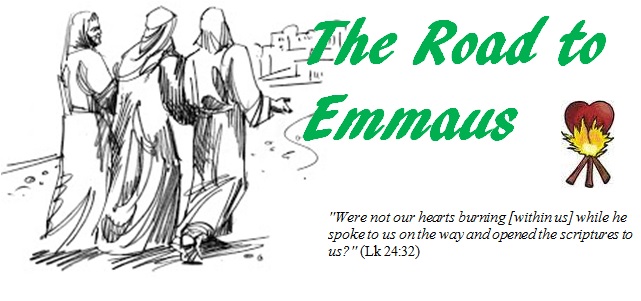
When he was at table with them, he took the bread. He blessed the bread, and broke it, and gave it to them. And their eyes were opened and they recognized him!(Luke 24:13-35)

Saturday, April 18, 2020

Stoking the flame of faith


“But later, as the Eleven were at table, he appeared to them and rebuked them for their unbelief and hardness of heart because they had not believed those who saw him after he had been raised.”  (Mark 16:14)

So often we’re invited by Jesus to have faith and believe in Him and to accept many things as a matter of faith.  The gift of faith is like a small flame within our hearts that we carelessly expose to the winds.  This carelessness allows the flame of faith to be extinguished before it can grow.

The goal of our Christian walk is to let that flame of faith become the blazing fire that God wants.  And it’s possible!  It’s entirely possible to let that flame become so all-consuming that nothing can put it out.

The path to this blazing fire of faith within has to do with the way we handle that spark which is already there.  We have to care for and nurture that small flame.  We have to treat the beginnings of our faith with great care.  We must guard it and feed it so that it grows.  This is done, in part, by avoiding carelessness in our life of prayer. 

Prayer is the key to letting God grow within.   He’s there, speaking to us and calling us to believe.  Every time we doubt, or harden our heart, we expose that tiny flame to the elements.  But every time we intensely focus upon that flame, we enable it to grow and take hold.  Praying, listening, seeking, loving, and believing are the ways to the faith God wants to bestow upon us.  And if the Apostles would have just let that gift of faith, planted deep within, grow by a softening of their hearts, they would have quickly and easily believed that Jesus was alive without having a need to see Him with their own eyes.

We don’t see the Resurrected Christ in a physical way, but we do have the same ability as the Apostles to know and love Him.  A good start would be to recommit ourselves to prayer and watch our faith in Christ grow brightly!

Thursday, April 16, 2020

Teach a man to fish

I get the feeling that sometimes when in prayer I, too, am a fisherman like Peter and his friends (John 21: 1-14).  I cast my net repeatedly, over and over again until my arms are tired and my back is aching.  Then, when my prayers are concluded I turn on the TV or read the news and lament how bad things are in the world.

It’s at times like those that I need to stop casting my net for a while where I want to—where I think the fishing is best—and wait for instructions from God through His Holy Word where I SHOULD be fishing.   This is what the Mass and Adoration are for me—a time to stop fishing and head for shore, where Jesus is waiting to give me new instructions.

His instructions are usually, “Come and eat.  Fill yourself with My Body and Blood.  Come and experience love in its highest form—be with Me for a time.  Come and listen and learn how to make Heaven on Earth.  Come and be.  Just be.” That’s why I love going to Adoration and Mass so much.  During these visits with our Lord, I don’t worry so much.  I don’t fret.  I don’t think about how the world is going.  I only think about now---and that I’m with Jesus.  

Then, nourished and strengthened by His Word and Presence, I can face my fears for this world and those I love the most with confidence and hope realizing, in the words of St. Peter, "There is no salvation through anyone else, nor is there any other name under heaven given to the human race by which we are to be saved." (Acts 4:1-12)

He's not a ghost! He is present!


Luke’s gospel today tells of the importance of the Word of God.  The gospel opens as the disciples of Emmaus are recounting what had taken place on the walk with Jesus and had set their hearts on fire; how He interpreted for them every passage of Scripture that referred to Him (Luke 24:35-48).  Recently there was a series on TV by National Geographic about Jesus.  The approach the show took to talk about Jesus was very different than the approach of the gospels.  They went to the Old Testament, much like what Jesus said to the disciples of Emmaus; “everything written about me in the law of Moses and the prophets and psalms had to be fulfilled”.  Then Jesus opens their minds to the understanding of the Scriptures.  Today’s reading from Acts (3:11-26), also written by Luke, bears this same importance of Scripture as Peter preaches in Solomon’s Portico.

When the risen Lord appeared to the Apostles, according to the gospel we read today, they displayed terror and shock, despite the words of greeting, ’Peace’.  They feared a ghost.  The presence of Jesus after the traumatic events a few days earlier were a bit confusing.  If you ‘read between the lines’, He is not back with his friends in the same ‘relaxed’ way that we can imagine earlier in the gospels.  He eats fish to show that He is not a ghost, but still, Our Lord just appears, omitting doors!  The most ordinary gathering may be the breakfast at the lakeside in John (John 21:1-14), but as they join Jesus no one dares to ask, ‘who are you?’ because they know it’s Jesus.  There is the important conversation with Peter, but we hear of nothing with his other friends (John 21:15-19).  When Mary Magdalene cannot hold Jesus, it is often interpreted as a way of saying that the old ways of being with Jesus are gone (John 20:11-18).  It will be the Risen Lord that they (and we) will come to enjoy.  The good days of Nazareth would never be again although Jesus had risen.

With the Scriptures, we can sit and talk and listen to Jesus.  He is risen, we are not.  But our Lord is present to us in the Word of God.  May this be the gift that keeps on giving: joy, life, hope, and the presence of Jesus to us during an Easter season wrought with loneliness, sadness, death, and despair because of this viral pandemic.

Tuesday, April 14, 2020

An eye opener


Sitting here, sheltering at home, and thinking about Wednesday’s readings, I’ll admit to you; I have favorites.   And when it comes to favorite Gospel accounts, the story of the disciples’ encounter with Jesus on the Road to Emmaus certainly sits in the top three on my list (Luke 24:13-35).  I even chose this passage as the theme for this blog!

It’s the classic story that begs the questions; how do we come to know Jesus, and how does Jesus lure us in?

Have you ever stared at a statue of Jesus or a crucifix or even a picture and hoped that He would miraculously appear and tell you that you’re on the right path, or even that you’re not, but He forgives you anyway?  I have, and I still do at times.  The fact is Jesus appears to us in mysterious ways all the time!

He appears to us subtly, in and through other people.  He can choose to appear in others through a smile, or a kind word or action.  One  Thanksgiving Day about ten years ago, my mother’s neighbors cooked her a full holiday dinner when I had to work and couldn’t be there with her.  Jesus was certainly there.  When those same neighbors planted pretty flowers in the flowerbox outside her window, and then took the time to maintain them, it was an act of pure charity, in the example of Jesus.  During this time of isolation for most of us, He is appearing more and more frequently in the people who are performing both random acts of loving service, and especially in the doctors, nurses, caregivers and ‘essential’ persons who are fighting hard every day to end this pandemic.  Let’s not forget the priests and other spirit-driven messengers of God.

He doesn’t appear only in other people; we see Him outside of us in all creation, in the silence of a forest or the majestic beauty of the sky, when dawn breaks or when the sun sets.

While it is a great feeling to see Jesus at work in others, His most mysterious and miraculous Presence is in the Holy Eucharist.  Oh, how I miss my Lord in the Eucharist!  Every time I receive Him in Holy Communion, “my heart is burning within me” with love for Him!  When Jesus appears inside of us, there is an immediate comfort, a sensation of love, a feeling of exuberant joy, from which we can finally become one of those through whom others recognize Him.

Just because we can’t see Him doesn’t mean that He isn’t there.  There are the moments when we feel like we can’t recognize Jesus, when He “disappears from our sight.”  We’re a lot like the disciples on the road to Emmaus: “They stopped, looking downcast.”  It probably means that our eyes are closed, for some mysterious reason; most likely blinded by even the least venal sins or out of despair or anxiety.  And when we can’t see, that’s when we turn to hearing.  When we can’t hear, we turn to feeling.  When none of our senses work, we often turn to loving.  That’s when we will always find Him, waiting for the right moment to open our eyes and reveal Himself to us.  He always helps us, coaxing and encouraging, until finally we wake up and see Him, and know that everything is okay. There are many ways to recognize the ones we love most.  Let our eyes be opened and recognize Jesus!

Monday, April 13, 2020

The reassuring voice of the 'Gardener'


The joy that we experience at Easter is enhanced by the gospel accounts of the joy felt by those who were privileged to see the risen Jesus on Easter day.  On Tuesday St. John directs our attention to Mary Magdalene who, according to the gospel accounts, was the first person to see Jesus after His resurrection (John 20:11-18).

There is a tradition in the Catholic Church that even before His appearance to Mary Magdalene Jesus visited his mother Mary.  The gospels are silent about such a visit, but when I contemplate this gospel about Mary Magdalene, I always think also of the Blessed Virgin Mary.  What joy she must have felt on seeing her risen Son! The lives of the two Marys offer an interesting contrast: the sinless Virgin Mary and the repentant sinner Mary Magdalene.  And yet they are very much alike in their love for Jesus.  Their love of Jesus bound them in a friendship reserved for the very closest of His followers.

During her life after she met Jesus and was forgiven her sins, Mary Magdalene did indeed become one of His closest followers.  She proved her love and her loyalty over and over again.  At the time of the passion and death of Jesus, Mary and the other holy women followed Him through all the terrible events that led to Calvary.  They stood grieving at the foot of the cross as Jesus suffered and died.  And during the time that Jesus was in the tomb, Mary and the others learned the location of the tomb and prepared spices and perfumed oils for the body of Jesus.  In all of these events Mary Magdalene demonstrated how totally devoted to Jesus she was.  And Jesus rewarded her devotion with His appearance to her on the morning of the third day.

The scene of the meeting of Jesus and Mary Magdalene in the garden is moving.  It reveals Mary Magdalene as very human and very devoted to Jesus.  When Jesus appears Mary is weeping.  She is terribly distraught that the body of Jesus has been taken away and is frantic to try and find out where it is.  In the early morning light and with tears in her eyes, she fails to recognize Jesus.  She mistakes Him for the gardener.  Her words reveal her devotion and her concern to find the body of Jesus so that she can clean and prepare it for a proper burial.  She is determined to find and take possession of the body because of her great love for Jesus.  And then we have the very tender moment when Jesus reveals Himself to Mary, by speaking her name.  But He must speak her name in such a way and with such inflection that Mary recalls other occasions when Jesus called her by name, and she knows without a doubt that this is Jesus.  Immediately her tears are turned from sorrow to joy.  Immediately she believes that Jesus is risen and lives.  And then she does something else that is very human: she is so beside herself with joy that she wants to hold on to Jesus and never let go.  Jesus has to gently tell her to let go of Him.  But then He also gives Mary an important task.  He makes Mary His messenger and sends her to His disciples in Jerusalem to announce His Resurrection.  Mary makes the perfect messenger because she is so full of joy and so clearly proclaims her belief in the Resurrection.

This gospel reminds me of a lady whom I visited in the hospital of couple of years back, when I was a Eucharistic Minister for St. Anne’s church in Lodi.  

The woman was very fidgety and restless and when I asked her if she would like to receive Jesus in the Eucharist, I was met with a blind stare mixed with what I perceived as fear.  It was obvious to me that she couldn’t understand what I was asking, and in fact, I realized right away that she would not be able to discern our Lord’s presence enough to receive Him.  So instead, I felt inspired to recite the Our Father, a Hail Mary, and a Glory Be.  The very moment I made the Sign of the Cross on myself and began the Lord’s Prayer, she began to settle down.  By the time the Hail Mary was finished, she was laying down on her side.  After I said the Glory Be, it appeared that she recognized what had just happened.  She shut her eyes and had a slight smile on her face.  It was obvious to me that she recognized the presence of Jesus in the room with us and it was calming for her—and me, too!  It makes me think that it must have been the same feeling that Mary Magdalene felt when “the gardener” spoke her name in that special way that gave her the confidence to know everything was as it should be.  That was one of my most memorable experiences as a Eucharistic Minister.  I will never forget it.

Sunday, April 12, 2020

Alleluia is our song


This Easter Sunday was vastly different than we had planned or even expected.  Things felt very surreal having to ‘bake’ cakes and color eggs, and to blow ‘air kisses’ at our young grandchildren through the windows of our cellphones or computer screens.

Nothing feels ‘normal’, and I wonder if that was the case for the followers of Jesus on the first Easter Sunday morning?  “Afraid of the authorities”, they too, were ‘safer-at-home’.  Yet we know that THIS day dawned like no other in the history of the world.  Death had been conquered and Resurrection had taken place.  Imagine the joy of Mary Magdalene and the other Mary as they tried to rush back to tell the disciples, holding their joy.  They were the first to hear and see Jesus post-resurrection (Matthew 28:8-15).  Have you ever held a joyful secret bursting to share your news, knowing that what you have to share would change everything?  I think it may be akin to young married couples who find out they are expecting—maybe even twins(!)—and having to wait to tell the grandparents the good news.

Today is no different.  If we look at the story told in Matthew’s Gospel through the Christianity lens, unfortunately we are unable at this time to live into this joy.  To gather with our faith communities and families sharing the joy of resurrection.  We are an Easter people and Alleluia is our song.  Exiled from our places of worship, I am reminded of the words of Psalm 137 as the Israelites struggled to “how can we sing the Lord’s song in a strange land.” (137:4)

Peter offers us much consolation in the Book of Acts (Acts 2:14, 22-23), and I wonder, how did he get to this point? He who denied Jesus three times (on Good Friday) is now proclaiming His Resurrection and offers stern words for “children of Israel;” in spite of the “priests and the elders” trying to shut them down as we read in the Gospel.  His use of Psalm 16 is just as relevant today: “…..with him at my right hand I shall not be disturbed.”(16:8)  This part of the Book of Acts is following Pentecost, and Peter has already received the Holy Spirit.  Peter is proof that the Spirit is alive in him and he will not be silenced by anyone.  His transformation and courage offer us hope today.  We remember the gifts of the Spirit that have been shared with each of us; the gift of Wisdom, Understanding, Knowledge, Counsel, Fortitude/Courage, Piety and, Fear of the Lord.

As Christians, we are called to find the seeds of resurrection. Even within this seeming nightmare of COVID-19. My prayer this Monday in the Octave of Easter is this:

May our world be healed; may we learn from this time of exile, may we remember the words of Jesus as He greets his followers, “Peace be with you” and may God hold us all in the palm of his hand. Amen. Alleluia, Alleluia.

Saturday, April 11, 2020

Easter joy, even in the midst of Covid19


Christ is risen!  Alleluia!  Alleluia! He is risen, indeed!  Alleluia! Alleluia!

As we celebrate the Resurrection of Jesus, we’re challenged to expand our Easter joy to more than just hope in eternal life.  The Resurrection is the pouring forth of the promise of the Holy Spirit here and now.  It’s the assurance of the presence of God at this very moment, not just about what we can expect when we leave this earth, but while we are still here.  The bigger picture of the Easter story is that we haven’t been abandoned to hopelessness, ever.

But tell that to the poor.  Tell that to the beaten and abused, the tortured and the unjustly imprisoned.  Tell that to the terminally ill and tell that to the lonely.  Tell that to the hungry and the homeless who wander in every city on every continent.  Tell that to the people around the entire world currently in quarantine or home shelter who feel in very real ways that they have been abandoned to hopelessness.

While our faith in the resurrection is certainly about God keeping us safe and the assurance of abiding in hope for our own lives, we pray in Psalm 16 that God will also show us the path to life, and fullness of joys in the presence of God.  So if the death and resurrection of Jesus was about our liberation from the hopelessness of our own deaths, why do we have to follow a path to life?  Hasn’t it all been done for us already?  Yes, it has.  But life is not living unless it’s experienced in joy, the joy of the presence of God.  So there is something we can do in response to our joy to make it fuller.

To more fully experience the presence of God, we must tell the poor, the beaten, the abused, the imprisoned, the sick, the hungry, the homeless and the lonely that they too have not been abandoned to hopelessness.  Actually we must do more than tell them—we have to show them through our example that Christ isn’t just our hope, but the hope of the world.  The Resurrection of Jesus is the redemption of all of humanity.  And it isn’t just about whether we believe it or not, it is about whether we feel confident enough to act on it.

As I reflect on these lessons, I think about the reason why the first words Jesus said to those who saw Him after the Resurrection were “Do not be afraid.” (Matthew 28: 5,10)   It wasn’t because He thought they might be afraid of ghosts; I think He says this to us today, just as He did then, because His Resurrection means that He is the fulfillment of the promises of God.  It’s not our fear of death; it’s our fear of life that we need to think about now.  If Jesus really is alive, then God really meant it when He said He loved us and we, meaning all of humanity, are worth saving.  That means nobody has been abandoned to hopelessness.  Believing in the Resurrection means believing in the entire promise of God’s enduring presence with humanity.

I feel great joy at Easter, but the fullness of joy that I seek in the presence of God is not just about the relief that the fear of death has been lifted.  The joy of Easter Sunday encourages me to identify with the suffering of others who don’t feel that hope.   Alleluia!  I pray today that I will not be afraid to stay on that path and share that Easter story by bringing hope and joy in very concrete ways to those who do feel abandoned.  We are presented with an unprecedented opportunity especially this Easter 2020 to open up to someone we know who is not sharing in our joy and let them know they are loved by God! 

Christ is risen!  Alleluia!  Alleluia!  He is risen, indeed!  Alleluia! Alleluia!  

In silence, we wait....


Throughout the world on this day, the tabernacles in Catholic churches sit empty.  Mass is not celebrated on this day.  Like an empty tabernacle, Saturday is a day of emptiness.  This is how we celebrate every Holy Saturday.  This is the day described in the Apostles’ Creed, the first prayer we say to begin the Rosary: “He was crucified, died, and was buried.  He descended into hell…”  By the expression "He descended into hell", the Creed confesses that Jesus did really die and through His death for us conquered death and the devil "who has the power of death" (Heb 2:14).  It also means that in His human soul united to His divine person, the dead Christ went down to the realm of the dead.  He opened Heaven's gates for the just who had gone before Him.  [Catechism of the Catholic Church, Part 1, Section 2, Chapter 2, Article 5, Lines 636-637]

This is the day we keep silent vigil between Good Friday and the Resurrection.  In a lot of ways, we have been experiencing this for several weeks already.  On this day, as in so many days and weeks throughout the world-wide pandemic, we have been called to wait in silence and solitude in a new and different way.  In these times of social distancing from one another, and on this day, we are called to experience a spiritual distance from Christ, even as we pray “Out of the depths I cry to you, O Lord.” (Psalm 130:1)

Holy Saturday is the day of hope, when we are reminded that God’s hand can reach to deepest recesses of our lives, of our experience.  Hope calls us to resistance; to resist despair, darkness, and death.  Where there is resistance, there is hope – as we await Easter.

Thursday, April 9, 2020

Finding Hope in the 7 Last Words of Christ from the Cross


Scripture records seven last statements, or the “Seven Last Words” of Jesus on that first Good Friday.  It’s a good spiritual exercise to reflect on them on this Good Friday.

“Father, forgive them, for they know not what they do.”  (Luke 23:34)

Jesus’ forgiveness of others was radical and to a degree never seen before.  While hanging on the Cross and enduring the cruelty of others, Jesus spoke words of forgiveness.  He forgave them in the midst of His persecution.

What’s more is that He even acknowledged that those crucifying Him were not fully responsible.  They clearly didn’t know what they were doing.  This humble acknowledgment of Jesus shows the depth of His tender mercy.  It reveals He died not in anger or resentment, but in willing sacrifice. 

It’s very hard to pray for someone who has hurt us, asking God to forgive them as well.  But we have to follow Jesus’ example and leave judgment to God and offer mercy and forgiveness.


“I assure you, today you will be with me in paradise.”  (Luke 23:43)

What a consolation it must have been for the good thief to hear these words.  He must have been experiencing a certain despair in life at that moment as he, along side of Jesus, was dying on a cross.  What a gift it was to be there next to the Savior of the World, sharing in the sufferings of Christ in such a real way.  And this man was privileged to be among the first to receive this gift of salvation won by Jesus on the Cross. 

Jesus offers us the same assurance.  He offers salvation to us beginning today.  And He offers it to us in the midst of our own suffering and sin. 


“Woman, behold your son.”  (John 19:26-27)

What a gift!  Here, dying on the Cross, Jesus entrusted His own mother to John.  And in so doing, He entrusted her to each one of us.  Our unity with Jesus makes us a member of His family and, thus, sons and daughters of His own mother.  Our Blessed Mother accepts this responsibility with great joy.  She embraces us and holds us close.  She intercedes for us, if we only ask!


“My God, my God, why have you forsaken me?”  (Mark 15:34; Matthew 27:46)

Jesus wasn’t abandoned but He allowed Himself to feel and experience this complete loss of the Father in His human nature.  He felt the deep experience of despair.  He allowed Himself to know and experience the effects of sin.  So He knows what we go through when we despair.  He knows what it feels like.  And He’s there with us in those temptations enabling us to press on through any despair toward total faith and trust in the Father.


“I thirst.”  (John 19:28)

What a meaningful statement.  He thirsted physically at that moment for water to quench His dehydration.  But more than that, He thirsted spiritually for the salvation of all of our souls.  Jesus’ spirit still longs for this gift of salvation.  He longs to call us His children.  It’s a deep and burning thirst for our love.  We satiate Jesus’ thirst by returning that love. 


“It is finished.”  (John 19:30)

Jesus affirmed that His mission of the redemption of the whole world was accomplished.  “It” refers to His perfect sacrifice of love offered for all of us.  His death is the perfect sacrifice which takes away the sins of all.  What a gift!  And what a sacrifice Jesus endured for us!

As Catholics, we’re used to seeing this sacrifice on the Cross.  We ponder this sacrifice every time we look at the crucifix.  But it’s important to note that our over-familiarity with the Cross can tempt us to lose sight of the sacrifice.  It’s easy for us to miss what Jesus actually did for us.  He accomplished the act that saves us, and He is now offering it to us.  He desires to say that His sacrifice has “finished” its work in our soul.


“Father, into your hands I commend my spirit.”  (Luke 23:46)

These are the words we need to pray more than any.  These are the words of complete surrender to God.  Prayer is ultimately about one thing.  It’s about surrender.  It’s about trust. 

Surrender means God is in control.  It means that we let go of our own will and choose only God’s.  And it means that God pledges to accept our surrender and guide us into the perfect plan He has in mind for us.

Understanding Jesus’ sacrificial love will enable us to love as He did.  It will enable us to love those who have hurt us and those who persecute us.  His love is total.  It is generous beyond description.

The world and all those who live in it are enduring a tremendous cross right now.  The COVID-19 virus spread globally, infected over a million and killed tens of thousands so far with no end yet in sight.  It can certainly seem like everything we depended on has died.  A lot of people are losing hope, if they haven’t lost it already.

We can find hope by recognizing that, as Paul says, we do not have a God who is unable to sympathize or understand our weaknesses and our suffering, but one who has also endured it.  Our God, in Jesus, knows pain, betrayal, abandonment, torture, injustice, despair, and death.  (Hebrews 4:14-16; 5:7-9)

We can find hope knowing that when we are ‘nailed to the cross’, we’re not nailed there alone.  We have someone with us, as close as our own breath, suffering with us, crying with us, and never leaving us.

We can find hope knowing that if we walk hand-in-hand with Jesus, then no matter the pain, no matter how deep the tomb, no matter how black the night, somehow, some way, God will bring resurrection on the other side.  We can’t see it right now.  It’s like looking at the black sky at midnight and trusting that dawn will come, the sun will rise, the sky will be blue, and a new day will arrive.  There is absolutely no evidence of that at midnight.  It’s only through experience of its reliability that allows us peace and trust.

Our experience of God is of the paschal mystery – life, death, and resurrection.  We were never promised an easy life.  We were never promised no pain, no sorrow, no uncertainty, no suffering, and no death.  In fact, we were promised quite the opposite.  God does not just take the cup away (Luke 22:42).  Yet we were also promised faithfulness, and resurrection in this life and the next (Luke 23:43).  We were promised the same reliability as the sunrise – a powerful, strengthening, life-giving presence that will never leave us in the dark but will lead us through the dark to new light (John 11:  25-26).

So as our global family faces our own version of Good Friday with this virus and all the destruction, decimation, and death it brings, we can trust that somehow, some way, our faithful God of life will find ways to bring resurrection out of it, both for individual people and for our world as a whole.  It’s hard to see it when nailed up in excruciating pain, but the promise remains.  And hope lives.

Wednesday, April 8, 2020

#washtheirfeetchallenge


Jesus didn’t wash the feet of His disciples because they were too lazy to handle their own hygiene, nor to make life easy for them, as a good servant would do!  Rather, He gave them (and us) a model to imitate. (John 13:1-15)

Naturally, we want Jesus to make our lives easier.  Isn't that the purpose behind many of our prayers? It should come as no surprise that we do get what we ask for, but not the way we had imagined.  When we imitate Jesus, it's the way we cope with the difficulties of life that becomes easier.

During the Mass of the Lord’s Supper on Holy Thursday, at one of our local parishes (St. Bernadette’s) in Stockton, California, at the point in the Mass where the priest usually washes the feet of others in ‘non-Covid19’ times, he is going to allow time for anyone who wants to imitate Christ’s last action before His Crucifixion to wash the feet of others in the household who may be watching on-line.  You can learn more about the #washtheirfeetchallenge here.  You may even want to join in on the Mass with Father John Peter.  Just google St. Bernadette's church in Stockton and "like" the Facebook page.  It will notify you when Mass starts at 7PM (Pacific Time).


Have you washed anyone's feet lately?  Maybe you haven't literally soaped up a friend's smelly feet as a sign of your unconditional love, but you probably have given of yourself in a foot-washing way.

To wash the feet of others is to love them even when they don't deserve your love.

To wash the feet of others is to do good to them even if they don't return the favor.

To wash the feet of others is to consider their needs as important as your own.

To wash the feet of others is to forgive them even if they don't say, "I'm sorry."

To wash the feet of others is to serve them even when the task is unpleasant.

To wash the feet of others is to let them know you care when they feel downtrodden or burdened.

To wash the feet of others is to be generous with what you have.

To wash the feet of others is to turn the other cheek instead of retaliating when you're treated unfairly.

To wash the feet of others is to make adjustments in your plans so you can serve their needs.

To wash the feet of others is to serve them with humility and not with any hope of reward.

Notice the posture of Jesus. He knelt.  Imagine Jesus kneeling in front of you now, lowering Himself to the level of your feet and tenderly ministering to your needs.  He is in fact doing this, right now, today. And He will do it again and again, as often as you need Him to care about you!

He’s asking you to go and do likewise: Be the hands of Jesus that wash the feet of the people around you.  You’re the answer to their prayers!

By serving others, we gain understanding of what Jesus did for us that holiest of Thursday nights 2000 years ago, and we become more observant of how He's ministering to us.  We meet Jesus in the dirty feet that we lower ourselves to clean.

Tuesday, April 7, 2020

Love makes all of this bearable


Although the Book of Isaiah is a prophecy about the birth of the Messiah, it also foretells the sufferings of Jesus.  We can find wisdom and strength for endurance from the prophecy, as well as from Jesus’ fulfillment of that prophecy, and we can apply it to our own lives and thus unify ourselves with His cross and with His resurrection.  Let’s look at Isaiah 50:4-9:

"The Lord God has given me a well-trained tongue ... to speak to the weary a word that will rouse them."  After almost 4 weeks into our ‘exiles’, we probably have grown in compassion as a result of suffering, and what we have learned we can now pass onto others who experience similar trials in the future.  It doesn’t mean they will listen.  Take the lessons we should have learned from the Spanish Flu epidemic 100 years ago; we were ill-prepared to treat the virus then, and it appears we were ill-prepared for today’s pandemic.  We must not forget this trial!  Rather, it is now our duty to pass on what we know and to do our best to be better prepared for the next one…and there will be a next one.

"Morning after morning he opens my ear that I may hear; I have not rebelled".  Jesus faced His betrayal with determination and single-minded trust in the Father (Matthew 26:39).  We, also, have the same Father God helping us move forward into healing and redemption.  We only have to ask, then submit to His will.

"My face I did not shield from buffets and spitting."  Have we ‘turned the other cheek’ in imitation of Jesus when others have tried to belittle us for our faith?  God knows how many times we have refused to retaliate against evil with evil, and he appreciates our efforts.

"I have set my face like flint, knowing that I shall not be put to shame."  By forgiving those who hurt us and by refusing to compromise our moral stand, although others try to shame us, the Father holds us close to his heart.

"He is near who upholds my right; if anyone wishes to oppose me, let us appear together."  When people oppose us and cause us to suffer, they're also opposing and attacking Jesus.  He is at our side, supporting us, healing us, comforting us, and taking the worst of the blows.

When we desire and expect people to strengthen us, encourage us, sympathize with us or heal us during our difficulties and pain, we always end up disappointed.  Even the most caring friends cannot give us enough of everything that we need.  Only God can.  Consider Judas’ betrayal of Jesus, and His agony in the Garden of Gethsemane (Matthew 26: 36-46).  Only God can turn our mourning into dancing and joy (Psalms 30: 11-12).

By offering our sufferings to God's plan of redemption, and by turning to Him for comfort, we experience the same great love that the Father gave to His Beloved Son.  That love is what makes it all do-able.  That love is what helps us endure.  That love is what heals us and resurrects us to a renewed, victorious life.

Monday, April 6, 2020

Jesus' "troubled heart"


Jesus had a human heart and loved Judas with a divine love through His human heart.  As a result of this perfect love of Judas, Jesus’ heart was “deeply troubled” (John 13:21-33, 36-38).  It was “troubled” in the sense that Jesus could do nothing more than He had already done to change the mind and heart of Judas.  It’s not that Jesus was personally offended or angered by Judas’ betrayal.  Rather, it’s that Jesus’ heart burned with a deep sorrow at the loss of Judas whom He loved with a perfect love. 

Judas had free will.  Without free will Judas could not freely love Jesus.  But with free will, Judas chose to betray Jesus.  The same is true with us.  We have free will and we are given the same ability that Judas had to accept the love of Jesus or to reject it.  We can let His loving gift of salvation and grace enter our lives or refuse it.  It’s 100% up to us.

Holy Week is an ideal time to seriously contemplate the road we are on.  Each and every day of our life we are invited by God to choose Him with all our might and love.  But, like Judas, we so often betray Him by our refusal to enter Holy Week with Jesus, embracing His Cross as ours.  We so often fail to give completely of our lives in a sacrificial and generous way, as our Lord did that Holy Week.  If there could be a ‘silver lining’ to our current pandemic, it’s the sacrifices and hardships we’re enduring as a result of our quarantines from sons, daughters, grandchildren, friends, and especially the Eucharist that at times it seems we are walking with Christ on the Via Della Rosa.   

I reflected for a long while today upon the love Jesus had for Judas.  It was His love for Judas, more than Judas’ sin, that brought so much pain to Jesus’ Heart.  If Jesus didn’t love him, the rejection would not have hurt.  I also thought about the love Jesus has for each and every one of us.  I think that if we, in fact, do profess our love for Jesus, we have to wonder whether or not His Heart is also troubled as a result of the actions we’ve taken in our life.  If Jesus is troubled in any way as a result of our actions and choices this is no reason to despair as Judas did.  Rather, it should be the cause of rejoicing that we’re aware of our weakness, sin and limitation.  We need to turn that over to Jesus who loves us more than we love ourselves.  Doing this will bring much consolation and peace to our hearts.  And it will also bring much consolation and peace to the Heart of our Divine Lord.  He loves us and is waiting for us to come to Him this Holy Week.

As I sit here tonight thinking about and writing of Judas’ betrayal of Jesus, I can think of a lot of different reasons (although none are justified) why he did it.  I think the most important conclusion I came to is that Judas’ betrayal was the result of failure to understand.

What kind of Messiah was Judas expecting?  It would seem that the Messiah was not a spiritual figure for Judas but rather the concept that had evolved of a military, royal figure who would restore Israel to greatness among the nations.  I imagine that Judas, as a close follower, pictured himself in high place in such a kingdom.  Thus Jesus’ message of loving one’s enemies, concern for the poor and so forth was probably nonsense to Judas.  His disillusionment then gave way to greed.

Judas also failed to understand Jesus on a far deeper level.  His subsequent despairing end indicated his failure to understand the forgiveness of Jesus.  The tragedy of Judas’ life was not that he betrayed Jesus but that he did not ask for forgiveness.  Judas failed to realize that our God is a loving and forgiving God.

This leads me to wonder, what kind of savior am I looking for?  One that will keep challenge and hardship out of my life or, hopefully, dispatch a miracle to resolve any such problems?  Do I realize that the value of suffering consists in the lessons to be learned from it?  I may not reject, but do I simply ignore those areas of the Christian message that appear too challenging?  It’s something I need to work on.

With God’s grace, I realize that Judas’ failure in understanding must not be mine.  In my opinion, every person must ask the question: What kind of God do I pray to?  The redemptive events of Holy Week supply the answer: Our God is a loving and forgiving God.

We all have a role to play


I just finished praying over the story told in John 12: 1-11.  I saw myself in the story.  I saw all of us who believe in Christ.  Jesus shares the spotlight with several people, all of whom represent a part of all of us as disciples. 

There’s Martha, who serves at the banquet, just as we've seen her do before (Luke 10:38-42).  Perhaps Martha represents the action part of discipleship.  Perhaps Martha is the part of us that wants to make sure that the hungry are fed and the homeless have shelter.  Martha fights against injustices, and sometimes has little patience with people who seem more concerned with spirituality and devotions than action. 

Mary anoints the feet of Jesus.  Perhaps Mary represents the part of us that’s drawn to prayer, worship, and devotion.  She’s the part of us wanting to praise and honor God.  She may be the one who lives most fully in the now.  She’s one with a grateful heart. 

Lazarus has done nothing but be loved by Jesus and rescued from death (John 11: 1-44).  Perhaps Lazarus represents the part of us that tells the world of God's love and power to save.  Lazarus is responsible for many believing in Jesus. 

And then there’s Judas.  Perhaps Judas represents the sinful parts of all of us, the parts of us that let fear and doubt win until they turn us away from God's love.  We’re all capable of greed and sin.  We all have our own stories of greed and betrayal.  

What's the greatest difference between Judas and the others in the story?  Perhaps it’s that the other disciples chose to stay in, or return to, the light.  No matter how weak and sinful they were, they held on to their relationship with Jesus.  They lived in His light and shared in His forgiveness.  We too can choose to stay in the light of Christ.  Jesus holds out a loving invitation to us all to believe His good news and be healed, and to proclaim Him as our light and our salvation.

Saturday, April 4, 2020

Jesus has not abandoned us!


What a Lent this has turned into.   When we began this sacred season on Ash Wednesday, none of us could have predicted such a rapid global upheaval.  The ‘new normal’ includes social distancing, confining isolation, evolving information, daily frustration, and nightly confusion.  Stories of heroism complement the reality of grieving.  And yet how can anyone grieve when the need to maintain distance for one’s health takes precedence?

The streets are eerily quiet.  The hospital reports say it’s a war zone.  And another scene is replayed in tens of thousands of households where a young mother and/or father with small children is working from home and has just lost it because they can’t find a way to be a productive employee, a loving parent, a good spouse, while confined to the indoors.  All they want is a little mental sanity.

Where is God?  Why doesn’t God do something about this situation?  A lot of people are asking, “My God my God, why have you abandoned me?” (Psalms 22:2)

On top of everything else, there’s the financial problems being caused by the pandemic.  Homeowners and shop owners, small-business people and people who live from paycheck to paycheck who have no money coming in.  The prayer from their mouth is, “Oh God, how are we going to get through this month?”

There was a story in the newspaper today about a woman who is in isolation in her home having tested positive for Covid-19.  Her husband lies in a different bed several miles away in the ICU and she can’t be there as he struggles for his last few breaths.  In fact there is no one there to hold his hand, except maybe a doctor or nurse if they’re not too busy saving another life at the same time.   And for those who have died, either from the virus or another cause, their loved ones can’t be together to grieve.  People are kept apart from each other even in times of painful loss.  We can’t even come into our churches to pray and grieve.  And the most we can do to show our support is to “drive by” while maintaining our social distancing.

“My God, my God, why have you abandoned me?” (“Eli, Eli, lema sabachthani?”) These words of Jesus, as He hangs on the cross haunt us this day (Matthew 27:11-54).  It’s all a little too close to home.

Maybe Palm Sunday/Passion Sunday, is a good time to move the perspective from an event that happened two thousand years ago to who we are today.  Literally, the whole world is affected.  We are hurting, confused, frightened, haunted, and wishing we could just wake up from this nightmare.  Like the two Gospels given to us on this day every year, first the triumphant entry into Jerusalem (Matthew 21: 1-11) and the second the proclamation of the Passion (Matthew 26:14-66, 27:11-54) this Lenten season has shifted our mood and our direction.  We have gone from personal expectations of Lent to the unpredictability and a deeper crying out to God because of human suffering.

Was it any different than the nightmare of the Apostles who just in a matter of hours lost the One in whom they had put all their hopes and expectations?  Was it any different than the regret of Peter whose mental tape played his last words of denial over and over in his mind?  Was it any different from the emptiness Mary felt when after birthing and raising this special little Child, and she now holds His crucified, lifeless body?   Was it any different from the fear of the disciples locked in the upper room wondering if they were going to be next?  None of this made any sense to anyone living subjectively in the midst of the situation.  And the uncertainty of what might be coming next plays with the mind and the emotions.

One thing the Gospel accounts insists on is that you can’t read the Gospel stories like a newspaper.  And in fact, every time you read the Gospels wearing the lenses of the resurrection, suddenly the stories begin to sound differently.  Christians are supposed to be people who can not only see and live in the Kingdom, but they can share and proclaim it as well.  How do we get there?  The answer is practice.  To be proficient at any trade, talent, or sport requires practice.  So too is practicing the art of interpretation in light of the resurrection.  The more a person practices this art, the greater their skill and prayerful reward.

Only a few years after Jesus’ death and resurrection, Paul wrote to the Christian community in Corinth reflecting on how interconnected we are, because all of us make up the body of Christ: “If one member suffers, all the members suffer with it; if one member is honored, all the members share its joy.” (1 Corinthians 12:26)   Christ never abandoned the church.  Christ lives in and through its members. 

Theresa of Avila’s teaching was quite the similar invitation: “Christ has no body now on earth but yours; no hands but yours; no feet but yours. Yours are the eyes through which the compassion of Christ must look out on the world. Yours are the feet with which He is to go about doing good. Yours are the hands with which He is to bless His people. God alone suffices.”

Today as we reflect on the Passion of Jesus, we live, and we pray this truth.  The liturgical readings and our lived communal experience have aligned asking us, do you see Christ Crucified today?  This is not a mere historical occurrence.  This is a reality which we live with and are being asked to internalize.   Instead of pleading to God to change this situation, can we begin to see how the suffering of Christ is a reality in the suffering of humanity?  Indeed, Christ chooses to suffer with us in our afflictions.

Two thousand years ago the whole world was affected by the death of Jesus.  That event changed the face of humanity.   Today, in the contemporary event of human suffering, we sit, ponder, and prayerfully meditate with the Passion of Christ from both the historical and contemporary dimensions.  As Jesus did not abandon us even in His suffering, so too are we assured of His presence in this challenging time.  And we pray from the core of our being, not as defeated people, but people who know that God is faithful to the splendor of the resurrection.

Friday, April 3, 2020

God is in charge


The Scriptures I’m reflecting on tonight highlight the providential love of God for everyone — even the sinful.  John’s Gospel recounts the plotting of the chief priests, Scribes and Sanhedrin to kill Jesus.  Jesus preached healing and love, attracting many followers.  The high priest Caiaphas expressed his idea that one man should die instead of many people, based on his fear that the Romans would disturb the status quo and rob the freedom and land of Israel (John 11:45-56). 

With our 2020 hindsight and knowledge, no doubt Jesus’ death on the Cross was better than the whole human race “perishing” in sin.  God’s plan was that the life, suffering and death of Jesus would bring about atonement for the world’s sinfulness; Divine Love would triumph; goodness would blossom from evil, risen life from crucifixion.  As someone I read once put it: “Good Friday didn’t spoil the weekend…”

This Lent is certainly a unique journey of faith!  It’s one that surely will be one of the most remembered!  The pandemic experience of global sickness and death, of fear and isolation, of short-sightedness and confusion – all are vivid examples of 21st century Evil.  Yet as we ponder the life of Jesus, as we dig deep as men and women of faith, as we come together as a faith community within our socially isolated spaces, God can and will bring new life and goodness from the evil we experience.  Just as God brought about good from the evil plot to kill Jesus, God will bring about good in our day.  We are to be men and women of ever-deepening faith, selfless and generous in union with Jesus, firmly confessing that “God is in charge”.

As we enter these concluding days of Lent, we should be embracing our share in the Cross of Jesus.  Paraphrasing Jeremiah (Chapter 31), “God shall guard us; God will redeem us; God will turn our mourning into joy and console and gladden us.”  God lovingly says: “Yes!” 

Thursday, April 2, 2020

Social distancing is a corporal work of mercy


In the Gospel of John, some of the people are ready to stone Jesus.  When Jesus asks which good work He did to provoke them, they answer: “We are not stoning you for a good work, but for blasphemy. You, a man, are making yourself God.”

Jesus uses Scriptures to explain Himself to them, and eventually says, “If I do not perform my Father’s works, do not believe me; but if I perform them, even if you do not believe me, believe the works, so that you may realize and understand that the Father is in me and I am in the Father.” But this doesn’t seem to persuade them all, and they try to arrest Him, but Jesus escapes. (John 10:31-42)

What are the “works” that Jesus is talking about?  Of course they’re works of healing [the man born blind] (John 9: 1-410), of feeding the hungry [the multiplication of the loaves and fish] (John 6: 1-15), and of answering people’s needs [the wedding at Cana], to name just a few.  We know that Jesus would later perform the great work of our redemption and reconciliation.

The same challenge that Jesus faced we face today.  We may share the Good News about Him, and many may not believe.  And so, our challenge may be, then, to do good works, by the grace of God, so that even if people won’t believe what we say, they can at least believe in the works, and see that love and hope, peace and justice, and joy, can and do exist, and there is a God who is the Source of it all.

May we follow Jesus in doing good works.

Our good works in this difficult time of the coronavirus pandemic may simply be doing what we are being advised to do by those who have expertise in the control and prevention of infectious diseases.  I’m not going to list them here because, after almost 3 weeks, we should be living them.

Nothing hurts me more spiritually than not attending Mass and receiving Jesus’ body, blood, soul and divinity in the Eucharist.  I was extremely upset when we were told by our bishops that we will not be able to celebrate Holy Week and Easter Sunday in our churches.  I was buying into the same argument that some pastors in some of the more evangelical denominations are using for not stopping communal services.  “No one is going to stop ME from worshipping MY God!”  “Jesus won’t let anything happen to those who remain faithful to Him, especially in trying times like these!”

The more I gave myself to the Holy Spirit in prayer and reflection though,  the more clearly I heard Him say, “Yes, the Law says to love God with all your heart, mind, soul and strength—and I appreciate that you do.  But you are forgetting the second, and equally important half of that Law; ‘and to love one another as I have loved you!’”

You see, you may think you’re loving God with everything you’ve got, but if you don’t love your family, friends—and even your enemies(!)—you can’t begin to love God.
  
Another important thing to remember is that it's probably (God willing!) temporary.  Think of it as a Lenten sacrifice.  Stay safe, do good. 

Wednesday, April 1, 2020

Time to renew the Covenant?

Of course, remember social distancing!
The entire world is in the midst of working out a new ‘Normal” due to the worldwide pandemic of the Coronavirus.  Many people are frightened about what's happening and what it means for the future.

Leaving the pandemic aside for a moment, let’s look at the state of our world…a record number of refugees; communities in peril due to climate change; an obscene number of children still dying each day from malnourishment or preventable diseases; and countless other horrors.  The human misery index is soaring and many of us are paralyzed by what Pope Francis calls the “Globalization of Indifference”.  Since we didn’t cause it and certainly can't fix it, we either do nothing or we look the other way.

These are uncertain times.  Many people are afraid and worried about their health, their finances, and their loved ones. There's not a clear path to follow as we're in uncharted territory.  We can panic or stress out about this crisis the world is experiencing or we could look at this time in our world as an opportunity.

I've been thinking alot about the irony that our world is being hit with COVID19 during the Lenten season. Social distancing is being urged by health experts. We're being told to avoid large gatherings, to work from home, and almost all businesses are closed except grocery stores.  It feels like this extraordinary time is an invitation from God to review our response to the final covenant that Jesus represents (Genesis 17:3-9).  We should take this unexpected "time out” to reflect on how we could model Jesus’ generosity; to love as Jesus did,to do what we can, where we can.  None of us can solve the mess we're in, but surely, we all can do something to reduce the misery we see.

This could be our moment; the time to renew God’s final covenant.  Can we move away from war and violence?  Can we create societies where all people have the opportunity to thrive?  Right now we have some unexpected opportunities and I'm hoping we will use this time to come together and work to create God’s kingdom in our communities and the world.  As followers of Jesus we know there's a better way.  Following Jesus’ example will take lots of prayer and courage, but isn’t that what Lent is about?