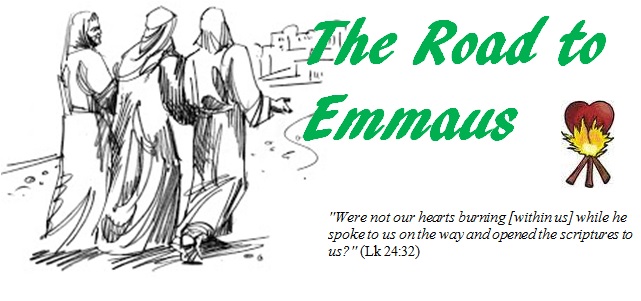
When he was at table with them, he took the bread. He blessed the bread, and broke it, and gave it to them. And their eyes were opened and they recognized him!(Luke 24:13-35)

Thursday, May 14, 2020

No greater love


The more we love others as Jesus loves us, the deeper our relationship with Him will be.  

Jesus gave a commandment to His disciples: “love one another as I love you.” And then He tells them what kind of love that is: “No one has greater love than this, to lay down one’s life for one’s friends. You are my friends if you do what I command you.” (John 15:12-13) I think it’s important to note that Jesus’ love for us doesn’t depend on whether we obey His commandments.  There’s no way we can earn God’s love!  But Jesus does tell us is that if we want to develop our relationship with Him, we will follow His commandment to love. 

Are we willing to have that kind of relationship with Jesus?  To answer “Yes” carries certain implications.  It carries implications about how we are to pray.  Jesus also says, “It was not you who chose me, but I who chose you and appointed you to bear fruit that will remain, so that whatever you ask the Father in my name he may give you.” (John 15:16) When we have a close relationship to Jesus, we’ll find ourselves praying not for things we want, but for what we need to “bear fruit.”

To have a deeper relationship with Christ carries implications about how we relate to each other.  The leaders of the early Church in Jerusalem sent two messengers along with Paul and Barnabas to Antioch with a decision about whether Christians had to first be circumcised according to the covenant with Abraham (Acts 15:22-31).  In the letter they sent, the leaders wrote: “It is the decision of the holy Spirit and of us not to place on you any burden beyond these necessities…”  A good criterion indicating our love for others may be whether we’re trying to place burdens on them that are not necessary.  Too often we see people burdened by poverty and discrimination and oppression.

Jesus’ commandment to love must not be taken lightly.  The more we strive to follow His commandment, the deeper and richer our relationships will be with God, each other, and all of creation.

Wednesday, May 13, 2020

Remain in Jesus' Love

For the past two months, we’ve borne the challenge of renewing our sense of what Jesus’ call to remain in His Love (John 15:9-17) means from the vantage of church closures and quarantine.  Seeking ways to live a sacramental life within the confines of our homes with both the gift of on-line Masses but also in the other ways we’ve found to meet the Risen Christ from our own upper rooms.
“Remain in my Love”.  As a Catholic, the experience of His Love, Mercy and Grace is so deeply, tangibly sacramental.  How do we hold this space in a time that has ruptured the only ways we have ever known?  As part of this faith community, I can’t help but reflect on what we’ve lost and what’s been gained.  We may be sorting through this for a while. Not long, I pray.
In the earliest moments of the church closures and quarantine, I remember wondering if I would fully understand what would be lost in not being able to receive the Eucharist.  In those early days, I most acutely felt the loss of our Lord as I drove by the locked doors of my parish church, with the altar and tabernacle no longer in view.  In my heart, I knew it was not just an empty building, but one filled with His Presence.  Moving closer to Holy Week, I felt an invitation to respond to Jesus’ call to remain with Him, in the only way I knew how.  To pray that much harder.  Each day.  I was participating in on-line Mass, yet it was here that I felt the loss of His Presence most deeply.  No longer able to receive Him tangibly in the hand or on my tongue.
Throughout my lifetime it has been in the entering of a church and sitting in front of the tabernacle where I’ve gone to pray the prayers that mattered most.  Confident in the comfort of His very real Presence.  How strange to live in a time when we’re asked to move away.  
I am drawn to the Mystery of a belief in the Presence of Christ so strong that someone would run into a burning building or in the midst of war to save the consecrated hosts in a tabernacle.  Each story reflecting what we believe.  That this is true and beyond important to us.  This is our Lord.  Even as the world shifts drastically around us candles continue to flicker inside churches next to each tabernacle throughout the world proclaiming the Presence of our Triumphant Lord.
There have been some beautiful stories during the quarantine of outwardly making His Presence known. A bishop standing at the top of a mountain range in the wind holding a monstrance with the Blessed Sacrament to bless the people in the valleys below.  The priest who stood on the back of a pickup truck driven through his parish neighborhood holding the monstrance on Easter Sunday as people gathered on driveways.  The priest who placed the Blessed Sacrament in the window of the church so people could come and pray.  My own parish is holding “Holy Hours” of adoration of the Blessed Sacrament and reciting the Rosary every Wednesday night in front of the church, and we are welcome to attend while seated in our cars and listening through our smart phones in the parking lot.  I’ll say it again; we’re living in a strange (but telling) time.
The most important thing to remember in all of this is to remain in Jesus’ Love.  “If you keep my commandments, you will remain in my love, just as I have kept my Father’s commandments and remain in his love.”  (John 15: 9-10) “This is my commandment: love one another as I love you.  (John 15:12)
With all the uncertainty and challenges that lie ahead, may we never lose sight of the tangible, physical, real Presence of Christ, that visibly proclaims –
God is with us!

Prune away, Lord!


My good and faithful apricot tree before we uprooted it

Jesus said to his disciples: "I am the true vine, and my Father is the vine grower. He takes away every branch in me that does not bear fruit, and every one that does he prunes so that it bears more fruit.”

My reflection on the gospel of John (15: 1-8) today brought back memories of my apricot trees that Marilyn and I planted in our back yard a few weeks after we bought our house.  We love apricots, so we planted two.  We were told by the nurseryman that we should plant two trees so that they would “cross-pollinate” and thereby create a better yield.  In a sense, he was right; the trees produced fruit every single year. The only problem was that only one of the trees produced ‘good’ fruit.  The other produced fruit, but the apricots were never any larger than a large walnut, and the flavor was bitter. The apricots on that tree never saw maturity.  We gave it 2 or 3 years to see if it would come around, but all it ever produced was a mess of leaves and green fruit I would have to rake up before mowing the lawn; eventually, we uprooted it from the yard so we could expand our garage. 

The first year without its “sister”, the productive tree still produced fruit, but it looked a lot smaller than in the previous years.  I asked my father-in-law to help me prune it—because he knew a lot more about this kind of thing that I ever did or ever will—and the apricots that next summer were the largest and sweetest they had ever been!

As long as I kept pruning the tree after that, it produced a good yield of good-tasting fruit.  If I tried to rush through the pruning and made the wrong cuts, the yield the next Summer was again smaller and less sweet, and Marilyn and I would skip the pruning for a year in the hopes that the tree would “snap out of it”.  Usually it resulted in a poor crop of apricots or worse yet, a branch would become so large and laden with small, worthless, sour fruit that it (the branch) would fall off.

When I took my time to do it right, and showed the tree some tender loving care, I could count on plenty of apricots each Summer. That’s because when it was done right, new branches were formed, and I could “shape” the tree to produce more and more apricots (thanks to some self-help books).  Sadly, the tree finally became so old that it wouldn’t or couldn’t produce fruit anymore, so we uprooted it, as well.  But we have planted a new tree in its place.  I can only hope it’s as fruitful.  Time and proper pruning will tell.

Getting back to the gospel; Jesus Christ is like that apricot tree, and we are His branches.  God “prunes” us based on our actions and deeds as well as what’s within our hearts.  He wants us to produce good fruit.  We must not bear fruit like that which was on that worthless tree I uprooted.  The fruit that we produce must be the same fruit that is produced by Christ—namely, keeping His commandments; that we love God above all else and to love one another as He loves us.  When we forget that Christ is within us, and share Him with everyone around us, we forget what we were created for, and we become less loving, less caring, and as worthless as those apricots that I could never eat.  I think St. John said it best: “Children, let us love not in word or speech but in deed and truth….  Those who keep his commandments remain in him, and he in them, and the way we know that he remains in us is from the Spirit he gave us.”  (1 Jn 3:18-24)

Monday, May 11, 2020

Soul search


It has been about 50 days since we began to abide by the law to “stay at home” in order to save lives. Just a few months ago this would have sounded bizarre to make this statement. But that is the international reality with which we are faced.  And the strain of the isolation and the uncertainty has caused me to do a lot of soul searching, or as we Catholics call it—examination of conscience.

One year, when my family and I were walking out of Disneyland back to our hotel room across the street, there was man shouting out Bible verses and calling for people to be ‘saved’.  It was quite the sight. It didn’t appear that anyone was paying any attention to him (other than to give him eye-rolls and silent chuckles) but nothing deterred him. 

Maybe he was crazy, certainly a “fool for Christ” (1 Corinthians 1:26-31), but as I reflected on a reading from the Acts of the Apostles today (Acts 14:19-28) it occurred to me that he was probably more like Paul and other early disciples than us respectable people rushing around for work or leisure or God knows what else.

In my reflection today, that street corner became the public forum of Antioch ringed by temples and marble buildings instead of Disneyland and Anaheim traffic.  Try as I might to imagine myself as a disciple, I couldn’t. Instead I kept envisioning myself as a fairly privileged white male in a toga wondering who these strange people were, and why they were disrupting my community’s public square?

Just as I had ‘tuned out’ and hurried past the street corner evangelist to get back to my hotel, I did the same thing in ancient Antioch.  I avoided the crowd that stoned Paul just as I do the people living in tents along the waterways just blocks from my home that I see on my daily walks.  Just as I did nothing to help Paul, I do nothing for the crowd of homeless people.

In both my imagined ancient Antioch and the real downtown Anaheim, I did what most respectable people have always done – minded my own business and avoided getting involved in anything troubling or distasteful.

I’m not proud of either my ancient or modern self for this perfectly rational behavior.  I believe that Jesus demands more of those of us who claim to be His followers than polite piety, especially when it comes to helping the least of our brothers and sisters like the homeless.

Being Christian demands that we take a certain level of risk on behalf of others and spread the gospel. Why do I find this so difficult????

Sunday, May 10, 2020

How do I know God dwells within me?


“Whoever loves me will keep my word, and my Father will love him, and we will come to him and make our dwelling with him.”  (John 14:23)

One day a few years ago, Lily and I were on some errand or another and out of the blue she said, “If we stop breathing, we go to Heaven.”  What simple faith she has!  She doesn’t worry if she’ll go to Heaven, she simply has enough confidence in the love of God the Father for her that she believes she will go to Heaven when she dies.

I’m reminded of the story in the Bible when Jesus pulled a child close to Him and told the disciples that unless they became like children, they would not see the kingdom of God (Matthew 18: 1-14).  The child was held up as a model for the disciples not because of any supposed innocence of children but because of their complete dependence on, and trust in, their parents.  So must the disciples (we) be, in respect to God.

Children seem to get it.  They seem to understand that God dwells in their hearts.  Of course if you asked them how they know this they may look at you with a confused look and not know how to respond.  But somehow, they do understand that God dwells within them.

So, how do we know that God comes and makes His dwelling within us? 

By the gift of faith we, like little children, “just know” that God wants to dwell within us.  We know that He wants to possess our souls, speak to us, strengthen us, lead us, and guide us.  We know, by the gift of faith, that God is real and desires the deepest and most intimate relationship with us.  We just know.

The good news is that faith leads to understanding.  This means that the more we’re attentive to the voice of God speaking within us, leading and guiding us, the more we begin to understand His indwelling presence.  As St. Augustine said, “Faith is to believe what you do not see. The reward of faith is to see what you believe.”  Faith in God’s indwelling presence leads us to the answer of the question above.  The answer is one that God and God alone can give to us.  We can share our faith with others, give witness to His presence in our lives, and give those around us the answer to that question through faith.

How do I know God dwells within me?  Because I see Him there, I speak to Him there, and He speaks to me. 

Saturday, May 9, 2020

Some words of encouragement on a 'troubling' Mother's Day


Mother’s Day.  In ‘normal’ years, it’s the most popular day for the restaurant industry, the flower stores and in the memory departments of most of us.  Graduates refer to their schools as their “Alma Mater” which literally means “Nourishing Mother”.  Religious orders refer to their foundation buildings as “Mother Houses”.  Miners hitting a large strike of ore would call that hitting the “Mother Load”.  We refer to this planet we all inhabit as “Mother Earth”.  There is something precious, like gold, nourishing, sustaining and stable about the vocation of being a mother.

As we prepare today to remember our mothers and journey toward the celebration, as well, of the Eucharist (although for many of us still, it will be a ‘spiritual communion’), we might reflect on how we relate to God not only as our Father, but often as a Mother; stable, precious, tender, the Source of All the Living.  In most families we learned of God, not through theology, or catechism, but through a gentle force which picked us up, sat us down, rolled us over, let us go and brought us back. We can pray with the memories of how our mothers brought us to life and played their part in bringing God to life for us as well. 

There were several times in my childhood when I was so frightened at the prospect of death that I would wind up crying in my mom’s arms asking, “Does everyone die?  Am I going to die?”  The answer she would give me always comforted me.  “Yes, but Jesus promises us then we go to Heaven.  So don’t worry!”  As I got older, her responses got deeper in theology and meaning, but that first time will stay with me forever.

In my reflection on the Gospel today, it seems that Jesus, too, learned a lesson or two from His mother.  He affords protection and calm to His followers.  His mother, Mary, offers protection and peace.  My hope is that we can all experience times of peace as we renew trust in the words of Jesus and His mother during this turbulent time.

Jesus said to his disciples: “Do not let your hearts be troubled.”  (John 14:1-12)

I have found these last 8 weeks or so to be full of challenges.  I’ve heard criticism of many decision makers and I’ve heard critics who maintain that this is all a hoax.  People are unkind to each other over decisions that are made without remembering that this is a novel situation.  Nobody alive today has encountered a global pandemic.  The last one of this magnitude was over 100 years ago!

I’ve had to be very intentional about remaining positive, graceful, and hopeful.  The one thing that I’ve leaned on the most is my faith.  I’m continually practicing gratitude and at night I tell myself to “Give it to God and go to sleep.”  I pray the rosary frequently because it really helps me manage the anxiety that can come with the unknown.  I find comfort in knowing that Mary asks that we pray the rosary for peace.  I need some peace as I witness the current chaos around me.

So, I urge us all to take some time and remember Jesus’ words: “Do not let your hearts be troubled.” I suggest we really think about these words.  Trust in God’s love for us.  Try to give it to God and go to sleep.

The Trinity---A Mystery of Certainty


One of the benefits of this stay-at-home era (and there aren’t many!) is that I have become quite serious in my quest to improve my health and stamina by walking more.  I started by struggling just to get around the block, but I’m now up to 3 miles.  It takes me about an hour and a half; the same time it takes me to pray 3 Rosaries, with a little time left to reflect on Scripture, as well.  I still can’t wait for the restrictions to lift enough so that we can attend Masses and receive the Eucharist, though.  I’m coping with my ‘fast’ of the Body and Blood of Christ with these added Rosaries and meditations.  They’re helping me get through my feelings of loneliness for Jesus.

My meditation today on Jesus’ gentle chastisement of Philip led me to an image of God that, I realized, I invoke less frequently these days.  It’s of God as the Holy Trinity.  It’s that Triune God about whom Jesus is speaking to Philip and sounding almost frustrated when He replies to the apostles request for proof by responding, “After I have been with you all this time, you still do not know me?  Whoever has seen me has seen the Father”; and later, “Believe me that I am in the Father and the Father is in me” (John 14:7-14).  It’s also the image of God about whom Paul and Barnabas, after the Resurrection and now “filled with the Holy Spirit”, were preaching to the Jews, who understandably rejected that image and drove those apostles out of their community (Acts 13:44-52), the two following Jesus earlier instruction to pause only long enough to “shake the dust” from their feet and move on (Luke 9:5). 

Ive known about the Trinity since I was in grade school, but I’m still confused by the concept; One God, three Divine Persons.  When any of us back in 2nd grade expressed our confusion, we were assured that if we didn’t understand the concept, it was OK, because this was one of Gods mysteries”.  Over the years though, Ive found myself picking and choosing between those three Divine Persons, depending on the nature of my prayer on a given occasion.  When my prayer seeks the ear of the omniscient and all-powerful One who is imagined as looking down on me from above, I pray to God, the Father.  When the topic is more one of human foible and mishap, I turn to Jesus, the Son.  And when I’m looking for wisdom or insight into the here-and-now of my life, the Holy Spirit gets a call.  Very seldom, anymore, do I explicitly recognize the unity of those three Divine Persons.

But my meditation today encouraged me to do exactly that.  And when I did, I was struck immediately by the magnificent majesty of the Trinity, of God as Supreme Being with a splendor and a glory beyond my comprehension.  I was simply left in awe.  What most overwhelmed was that the magnificence of the Trinity was in its expression of Gods Love for me by the Father who loved me enough to send His Son, by the Son who was born, lived and died for me, and who then left behind for me the very Spirit of His life to accompany me in love on my own journey.  I might not have said this all right conceptually, but thats still OK, because the Trinity is still a mystery, as I was assured so long ago. 

Thursday, May 7, 2020

Our dwelling place is in the presence of God


There are a lot of people these days justifiably worried that they will catch the corona virus and maybe even die.  The thought of leaving this Earth and meeting our Maker is a frightening thought for some (dare I say, most) of us.  Maybe it’s the fear of the unknown, the realization that we’ll leave our loved ones behind, or possibly even a fear that Heaven won’t be our final resting place.  Jesus tells us to not be troubled, that we know the way there; He says, “I am the way and the truth and the life.  No one comes to the Father except through me.” (John 14: 1-6)  

As Christians, it’s essential that we work at fostering a great love of Heaven by gaining a proper understanding of not only Heaven itself, but also the purpose of our lives on Earth.  Heaven helps order our lives and helps us stay on the path that leads to this eternal beatitude. 

Jesus gives us the image of the “Father’s house” (John 14:2–3).  This image is a good one to reflect upon because it reveals that Heaven is our home.  Home is a safe place.  It’s a place where we can be ourselves, relax, be with loved ones, and feel as if we belong.  We’re God’s sons and daughters and He’s decided that we belong there with Him by way of Jesus.  He’s left it up to us to decide whether or not we join Him by following His commandments to love Him and to love our neighbors, and even our enemies!

Reflecting on this image of Heaven should also console those of us who have lost a loved one.  The experience of saying goodbye is exceedingly difficult.  And it should be difficult.  I heard a particularly good homily at a funeral Mass once, when the priest said it’s good to grieve for a loved one who’s died, because the difficulty of losing a loved one reveals that there’s true love in that relationship.  And that’s good.  But God wants the feelings of loss to also be mingled with joy as we ponder the reality of our loved one being with the Father in His home for eternity.  They are happier there than we will ever be able to imagine, and we will one day be called to share in that joy.

Wednesday, May 6, 2020

Bring past graces into the future, glorifying God


When Jesus had washed the disciples’ feet, he said to them: “Amen, amen, I say to you, no slave is greater than his master nor any messenger greater than the one who sent him.  If you understand this, blessed are you if you do it.” (John 13:12-14)

Jesus is telling us two things in the passage above:  First, that it’s good to see ourselves and to recognize others as slaves and messengers of God, and second, that we are to always give the glory to God.  These are important points to live in the spiritual life.  Let’s look at both.

Depending on who you listen to or believe, the coronavirus pandemic is either reaching its peak in the United States or it is on the wane. Either way, the present is still full of uncertainty and anxiety.  The past (the way things used to be) is becoming a distant memory.  Our future is described as the “new normal.”  We can only imagine what that future “new normal” will be like.  As Christians—messengers of Christ—we have a duty to bring Christ into this future “new normal.”   As Christians, this duty begins now with service to one another, washing our hands and each other’s feet.  As Christians, we recall the graces of the past so we can bring them into the future.

On my walk this morning, I traveled past several local restaurants that Marilyn and I got used to getting take-out from several times a week before COVID-19.  We don’t do much take-out these days, except on Friday, which is a ‘small t’ tradition we have managed to maintain through all of this.  Instead, Marilyn and Alicia have been planning and cooking more meals at home, which is a good thing; but still, I miss going to the restaurants and even grocery stores more than I thought I would. 

This “sheltering in place” has opened my eyes to how much we all like being served, and how I’ve been taking for granted the people who serve me, especially my wife, my daughters and my grandchildren (in their own way).  Also the cooks and the wait staff in restaurants and even clerks in grocery stores.  It’s taught me how dependent I am upon my family and even ‘unseen’ neighbors.  

Luckily, I’m served by many servants I don’t see nor have an opportunity to say “Thank you!” to, like the plumbers, roofers, truck drivers, and yes, the nurses and doctors serving on the front lines trying to keep me and all of us safe from the COVID-19 that has us all sheltering in place today.

God, I thank You for the many servants You’ve graced my life with and pray that You will open my eyes today to any opportunity I receive to serve You and to glorify You by freely sharing my gifts and talents to each person I encounter You in, especially the most needy and marginalized in our world today.

The “Super Moon” tonight reminded me of a lot of the campouts I went on when I was in the Boy Scouts.  There were so many stars out that you could actually see all of the constellations at once without having to look very hard.  Those of us who were going for our Astronomy merit badges would make sure we had a brand-new battery in our flashlights so we could aim the beams at the different stars that made up the constellations and amaze the younger guys with our knowledge.

One could even see some of the nebulae, or "clouds" around clusters of stars.  And, once in a while, even a planet was visible to the naked eye.  On particularly warm, clear nights we would beg the scoutmasters to let us "sleep under the stars".  Shooting stars would occur about every 10 minutes and almost invariably someone would let out a sigh, or a gasp, or even a shout of "Oh, my God!" without realizing they were in fact praising the Creator for the view. 

This reaction is natural. Anyone who has experienced a night sky like this knows what I'm talking about. Even the most scientific-minded individual must know instinctively that the universe didn't create itself. One can't look at this sight and not feel God's hand in all of it.

The most incredible thing about the sight is that it is the exact same night sky that has been viewed by Adam and Eve from the Garden of Eden, Noah from the Ark, Abraham on the mountain in the Land of Moriah, Jonah from the bow of the ship he was thrown off of into the belly of the whale, the wise men from the East (although in this case there was that one extra-special star), and the Holy Family as they traveled to their exile in Egypt!

They are the same stars that God told Abraham to count as a measure of the number of descendants he would father (Genesis 26:4).  Can you imagine that the number of people who have been born since the beginning of time might even exceed the number of stars in the night sky?  And Jesus sacrificed Himself for every one of them and us!  Why wouldn’t everyone want to serve and glorify Him?

Tuesday, May 5, 2020

Each of us is 'set apart' to promote unity through love


At a time in the world when we are cautioned to stay at home and stay safe, the readings I’m reflecting on today are all about being Sent.  Jesus tells us three times in the gospel that He is sent by the Father (John 12:44-50).  In Acts (12:24--13:5), we hear of God sending Barnabas and Saul. 

The two men have returned to Jerusalem after a relief mission.  There, in the midst of the disciples, the Holy Spirit tells the followers, “Set apart for me Barnabas and Saul for the work to which I have called them.”  They had been praying and fasting with the community, and now felt the call from the Holy Spirit.  It was a call to a mission that, at least for Saul, would last the rest of his life.  And the call from the Holy Spirit came as they prayed. 

God can speak to us loudly in the silence of our lives.  For many of us, one benefit of these current times is an increase in quiet and time to reflect.  More time to listen in the stillness for God to speak to us.

Jesus says, “I came into the world as light so that everyone who believes in me might not remain in darkness.”  All of us, like Barnabas and Saul, are called by God, sent on a mission for God to carry that light into the world.  We are sent to witness with joy in our isolation.

For each of us, the sending is different.  At our jobs, in person on or online, we can make an extra effort be kind in times of tension.  At home we may have more time to spread light to others with phone calls, emails and making an extra effort for our family.

The word Apostle means “one who is sent.”  Today, each of us is sent in some way into the world as the apostles were.  It may not seem dramatic, but it is a relief mission of bringing comfort and light to others.  We can share our joy and offer ourselves at a distance as a source of love and companionship, so that like Barnabas and Saul, “the word of God continued to spread and grow.”

One key thing to ponder here is the unity of the Father, the Son and the Holy Spirit.  Prayerfully reflecting upon their unity is a very healthy meditation for our prayer life, because we are called to share in their unity, and we are called to share in unity with one another.

Unity is hard.  It takes a tremendous amount of love.  It means being fully present to the other, seeking to fully understand, accept and know them.  And the Trinity is our model for this.  Be it parents and children, spouses, friends or others, we are called to a deep and abiding unity. 

Think about someone you know well.  And think about someone that person knows well and loves.  To a certain degree, you may feel you know that other person just by knowing the one who knows them.  For example, say you have a very close friend who has a child and your friend shares much with you about their child.  What you’re experiencing is the unity of that parent and child in your relationship with your friend. 

So it is with God.  As we come to know God the Son, we automatically come to know God the Father.  And the good news is that if we know God, and then let another get to know us, the effect is that we will be letting them come to know God through us.  This is one of the wonderful ways to evangelize and bring God to those whom we know and love. 

Monday, May 4, 2020

Open my eyes and ears, Lord


There's a distinct difference between those who are the sheep of Christ and those who aren’t.  By nature, we all want to follow the Good Shepherd.  We were created in the image of God (Genesis 1:26), and we instinctively want to be with the one whom we're most like.  More than that, everyone wants a savior who’ll love them no matter what and who will rescue them from evil when no one else can.  But many don't recognize his voice.

"If you are the Christ, tell us plainly," these people say.

Jesus answers, "I told you and you do not believe." (John 10:22-30)

The early Church in Jerusalem heard of the Gospel being preached to the Greeks (Gentiles) and their coming to believe.  This was hard for them to understand.  Many of the disciples of Jesus had yet to understand that His message was for the whole world.  And so they sent Barnabas to see what was going on.  This passage in Acts (11:19-26) is interesting to me because it says Barnabas, “arrived and saw the grace of God.”  Seeing the grace of God requires approaching a situation with an open, non-judgmental heart.  As Jesus Himself said, “Let those who have the eyes to see, see!” (Matthew 13:9-17) Often in the bustle of day-to-day life, especially when we’re under stress, it’s hard to “have the eyes to see.”  We don’t like to hear news that conflicts with our preconceived ideas of what is going on.  Jesus encourages us to approach every situation in life with an open heart and open eyes and truly discern what God is showing us.

In John’s Gospel (10:22-30) we also find people looking for the truth.  But they wanted it said to them in a particular way.  They resisted understanding or discerning unless they received the news in a fashion that fit with their preconceived ideas of what it meant to be the Christ.  Jesus responded by telling them to look around.  He told them they needed to believe the evidence of their own eyes.  The works of the Father were (are) evident all around them (us) and yet, they (we) want it said “plainly.”

Have you ever wanted God to come down from Heaven at times and tell you “plainly” the answer to this or that question?  He doesn’t do that.  He does it in His perfect way with His perfect language.  It’s the language of faith and it requires a complete submission of our minds and wills to God to hear and understand.  This is the only way to become converted in the way God wants us to be.

How often do I miss God speaking to me because I want to hear it “plainly”?  Like those questioning Jesus in John’s Gospel, I often want God to speak to me on my own terms.  However, as God says (‘plainly’), “my thoughts are not your thoughts, neither are your ways my ways” (Isaiah 55:8-9).

My prayer today is that I have “the eyes to see and the ears to hear”.  May I be open to God‘s Word and Truth in the way He chooses to speak to me.

Shepherd me, O Lord


As our Easter celebration continues, the Gospel has Jesus sharing His loving message:  He is the Good Shepherd who lays down His life for us; He knows us, and we know Him; He seeks to unite us all.  In all of life He offers us the gift of His Love…the Good Shepherd. (John 10:11-18)

For many of us in 21st century United States, our image of “sheep” and “shepherding” relies simply on textbook knowledge or the occasional ride through the countryside.  We may have various types of household pets, yet we lack the full understanding that Jesus imparts in His image of shepherding, protecting, and caring for a flock of sheep in the everyday world of times past.

In researching for this meditation, I found that sheep have a particularly aggravating vice.  As Garrison Keillor puts it, “sheep are fine as long as sheep do what sheep want to do, but when a shepherd tries to get sheep to do what he wants them to do, many people get out of the shepherding business.”  Thank God our loving Shepherd has not “gotten out of the shepherding business.”  That is not to say that each human being, “created in the image and likeness of God” (Genesis 1:26), is on a par with sheep.  The point is, even in our weakest moments, the Shepherd is always seeking us out to bring us back to Him who loves us and cares for us unconditionally.

Jesus the Good Shepherd speaks to us today.  As our world experiences the COVID-19 global pandemic, the Risen Jesus speaks to us today as He did to the men and women of long ago: “I care!”  “I love you!”  Wracked by the illness, death, fear and uncertainty so evident today, we meet the Risen Jesus who as a gentle shepherd reaches out to us with His hands of love that are marked by the nails of crucifixion; Jesus the Good Shepherd walks with us on the road of life, His feet marred by the nails of crucifixion; Jesus the Good Shepherd looks us in our eyes and lovingly sees into the depths of our hearts.  Jesus knows us well, what it is to suffer; we are not alone as we deal with life today!

As people of faith, we are invited to deeper trust, to a renewed realization that we are not alone, that both security and goodness are shared with us in ordinary and extraordinary ways, that healing and life and growth and love are real…in Jesus!  Jesus knows us well … and loves us dearly! 

As I write this, I am quietly singing a song to myself that I had no idea I even knew by heart!  Well…the refrain, to be exact:

“Shepherd me, O God, beyond my wants, beyond my fears, from death into life.”

Saturday, May 2, 2020

All that is visible and invisible....


All too often, when things seem to be going great, something happens that brings us emotionally and spiritually down to complete emptiness.  At these times we may find ourselves in a place of grave desolation, a place incomparable to anything we have ever experienced before.  We may suffer broken hearts, terrible losses, crushed spirits, or profound loneliness and depression.  We may feel as if our hearts are being ripped apart under the burdens of grief, despair, loss, and regret, and that God has completely abandoned us.  We find ourselves in a downward spiral where everything is working against us and things only seem to be getting worse.  These times we feel as if we may never make it out. 

Our prayer life is profoundly affected by this desolation.  We beg God to come into our lives and fix our situation, heal our wounds, give us companionship, bring somebody back, ease the burden of grief and guilt we have to carry, fill the void in our hearts, etc.  For hours on end we may pray like this only to come back to life finding that nothing has changed, that God has done nothing for us, causing us to fall even deeper into despair.  At times like these, we “long to see one of the days of the Son of Man”, for an end to the pain, but there’s just no end in sight.  Welcome to early 2020 and the coronavirus pandemic, with all of the accompanying issues I just described.    

During these times, though, we must realize that God is more at work in and around us than ever.  As Jesus said, “The coming of the kingdom cannot be observed” (Luke 17:20-25).  The end of our suffering will come but we may not be able to see it.  We can, however, ‘see’ hope.  As Saint Paul says:

“Therefore, since we have been justified by faith, we have peace with God through our Lord Jesus Christ, through whom we have gained access by faith to this grace in which we stand, and we boast in hope of the glory of God.

Not only that, but we even boast of our afflictions, knowing that affliction produces endurance, and endurance, proven character, and proven character, hope, and hope does not disappoint, because the love of God has been poured out into our hearts through the Holy Spirit that has been given to us.  (Romans 5:1-5)

Even though we may think we see inaction on God’s part and begin to blame God, we must realize He would never impose such a terrible burden of grief on anybody.  Yet we still find ourselves here.  Our temptation is to turn away from God and to abandon our faith just as it seems God has abandoned us.  But we must realize that this desolation we experience is an opportunity to make our faith stronger than ever.  It’s so easy to have faith during times we’re blessed by God with fortune, but the test of faith comes in times of intense desolation.  If our faith holds strong, even in the wake of debilitating attrition, that desolation will be nothing in comparison to what will await us in eternity.  Through the worst, God often brings the best.  We’ll find that great joy awaiting us when we keep the faith as Paul does in his letter to Philemon:  “I have experienced much joy and encouragement from your love, because the hearts of the holy ones have been refreshed by you, brother.” (Philemon 1:7)

Keep faithful and vigilant, even in times of despair, because God loves us infinitely.  We are not alone in our desolation.

Convinced


There are many of God's children who for one reason or another do not or cannot believe in the real presence of Christ in the Eucharist.  And nothing in the way of science or reasoning, or logic or mathematics, or any other "I've got to see it to believe it" methods are going to convince them.  The only proof we have is that Jesus Christ Himself tells us , "I am the living bread that came down from heaven; whoever eats this bread will live forever; and the bread that I will give is my flesh for the life of the world." (John 6:51-58)   Faith is the only proof I need.

Here's another way to look at it: When a man and a woman fall in love, they usually express their love verbally and often.  But how can they know for sure that the love is there with just words, and no actions (no, not "relations") to back those words up?  They can't, until they have built a trust in one another based on intimacy and friendship and they can't help but to believe unequivocally that the words have truth.  It's the same with Jesus telling us that the Eucharist is truly His flesh and blood.  He doesn’t mince words with us.  He tells us point-blank at the last supper that this is His Body which will be given up for us.  And that the wine becomes His Blood which is the new and everlasting covenant, which was shed for us and for ‘the many’ (Matthew 26:28), so that sins may be forgiven.  And I know that this is true, because I continue to develop an intimate relationship with Him through thoughtful prayer and penance that assures me of His Truth and allows me to believe in Him to the point that everything He tells me is true—I no longer have to see it to believe it.

Peter, in John’s Gospel, gets it: “Jesus then said to the Twelve, ‘Do you also want to leave?’  Simon Peter answered him, ‘Master, to whom shall we go?  You have the words of eternal life.  We have come to believe and are convinced that you are the Holy One of God.’” (John 6: 67-69)

Well said, Pete, well said.

Thursday, April 30, 2020

An instrument of the Lord

We will be hearing a lot of selections from the Acts of the Apostles during this Easter Season leading up to Pentecost.  The whole second half of Acts focuses on the dynamic missionary journeys of Paul, as he brings the gospel to Asia Minor (present-day Turkey), Macedonia and Achaia (present-day Greece) and beyond.  He indeed was God’s “chosen instrument” set apart to bring the message of God’s intense love and mercy to the world. (Acts 9: 1-20)
The beauty here is not only Paul’s matchless contribution to the spread of the gospel, but the fact that God works with those who are flawed and very human.  We live in a unique moment in history—a threat to our lives that both tests our own faith and, and at the same time, offers opportunities for us to proclaim its message of hope to a troubled and frightened world.  The example of Paul can be our inspiration.

Wednesday, April 29, 2020

Belief before understanding


The resurrection of Jesus is what centers our faith, the mighty deed done by God, in relation to our need for salvation.

As a result, what really matters is how each one of us lives the mystery of the Resurrection of Jesus.  The Easter season provides the opportunity to discover again and again how it impacts our lives.

Wherever we encounter Christ, the effects of His Resurrection extend to us.  Encountering Christ clearly flows from the reception of the Sacraments: When we receive the Eucharist and when we receive forgiveness for our failings and sin in the Sacrament of Reconciliation to name but two of the Sacraments.  I name those two specifically because we can—if we want to—avail ourselves of these daily.

These next 40 days or so of celebrating Easter invite us to set our sights on Jesus, raised from the cruel death of the cross by God’s loving hands only to come alive again as the Risen Christ present to us all in so many remarkable and simple ways.  Our task is to open ourselves to the Risen Christ, to the many ways that He’s present to us and to continue to grow as women and men of faith, hope, and love because of His presence.  Our mission, these next few weeks during the Easter season and beyond, is to discover Christ in those persons we meet and in the situations that make up our lives.

One of the first examples of the missionary work of the apostles among the gentiles, an example we should strive to imitate is found early in the Acts of the Apostles (Acts 8:26-40).  

The Ethiopian eunuch was seated in his chariot while traveling home from Jerusalem.  And as he journeyed, he was reading aloud Isaiah chapter 53, which contains the ‘suffering servant’ narrative.  A few verses later, he read:

“The foreigner joined to the LORD should not say, ‘The LORD will surely exclude me from his people’; Nor should the eunuch say, ‘See, I am a dry tree.’  For thus says the LORD:  ‘To the eunuchs who keep my sabbaths, who choose what pleases me, and who hold fast to my covenant, I will give them, in my house and within my walls, a monument and a name better than sons and daughters; an eternal name, which shall not be cut off, will I give them.’” (Isaiah 56:3-5).

As a foreigner and a eunuch, this passage of grace, love, and hope must have also spoken to his heart, preparing him to wonder how these things might be accomplished.  Unbeknownst to him, the prophesy of the suffering servant, which he was then pondering, provides the key.  A divine appointment with Philip would soon reward his curiosity with understanding.  And we subsequently learn, he was reading without understanding the meaning of what he was reading.  When I thought about this scene it struck me as strange.  I can't think of anyone who, while going on a journey, would pass the time on a plane or train by reading a book that they couldn't understand.  Obviously, the next question is why was the eunuch reading Isaiah of all things?

St. Luke, who wrote the Acts of the Apostles, tells us that the eunuch had made the trip to Jerusalem to worship.  Somehow, he had heard about the one true God and that the great temple at Jerusalem was the most sacred place to worship God.  Since he was an important and powerful man in Ethiopia, he was able to arrange to journey to Jerusalem to see the temple and to worship there.  He must have been impressed with the temple and sincerely worshipped there.  During his stay at the temple, the eunuch had obtained a copy of the prophecies of Isaiah the prophet.  He began to read the prophecies on his homeward journey, but since he was not familiar with the writings and customs of the Jews, he was unable to understand the meaning of the text.  But he seems to have had a sincere desire to know and understand the book of Isaiah.

At this point God intervened to help the eunuch.  He sent an angel to direct Philip to rendezvous with the eunuch on the Gaza road.  Next, we see the Spirit at work, directing Philip to the chariot to converse with the eunuch.  The Spirit was also at work in the eunuch and he willingly asked Philip to join him in the chariot and to explain the meaning of the text he was reading.  Remember, the eunuch was reading one of Isaiah's great prophecies about the coming of the Savior.  Philip explained the prophecy and used this passage as a point of departure for explaining the life of Jesus and his teaching and preaching to the eunuch.

The thing that strikes me about this story was the willingness of the eunuch to believe.  Sitting with Philip in his chariot he was a very eager listener to the story of Jesus.  After an initial question he was content to listen and learn.  When they came to the water, the eunuch eagerly asked to be baptized, and Philip baptized him.  The eunuch embraced the faith and became a follower of Jesus.

The story of the eunuch ends as strangely as it began.  After they came out of the water Philip just disappeared and the eunuch never saw him again.  St. Luke tells us that the Spirit of the Lord snatched Philip away and that he went to a town called Azotus where he continued to preach the good news.  The eunuch continued on his journey home and he rejoiced as he went.  He rejoiced to know and follow Jesus.  He was a convert and follower of Jesus, and we can be sure that he told his family, friends and acquaintances in Ethiopia about Jesus.

At this time of the year, we are ordinarily welcoming catechumens and candidates who have been joined to the Church at Easter.  Of course, with the restrictions on social distancing, we are temporarily unable to do so in our usual manner.  To my brothers and sisters who this virus has affected in this way, I can only pray for their continued patience.  But maybe they will identify with this story and share in a sense of wonder, as they share a similar experience of being drawn into a new relationship accompanied by revealed truth.  All who are called to a relationship with Christ can share in that wonder.  We have sensed that God is patiently drawing us toward a future and hope that is rooted in His Son Jesus Christ, who is the bread of life we read about in the Gospel (John 6:44-51).

Are we prepared to recognize the divine appointments happening all around us?  God is calling us to journey with Him.  Preparation and curiosity are needed, as well as patience and endurance.  Let's journey on and be taught by God as we go on our way rejoicing.  Thanks be to God.

Tuesday, April 28, 2020

Easter is a season!


We traveled forty days through Lent.  The last couple of weeks took on a new meaning when the COVID virus began making its way through the United States.  We were asked to stay in our homes and away from each other; we can't even assemble for Mass.  At first it was for 2 weeks, then 6 weeks.  Now we’re starting week seven.  Many of us looked to Easter to celebrate and ease our struggles and desire for the Eucharist during this time. 

The good news is that it’s not too late to celebrate.  Easter is more than just a day.  The Church gives us a seven-week Easter season to celebrate that will last until Pentecost Sunday.  Yet during what some are calling #Covid19Easter, our everyday lives feel so heavy that celebration is not a part of them.  Critical illness in the family, loss of a job, disappointment in a relationship and the burdens of everyday life can make it a challenge to feel particularly joyful – even in the Easter season. 

But the joy we’re being invited into this season is beyond what we see in our everyday lives.  It's true that Jesus says, “Come to me and bring me your burdens” (Matthew 11:28), but we usually can’t believe it.  Maybe we don’t want to believe it.  If I really allow Jesus to come into my heart the way He wants to, will He ask me to change my life in ways that are too hard?  How do I share the chaos of my life with Jesus?  If I keep Him at arm’s length, my life might be difficult, but at least my problems are familiar.  What would it cost me to let go and change my life?

We know our own faults and failings so well.  Too well.  We begin to believe that Jesus loves the way we love – with all of our human limits.  How could Jesus love us and accept us the way we are right now?  Maybe when we fix a few things about our lives, love our spouse a little better, stop being so critical of family members, stop drinking, stop nagging, love a little more… when we’re perfect, then Jesus will love us.

If we can overcome our fears, the real power of letting Jesus into our hearts is how free our hearts will become.  Suddenly, we’re not afraid, not burdened and simply ready to serve with Jesus.

Jesus loves us - right now.  At this moment, Jesus holds each one of us in His warm and loving gaze and loves us so freely at a depth that our human minds can’t take in.  Whether we comprehend this or not, Jesus loves us endlessly and waits for us with His arms open, ready to hold and support us. 

As we receive His embrace and feel the peace and joy of Easter wash over us, we can look over His shoulder, and see beyond to those in need who now wait for us.  That’s when we realize that the real joy in our lives is putting aside our own faults, challenges and difficulties for a while and entering into the lives of others.

Pope Francis said at Easter, “We leave ourselves behind and encounter others by being close to those crushed by life’s troubles, sharing with the needy, standing at the side of the sick, elderly and the outcast.”

We are being missioned as Easter People.  We find peace in Jesus’ love for us and now we share it with others.  We find ourselves standing side by side with Jesus, looking together at those we are being sent to love.  

That’s where the real joy of Easter waits for us.

Monday, April 27, 2020

Eternal Comfort


For many weeks now, COVID-19 has forced us to look at our comfortable lives in a different way.  It continues to test our faith and leads some to wonder where God is in all of this suffering and chaos!  In a way we’re like the apostles in the early church, who must have felt very alone and scared without their friend Jesus by their side.  Jesus told them many times He would not be with them forever in the same way, but they didn’t really believe He would really leave them.  As believers we know God is right here in the midst of our suffering.  Just because our God chooses to be present in a lot of ways we don’t expect doesn’t mean we have been abandoned by a God who promises us we would never be hungry or thirsty if we put our faith and trust in Him.

Our hungers and thirst are satisfied when we grow closer to family who we may not have taken the time to truly appreciate in ‘ordinary’ times.   It’s reminding us of how important we all are to one another.  It’s amazing how much time we spend laughing!  Our parish and the school that Lily attends are using many innovative ways to teach, learn and pray together.  In addition to the Sunday Mass being live-streamed, our pastor and other members of the parish team are having on-line prayers, bible studies, and even ‘virtual’ pilgrimages to holy sites around the world.  These are all designed to keep our parish family as close to us as our ‘blood’ family, and to strengthen the Body of Christ in our local community. 

My own hungers and thirsts are being met in different ways:  

As I enjoy the time spent out of doors on my daily walk, to see the hand of God in nature all around me as I pray the rosary and reflect on the gospel. 

To hear and see so many people doing so many wonderful things in our community to help one another and taking the time to get to know our neighbors has all been an unexpected gift to pave the way into a new life to come in the months ahead.

The highlight of most of my days recently is when I get a ‘video chat’ request from my out-of-town grandchildren and all of us (including each of us in the same household) get on the screen as if we’re all in the same room visiting.

But, while I am coping with this necessary lockdown with confidence and hope, I do miss the Eucharist!

“I am the Bread of Life; whoever comes to me will never hunger, and whoever believes in me will never thirst” (John 6:35).

There is no better place to encounter and personally experience the living Person of Jesus Christ than at Mass, where He is physically present to us, where we receive His Body and Blood, Soul and Divinity, and become intimately acquainted with the almighty and eternal God.  This is a great mystery, and if we truly knew what we were receiving, we would die of joy.  We receive meaning, purpose, the One who is the Way, the Truth, and the Life, Jesus Christ, the Son of God.  There is nothing greater we can do in this life.  Receiving the Eucharist makes heroes out of ordinary humans, like you and me.  It equips us to be as loving as Mother Teresa, as devout as John Vianney, as courageous as Maximilian Kolbe, and as mystical as Theresa Lisieux because when we receive the Eucharist, we’re receiving the rare fine air of Holiness itself as Heaven kisses earth.  But it’s a hard journey and so few recognize the courage within them needed to continue.  St. Stephen found out just how hard it can be.

St. Stephen was proclaiming the Truth of the Gospel of Jesus Christ and those surrounding him rejected it, so they took him outside the city and stoned him (Acts 7:51—8:1).  Stephen stood in the face of the most dominant powers of his society and proclaimed the Truth of God, Whom he had personally encountered, and it cost him his life.  Amidst the darkness of the modern world, the light of Truth and Love found in the Church continues to shine.  We must strive to become a beacon of that light to the world around us.  This begins with surrendering ourselves to Christ.  Then we must encounter Him, and finally, we must proclaim Him from the rooftops, telling everyone we encounter the Good News of Jesus Christ, and living it out in every aspect of our lives.

“Do not be afraid.”  We have been entrusted with a mission from God, a mission to proclaim the Gospel at all times, regardless of the circumstances.  We must live for the Truth of Jesus, as proclaimed by the Church, never letting anyone or anything stand in our way.  While Stephen was being martyred, Saul was giving his consent because he couldn’t understand why someone would give their very life for a man crucified.  What he soon realized, however, is that Stephen wasn’t willing to die for a poor carpenter that taught people good ideas about life.  Rather, Stephen lived for the eternal Truths that God revealed to us in the person of Jesus Christ, and that choice cost Stephen his life.  Ironically enough, in time, Saul, later Paul, discovered those same Truths for himself.  Again, that choice cost him his life.  He didn’t give up, let up, or quiet down until the end.  He was a disciple of Christ.  So, too, we are called to become saints.  We must get holy or die trying because holiness is not a spectator sport. We are all in this together: Sainthood or bust!