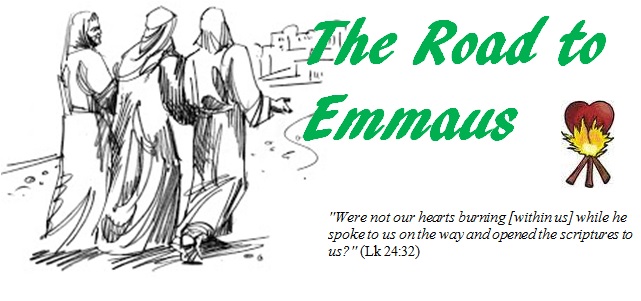
When he was at table with them, he took the bread. He blessed the bread, and broke it, and gave it to them. And their eyes were opened and they recognized him!(Luke 24:13-35)

Thursday, May 13, 2021

Chosen and appointed


After Judas betrayed our Lord, the Apostles gathered together to pick someone to succeed him. They decided it should be someone who had been with them from the beginning.  They prayed for guidance and cast lots “and the lot fell upon Matthias, and he was counted with the Eleven Apostles” (Acts 1:26).

We can only imagine how utterly incomplete and broken "the Twelve" must have felt after having one of their own betray not only the Lord but his brother apostles as well.  What better way to heal that rift, that open wound, than by selecting another to take the place of the apostate Judas.  And so Peter, who was no stranger himself to what it meant to be a denier of the Lord, called out to his brethren quoting the Psalms (Psalm 69:25): “Let his encampment become desolate, and may no one dwell in it.”  And (Psalm 109:8) “May another take his office.”  And so it was that Matthias was elected and played a key role in making "the Twelve" once again a complete and restored body of apostles who would guide and shape the early Church (Acts 1:15-26). 

Little is known about the ministry of Saint Matthias.  He is thought to have been killed for his faith, either by stoning or by beheading or both, which is why he’s honored as a martyr.

As we honor Saint Matthias, we honor more than just a man who became an Apostle and preached the Gospel with His life, we also honor the divine plan by which God has chosen to use weak and humble instruments to further His Kingdom.

“It was not you who chose me, but I who chose you and appointed you to go and bear fruit that will remain, so that whatever you ask the Father in my name he may give you.” (John 15:16)

This certainly applied to Saint Matthias, as well as to all of us to one extent or another.  It was God who “chose” Saint Matthias, as well as each and every one of us, for the purpose of going forth to “bear fruit that will remain.” But this form of good fruit, the fruit that has eternal consequences, can only be produced when we ask for it from the Father in the name of His Son Jesus.

Asking the Father to produce good fruit through us in the name of Jesus His Son doesn’t mean that we get to choose what we ask of the Father.  Rather, asking “in Jesus’ name” must be understood to mean that we ask the Father only what the Son has asked.  We choose to share in the one eternal prayer of the Son that the will of the Father be fulfilled.  And in praying this way, we commit ourselves to unity with His holy will.

Sometimes we can all find ourselves asking God for this favor or that.  We can place before Him our preference and our will.  But if we want to be used by God, to become an instrument of His grace so as to bear an abundance of good fruit, then we must humbly set aside our own will and allow God to be the one Who chooses our mission and appoints us to His holy task.  Detachment from our own will and humble submission to the will of God is the only way to bring forth God’s Kingdom.

How does this process of healing and renewal take place for us today as it did in the apostolic times of the early community? 

The world we live in is pretty complicated.  We get so many mixed and conflicting messages.  Our Religion and our faith are constantly under attack.  Political correctness seems to rule the day.  Many basic Christian beliefs are increasingly not accepted, or at the very least, put into question.  The open practice of faith is being challenged at every opportunity.  It appears to me to be similar to what it was in Jesus’s time.  There were Romans and Jews and religious tension.  There were Sadducees and Pharisees and rules and laws with different interpretations.  In both times, the situation can seem intolerable with no way forward.  We see in John’s gospel that Jesus entered into that complex world, as He does today, and gave His disciples a simple, yet profound message.  Love.  He tells them they’re loved, and they should love in return (John 15:9-17).

Pretty basic stuff…but it cuts through all the noise.   Suffering, confusion, mixed messages and rejection will always be with us.  His answer to all that is that He loves us, and we should love others.  Then almost knowing that we might stray or become disheartened, that we will be tested in and by the world, He encouraged them (and us) to "remain" in His love.  Seemingly a reminder to just stay close to Him through thick and thin.  There is so much in the world we can’t control, but to love is our choice, something we can control.  He has so often shown us that He won’t abandon us.  To remain with Him is our choice.

Our reward for loving, Jesus tells us, is a joy that’s “complete”.

No confusion, no lack of clarity, hard to misinterpret.  Love is the answer.  The way forward.  It will bring us joy.  Good for us to remember when we’re trying to overthink things or when we wonder how to respond in a world not always on our side.  I was at mass once and rather than a homily, the priest just said, “Let’s take a few minutes to reflect on the readings we just heard.”  Maybe we can try a similar exercise.  Just sit and repeat the following…. (your name here), Jesus loves you.  How can I stay in that love and bring that love into the world? 

Wednesday, May 12, 2021

A little while.....


I found myself thinking about my mom a lot today as I continued my reflections on the Gospel of John, and Jesus’ words to the Apostles just before His Passion: “You will grieve, but your grief will become joy.” (John 16: 20)

Jesus tried to prepare His followers for the days to come.  He would be gone, and fear would grip them.  Still in His presence, they didn’t understand.  Hidden in locked rooms after the horror, they clutched His words and still did not understand.  Didn’t He promise: “I will not leave you orphans” (John 14:18)?  But there they were.  Left behind.  Forgotten.

Being left behind leaves a sting that is hard to forget.  We remember the emptiness we feel when our grandparent or parent dies.  Some separations are harsh.  We hear of children being left at the police station or in dumpsters and then placed in an orphanage, never to see their biological family again.  There are countless stories of women fleeing violence who arrive at our borders, only to have officials take their children for months of separation.   Abandonment is a brush with death.

Jesus spoke His words in the Gospel (John 16:16-20) before the crucifixion, but they’re especially meaningful as we ponder His Ascension.  He told the disciples then that they wouldn’t see Him for a while, but then they would see Him again, referring to the time between the crucifixion and the resurrection, and that their grief would turn to joy.  And of course He was right.  Imagine how deep their grief was watching Him die, then imagine their joy at His resurrection.  But at His Ascension, He was leaving them again.  How could they bear this separation?  He had just come back – from the dead – and now He was leaving them again.  How unfair this must have seemed.  They just got him back, and now He was leaving again.  He said He was going to the Father, which is a good thing for Him, but a sad thing for those He was leaving here.  And we need to remember His words again, “A little while and you will no longer see me, and again a little while later and you will see me.”  At Ascension when He goes to the Father, He won’t be back in a few days like He was at the resurrection, but we hear again that a little while later they will see Him.  This time when He goes to the Father, He’ll wait for them there. He’ll wait for all of us there.

When they meet again in heaven their grief will turn to joy.  When we see Him in heaven our griefs will turn to joy.  Jesus proved at the resurrection that death is not the end and left us with that hope at Ascension, and not just for Him but for everyone.  He proved that all death is not the end and opened the gates of heaven.  After a while, the disciples will see Jesus in heaven.  After a while, we will see Jesus in heaven, and after a while we will see our loved ones in heaven.  That’s the hope Jesus gives us today. My mom died a few years ago, and my grief is deep.  But a little while and I will see her, and my grief will turn to joy.  And it’s what we all can look forward to.  A little while and we will see Jesus.  A little while and we will be reunited with our loved ones.  Easter promises us that death is not the end.  A little while and we will see Him, and our grief will become joy.  A little while later………

Tuesday, May 11, 2021

Live, move, and be in Christ Crucified


In Acts, Luke tells us that Paul was exasperated (some translations use the word “restless”) when he arrived in Athens (Acts 17:15-16).  The Spirit was at work within him, something was brewing, he was unsettled.  At the synagogue he spoke to the Jews and those interested in Judaism, then went out into the marketplace where the locals came together to keep life going – the shopping center, a busy place and a place to talk, a little leisurely shopping squeezed in during the days’ tasks.  Unexpectedly, some of his hearers, who were philosophers, brought him to the Areopagus where he had an audience of what seemed to be professional listeners.  Luke describes them humorously as Athenians who ‘love nothing more than to tell or listen to something new.’ (Acts 17:22-34)

Although he was ‘exasperated’, Paul also must have been impressed by the temples and shrines he saw in Athens.  The city was noted for them.  As a Jew he lived in a less pagan world than that of such a cosmopolitan city.  He focused his talk immediately on a shrine he had seen ‘to a God Unknown’.  Paul intended to make known to his listeners the God they had been worshiping but whom they didn’t know. His sharing was beautiful, moving in a respectful, understandable progression to his goal of telling them of Jesus who is Risen from the Dead: “For ‘In him we live and move and have our being.’” (Acts 17: 28)

I can only imagine how crushed Paul must have been that his preaching ended with an invitation to come again at some later date, knowing that no date would be set!

The failure in Athens, their lack of response to the Risen Lord, the ongoing groping in darkness of the Athenians amidst their numerous temples, the unheeded answer that Paul offered to the question of the Unknown God – all of these must have been ingredients stirring in his restless spirit.  When Paul found himself in Corinth his restlessness blossomed into the grace of a new understanding, a new missing piece that he could now articulate for himself and for all of us who continue to grope in darkness: ‘Yes, Jews demand “signs” and Greeks look for “wisdom,” but we preach Christ Crucified…God’s folly is wiser than men, and his weakness more powerful than men.’  (1 Corinthians 1:18-25)

We have so many gods in our society.  Those things that lead us away from God.  Things that don’t assist us in becoming the person that God created us to be.  We can clutter our lives with so many things or activities we think we need to do.  Keeping focused on what is true and right and just is an extremely difficult task in our modern society.  The scriptures I reflected on today help to keep our focus on God.  In the Gospel of John, Jesus calls the Holy Spirit, the Spirit of truth (John 16:12-15).  Opening our minds and hearts to the Holy Spirit will give us the ability to know what is true and right and will give us the graces to follow that truth.  The catch is being open.  God leads us in the direction we need to go.   We, for our part, place our trust in that direction as we listen through prayer, reflection, and others.

Monday, May 10, 2021

Life in the Spirit


There’s a passage in the Acts of the Apostles that gives us a glimpse of what “life in the Spirit” (Romans 8:1-4) looks like.  The Romans had imprisoned Paul and Silas to silence them from preaching the Good News of Jesus Christ.  But a miraculous earthquake freed them from prison bars.  The Spirit can’t be imprisoned, can’t be contained (Acts 16:22-34).

First, the guard and his family came to believe in Jesus through the power of the Holy Spirit.

Then, the guard welcomed Paul and Silas into his home to feed them and tend to their wounds.

Through Paul and Silas, the Holy Spirit had brought about the radical conversion of the prison guard and his family.  Then, the guard’s conversion led him to offer hospitality to the disciples.

The Holy Spirit was at work, giving the guard the gift of faith and empowering him to love the men who had just previously been his enemy.

One night, years ago, after a long day at work I thought, “I should go to the chapel right now and say my Rosary before dinner, so I don’t get so tired and distracted with other things that I neglect to say it later.”  I heard a faint voice say to me, “No, go to dinner and back to the hotel.  The gate will be locked anyway, and it will just be a waste of time.”  Another louder, more authoritative voice broke in and said, “What will it hurt to try?  There’s still the grotto with the Holy Family that you can visit and say your Rosary.”  The second voice was much more convincing, and so I drove to the chapel.  There was only one car in the parking lot, and, as the first ‘voice’ told me, the gate to the chapel was shut and locked (the church and chapel are in an extremely bad neighborhood, with a lot of gangs and criminal activity.  The gate is there to protect the Blessed Sacrament and the people who are there to adore Jesus in perpetual adoration).  I was getting ready to drive off, but the second voice said, “Don’t leave yet.  Try the gate.”  As soon as I got out of my car and walked up to the gate, a man came out of the chapel, as if he knew I would be there.  I asked him if he would mind letting me in.  He said, “Of course not. The woman who is supposed to be relieving us called a few minutes ago and said she was going to be late.  My wife and I were just praying that someone else would show up earlier because we have somewhere to go, as well, and we really didn’t want to be late.”  I knew at that moment that I was “called” by Jesus to come and sit with Him until the lady who was scheduled could show up.  I don’t remember my dinner that night, but I certainly remember my ‘invitation’ from the Holy Spirit to show up at the ‘appointed time’. 

My experience, as well as the story in Acts, are examples of the power of the Holy Spirit as we cooperate with the Spirit’s continual grace in us.  This is what Jesus meant when he proclaimed the Good News: The Kingdom of God is near (Luke 10:9).  Jesus, the incarnation of God, has entered our world.  The reign of God has begun, and it will be fulfilled at his second coming.  In the meantime, the Holy Spirit dwells with us – at work, inspiring us to faith, hope, and most of all to love.

Jesus doesn’t abandon us.  Rather, through the indwelling of the Holy Spirit, Jesus is still with us.  As with every generation of Christian since the disciples, it’s now our turn to continue the ministry of Jesus: to care for one another, to love one another.  In other words, filled with the Holy Spirit, we’re summoned to proclaim the Good News — That the Reign of God is near us in Christ Jesus.

Sunday, May 9, 2021

Getting out of the parking lot


Some of the funniest, but more profound experiences in my life growing up was my dad’s commentary each Sunday when he would pick us up from Mass.  (He was non-Catholic, so he would drop Mom and us off, go home for a bit, then come and get us as Mass ended).  Invariably, there would be tires screeching, horns blaring, and the occasional expletive being hurled by someone who presumably just listened to a Gospel, and Dad would say, “It’s easier to get out of jail than it is to get out of this parking lot after the Mass!”

As I’ve gotten older, I realize Dad’s sentiments were not his alone.  I’ve heard others who comment about people who faithfully attend Mass on Sundays, yet in the parking lot immediately after Mass, it’s as if none of what they heard, did, or sang at the liturgy “stuck” or made a difference in their lives.  Attending Mass is just a rote exercise so they can fulfill the requirements for being a “good Catholic”, but their faith doesn’t change their hearts or affect their day.

Paul had the opposite experience in Philippi (Acts 16:11-15).  On the Sabbath, Paul and his traveling companions went outside the bustling city to pray.  A key point, however, is the people who just “happened” to be at that same spot Paul was heading.  These weren’t old friends, but simple people who “happened by the grace of God” to be there.  Lydia was one of those people.  We learn that God “opened her heart” to what Paul was saying.  Lydia and her household were baptized and then she invited them to her home.  She was just an ordinary person, like you and me, and yet God powerfully intervened in her day-to-day life and the lives of her family to make a life changing impact.

Think about that for a minute. When is the last time you celebrated Mass in the community and allowed the message to so deeply sink into you that it changed your plans and actions going forward?

It may seem unrealistic that such a conversion could happen every Sunday.  But is it?  Jesus’ teachings are deeply challenging, especially to those of us in privileged Western society.  If we aren’t changing our actions and plans as a result, then we aren’t listening.  It won’t always be such a major change as Lydia experienced.  Although we need to remain open to that possibility, it’s admittedly less frequent.  Yet we need to constantly be growing and changing in our faith or risk having it die.

I try to reflect on the lessons I learn each day through the Scriptures, pray with them, open my heart to God, and challenge myself to let them affect my life in at least some way.  I find that often the lessons build on each other, which means that over time I’m learning significant lessons and making necessary adaptations.  I’m constantly being confronted with ways I fall short of the Gospel.  It’s humbling, sometimes to the point of discouragement.  Yet God calls me on.  

If I could impart just one piece of advice I learned from Paul’s experience in Acts, it would be to consciously try to be a little more like Lydia and a little less focused on getting out of the parking lot!

Saturday, May 8, 2021

Thanks, Mom(s)!


As Christians, we believe that the love of Jesus embraces everyone and shows God’s divine love for all of us.  We can’t praise the wondrous deeds the Lord does for us and for others without love.  We can’t be a witness to God’s love without loving others.  We can’t follow the commandments without love.  We can’t keep Jesus in our hearts without love.  And we can’t go out and bear fruit that will remain without love.  We can’t ask the Father for whatever we need if we don’t know of God’s love for us.  Hearing that we’re called and sent isn’t enough.  We must remain focused on our response to God’s great love for us.  We’re called and sent to share God’s love for us with others.  It’s all summed up with one commandment: “Love One Another!”

Who loves with a sacrificial and unselfish love more than a mother?  That’s what we celebrate today, Mother’s Day, and why we salute our mothers.  Mothers should be saluted for their tenacious and sacrificial love for their children, for the tremendous impact they have on their children, and for their intimate relationship with us from birth to death.  

“The loveliest masterpiece of the heart of God is the love of a mother.” -St. Therese of Lisieux

On this Mothers’ Day, my attention is drawn to the Good Shepherd who reminds us that “my sheep hear my voice. I know them, and they follow me.” (John 10:27).  Mothers instinctively recognize this.

“Mom, Mama, Mother” or something like this were the first words we formed as tiny infants.  Always hungry, needing diaper change, always needy.  And our mothers were there, available with milk, or a powdered butt and a fresh diaper.

She fed us with her milk before we knew what it meant to eat.  Taking care of diapers, dirty clothes, and, when we were tired, or whined, or were in tears, she was there.

Sometimes we have had only God’s presence or voice inside of us to keep us company. “My sheep hear my voice. I know them, and they follow me.”

Many years later, when we fell in love for the first time and only Mom knew what was going on.  If or when we fell out of love, she could help us pick up the pieces of loss, anger, confusion and hurt.

Mother’s little secret is where she gets the energy. “My sheep hear my voice. I know them and they follow me. No one will snatch them out of my hand.” (John 10: 27-28)

Men, love your wives and the mother of your children.  Have there been times when you’ve taken her for granted?  I know I have!  But I also know that my wife has gotten through disappointments or self-doubt because I’ve let her know that she’s loveable.  Even though I wasn’t able to find the right words, I stayed with her by her side.  

Sons, daughters, grandchildren, how many years were you totally dependent upon your Mom?  How many times, did you just walk away, not realizing from what you were leaving…all the energy, patience, mercy, and the desire she had deep within her to be able to understand you, and even, take you in her arms.  How many times did you not pay attention to what your Mom has gone through? (By the way, she doesn’t want you to know).

Mothers can hide their grief, their loneliness; they don’t want to burden anyone, so they carry their own burden.  Yet, our burdens, all the stuff we carry around, our mothers are there to carry, they’re there with us not just for us.  Our fears, our worries, – mothers have this capacity to hold us up, not to abandon us.

Need a further explanation?  Look at the One who lives inside of her.  You can find Him on the Cross.  “My sheep hear my voice.  I know them, and they follow me.”

On Mother’s Day, we Christians should acknowledge the truth that we have two mothers: our earthly mother and our Heavenly Mother, Mary, the Mother of Jesus (John 19:26-27).  The Catholic Church proclaims the great nobility of the Mother of Jesus, Mary most holy, and presents her as the supreme model for all mothers.  Born into humble surroundings, she was called by God to be the Mother of the Son of God.  She affirmed her obedience to the call of God, and she lived her vocation throughout her entire life.  Mary is the true model of motherhood.  “It can thus be said that women, by looking to Mary, find in her the secret of living their femininity with dignity and of achieving their own true advancement. In the light of Mary, the Church sees in the face of women the reflection of a beauty which mirrors the loftiest sentiments of which the human heart is capable: the self-offering totality of love; the strength that is capable of bearing the greatest sorrows; limitless fidelity and tireless devotion to work; the ability to combine penetrating intuition with words of support and encouragement” (Pope St. John Paul II).  Through Mary, the work of Motherhood is glorified and sanctified.  

On this Mother’s Day, let’s gratefully admit the fact that we can’t return, in the same measure, all the love that our mothers have given us.  Let’s thank our mothers today by lavishing our love on them if they’re alive and by offering our prayers for them if they’ve gone for their eternal reward.  Who can ever take the place of a mother who gave us birth, trained us, sacrificed her time and health for us?

Friday, May 7, 2021

The cost of our joy


My reflection today made me ponder how the world receives the Good News of Jesus and the diversity of those who spread (and receive) that Good News.   In the Acts of the Apostles, there’s a litany of early believers.  Jewish, Greek, male, female, circumcised, uncircumcised, from Lystra to Iconium to Jerusalem.  A diverse lot (Acts 16:1-10).  A Psalm proclaims, “Sing joyfully to the Lord, all you lands.”  (Psalms 100:1-5).  And in the Gospel of John, Jesus warned the disciples that, because Jesus had chosen them, the world may hate them.  “They will do all these things to you on account of my name, because they do not know the one who sent me.” (John 15:18-21).  Jesus doesn’t promise a rose garden for those who follow Him.

As I write this, I’m surrounded by pictures of my family.  I love them with all my heart, but I know they aren’t perfect.  If they were perfect, they wouldn’t need my love.  If they were perfect, my love for them would cost me nothing.  But they aren’t perfect.  They have troubles, quirks, problems, needs, wounds and scars.  Just like me and just like every other human being on the planet.  And this means, in order for me to love them, it’ll cost me.  It will require some sort of sacrifice.  My hope is that my love and sacrifice will be life-changing for them.

In addition to the pictures of my family on the wall (in fact, it’s in the midst of the pictures), I have a retablo which holds a small figure of Christ carrying His cross that my daughter Sarah bought for me in Ecuador.  As I look at the cross right now, I think, “what an incredible gift we’ve been given!”   Christ’s sacrifice wasn’t because we’re all perfect and deserving.  It’s just the opposite.  If we want a fuller life, this is something we need.  This is the cost of our joy.  We are a people in need, and this is the emblem of God’s love for us.

My prayer today is for those of us who struggle to comprehend Christ’s sacrifice and how to convey that Good News to a needy world.

Thursday, May 6, 2021

Laying down for love


What does it mean for me today to love one another and do as Jesus did, i.e., lay down His life for His friends (John 15: 12-14)?

The Gospel reading from John is a beautiful but a difficult one.  Jesus asks us to be prepared to lay down our lives for our friends.  I have to confess that I don’t have many friends for whom in my heart of hearts I’d throw myself into the path of certain death for them.   My children, grandchildren, or my wife?  Absolutely.  Friends?  That’s a lot harder.

Of course, Jesus did exactly that for His friends.  But me, I’m afraid that I’d be more like Peter on that fateful Thursday night denying that I knew Jesus because I’d be too chicken to admit it and risk my life (John 18:15-27).  I suppose this is one of the reasons I’ve often identified with Peter.  He seems so human.  He chickens out, he says the wrong thing (such as his suggestion that they build three tents after witnessing the Transfiguration) (Matthew 17:1-8) and his faith wavers (as it did when he tried to walk on water) (Matthew 14:22-33).

But Jesus chose him as the rock on which the Church was built (Matthew 16:17-19).  So why choose Peter?  I think it’s because Jesus knows we can’t be Him, but we can be Peter.  We can be Peter putting our foot in our mouth, lacking courage and losing faith — but never giving up.  We can all be rocks of faith and justice, even with our many human imperfections.

As I reflect on this, I think that maybe what I’m living for today is also what I’m dying for today.

Maybe it means I can listen intently to that person who just seems to go on and on and on and on, insisting that what they have to say demands more time than the rest of those gathered to discuss an idea or issue.

Maybe it means giving up a “personal freedom” and wearing a face mask whether or not I believe it’s necessary, instead of ridiculing or demeaning someone else who believes the opposite.  It just may save someone’s life.

Maybe it means I have to read some goofy reflection like this one, just because I get to be part of a community that is much bigger than my narrow view of “the saved” or “the righteous”.

Thank You, Jesus, for all these reminders to love; especially those individuals who initially give rise to resentments in me, but more often than not offer just what I need today.

Wednesday, May 5, 2021

Quid pro quo


It might be easy to gloss over the passages from Jesus’ last comments to His disciples before His cruel crucifixion because, since our youth, we may have heard them repeatedly.


But reading them afresh, slowly, gives us an opportunity to ponder their meaning in a prayerful manner.  We can let the words penetrate our hearts and transform us, if only just for today.


The best quid pro quo in Scripture is when Jesus offers us a deal; “You keep my commandments and “the joy I have in me, you will have in you.” (John 15: 9-11)


And what are the commandments we’re to keep?  The command to love one another is at the core of all of them.


Joy isn’t found in the myriad of distractions and entertainments that fill our modern world, no matter how alluring, how stimulating they may be.  Nor is it found in the three things spiritual writers tell us we are most tempted to spend our lives seeking: wealth, power and prestige and the comforts that may follow from their possession.  The true, lasting joy in Jesus’ heart that He wants in our hearts is experienced when we surrender our lives in love for others.  It’s a daily willingness to have God change us, realign our priorities, our urges, our passions to be at God’s disposal.


This surrendering frees us to love one another in powerful ways that change the world, one person at a time, for good.  This is how God’s reign happens.


As our reward, deep within us, at our core, we experience Jesus’ joy… it’s a very good quid pro quo, indeed!


What distinguishes us as Christians is not our grand institutions and houses of worship, not our influence in the political arena or honors.  What sets us apart is the joy we have in facing the challenges of each day.  We relish this joy…Christ’s joy within each of us…no matter what crises, tragedies, efforts, sufferings, illnesses, losses, disappointments we’re dealt. The joy is seen in our eyes, our disposition, our sense of hope. It’s Christ fully alive in us!

Tuesday, May 4, 2021

Connected in Christ


“I am the vine; you are the branches.”  (John 15:5).  Along with Paul’s image of the church as the body of the risen Christ (1 Corinthians 12:14), this image of the Church as grapevine spoken by Jesus in John’s Gospel is one of the great images of the unity of the living Church.  The body analogy is a rich analogy for celebrating the unity that comes from the collaboration of diverse members that utterly depend both on one another and on their common head for life, survival, and direction.  The power of the vine-and-branches image comes from the way it illustrates and emphasizes the complete dependence of the life of each member on the head, Christ, for its vitality and fruitfulness, and how each member flourishes under the care coming from yet another distinct source, the Father.

The painful discipline of fruitful spiritual growth is caught in the detail of the Father’s pruning.  Observed apart from the context of the life of the branch, the act of pruning seems at first to be a violation of the branch; something is cut off, after all—amputated.  But the full context reveals that the loss of a random sprout results in a branch that delivers more nourishing fluid to the eventual budding and production of the cluster of grapes.  And that wonderful process requires that the branch maintain its connection with the nurturing vine. The fruitfulness of all the branches depends on their union with the one vine--the risen Christ (John 15:1-8).  The teaching power of the vine and branches image might be the reason it appears so frequently in Christian art.

St. Luke, the author of Acts, tells how the church in Antioch was divided by different responses to a thorny problem, namely, the question of whether Gentiles needed to take on the Jewish way of life (especially circumcision) if they accepted the (Jewish) Messiah and joined the (mainly Jewish, at that time) Church.  The disciples’ first response to division was to seek unity, to gather with the elders and Apostles in Jerusalem to seek a solution.  They knew that they were meant to be an organic whole, one body in Christ.  Their lives were driven by the faith conviction that they were to do everything they could to enable the Holy Spirit achieve unity even when they were divided over a policy issue (Acts 15:1-6).

To a lot of people these days, we’re a Church divided in many ways, just as we were in the first days of Christianity.  The scriptures I reflected on today reminds us to imitate the spirit of the early Church as Luke narrates it in the calling of the first council of the Church.  Luke’s portrait of the decision-making process of the early church—reflecting on experience in the light of the longer tradition—remains a model for us today.

Monday, May 3, 2021

The gift of peace


"Peace I leave with you; my peace I give to you.  Not as the world gives do I give it to you…”   (John 14:27-31)

Peace is a beautiful reality, impossible to fully define and yet experienced by all of us at various times and in various ways.  Peace can be thought of in a negative way, such as an absence of war between peoples, or a lack of turmoil within a family, or freedom from anxiety in one’s heart.  True peace is a positive reality—a sense of tranquility and harmony and life.  Nations are truly at peace when they cooperate with each other; a family is at peace when they live together in harmony; a person is at peace when resting confidently in the loving arms of Jesus.  Peace is positive — and precious!

This positive, precious peace is the farewell gift of Jesus to His disciples – and us.  Jesus gave us more than descriptive, “nice” words about peace; He also gave us the means to find peace, and that “means” is His very Body and Blood in the Eucharist.  The Eucharist is the means by which we become one in Christ.  By uniting us in Himself, a harmony and positive spirit builds us up and helps heal our troubled, fearful hearts.  No doubt, as we see in the Acts of the Apostles (Acts 14:19-28), Paul and Barnabas based their exciting and fruitful missionary journeys on the peace and strength they experienced in celebrating the Eucharist.

In our pandemic-ravaged world, Jesus encourages us: “Do not let your hearts be troubled or afraid.”  With Jesus’ gift of peace in our hearts, we can live in peace with one another as we breathe a sigh of contentment, relief and encouragement — leading to true healing and life.

“May all creation bless God’s holy name forever!” (Psalm 145:10-21) 


Sunday, May 2, 2021

The Word of life


I think it’s good once in a while to step back and just look at what kind of space I’m creating each day to be receptive to God’s Word and God’s Will.  Basically, I’m talking about reading the prophetic messages of God’s spokespersons, psalmists’ inspirations from following God, accounts of the early Church (the Acts), letters from Paul and other apostles, and Jesus’ words and activities in the Gospels. 

So I get settled in a place, know how much time I have, offer some expression of gratitude to God, take some deep breaths, accept the feelings and thoughts that are flowing though me, and then, bracket it all as best I can to concentrate on the Word of the day.  Most days, I take a walk and pray the Rosary and Divine Mercy Chaplet to focus on prayer.

Then I ask myself some basic questions:  "To what, Lord, do you want me to pay attention?  The fact that I’m being saved?”   Am I open to the "appearance of Christ" today, as is described in various ways in the same reading (1 Corinthians 15:1-8)?   Do I believe when Jesus says, "the one who believes in me will also do the works that I do and, in fact, will do greater works than these, because I am going to the Father." (John 14:6-14).  So, for what am I asking Jesus, and am I open to "the answer to my prayer?"  

And, finally, understanding "that the Father may be glorified in the Son."  What is "glory?"  When someone is in their "glory" their wishes, desires, hopes and plans have been fulfilled.  We may be in our glory because we’re a new grandparent, we got the last child through college or married off to someone, or our favorite sports team has won it all.  God the Father is in glory when THE Plan to transform the world, one person at a time is a happening, through our prayer and intentional works. That is "thy kingdom come thy will be done on earth as it is in heaven."

Give "glory to God," by carrying out His Will, and glorifying His Son.  This prayer method can help.

Saturday, May 1, 2021

Good enough for Jesus


Not being included or being simply rejected is one of our deepest human fears.  Not being asked to a party, not being chosen for a team, receiving a dismissal notice are all terrifying memories or dreams.

The Scriptures I reflected on today all speak of this human experience.  Saul, who had been knocked off his horse and was converted by conversing with the Jesus Whom he persecuted, went back to the group of apostles in Jerusalem.  But they refused to have anything to do with him, because of his reputation.

After a while, Barnabas stood up for Saul and spoke of his having been preaching freely elsewhere about Jesus.  Paul was allowed into the group and then sent out to begin his many miles of missioning.  Saul found out the hard way how hard it is to live with his past (Acts 9:26-31).

In the First Letter of John we’re given some advice: “Let us love not in word or speech but in deed and in truth.”  Actions speak louder than words.  It’s pretty easy to talk about doing the right thing but acting on it can be a challenge.  However, John goes on to share some tips to help us do this: (A) Love one another, and (B) Keep His commandments and do what pleases Him (1 John 3:18-24).

Sounds simple right?  I can easily think of a couple of people in my life who presented huge challenges to me personally when I tried to practice the “love one another” idea.  No matter what I did, or how hard I prayed for patience in dealing with them, things were difficult!  However, I still had to persevere and love them.  So my trick was think of how difficult I might be to deal with, and how it may be difficult to love me—this was often painful.  I tended to spend more time thinking of the shortcomings of those I was trying to love than my own faults, but perspective was gained.

Love is manifested in actions as well as words; loving one another is His commandment and keeping His commandments is how we love God in return for God's love for us.  Our problem always is that we would rather love our way and our times, rather than His way and his times.

And finally, the Gospel puts it very clearly.  Jesus is the Vine, we are branches and if we’re apart from Him, rather than a part of Him, we can do nothing.  Bearing fruit is the result of living His words and ways (John 15:1-8).  Being barren is the result of doing "our own thing," rather than allowing His word to influence "our thing."

After the Resurrection of Jesus, His starting line-up was set.  They were the ones chosen to go out there and win the world for Jesus.  That’s the way they saw it until Jesus went out and got somebody from the opposing team, Saul, who by his own admission, was born out of time (1 Corinthians 15:8).  Jesus converted the one who would convert many to the ways of his Master.  Once Saul became a part of Jesus, he was a part of the whole team, the Body of Christ.

At this time of year—the “Easter Season”—we celebrate and welcome our new members into His Body, the Church.  From whatever religious persuasion they have come, they’re not our opponents; they have not "come over," but have simply been welcomed into full communion with the Church as we call it.

Sometimes I hear of someone who has been baptized or confirmed that I know, and their past, and thought, “them?”  Paul had to live with his past as did many of the saints in our history.  Each of us has a past, which just might lead us to think that we’re not includable ourselves.

When we’re admitted into the Church in various steps and degrees, we’re experiencing our own conversions, and one main aspect of conversion is being converted about our views of our pasts.  Paul writes that he has to forget what is the past and press on into what lies ahead (Philippians 3:13-14).

Self-rejection, self-judgment, self-exclusion has no power in the life of Saul or the newly baptized, nor us long ago baptized.  Loving one another as Jesus commanded is only possible if we love ourselves first, because He does.  His love for us includes our pasts as well as what lies ahead for us.  Jesus, in Baptism, has grafted us all into and onto the Vine of God's love.  Worthy is not a Eucharistic word, but immediately before receiving, we do say, "Lord I am not worthy...."   That’s not the end of the prayer.  We can so easily stop there as a good excuse or a falsely humble statement that can render us as the rejected or uninvited.   We continue the prayer by saying, "say but the word and my soul will be healed."  The Word has been spoken and our negative disqualifying sense of our pasts has been healed from unworthy to unexcluded or welcomed.

We are Christ's starting line-up now and as we line up for our reception of the Eucharist, we receive both His Body and being included into that same Body.  We also receive His mission, which He shared with Saul, of bearing witness to the embrace of Jesus by embracing in our hearts those whose pasts we know and those we don't.  If Saul was good enough for Jesus, then so are we and so are they.

Friday, April 30, 2021

An outstanding example of holiness


On December 8, 2020, Pope Francis announced the beginning of the universal celebration of the “Year of Saint Joseph,” which will conclude on December 8, 2021. He introduced this year with an Apostolic Letter entitled “With a Father’s Heart.”  In the introduction to that letter, the Holy Father said, “Each of us can discover in Joseph—the man who goes unnoticed, a daily, discreet and hidden presence—an intercessor, a support and a guide in times of trouble.”

The Gospel of Matthew points to the fact that Jesus was “the carpenter’s son.” (Matthew 13:54-58).  Joseph was a worker.  He worked with his hands as a carpenter so as to provide for the daily needs of the Blessed Virgin Mary and the Son of God.  He provided them with a home, with food, and with the other daily necessities of life.  Joseph also protected them both by following the various messages of the angel of God who spoke to him in his dreams.  Joseph fulfilled his duties in life in a quiet and hidden way, serving in his role as father, spouse and worker.

Though Joseph is universally recognized and honored today within our Church and even as a prominent historical world figure, during his lifetime he would have been a man who was largely unnoticed.  He would have been seen as an ordinary man doing his ordinary duty.  But in many ways, that’s what makes Saint Joseph an ideal man to imitate and a source of inspiration.  Very few people are called to serve others in the spotlight.  Very few people are publicly praised for their day-to-day duties.  Parents, especially, are often greatly unappreciated.  For that reason, the life of Saint Joseph, this humble and hidden life lived out in Nazareth, provides most people with inspiration for their own daily lives.

If our own life is somewhat monotonous, hidden, unappreciated by the masses, tedious, and even boring at times, we can look to Saint Joseph for inspiration.  Today’s memorial especially honors Joseph as a man who worked.  And his work was quite ordinary.  But holiness is especially found in the ordinary parts of our daily lives.  Choosing to serve, day in and day out, with little or no earthly accolades, is a service of love, an imitation of the life of Saint Joseph, and a source of our own holiness in life.  We must not underestimate the importance of serving in these and other ordinary and hidden ways.

As I reflect today upon the ordinary and “unremarkable” daily life of Saint Joseph, I find that my life is similar to what he would have experienced as a worker, a spouse and a father; I rejoice in that fact! I rejoice in the fact that I’m also called to a life of extraordinary holiness through the ordinary duties of daily life.  I strive to do them well, do them with love, and do them in inspiration of Saint Joseph and his spouse, the Blessed Virgin Mary who would have shared in this ordinary day-to-day life.  

It’s comforting to know that what we do each and every day, when it’s done out of love and service of others, is the surest path to holiness of life for us.

Thursday, April 29, 2021

The steps to grace


As I read the Scriptures preparing for my reflection today, the juxtaposition of two figures that are well known to Christians shouted out to me:  Paul and Thomas.

It’s probable that Paul never knew Jesus prior to when He was crucified and resurrected but came to know Him when Jesus appeared to Paul on the road to Damascus (Acts 9).  Despite not having known Jesus during Jesus’s earthly ministry, Paul’s heart clearly was on fire.  Twenty centuries later, one can almost hear the power of his voice urgently proclaiming the Good News that Jesus died to atone for our sins (Acts 13:26-33).

And then we have Thomas in the Gospel.  Thomas was apparently the disciple who wanted to make sure that everything was in order before being convinced.  Before being sure that Jesus actually rose, he wanted to touch His hands and sides (John 20:24-29).  Then, even Jesus’s soothing words that the Father’s house has many rooms, and that Jesus would come back to guide the disciples home wasn’t good enough for Thomas; he wanted to know exactly where Jesus was going for fear that Thomas would get left behind (John 14:1-6).

So it’s easy to admire Paul and belittle Thomas, but I know I have a lot of Thomas in me; and I bet I’m not alone.  It seems clear to me that Thomas wasn’t in any way a person lacking in faith.  He was just a bit of a worrier.  He worried about what would happen the next day and about whether Jesus and God would really be there for him.  I imagine he worried about a lot of the things that many of us do.

There aren’t really that many Pauls among us.  Personally, I’d have a hard time running into a place of worship and boldly proclaiming the Resurrection to a bunch of people that I didn’t know.  But that was Paul’s greatest gift.

We all have gifts, and we all fail to use them at various points in our lives.  Maybe that makes us all a little bit like Thomas.  But look how much Jesus loved Thomas, because rather than rebuking him Jesus responded with one of the most loving passages in the Gospels: “I am the way and the truth and the life. No one comes to the Father except through me.” (John 14:1-6)

Those three words – way, truth, life – reflect who Jesus can be to every one of us.

There’s only one way – Jesus’ way.  Most of us want to live as Jesus would have us live, because we want to go to heaven when we’ve finished our earthly journey.  We want to be Christ to others; we want to turn the other cheek (that’s a hard one) and we have to serve others in whatever capacity the Lord sees fit.  We want to see our Father’s house at the end of this journey.

There’s only one truth – that Jesus Christ is Lord, and He is our one saving grace.  His words and actions should be reflected and shared through us to others.  In trusting in Him, we know that He’ll lead us to His truth, enabling us to see through the mess through which some have blurred the clear vision of truth.

There’s only one life – a life sharing Jesus with others and living in a way that promotes His unending and beautiful love.  And in living this life, we’re reminded of the steps to grace that we can accomplish, enabling ourselves and others the chance of entering the gates of Heaven:

To hear Christ’s words and put them into practice (Matthew 7:24).

To believe in Him and have an everlasting faith; “for God so loved the world that he gave his only begotten son, that whosoever believes in him will have everlasting life”. (John 3:16)

To repent from our sins. (Luke 5:31-32)

To confess Christ to others. (Matthew 10:32)

To being baptized into Christ’s death, and living and sharing His Passion.  (Mark 16:15-16)

To remember a constant commitment in presenting our bodies as a living sacrifice, holy, and acceptable to God. (Romans 12:1-2)

If Jesus was there for Thomas, we can rest assured that He’s here for us now.

Wednesday, April 28, 2021

Feet


Feet.  Underappreciated, overlooked.  What grounds us, literally, to this earth.  (Yes, I know gravity is the force that actually does this, but I can’t see gravity.  I can feel my feet grounded to the earth.)  In a time when travel was almost exclusively by foot, a sign of respect and reverence, and of hospitality, was to wash the feet of visitors. One of the perks of my retirement is that I try to get a pedicure every 3 months or so.  I enjoy the rejuvenation of my spirit that I feel when I’m having my feet massaged and rubbed with lotion.

As we age our feet show the travails of our lives.  Infants have innocent and almost perfectly formed feet, yet they’re also soft and weak, incapable of holding their weight or transporting them.  Children, teens, and young adults have feet that become progressively stronger, more capable and supportive, more able to move in a willed direction.  But these feet also start to develop signs of age, signs of toughening, of callousing and callousness, to the forces around them.  Think of how calloused the feet of Jesus and His disciples must have been – tough as leather, reflecting the many miles that they had traveled.  Even later in life feet show more of the stress that they’ve received – bunions, and aches, and pains that only increase as they’re used. 

Jesus, by His act of washing the calloused, dirty, tough soles of the disciples’ feet clearly sends the message that, as He reminds them and us, no master is greater than the disciple (John 13:16-20).  I think there are other possible messages here though.  Jesus chose to humble Himself by washing feet, the means by which people move in a willed direction.  And so we can ask ourselves in what direction are we moving, and is it the direction we feel called by God to follow?  Is Jesus reminding us to ask if our feet are moving us closer to God?  And what of our feet themselves?  Are they innocent like the infant’s or calloused and world-weary like the older person?  Doesn’t Jesus rejuvenate our feet, and our spirits, by His washing and refreshing, His message of hope and salvation?  And can we accept His washing, as did the apostles, by surrendering to the act of charity that He provides with a grateful heart?  When we’re aware of Jesus washing our feet, do our eyes shine with the gratitude of an old man whose feet are caressed and rubbed with lotion?

My prayer today is that I can be conscious of Jesus being there to wash my world-weary feet as I journey through life, and that in my consciousness I can be grateful for His sacrifice for me.