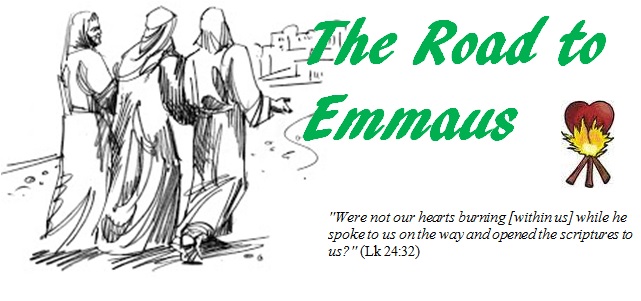
When he was at table with them, he took the bread. He blessed the bread, and broke it, and gave it to them. And their eyes were opened and they recognized him!(Luke 24:13-35)

Monday, February 19, 2024

Babbling? Far from it!


When He’s asked about prayer, Jesus says not to use lots of words but to speak simply, to call God our father, to speak to Him like family, because He is our father in heaven, and like our father on earth, wants to help and protect us.  We should call God Father.  And we should respect God, like we respect our parents.  His name is holy, and we honor our father.  We call on Him for what we need.  And like a good parent, He knows what we need even before we ask for it.  We ask for our daily bread.  If an earthly father cares for and supports his family, how much more will our heavenly father?  When we ask for what we need to live, He will provide.  He’s a good father to us.  Our earthly parents don’t abandon us if we do something wrong, nor will our heavenly father.  God wants to teach us right from wrong and protect us from danger, like any good parent.  We’re not perfect.  We sin, even when we try not to, and we probably don’t try hard enough not to.  And if we imperfect beings are still good parents to our children, how much better is our perfect heavenly father.  And He’s our role model.  Like our Father loves and forgives us, we should love and forgive each other.  We should help our friends in need like our Father provides for us.  We should forgive each other like our Father forgives us.

The prayer has become standardized and formal.  To build a stronger relationship with God, we should say it every day.  And when we do, we should think about what it means and what we are saying.  In these or other words, we’re talking to our father.  We’re acknowledging that we love and respect Him. We’re asking for our basic needs, asking for His forgiveness when necessary, and promising to love and care for each other like He loves and cares for us.

“Our Father, who art in heaven, hallowed be thy name.”  How many times have we said this prayer?  It may be the first prayer we learned.  And in a bit of irony, this formal prayer almost everyone knows seems to come from Jesus telling the disciples not to rely on formal prayers, but to pray simply, familiarly, and from the heart. (Matthew 6:7-15)

I was accused once of “babbling” prayers when I pray the rosary.  This couldn’t be further from the truth.  I hope to show this by telling of the origin (as well as I can research it) of the prayer.

According to tradition, the rosary’s began during an apparition of Mary to Saint Dominic around the year 1221.  Dominic was combating a popular heresy in France called Albigensianism.  Mary gave him the rosary, told him to teach people this devotion, and promised that his apostolic efforts would be blessed with much success if he did.  The religious order Dominic founded (the Dominicans) clearly played a major role in promoting the rosary throughout the world in the early years of this devotion.

Another important development in the history of the rosary is found in its roots in the liturgical prayer of the Church.  In the medieval period, there was a desire to give the laity a form of common prayer similar to that of the monasteries.  Monastic prayer was structured around the Psalter—the recitation of all 150 psalms from the Bible.  At that time, however, most laity couldn’t afford a Psalter, and most could not even read.

As a parallel to the monastic reading of the 150 psalms, the practice developed among the laity of praying the Our Father 150 times throughout the day.  This devotion came to be known as “the poor man’s breviary.”  The laity eventually were given beads to help them count their prayers.

Marian devotion followed a similar pattern.  Gabriel’s words, “Hail Mary, full of grace, the Lord is with you” (Luke 1:28), sometimes were read in the monasteries at the end of a psalm, showing how the psalms found fulfillment in the New Testament with the coming of Christ through the Virgin Mary.

Some laity began to recite these words in the manner of the Our Father—150 times, while counting their prayers on beads.  In repeating the words of Gabriel, they were reliving the joy of the annunciation and celebrating the mystery of God becoming man in Mary’s womb.

Christians linked this prayer with Elizabeth’s words to Mary at the Visitation: “Blessed are you among women, and blessed is the fruit of your womb” (Luke 1:42).  Finally, with the addition of the name “Jesus” in the thirteenth century, the first half of the Hail Mary was in place.  This early form of the Hail Mary was recited 150 times on the beads.  By the fifteenth century, the 150 Hail Marys had been divided into sets of ten, known as “decades,” with an Our Father at the beginning of each.

Another line of development in monastic prayer eventually led to the practice of contemplating Christ’s life while reciting the Hail Marys.  Some monasteries began associating the psalms with an aspect of Jesus’s life.  At the end of each psalm, the monks would recite a phrase relating that psalm to the life of Jesus or Mary.  Taken together, these phrases formed a brief life of Christ and his mother.

A devotion that joined fifty of these phrases with the praying of fifty Hail Marys began in the early fifteenth century.  However, since fifty points of reflection generally couldn’t be recalled without a book, the devotion was simplified by reducing the meditation points to fifteen, with one for every decade. So, by the end of the fifteenth century, the basic structure of the rosary was in place: Our Fathers dividing decades of Hail Marys, with meditations on the life of Christ and Mary.

In the sixteenth century, the sets of five Joyful, five Sorrowful, and five Glorious Mysteries as we know them today began to emerge.  Also, the vocal prayers of the rosary were finalized. The Glory Be was added to the end of every decade, and the second half of the Hail Mary was formalized: “Holy Mary, Mother of God, pray for us sinners now and at the hour of our death. Amen.”  In 1569, Pope Saint Pius V officially approved the rosary in this form: fifteen decades of Hail Marys introduced by the Our Father and concluded with the Glory Be.  And so the rosary remained for over four centuries.

In 1917, Our Lady of Fatima (Mary) taught three shepherd children a prayer to be said at the end of each Glory Be.  The prayer goes as follows: "O My Jesus, forgive us our sins, save us from the fires of hell, and lead all souls to heaven, especially those most in need of Thy mercy".

Then, in 2002, Pope Saint John Paul II proposed something new—The Luminous Mysteries.

In that year, John Paul II published his Apostolic Letter on the Most Holy Rosary, Rosarium Virginis Mariae.  The letter announced the Year of the Rosary and called on Catholics to renew their devotion to this traditional prayer.  However, what grabbed the attention of the entire Catholic world was John Paul II’s proposal of a whole new set of mysteries for contemplation in the rosary, the “Mysteries of Light” or “Luminous Mysteries.”

John Paul II suggested that reflection on the mysteries of Christ’s public ministry would help Catholics enter more fully into the life of Jesus through the rosary: “To bring out fully the Christological depth of the Rosary it would be suitable to make an addition to the traditional pattern which…could broaden it to include the mysteries of Christ’s public ministry between his Baptism and his passion” (RVM, 19). The pope proposed the following scenes to be contemplated: (1) Christ’s baptism, (2) the wedding feast at Cana, (3) the proclamation of the kingdom, (4) the Transfiguration, and (5) the institution of the Eucharist.

The pope’s invitation to reflect on these mysteries makes a lot of sense.  As some have noted—me included—in the traditional form of the rosary, the transition from the fifth Joyful Mystery to the first Sorrowful Mystery seemed rather abrupt.  We moved from Jesus as a twelve-year-old boy found by His parents in the temple to Jesus as a 33-year-old man about to be crucified on Calvary.  The Mysteries of Light fill in the gap.

The pope also said he hoped the addition of new mysteries would give the rosary “fresh life” at a time when the rosary was devalued in many parts of the Church.  He hoped this new vitality would help “enkindle renewed interest in the Rosary’s place within Christian spirituality as a true doorway to the depths of the Heart of Christ, ocean of joy and of light, of suffering and of glory” (RVM, 19).  Indeed, the Mysteries of Light seem to be not only a most fitting development of the rosary, but also a providential one for our age and one that is likely to stand the test of time.

If, after reading this rather lengthy history and evolution of the rosary which was given to all of us by the Mother of Jesus herself, you believe me to be “babbling”, that’s OK.  I’m going to continue babbling on and keeping all of you in my intentions as I pray.

Saturday, February 17, 2024

God's invitation


Lent is a season of being invited by God in a deeply personal way.  “Come back to me, with all of your heart,” our Lord beckons. "We will," we respond, but we aren’t quite ready yet, our hearts aren’t prepared.  We want to squirm, evade, avoid.  Our souls are not yet perfect.  We’re not ready for God to love us.

Yes, of course we want to have a deeper relationship with God, we tell ourselves earnestly.  And we will…Soon.  God calls to us again: “Come back to me, with all of your heart.”

Ok, ok, I really will.  Just a few more things to do at work.  Let me spend a little more time in prayer first.  Let me get to Reconciliation.  Let me clean my oven, tidy my closets.  Sell my yoke of oxen.  Check a field I’ve purchased.  Let me do anything else…  "Come back to me, with all of your heart.”

It’s an extraordinary invitation to each one of us.  To me in a personal, individual way.  God invites me to drop the defenses that I hold up between myself and God.  All God wants is for me to realize that my standards, my way of judging and loving are so very different from God’s way, and so much smaller.  God offers an entire Lent season, an entire lifetime, of loving me unconditionally, no matter what I’ve done or failed to do or how much I think I’ve hidden from God.

From the first day of Lent, the Ash Wednesday readings make God's call to us clear: “Return to me with your whole heart.”

“A clean heart create for me, O God,” Psalm 51 offers. “Give me back the joy of your salvation.” That’s exactly what our loving God wants to give us, the joy of salvation.

Lent falls in winter and these days are cold and dark, perfect for hiding ourselves indoors, perfect for hiding from God - or so we imagine.  But our God is insistent, loving, gently prodding.  God is the parent of the Prodigal Child, waiting faithfully, eagerly on the road for our return, night after night.  There are no folded arms and stern judging stares, only the straining eyes of a parent eager for our return, longing to embrace us and rejoice in us.

Yet we spend so much time trying to think of how to return and what to say, how to begin the conversation.  It’s only when we finally appear after so much time away, embarrassed and confused, that we understand we don’t have to say anything.  We only have to show up. 

Look up there on the road ahead of us: our loving God is jumping up and down for joy.  The invitation to us has been heard.  We’ve returned home!

But wait... What stops us from this great reunion?  What keeps us from accepting this invitation to something deeper in our lives with God?  We feel in our hearts that there are things we should say first: “wait…but…if only” and finally, “If God really knew about me…”

It doesn’t matter.  None of it matters.  Only the joy that we’ve turned to God and that like a loving father or mother, God is smothering us with embraces and joyful cries.  We have returned!

“Come back to me, with all of your heart."

Our acceptance of this call, this appeal to our hearts is simple if we can only get beyond the fear.  All we have to do is say to our Lord, "I'm here.  Where do I start?  Yes, I want to be with you."  Our hearts have been opened and we’ve taken the first step toward the rejoicing parent on the road.  No explanations are necessary, only to pause and picture in our hearts the joyfully loving and unblinking gaze of God that falls on us.

What's the next step on our journey home?  We could take the earliest moments of our day, before we’ve gotten out of bed to thank God for such a loving invitation and ask for help in opening our hearts to it.  We could remember throughout the day the invitation that has moved our hearts: “Come back to me, with all of your heart.”  And we can rejoice along with God.

That’s the invitation for each day of Lent.  Today is the day to accept it.

Friday, February 16, 2024

A journey through the Scriptures


In his Apostolic Letter, ROSARIUM VIRGINIS MARIAE, written by Pope Saint John Paul II in 2003, the Holy Father said, “The Blessed Rosary of Mary, a sweet chain linking us to God, in a way similar to what takes place in the Liturgy, the Christian week, centered on Sunday, the day of Resurrection, becomes a journey through the mysteries of the life of Christ, and He is revealed in the lives of His disciples as the Lord of time and of history.  To recite the Rosary is nothing other than to contemplate with Mary the face of Christ.”  He also wrote, “Mary lived with her eyes fixed on Christ, treasuring His every word: “She kept all these things, pondering them in her heart” (Luke 2:19; cf. 2:51).  The memories of Jesus, impressed upon her heart, were always with her, leading her to reflect on the various moments of her life at her Son's side. In a way those memories were to be the “rosary” which she recited uninterruptedly throughout her earthly life.”

Praying the Rosary can make us happy in several ways.  First and foremost, it’s a way for us to meditate on the life of Jesus and what He means to us in this life and the next. 

Second, it doesn’t matter what else is happening in our lives, when we pray the rosary, it has a way of clearing our thoughts of worldly things and putting our focus on what (Who) is important above all else.

Third, it’s a great way to build strong family relationships, and can possibly lead to even stronger community relationships when prayed with others outside of the family.

Fourth, the Rosary is our last best hope for bringing the world together in peace and love.  The goal is to get everyone to want to pray frequently and fervently out of love for Christ and His mother, and for one another.

Lastly, who doesn’t love a good vacation?  When we meditate on Jesus’ life, we can try to put ourselves at the same time, in the same place, and with the same people He was with.  It’s like taking a trip with the Blessed Mother as she tells us stories of her Son.

Thursday, February 15, 2024

Why pray the Rosary?

Train the young in the way they should go; even when they get old, they will not swerve from it.  (Proverbs 22:6)

“He called a little child to him and placed the child among them.  And he said: ‘Truly I tell you, unless you change and become like little children, you will never enter the kingdom of heaven.  Therefore, whoever takes the lowly position of this child is the greatest in the kingdom of heaven.’” (Matthew 18:2-4) 

I had a dream once in which Our Blessed Mother reached out and took my hand.  Then she said, “Come on a journey with me, child.”  As we walked along a path of roses, she told me a story beginning with the Angel Gabriel appearing to a young woman to announce the birth of a Savior to all nations and ending with the young woman being crowned as Queen of Heaven and Earth.  It was a story filled with love & hatred, joy & sorrow, and awe at the power of God and the love He has for His creation.  Of course, in my dream we—Mother Mary and I—were praying the Rosary.

I love the Rosary.  It doesn’t matter what else is happening in my life, when I pray the Rosary as it is meant to be prayed it has a way of clearing my thoughts and putting my focus on Who and what is important above all else.  The Rosary has the power to teach the uninformed, convert hardened hearts, and to strengthen faith with the help of the Blessed Mother.  I’ve experienced all three over the years in my recitations of the prayer.

I owe my love of the Rosary to my mother.  Her persistence and devotion in praying the prayer of the Blessed Mother of Jesus was an example I can only hope to attain.  I am sure it is through her prayers and sacrifices that I have received so many blessings in my life!

Although it has always been my “go to” prayer in times of crisis or distress, I didn’t know what the Rosary is intended to be—that is, a meditative prayer on the life and message of Jesus Christ—until I heard it from the Mother of Jesus herself in that dream so many years ago.  And I’m not alone:

“When you say your Rosary, the angels rejoice, the Blessed Trinity delights in it, my Son finds joy in it too, and I myself am happier than you can possibly guess. After the Holy Sacrifice of the Mass, there is nothing in the Church that I love as much as the Rosary.”-Our Lady to Blessed Alan de la Roche

“Hail Mary, full of grace, the Lord is with thee!’ No creature has ever said anything that was more pleasing to me, nor will anyone ever be able to find or say to me anything that pleases me more.”-Our Lady to Saint Mechtilde

“If you want to reach these hardened souls and win them over to God, preach my Rosary.”-Our Lady to St. Dominic

“When you give a sermon, urge people to say my Rosary, and in this way your words will bear much fruit for souls.”-Our Lady to St. Dominic

“The Rosary is a powerful weapon to put the demons to flight and to keep oneself from sin…If you desire peace in your hearts, in your homes, and in your country, assemble each evening to recite the Rosary. Let not even one day pass without saying it, no matter how burdened you may be with many cares and labors.”-Pope Pius XI

“If you say the Rosary faithfully until death, I do assure you that, in spite of the gravity of your sins, you shall receive a never fading crown of glory. For even if you are now on the brink of damnation, even if you have one foot in hell, even if you have sold your soul to the devil…sooner or later you will be converted and will amend your life and save your soul. If–you say the Rosary devoutly every day of your life.”-St. Louis de Montfort

“The Rosary is the most excellent form of prayer and the most efficacious means of attaining eternal life. It is the remedy for all our evils, the root of all our blessings. There is no more excellent way of praying.”-Pope Leo XIII

“The Rosary is the Weapon.”-St. Pio of Pietrelcina

“The Rosary is my favorite prayer.”-Pope St. John Paul II

“The greatest method of praying is to pray the Rosary.”-Saint Francis de Sales

“When the Holy Rosary is said well, it gives Jesus and Mary more glory and is more meritorious than any other prayer.”-Saint Louis de Montfort

“The Holy Rosary is the storehouse of countless blessing.”-Blessed Alan de la Roche

“One day, through the Rosary and the Scapular, Our Lady will save the world.”-Saint Dominic

“Never will anyone who says his Rosary every day be led astray. This is a statement that I would gladly sign with my blood.”-Saint Louis de Montfort

“The Rosary is the most beautiful and the most rich in graces of all prayers; it is the prayer that touches most the Heart of the Mother of God…and if you wish peace to reign in your homes, recite the family Rosary.”-Pope Saint Pius X

“It was not courage, not arms, not leaders, but Mary of the Rosary that made us victors.”-Venetian Senators after Battle of Lepanto (1571)

“How beautiful is the family that recites the Rosary every evening!”-Pope St. John Paul II

“The Rosary is a prayer both so humble and simple and a theologically rich in Biblical content. I beg you to pray it.”-Pope St. John Paul II

“If you wish to convert anyone to the fullness of the knowledge of Our Lord and of His Mystical Body, then teach him the Rosary. One of two things will happen. Either he will stop saying the Rosary — or he will get the gift of faith.”-Venerable Archbishop Fulton Sheen

"The holy Rosary is a powerful weapon. Use it with confidence and you'll be amazed at the results." -St. Josemaria Escriva

"If you say the Holy Rosary every day, with a spirit of faith and love, our Lady will make sure she leads you very far along her Son's path."-St. Josemaria Escriva

"Say the Holy Rosary. Blessed be that monotony of Hail Mary's which purifies the monotony of your sins!"-St. Josemaria Escriva

"You always leave the Rosary for later, and you end up not saying it at all because you are sleepy. If there is no other time, say it in the street without letting anybody notice it. It will, moreover, help you to have presence of God."-St. Josemaria Escriva

"Give me an army saying the Rosary and I will conquer the world."-Saint Pope Pius IX

"There is no problem, I tell you, no matter how difficult it is, that we cannot solve by the prayer of the Holy Rosary."-Sister Lucia, of the seers of Fatima

One day, St. Dominic prayed to Our Lady that she would force the devils who possessed a man to reveal the truth about devotion to her.  She granted that request.  Here is what the devils said: “Now that we are forced to speak we must also tell you this; Nobody who perseveres in saying the Rosary will be damned, because she obtains for her servants the grace of true contrition for their sins and by means of this they obtain God’s forgiveness and mercy.”

“Praying the Rosary has given me so much comfort throughout my life.  It’s my refuge from the troubles of the world.”-Mom  

What more needs to be said?  

Wednesday, February 14, 2024

Lent 2024: A journey with Jesus and Mary through the Rosary


Jesus said to his disciples: "Take care not to perform righteous deeds in order that people may see them; otherwise, you will have no recompense from your heavenly Father.

When you give alms, do not blow a trumpet before you, as the hypocrites do in the synagogues and in the streets to win the praise of others.  Amen, I say to you, they have received their reward.  But when you give alms, do not let your left hand know what your right is doing, so that your almsgiving may be secret. And your Father who sees in secret will repay you.

When you pray, do not be like the hypocrites, who love to stand and pray in the synagogues and on street corners so that others may see them.  Amen, I say to you, they have received their reward.  But when you pray, go to your inner room, close the door, and pray to your Father in secret.  And your Father who sees in secret will repay you.

When you fast, do not look gloomy like the hypocrites.  They neglect their appearance, so that they may appear to others to be fasting.  Amen, I say to you, they have received their reward.  But when you fast, anoint your head and wash your face, so that you may not appear to be fasting, except to your Father who is hidden.  And your Father who sees what is hidden will repay you."  (Matthew 6:1-6, 16-18)

A few weeks ago, as I was praying my daily rosary and meditating on the life of Christ through the Mysteries of the prayer, I was drawn to how many times I focused on the directional words “up”, “down”, “high”, “low”, and words like “drop(ped)”, “leapt”, “upon”, “below”, “descent”, and others.  As we are now in Lent, I felt this was the Holy Spirit’s inspiration for me to engage in prayer (adding an extra daily rosary), fasting (giving up hours of social media mindlessness, especially viewing videos) and almsgiving (showing others a way to Christ through meditation) for this year’s Lent.   

My theme for this endeavor will be “Rosary Meditations:  The ups, downs, highs and lows”.  I hope that by Good Friday or Easter Sunday I will have introduced my favorite prayer through my personal experiences and thoughts and convince some of you of the power of the rosary.

There are twenty “Mysteries” of the rosary—5 ‘Joyful’, 5 ‘Luminous’, 5 ‘Sorrowful’, and 5 ‘Glorious’.  I will be posting my meditations in this order, since this is the order which most accurately reflects the life of Christ chronologically.

Get ready!  Over the next six weeks or so, I anticipate a roller coaster of emotions and reflections about the ups, the downs, the highs and the lows in the journey that is the rosary!  (See what I did there?)

 Let’s have a ‘happy’ Lent!

Monday, February 5, 2024

Be attentive to the presence of Christ in our midst


I used to be a fervent fan of NFL football.  Even though my San Francisco 49er’s are expected to win the Super Bowl next Sunday, I’m still not that interested.  My ennui with the NFL began about 5 years ago due to the non-stop coverage leading up to the big game.  As the entire professional football season culminates toward the Super Bowl game, the final week is filled with extravagance and excess in every area.  I realize that pomp and pageantry are part of human nature, but c’mon!

All of the hype beginning this week raised some questions in my mind.  Why is it so hard to recognize Christ in our midst today?  Why do we so frequently turn our backs on the Holy One, neglecting and ignoring the sacred?  We might make excuses that we’re busy people, or the issues are political ones, or they’re too overwhelming.  Why is it that we sometimes put a price tag on the value of human life?  For many, even the sacraments of the Church, where Christ promised to be present in these sacraments, have become routine.  For others, they’re simply not valued.  Have we as a society become blind to the real presence of Christ in our world?

The simple recognition of Christ is a tremendous gift to society.  In St. Mark’s gospel (Mark 6:53-56) we hear that when Jesus and His disciples got out of the boat in Gennesaret, the crowds recognized Him.  Before they scurried off to bring Him the sick, they first recognized Him.  Mark tells us that those who after recognizing Him, brought the sick to Jesus on mats and they were healed.  Jesus changed the citizens of Gennesaret on that day.  It started with a group who recognized Him.  How would that day have unfolded if they didn’t recognize Him?  When we neglect the ability to recognize Christ, we prioritize our own needs and desires and are more prone to selfishness, apathy and a lack of concern for others.

We can get pretty charged up over an event like a Superbowl to which the media will bring excessive hype, placing it right in front of us.  It’s harder and even takes spiritual discipline to see the presence of Christ in the sacraments, in the marginalized, and in those who are suffering.  I think my—our—challenge is to be attentive to the presence of Christ, especially in the midst of human suffering.  I know some days I’m better at this than others.  And on the days when I am less blind, it changes the way that I pray.

Tuesday, January 30, 2024

Do you ever wonder?


Do you ever wonder what Jesus was like as a kid?  I do.  Quite often, in fact.

I didn’t use to, but one day years ago I had the blessing to attend a Mass in Fresno at St. Anthony Claret church.


What I like about St. Anthony's is the crucifix behind the altar.  The Corpus is life-sized and painted realistically and brings home to me the suffering Christ went through for me (for all of us).

The first time I saw it, something in the way the Corpus is painted occupied my thoughts for days; the crucifix shows Christ with skinned knees, “obviously representing the falls He took while carrying the cross to Calvary”, I thought.

But is that the obvious conclusion?  For some reason, it also makes me think of His childhood.  All children skin their knees often when learning to walk, and although Jesus is God, He still experienced all of the frailties of His human nature, so skinned knees probably occurred.

Then I think, "What other injuries or feelings might He have experienced while 'advancing in age and wisdom and favor before God and man'"? (Luke 2:52)

While He was learning to walk, did He skin His knees?  Did He cry and ask for "Mommy" or "Daddy" (meaning St. Joseph)?  When learning the trade of a carpenter was there a time when the hammer slipped and smashed a finger?  And if these things did happen, were they, in effect, a part of the redemptive sufferings He suffered for our sakes?

What about the anxiety He must have felt as a teenager in anticipation of His "coming out" at the wedding feast in Cana (John 2:1-12)?  He MUST have been anxious to spread His Father's Word, but in humility He waited until the appointed time.  Was this anxiety part of our redemption as well?

He must have had a hard time accepting who He was, and His mission.

The Gospel (Mark 6:1-6) has Jesus in His hometown, revealing Himself to the people who know Him best.  They’ve seen Him grow from that little guy learning to walk and making mistakes, and now He’s calling Himself a prophet and teaching in the synagogue with great wisdom and might!  The people in His city, His neighbors, know Him as the kid down the block… just an ordinary carpenter, and yet He teaches in the synagogue as one with learning and power.  He couldn’t possibly, in their eyes, be a prophet.  Their lack of faith, though, limits His ability to perform any “mighty deeds” that reveal the presence of God’s kingdom in their midst.

I’ll bet they, too, had a hard time accepting who He said He was, and His mission.

The people in this Gospel were a lot like me.  Here’s the Son of God Himself, standing right in front of them, talking to them.  God comes to heal the sick, bring sight to the blind, shower peace and love to all people, share the message of Eternal Life, and these folk were just too closed to see Him at work in their lives.  In fact they were so angry, they refused to let Him do any mighty deed there, tying the hands of God, refusing all the love and grace Jesus offers!

And yet, even fully knowing what would happen, God still pursued us.  He sent His Son as one of us to reach out, to call us home, even though He knew we would tie His hands and turn our backs on all the healing and love He has to offer.

Such love.  Such amazing love… to hold out a hand of care and forgiveness, even though those very people would slam a spike through it.

God waits for us.  Jesus is right here, in our midst.  The signs and messages are always there… if only we could be open enough to recognize Him.

There’s a refrain of a pop song, titled “Right Here Waiting,” that says it pretty well.

Wherever you go, whatever you do,

I will be right here waiting for you.

What a perfect description of God.  All we have to do look, listen, and be God’s beloved.

Saturday, January 27, 2024

Be soft; it's courageous


Today we're bombarded with many different factions who all have a message to share, a promise to offer, a product to make all things better.  They ask us to trust their message, buy their products and believe in those promises.  In election years like this one, the bombardment is magnified 100 times greater!  More often than not, it’s hard to know who to believe and trust that what’s being said and done is the right thing for the good of all.  I often wonder if Jesus was walking the streets of our cities, neighborhoods, churches and public markets with the message that He preached so long ago in faraway places like Capernaum, Galilee, Nazareth, would we welcome His message or would we find the messenger despicable, dangerous or even a fraud!

Jesus is our authority figure who loves us, challenges us, and walks with us throughout good times and unhappy times.  The Good News He preaches calls us to challenge those in authority who may not have our best interests at heart.  We are called to ask the hard questions, to take a stand that might make us unpopular or make us uncomfortable.  Psalm 95 psalm reminds us that:

“If today you hear his voice, harden not your hearts”.

Jesus calls us to lead with authority as people who have seen a great light, His light and life.  May our lives reflect hearts that are not hard, but, rather open to serving those most in need in our community and world.

Thursday, January 18, 2024

"Have a boat ready...."


“He told his disciples to have a boat ready for him because of the crowd, so that they would not crush him.  He had cured many and, as a result, those who had diseases were pressing upon him to touch him.” (Mark 3:7-12)

In the first three chapters of Mark’s gospel, Jesus has been on a whirlwind of healing.  Everywhere He went He healed and cast out demons.  His reputation (as a healer) preceded Him.  People were flocking to be in His presence – some even lowered through the roof!  In my reading today, they’re coming from Galilee, Judea, Jerusalem, Idumea and beyond the Jordan – quite literally people are swarming from every direction!  Jesus is worried about the size of the crowd –“ get me a boat so I don’t get crushed…”

Jesus’ reputation was that of miracle worker and healer—and everyone was attracted, everyone wanted to catch sight of Him, to touch Him, to be healed.  The demons though, cried out ‘You are the Son of God’.   Does that have the same attraction?   If Jesus is the Son of God, what does that mean for me?   How do I enter into that?

It’s much easier, safer even to come to the ‘miracle worker’, let Him touch me and cure me and then I can go my merry way.  But if He is the ‘Son of God’ do I have to stick around, do I have to believe?   Follow?   Change my ways even?

Who is Jesus for me?  Do I have (or want) a relationship or is it easier just to ask for help every once in a while?  What ‘miracle’ do I need to grow my relationship with the Son of God?

Reading this gospel today reminded me of my brother Tom, who died much too early at 44 years old.  I was so distraught that I wrote a booklet (published for family members only) to cope with my distress.  I called on the Holy Spirit often to help me discern what to put in the memoir.  I found a journal that Tom had been writing.  It was a form of therapy he came up with to deal with his own ‘demons’, including the loss of his son Tommy while they were fishing, as well as attention and memory issues related to complications from his illness. 

One of papers he wrote was this one, written when he (I imagine) felt like Jesus in the gospel reading today…crushed (under the weight of sorrow at the death of his only son):

Every time I go fishing I will remember that the last moments of Tommy's life were filled with love.  Because I know how much he loved me and that we had spent a blissful afternoon; and we were excited about the prospect of spending the remainder of the day together fishing, swimming and laughing--completely content. 

Some time ago, I was asked the question, "What do you think are the one or two words that describe how you would like to live the rest of your life?"  I responded with "contentment and serenity."  Afterwards, I was asked to draw what my vision of "contentment and serenity" would look like.

I drew a picture in my mind of a man sitting, no, reclining in a simple rowboat, with a straw hat providing his only disguise from the mid-day sun.  Far in the distance the shoreline doubled as the horizon, with images of some agricultural outbuildings, surrounded by harvested cornfields, somewhat overgrown by time.  The remainder of the horizon was in its natural state, as one would expect to see on any leisurely Sunday drive in the mid-west states of Iowa, Illinois, Indiana or Michigan—tall cottonwood trees, Dutch elms, oaks, river birch, and eucalyptus.

The sun was giving the most magnificent reflection of all of Nature's beauty on the water, ever-changing with the passing of the day.  Out of nowhere the sweet, warm afternoon breeze would cause the sunlight to sparkle through the leaves of the trees on the horizon, falling, then without warning, dancing with the boat through the rippling carpet of water.

Tom must have had more to say and was interrupted from his thoughts somehow, because he began another sentence but didn't finish it…”Possibly the most serene notion of this beautiful passage of time is that…"

As I read the passage, I could see what he was seeing as clearly as if he had painted it.  I like to think that the last sentence, if completed would have read, “Possibly the most serene notion of this beautiful passage of time is that…I am the man in the boat.”

Friday, January 12, 2024

How to hear the voice of God

Several times in my life, I was convinced that I was hearing the voice of God moving me in certain directions to help others or steering me away from harming myself or others through sin.  When Jesus says, “Follow Me,” how do we know it’s Jesus and not just our own imagination?

In every decision we face, where is Jesus and what is He trying to lead us into?  What do we need to better learn how to hear the voice of God?

Are there any areas of our lives where we are not following Jesus?  If so, what voices are pulling us away from the will of God?

Jesus said, “My sheep hear my voice and they follow me” (John 10:27).  As our Good Shepherd, He wants what is best for us — from the perspective of the Kingdom of God.  We wish we could hear His voice clearly every time He speaks to us.  He’s never silent.  He loves us too much to deny us any information that could help us follow Him well.

Meanwhile, there are many wolves in shepherd’s clothing who demand our obedience, not the least of which is our own misdirected will. Upon reflection, I came up with a few ideas about how I try to hear the voice of God successfully and discern that from all other voices and noises:

To hear the voice of Jesus and follow it, first we must be in a good relationship with Him.  We need to know Him as our Savior without whom we will never reach Heaven.  We need to know Him as a personal friend who cares about us.  We need to relate to Him by connecting our lives to His life, our burdens to His burdens, our sufferings to His sufferings, and our joys to His joys.

Next, we must examine our consciences in light of scripture and the traditional teachings of the Church: What have you heard that you have rebelled against?  We must examine our decisions: What are you deaf to because you’d rather believe it’s really not from Jesus?  We must examine our lives: What area of your life is not fully given over to Christ and filled with Christ?  (For example, are you sure that all of your political views have been taken over by Jesus Christ?  Have you voted for a politician who has policies that are anti-Christ, anti-life, immoral?)  Whenever we cannot hear or we fail to hear the voice of Jesus, we need to admit that we’ve been separating ourselves from Him, we need to obtain supernatural grace through the Sacrament of Reconciliation, and we need to desire to increase our holiness with the help of the Holy Spirit.

To hear the voice of Jesus and follow him well, we definitely need the help of the Holy Spirit. We must have a personal relationship with the Holy Spirit. Give the Holy Spirit permission to take over your life, your heart, and your soul. Start every morning with a prayer something like this: “Come Holy Spirit, fill me. Come Holy Spirit, open my ears to hear Jesus. Come Holy Spirit, change me.”

To discern the voice of Jesus amidst uncertainty and contrary voices, we benefit greatly from relationships with others who are also filled with the Holy Spirit.  God confirms what He’s telling us by reiterating it through Christian community.  It’s possible to successfully hear Him in our hearts and yet remain uncertain.  We long to hear God externally, in an audible voice.  Although sometimes He does it that way, He usually echoes what He has spoken to our hearts through other externals (for example, a supernatural Word of Knowledge that someone speaks in a prayer meeting, or a friend being anointed during prayer and receiving an idea that matches what you’ve been thinking). 

Saturday, December 23, 2023

Can you hear it?


If there is one message the world needs right now, in a moment of high anxiety and seemingly unending wars, you can find it in the story of the Annunciation.  In addition to the angel’s announcement to Mary about her role in salvation history, there’s a second announcement—a reminder of something so transcendent and persistent, we might easily forget about it.

The enduring annunciation here is the annunciation of hope.

You find it right there, at the end of the proclamation of an angel, who declares this news with the gusto and enthusiasm of someone who knows he’s making history.  This figure, Gabriel, stands before a young girl whose life is being rewritten and redirected right before her eyes and what does he do?

He leaves her—and us—with this message, his parting shot: "NOTHING WILL BE IMPOSSIBLE FOR GOD."

There you have it. All bets are off. Surrender your doubts, your questions, your worries and misgivings.  Believe the unbelievable, he says.  Embrace the mystery.  Miracles are possible.

Hope is possible.  Anything can—and will!—happen.  

We all know what comes next.  And this gospel (Luke 1:26-38), a prelude to Luke's famous account of the Nativity that we will hear at Christmas, offers us a kind of late-Advent gift, one that we need to continue to unwrap day after day, in moments of shock or wonder or worry.

When all else fails, we need to hang on to these six words, the ones that likely sustained Mary not only for the months that followed, but for the next 30 years, through a flight into Egypt and agony on a hilltop: Nothing will be impossible for God.

Maybe we’ve forgotten that.  Maybe we need to hear it, especially now.  At this dark moment in time, what is being announced is LIGHT.

Mary, we're told, was troubled at what she heard.  Of course, she was troubled.  Who wouldn't be?

But what follows is a message that defies any doubt.  In our moments of confusion, when we’re troubled by what God brings to us, we have this to hold onto.  It’s the announcement of possibility and promise.

Angels will speak.  The Spirit will come.  A virgin will conceive.  The world will be guided to a savior in a stable.  And decades hence, the blind will see.  The lost will be found.  God will raise the dead.

"How can this be?" Mary asks.

It can, because all things are possible.  Because "impossible" is not part of God's vocabulary.

There's much that we don't know about this episode from Luke's gospel.  We don't know if other words were exchanged between Mary and Gabriel.  We don't know what happened immediately after this encounter.  What's a pregnant virgin to do?  Did Mary share this news with anyone else before departing to visit her cousin Elizabeth?  It's intriguing to consider.  Writers and movie directors have created an entire industry imagining moments that Luke left out of the story.

But all that overlooks the central meaning of this pivotal scene -- and the profound message it offers in these last hours before we celebrate Christ's coming into the world.

Our God is a God without limits.  He is the God of possibility.  That possibility can even bring about something as elusive and as consoling as peace.  In our world.  In our country.  In our hearts.  Does it seem unlikely?  Remote?

When worried or troubled, filled with fear or doubt, maybe we need to ask "WWMD?"

What would Mary do?  Well, start by taking a cue from the Annunciation.  Hear the message within, the good news that defies logic, and hold on to what is really being announced.

In times of distress, we need to shut out the anxious noise of the world -- and trust enough to listen to angels.

When a mother is expecting a baby, in a way the whole family is expecting with her.  There is joy in expecting a beautiful happening to become.  There is excitement in anticipating a vacation trip that is going to be a whole new experience.  We may ask some friends and family who have been there.  Expecting keeps us young.  We look forward to the future instead of to the past.  There are always new and exciting aspects in life, if only we have the eye to see them and the gift of wonderment which children possess and grown-ups should never lose.

Christmas is such an event to come.  It is God revealing “the mystery kept secret for long ages” (Romans 16:25-27).  He wants to be present to us.  He wants to give us an image of Himself in Jesus Christ, an image that we are able to perceive with our weak human senses.  Christmas is great every year, but only for those who are expecting “Emmanuel—God with us” (Matthew 1:23) in faith and wonderment.


Friday, December 22, 2023

The hand of the Lord is with us, too

Throughout Advent, it seems we hear a lot about John the Baptist, including his birth.  Just as it is with the birth of Jesus, the birth of John the Baptist was associated with remarkable events: The appearance of the angel Gabriel to Zechariah, who was made mute after having doubts that he and Elizabeth could have a child; the fact that Elizabeth had conceived in her old age, even though she was considered barren; the fact that when John was to be named, when Zechariah affirmed Elizabeth’s statement that he was to be named John, at that moment he was able to speak and gave praises to God.  All these things told the people who knew Zechariah and Elizabeth that something special was planned for this baby: “What, then, will this child be?”

As I was reading St. Luke’s gospel this morning, I reflected on all of the commotion around naming the baby John.  The other people who were at the circumcision were ready to name him Zechariah after his father, but Elizabeth told them that he would be named John.  They pointed out to her that there was no relative with that name.  That’s when they asked Zechariah about it, and since he couldn’t speak, he wrote on a tablet, “John is his name.” (Luke 1:57-66)

The name “John” was a break from the past, and this might have been an indication of what John would be called to do.  John was a continuation of all the prophets who foretold that the Messiah would come.  But at the same time, he was the one who was preparing the people for the Messiah’s actual coming.

Like John, we have been called by name.  Like John, we’re called to point people towards Jesus.  There might not have been extraordinary events surrounding our birth, but what Luke wrote about John is true for us: “For surely the hand of the Lord was with him.”  Surely the hand of the Lord is with us.  May we accept our call and herald the reality of God’s love in Jesus Christ, on the holy day of Christmas and throughout our lives.

Tuesday, December 19, 2023

Reading the signs through the lens of faith


My reflection today started with a couple of significant contrasts in Scripture that struck me as I read about Gabriel’s announcement to Mary. 

The first contrast is between today’s gospel (Luke 1:26-38), Gabriel’s visit to Zechariah the father of John the Baptist (Luke 1:5-25), and several other stories of conceptions.  In those readings we are told of a child conceived as God’s answer to a woman’s request: Manoah’s wife [the mother of Samson] (Judges 13), Sarah [the mother of Isaac] (Genesis 21), Hannah [the mother of Samuel] (1Samuel 1:9-20), and Elizabeth (Zechariah’s wife).  In today’s gospel reading the conception of Jesus is a woman’s answer to God’s request.  This is the first contrast, indeed quite a contrast.

A second contrast is Mary’s reaction to Gabriel’s announcement compared to that of Zechariah’s, when told of Elizabeth’s coming pregnancy: how do I know?  Give me a sign.  I suspect that Zechariah was sorry he asked for a sign that cost him his speech until after the child was born.  Mary doesn’t ask for a sign. She does ask a question, yet it’s not a question of doubt, but rather a question asking for guidance: how do I go about what you’re asking of me?  A second contrast.

God is offering us signs in the events and circumstances of our daily living.  But we need to recognize the signs –signs of the times– that are already there and for this we need a faith vision.  Events and circumstances are only data, and they are the same for both believers and unbelievers.  Faith vision helps us to find in them a faith meaning, which in turn leads us to a faith response to the same data.

I am reminded of my own experience that seemed, at first glance, to be devastating for me.  I was struggling to support my family by working full-time at Thrifty Drug Stores in the early 90’s as a store manager.  The company was going through what turned out to be its demise by the end of the decade, and I was worried I would lose my job.  I had been promoted to be a “floating manager” of sorts, filling in for sick days and vacations for other managers.  It required me to drive a minimum of 4 hours each day in addition to a full 9-hour shift, and often on Sundays as well, leaving me little time with my family, or to attend Mass every Sunday or visit my mother as often as possible.  So I was getting frustrated and worried about the future. 

I prayed that God would send me some sort of assurance (a “sign”) that I was still in His good graces.  I was very specific in my prayer.  I prayed that I would be transferred closer to home, with time to worship on Sundays (at least), and that it could allow me more time to visit with my mother, who was by then living by herself in a small apartment in Lodi.  The day came that I was notified my position was being eliminated and my employment terminated.  As I said, I was devastated.  What was I going to do now?  This wasn’t what I asked God for!

I made a commitment to myself and my wife that I would find another job somewhere as quickly as possible with the intention of possibly going back to school as well, and study to be a pharmacist.  Again, God had other plans for me.

A few days after leaving Thrifty, I saw an ad in the paper that U-Haul was hiring Manager Trainees.  The pay wasn’t great—in fact, I would be seeing an almost 50% cut in pay from what I was making at Thrifty, but the benefits were outstanding, and I needed those desperately since we had two children at home to take care of.  I went through a pretty rigorous interview process with about 40 other candidates for the position at one of three locations.  I was chosen as one of the three new hires!  There were two positions available in Stockton, where I live, and one in Lodi (8 miles from Stockton), so I would be close to home.  I would have to work 5 full days and one half-day, but I would get Sundays off.  And the position assigned to me was the store in Lodi, which is located across the street from where my mother was living!

I realized rather quickly that all three of my prayer requests were met! The events were not how I had envisioned they would be, but that career move provided me with: the opportunity to visit mom at least weekly and sometimes even more; to spend more time at home with my wife and children; a place of employment for the next 25 years until retirement in pretty good financial and physical shape; and most importantly, to spend more time in worship of my God, who is so good to me.

It's all about reading the signs through the eyes of faith.

Monday, December 18, 2023

In God's time


We all have hopes and dreams of what our life should be like or how we would like things in life to turn out.  When I was a freshman in high school, one of the first assignments I was given by my English teacher was to research and write a paper on what I wanted my career path to be.  At that point in my life, I wasn’t ready to start thinking about that kind of stuff.  I already had a job at McDonald’s that I was pretty happy with.  I mentioned this to my teacher, and she said I was selling myself short, that I could be so much more!  She suggested that I could choose a career by reading various college catalogs to find out what professional career might interest me.  I ended up writing about chiropractors and how much they could make with just a community college degree.  Of course, that was back in the late 60’s and I’m pretty sure one needs a lot more education now to become a chiropractor.

Later on in the semester we were assigned the task of describing what our hopes and dreams were in the future.  Again, I had no clue.  I was a teenager just trying to adjust to high school.  One thing I had realized from the first assignment though, was that I didn’t want to be a chiropractor.  I was happy at McDonald’s, even though it was part-time.  I had a few friends, but no girlfriends.  I was in the Boy Scouts and band.  I was an ordinary, normal kid.  I wrote my paper thinking I would have an ordinary life, with an ordinary job and maybe an ordinary family with ordinary kids.  It wasn’t a hope or dream, it was just life.

By my senior year though, I at least had an idea what I wanted to make my career in—or so I thought.  I was going to major in law enforcement and become a CHP officer, using that experience as a springboard into the governorship.  That senior year was the year that my father passed away, and my mom and I, along with my younger brother, moved north to Jackson, California.   I enrolled in the local (50 miles away) community college to study law enforcement.  I also got a transfer from the McDonald’s where I was working in Northridge to the McDonald’s in Stockton, a few blocks from the college.  To help Mom with the rent and other necessities of life, I went to a full-time position, and several promotions followed, eventually into management.  It was at this McDonald’s that I met my wife, Marilyn.  If I had followed my freshman year teacher’s advice to seek a “professional” career, this blessing would not have happened, or the many blessings that have followed since!

I continued to lead my ordinary life, but now I had an extraordinary wife to share it with.  She helped me realize that being in law enforcement and politics would not be a good fit for me.  I was good at retail management, and I could make a good living out of it.  But we soon wanted more, as most married couples do.  Much like the parents of Samson and John the Baptist, we had a desire to bring new life into the world (Judges 13:2-25, Luke 1:5-25).  We had the desire to be blessed with the gift of at least one child.  We were eventually blessed with two daughters and three grandchildren! 

As parents one finds themselves wanting more for their children.  From a secular standpoint “the more” to some is to seek to fulfill the desire of fake riches of success and freedom to do whatever one desires or feels like.  From a godly perspective “the more” is to seek to fulfill the desire of God the Father, as His son or daughter and true freedom to do His will.  For some that have been made aware of such a gift to our children, we too consecrate them to the Lord, to be set apart for the service of God.  I, for one, envy the parents of priests and nuns.  How special is that grace!

From the beginning, Samson and John the Baptist’s parents weren’t even sure if they would even have children yet in God’s time they did.  As with their story we hear of the normal everyday events and yet as their life journey unfolds, we see how it was all directed to God and His timing in answering their prayers.

So, do we want this for ourselves?  For our loved ones?  After all, aren’t we all a gift from God created for His service?

Friday, December 15, 2023

Who are the prophets among us?


Elijah was a big deal for the Israelites.  Sirach recounts his wondrous deeds, asking “How awesome are you… Whose glory is equal to yours?” (Sirach 48:1-11) For the Israelites it was hard to imagine someone greater than Elijah who performed miracles, brought a dead man back to life and anointed the prophet Elisha as his successor.  Jesus’ disciples were no exception.

In Matthew’s account of the Transfiguration (Matthew 17:9-13), Peter, James, and John see Jesus transfigured and speaking with Moses and Elijah.  As they come down the mountain, they don’t ask about Jesus’ altered appearance or what Moses had to say.  Instead, they focus only on Elijah.

Jesus patiently explains that we no longer need to wait for Elijah's return.  Elijah has already come, and the disciples immediately knew He was speaking about John the Baptist.  After all, there are obvious parallels.  John’s odd diet, clothing, and desert life resemble that of Elijah.  And both endured persecution: Elijah from King Ahab and John from Herod Antipas.  So why did they miss this?  Caught up with the “celebrity” status of Elijah, they overlooked the prophet John in their midst.

So, I wonder: Who are the prophets among us?  Is it the famous actor or politician or the homeless man on the street we pass each day on our way to work?  Do we hear a prophetic message in a profound song lyric or do commercial jingles distract us?  Can we take time, in silence, to listen to the prophetic voices in our lives?

True prophets speak the truth in a way that challenges us to grow closer to God and to others.  False prophets spread lies and half-truths that reject Jesus’ teachings.  Pray that we may all discern the true prophetic voices in our lives this Advent.