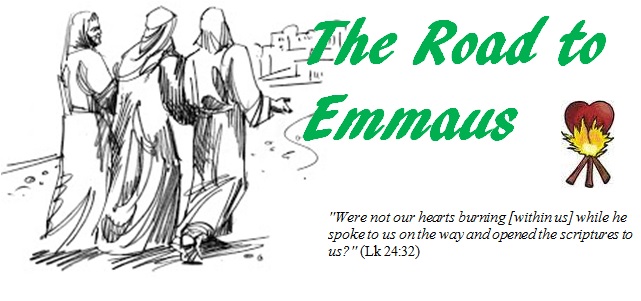
When he was at table with them, he took the bread. He blessed the bread, and broke it, and gave it to them. And their eyes were opened and they recognized him!(Luke 24:13-35)

Sunday, February 10, 2013

Beautiful beginning

“In the beginning, God . . .”(Genesis 1:1-19).  What a beautiful way to commence the Word of God!

The inspired writer of Genesis had no idea of the magnitude of human history that would follow that stage-setting opening. He didn’t know that there would be a New Testament. He did not know that the Creator of the universe he wrote about would enter the human race fully, being born of a woman (and no less than a virgin!) and then living, loving, dying and rising from the dead—forever changing life and death on the planet Earth.

There is no way the writer could not have envisioned the printing press and that thousands of years later, we would have a book called the Bible. Nor that we would be reading about those four words on a device called a computer or a “smart phone”.

Thinking along those lines leads me to the reminder that we don’t—and don’t have to—know everything. In fact, we know very little of where our actions, our words, our faith will lead. But we should exercise them anyway, doing our best to listen to God’s promptings, the Spirit’s whispers. There is a plan. We need to cooperate with it.

“In the beginning, God . . .”  Another reminder I received from reflecting on these words was that the fourth word is “God,” not “humans” or “humankind.” This is God’s story. It is God’s wisdom, God’s mind. Humans are a key element to the story, for sure, but we are not the primary actors. We are creatures. We are receivers of God’s love. But in the beginning, there was only God. And God moved and acted and created. Just as His Spirit has throughout the Bible, throughout history, and will forever more.

I find that very comforting. It leads me to want to know this God, to align with this God. Even more amazing, I find that this God is knowable and seeks friendship with his creatures. Could there be a more wonderful reality than that?

We learned as children that we are all created in the image of God. Do we really believe it on a day to day basis? Christ reminded His followers also that they were to be good, were to seek perfection.(Matt 5:48) Do we really take His advice seriously?

One of the ways God has sought our friendship is to send Mary, His daughter through her creation, His spouse by her fiat, and His mother through the Incarnation to help us find our way to His Son.

Today is the beautiful feast of Our Lady of Lourdes. We are familiar with the many healings that have occurred over the years at Lourdes. In many places the gospel describes the early healing ministry of Christ. People scurried around to bring their infirm loved ones to Him, mostly for physical healing. (Mark 6:53-56)  It must have been awesome to watch those healings take place!

Lent begins Wednesday. It might be a good time for us to reflect on the recommendations of Christ, that we should seek perfection. Couldn't we benefit from some healing? It is an ongoing process, one that requires ongoing vigilance. 

Pray for Us!


It’s been a long day!  I have managed to get together a list of the saints who I feel comfortable recommending to you as intercessors for what I see are the most pressing problems today.  I have already featured Sts.  Gianna Molla and Joseph.  Tonight, I simply don’t have the time or the passion required of me to write about any of the others.  But I think this is a good starting lineup for our “Legion of Heavenly Heroes”.  Every effective hero group needs a battle cry.  I like the tried and true battle cry when asking for heavenly intercession….”Pray for Us!”

Here’s my list:

Abortion   Gianna Molla
Euthanasia  Blessed Pope John Paul II
 Atheism St. Thomas the Apostle
Cancer St. Peregrine
AIDS St. Marianne Cope
The attack on sacramental marriage St. Joseph
The idolatry attached to technology Gabriel the Archangel (God’s Messenger), the patron saint of telecommunication.
 Wars St. Barbara and St. Michael the Archangel
The attack on the priesthood St. John Vianney
Lack of respect for the dignity of the human person St. Therese of Lisieux
Poverty Blessed Mother Teresa
 Injustice to immigrants Frances Xavier Cabrini
The assault on religious freedom and beliefs St. Thomas More
Addictions to drugs, alcohol, and pornography    St. Augustine

Friday, February 8, 2013

Time for a Year of Faith progress check!


Why do we pray?  At first our response may be “because it’s the right thing to do” or “because I was taught to pray growing up and have continued that habit.”  Looking deeper though, really—why DO we pray?  Something draws us in to prayer, something that may not make sense to us, something beyond us, something bigger than each one of us.  No, not someTHING, but SomeONE. That Someone is God the Father through His Son and Spirit.  In Mark’s Gospel (Mark 6:34) the people in the crowd similarly felt drawn to Jesus.  They may not have understood why, but they followed Jesus, they were drawn to Him.  The Gospel says, “They were like sheep without a shepherd.” Jesus is our Shepherd; He is the more that we are drawn to.  St. Augustine says, “You have made us for yourself and our hearts are restless until they rest in you, O Lord.”  Through Jesus Christ’s presence among each one of us, especially in the Eucharist, we are drawn to God where we find truth and happiness, just like the apostles and crowds were drawn to follow Jesus.

In this Year of Faith we are asked as Catholics to enter into deeper faith, a deeper relationship with God, deeper prayer.   We are almost five months into the Year of Faith; how is prayer going?  Have we responded to God’s call to enter into a deeper relationship of prayer with Him?  Have we followed in Mary’s example, saying ‘Yes!’ to the Lord?  I know I haven’t, not in all of the ways that I can.  The good news is that the Year of Faith is just that, a whole year long.  We aren’t quite halfway yet, there is still opportunity to respond fully, to say Yes to the Lord.  It’s a great opportunity today to reflect on our prayer life and what we have done for the Year of Faith so far.

Not sure what to do for the Year of Faith?  Saint Paul, in his letter to the Hebrews (Heb 13: 15-17) gives us a good place to start.  “Through Jesus, let us continually offer God a sacrifice of praise, that is, the fruit of lips that confess his name. Do not neglect to do good and to share what you have; God is pleased by sacrifices of that kind.” 

Everything we are, every gift we have is from God.  We should live our lives knowing that and offering our lives back to God in praise.  Today, enter into prayer not as merely saying words, but to enter into a personal relationship with Jesus Christ, to listen to Him and how He speaks to your heart through His Holy Spirit. Then take that prayer, that relationship to your daily life. 

With heroes like these, who needs the Avengers?


In yesterday’s blog, I said I thought it would be fun and maybe even necessary to ask a new set of Fourteen Holy Helpers to intercede for us so that we may grow closer to God through Jesus Christ and the Holy Spirit.  My first priority in choosing this particular group of intercessors was to identify some of the most pressing needs of our modern age.  The original Fourteen Holy Helpers were “assembled” to help in easing the burdens of the Black Plague in the 14th century.    I’ve been meditating on the plagues of the current world that we could certainly use the saints’ help with, and I think we’re going to need a lot of intercessory prayers.  So I’m not sure I want to limit the number of “Heavenly Heroes” to just 14, but we’ll see what we come up with.

In no particular order (except the first, which in my mind is the greatest plague on society today), these are the problems of the world as I see them:  Abortion, euthanasia, atheism, cancer, AIDS, the attack on sacramental marriage, the idolatry attached to technology, wars over religion or ideology, the attack on the priesthood, a lack of respect for one another, poverty, injustice to immigrants, the apparent assault on religious freedom and beliefs, and addictions to drugs, alcohol and pornography.  This is not by any means an exhaustive list, but I do think these are the battles most affecting us today.

So we’ll start with Saints who in my mind would be the “go-to” people in our battle against abortion:

Saint Joseph will be my #1 choice for a lot of the problems in today’s world; after all, he is the step-father of Jesus.  He could have chosen to quietly divorce Mary when he was told of her pregnancy, but instead he opted to love both Mary and her Child and raise Him as his own. He is a great saint to pray to in our fight against abortion.  This makes him a shoe-in for patron of the sacramental marriage, too. 
 
Tradition tells us that his was a happy natural death in the presence of Mary and Jesus after a full life.  So we can go to him to pray for an end to euthanasia, and the pains and sufferings of the diseases of the world. 
 
He can also be called upon to pray for the fair and equitable treatment of immigrants, since he and his family knew what it felt like to be immigrants exiled in Egypt just after the birth of Christ. 

There are a lot of saints we could go to for an end to the scourge of abortion, but one of the most logical choices is the fairly recently canonized St. Gianna Beretta Molla. 
 
You can read about her here. 

I thank God for giving us these two heroic saints who can bring our prayers to God in a much more eloquent way than we can and who we can try to model our own lives after.

Up tomorrow:  two more saints on our quest for a “Legion of Heavenly Heroes”….and a “battle cry” for our new friends in high places.

Thursday, February 7, 2013

We're All One Body (with lots of aches and pains)


Let brotherly love continue.
 
We’re all part of the body of Christ and therefore we’re one body in Him. Does it make sense for the hand to hate the foot, or the stomach to hate the brain? As part of one body, hatred and anger simply are not options to us. We are one body--as such we must operate as one body despite the fact that a recalcitrant knee gives pain to the whole. We don’t simply remove the knee; we seek to make it better.

When we deal with others, we should always keep in mind that they’re part of us. When we visit the prisons (either in person or in our thoughts), whether or not the person is justly or unjustly imprisoned, we should recall that we too are there. Wherever there is any part of the body of Christ, we are there. And so we should care for one another as we care for ourselves. When something goes wrong with one part of us physically, we visit the doctor. So too, when something goes wrong with part of the Body of Christ, we need to take ourselves to the Divine Doctor, who heals all ill and ask Him to touch and heal the body.

As we hear about illness in the Body of Christ, we should seek not to repudiate, but to take the body to the Lord in prayer. We ought to be thankful that we have been given the charge to care for one another. God has incorporated (literally--put into a body) all of us into a body that has Christ as its head. When we are tempted to anger or tempted to lash out, let’s recall that we "also are part of the body."

 
Thinking of this, I am reminded of a blog I read the other day talking about the Fourteen Holy Helpers.  This was a group of saints who, although they had their own feast days, they also shared a feast day of August 8th.  Their intercession was sought because they were the patron saints of the various maladies associated with the Black Plague in the 14th century.  They have since been—for want of a better word—“disbanded” and rarely, if ever, are invoked for help.

An interesting question was raised by the writer of the blog, “Ask Sister Mary Martha”.  She wanted to know who we would choose in today’s world to be the NEW 14 Holy Helpers.  For the next 2 weeks or so, I thought it would be fun and interesting to answer her question in my own blog. Then I'll respond to her request.  I hope I’m up to the task.  I already have several ideas.  If you have any ideas, put them in the comments and I’ll consider it.  I’ll start with what I think are the most critical issues of the day and the Saint who, in my opinion would be the best to ask for help and I’ll end—I hope—with a prayer to my “League of Extraordinary Saints”.  Keep reading!

Wednesday, February 6, 2013

"God Called the Priest"


One of the better Super Bowl commercials this past Sunday was the ad by Dodge titled "The Farmer".  Here is another take on it; I would argue a better one.  Click on the red.

Tuesday, February 5, 2013

Overcoming barriers to faith (Mark 6: 1-6)


"Have a nice day!" the server will say to me as I am walking out the door of the restaurant after lunch.  "Don't tell ME what to do!" I'll reply, "Don't you know who I am?" It always gets a laugh, but my meditation on Mark's gospel reading for Wednesday puts a different perspective on those two phrases.
Faith is the cornerstone of the effectiveness of the Lord in our lives. If we don't believe in Him, nothing miraculous can be accomplished through Him. Even among His own people, the Lord was unable to accomplish any mighty works.

How do we choose to limit the Lord? What assumptions have we made that, perhaps unknowingly, put limits to our faith? Maybe we assume the age of miracles has passed with the coming of the age of science. Perhaps we think that we're too unworthy to be invited into the power of the Lord. Maybe we assume that the world is too wicked, or people are too stubborn, or a particular person is too evil to withstand the miraculous intervention of the Lord.

Have you ever been disappointed when someone didn't believe in you?  Maybe Jesus was disappointed in the same way when the folks in His hometown didn't think He could work any "mighty deeds." After all, they remembered Him from His growing-up years and knew Him only as Mary's boy, a local carpenter. "He was amazed at their lack of faith," the gospel says. Don't you think Jesus was disappointed too?

It may be in our very nature to resist receiving advice or criticism from anyone.  It seems to be particularly difficult when we receive it from someone who is close to us. For instance, watch a child when a parent is instructing them and showing them what they had done wrong. In many instances the child will talk back or argue. For adults, when receiving criticism or advice from a boss or someone we are not particularly close to, while difficult, it’s generally accepted. However, when we receive advice from a loved one, such as a spouse or brother or sister, it is particularly hard to take.

Let’s go back to the example of Jesus in His hometown. He brought them the good news, the gospel. But for many of the listeners, it was probably something they did not want to hear. Jesus brought the truth and the truth in many respects was contrary to the way they lived their lives. He was asking them to change and change radically.  This was hard for the people He lived with His entire life. The result was they rejected Him, much as we sometimes do when we hear the truth from a loved one.

I’ll bet everyone can remember those times when those close to us brought us the truth which was hard to hear. Did we accept what they said and use it to improve ourselves, or did we reject them outright? When we hear the good news of our Lord, do we accept it as it is, as the truth for our good, or do we reject it also?

We need to weed out the barriers to faith, to cast them aside. We need to find out what we think, that stands in the way of what the Lord thinks. And there is only one way to do this--prayer, constant prayer. Through prayer we begin to understand God and we begin to understand the limits of our own knowledge. When we pray for release from our own prejudices, the Lord will oblige in His time.
 

Monday, February 4, 2013

It's OK to be vulnerable with Jesus


Christ offers us life.  Christ offers us meaning and purpose to all we do.  He calls us each to holiness just as He called millions before us.  When we accept His invitation, we find true joy in simply living.  The modern world has lost sight of what it means to live.  We are told that there is a certain way to live, that we need to be secure in ourselves, our possessions, and our livelihood.  The world teaches us to look out for ourselves.  But none of that satisfies.  We have become so focused on this earthly way of living that we have forgotten what it means to be intimate with one another.  Words like love, friendship, marriage, and relationship have such a shallow connotation today because we have lost sight of intimacy.  Many Catholics (and other Christians) would not describe their relationship with the Lord as being intimate, yet if it is not intimate, then all is lost.  If we cannot be intimate with Christ and share our deepest thoughts and desires with Him, then who can we be intimate with?
 
St. Paul, in his letter to the Hebrews (Hebrews 12:1-43), calls us to keep "our eyes fixed on Jesus, the leader and perfecter of faith." It makes sense, then, to go directly to Jesus in matters of faith. Since faith is a gift from God, we can simply ask Jesus for more faith. If we truly want it, He will not refuse us. This is what the hemorrhaging woman in the Gospel teaches us. (Mark 5:21-43)  It’s okay to be vulnerable with Jesus, to let Him see us in our weaknesses.  Only then can He make us whole.  Only then will we discover the true joy in living every day.

Sunday, February 3, 2013

It's all about recognizing the candlesticks in our lives


The Sacrament of Reconciliation loomed large in my mind today.  Not just because I went to confession, but because it was backed up by seeing Les Miserables with Alicia tonight.  I asked Marilyn if she wanted to go, but she said she doesn’t want to see such a sad movie.  She has seen the play, so she knows what she’s talking about.  I happen to agree with her that it is sad, but the sadness of the story only makes the triumph of the hero over sin that much more joyful.
Alicia has wanted to see the movie for months, but every time she made plans, they fell through for one reason or another.  When I found out I would have the weekend off, I decided to ask Alicia if she would like to see it with me; sort of a father/daughter night out.  The only stipulation would be that Lily would have to already be in bed so her feelings would not be hurt by being left home.  Alicia had to work all day today anyway, so our choice as to the showing was limited.  In fact, there was only one showing we could go to—at 10:10 PM!  The sacrifices we make for our children!  Sigh. Lol

Anyway, the good news about a movie at the theater at that time of night is that the parking was free and close, the lines at the concession stand were non-existent, and the distraction of children and their antics were nil.  I think there were only 3 to 5 other people in the theater with us for the movie, too, which was kind of cool.  It felt like we were given a private screening. As Alicia and I walked out the door at the end of the movie, the lights were turned off.  We were the last ones there!  That’s never happened to me before.  Again, that was pretty cool.

I will admit I knew nothing of the story of Jean Val Jean other that what I read or heard about in reviews of the movie.  It is a pretty moving message of recognizing Christ in everyone we meet—whether friend or enemy—and realizing the value of God’s graces of mercy and forgiveness.  Oh, and by the way—Russell Crowe’s performance is not as bad as the reviews say it is.  I wish I could hit all the notes!

I didn’t cry during the movie (although I’ll admit I thought I would), but I did after I got home and started to write this account.  I am reminded of my confession earlier today (yesterday—it’s 2 AM right now).  I confessed to what I consider some pretty serious sins and I was taken aback a little by the penance I was given.  I was told to say one “Our Father”.  I thought to myself “That’s it?  Wasn’t Father listening?”  Then I was relieved that it was only saying a prayer and not something like I’ve had in the past like pulling out the prayer of St. Francis when I get angry at others .  (That was actually one of the hardest penances I’ve ever received—Do you realize how hard it is to remember to pull up a prayer on the smart phone or out of a wallet when you’re focused on anger?  Let’s just say I had to confess to not completing my previous penance once. 

Reflecting on my penance today—coupled with the movie—drove home the fact that we can all share in the same mercy and forgiveness earned for us by Christ on the Cross.  We just have to ask for it and act on it.

I’m sorry if it seems I prattled on here.  It’s pretty hard to concentrate on writing something coherent at this time of the morning.  I just wanted to write about it while it was still fresh in my mind.  Good night and God Bless you.

Thursday, January 31, 2013

Keep the faith, baby!


St. Paul gives some very good advice to the Hebrews (Hebrews 10:32-39) and subsequently to us, exhorting all to persevere and not lose hope. That sounds pretty laudable, but what exactly are we to persevere in and not to lose hope of?

It is nothing less than to love God above all things and to love our neighbor as ourselves with the certain hope that such behavior will merit us everlasting life.

Loving God above all things seems doable, yet how often do we witness our own slippage and how does it take us away from serving the Almighty and giving Him the praise and thanksgiving that are His due?

If that wasn't enough, we also have the exhortation about loving our neighbor, which we all know is frequently difficult. It simply isn't enough that we merely avoid overtly offending our neighbor, but also, that we don't withhold anything that might assist him on his way to the Kingdom of heaven.

It can be easy to ignore the suffering of those who are in the various prisons where they might find themselves – prisons that are not just physical detention centers, but the prisons of disease, financial challenges, mental anguish, addictions, abusive relationships, workplace stress, persistent unemployment, violence and repression.  And we can be easily seduced to conclude that the bounty of material items, freedom from want, privilege, insulation from conflict and confrontation, and safety from personal harm is a birthright instead of a wonderful gift. 

Those of us who live in western society can easily forget that we generally live at the top of the historical pyramid of human privilege, and the benefits we enjoy are because of our good fortune in being born into this world in this place at this particular point in human history.  Even people in our societies who struggle for the daily means of existence are still in some ways (due to our governmental and private “safety nets”) better off than the poor and downtrodden of 2,000 years ago.

And so when the Hebrews author encourages us to “keep the faith” by not forgetting the ways in which we shared in the sufferings of those in prison, it really reminds us to keep demonstrating our faith by continuing to share in those confinements, however they are created for our sisters and brothers.  And when we are told we have joyfully accepted the confiscation of our property, I think it really means to be mindful of the need to detach our true selves from the wondrous bounty that surrounds us, and to realize that the true gift we have received is not physical things that will fade away, but the salvation we receive from trusting in the Lord.  We keep our faith by keeping our focus, by committing our way to that of the Lord.

Taken all together, it is a big bill to fill and no wonder we need God's grace to accomplish it. Yet, praise be to God, His grace is not lacking for those who seek it and utilize it as the freely given gift that it is.

Persevere then; don't lose hope. It was good advice then and it certainly is now.
 

Monday, January 28, 2013

Letting go


"Here I am, Lord. I come to do Your will." (Psalm 40: 8-9)

 It’s a powerful prayer.  When we pray this, we're saying to God, "I'm listening for Your command. I'm here to do whatever it is that You want. I come to do your will. Not my will. Not necessarily somebody else's will, but Your will, God. Whatever it is that You want, You've got it!"

Sometimes the greatest difficulty for us is in the discernment between what we want God’s will to be for us versus what it really is.  We still have a very human nature that seeks what is easy or comfortable and wants admiration, power and self-sufficiency.  We can fool ourselves about God’s will if we fail to develop self-awareness and trust in God’s love for us. This can lead to confusion about what is real and what is self-deception.
 
I have to be honest. I find it really hard to give God a "blank check" like this.

Why? Because I’m afraid of what He may ask of me.  I’m afraid of the unknown, the pain that may be involved.  I’m afraid of giving up control and possibly being embarrassed.  Maybe what He asks will cost me too much.

What if he asks me to go to a far-off land to help the desperately poor?  Am I willing to go?  It’s possible, but He's more likely to ask me to just go across the room to kiss Marilyn when she’s having a bad day, or listen to one of my kids’ problems without making judgments, or even phone my mother who may be feeling lonely.

I’m working on trying to discern what God is asking of me every day and learning to trust Him to help me do it. I know He won't ask more than I can do, with His help. I just need to give God a chance. I know I can trust Him.

What’s my plan to overcome my fear of following Christ completely without question?  I ask Him to help me. I tell Him about all my fears. Once I go to Him and list all the reasons that I’m so scared to death, at least they're out in the open. Then He can take all those fears into His hands . . . and they will no longer be in mine.

Sunday, January 27, 2013

Decisions, decisions


Sometimes it’s hard to decide what to write about in this blog.  I was reading through it from the beginning today and I see an evolution of my style and substance.  At first, I was writing it primarily for fun.  I thought someone out there in “internet-land” might be interested in the thoughts of an ordinary Catholic man as he tries to increase his faith and grow closer to God.

One day I inadvertently left the site up on a computer at work after showing it to one of the guys I work closely with.  Another of my co-workers saw it after I left and called me to say he enjoyed reading it, but more importantly that he would like to ask me some questions about my Catholic faith.  He was searching for God and my writing was—in his words—“simple enough for me to be interested in what your faith has to offer.”  We did speak several times and had many discussions about the Bible and Catholicism in general and even attended a Mass together once!  That’s what led me to believe this could be a great tool to use in evangelization and again, bolster my own faith in the process.

I've had about 5 more people I work with over the last 4 or so years since I began writing this blog ask me about one article or another.  I have decided I will keep writing and planting seeds as long as the Holy Spirit wants me to.

In my own opinion, I think my writing has run the gamut from mundane to profound.  Some days I feel profound, and some days my thoughts are so boring I’d rather not talk about them.  Then there are the days when I WANT to write something, but there are so many thoughts running loose in my head it’s hard to decide which would be the most interesting for my readers.  Today is one of those days.

This artice, and this one are the two most-read posts that I’ve written, according to statistics kept for me by “Blogger”.  I must admit they are a couple of my favorites as well, but they are two pretty diverse entries.  So that didn’t give me a clue as to what to write about today. 

The Saint of the Day is always a popular topic.  Today’s saint is Saint Angela de Merici, but I already wrote about her in this entry.

The Gospel today was the beginning of St. Luke’s Gospel.  I had quite a meditation on what I would feel or say or do if I were one of the Jews in the temple when Jesus sits down after reading Isaiah and says “Today, in your hearing, this Scripture is fulfilled.”  But there were so many different ideas in my meditation that the entry would be a) long and b) confusing.

Then, I was going to write how grateful I am to God through Jesus that Lily and I are finally feeling better after this last bout with the flu that’s going around.  Wait, I just did that!
 

So instead, while driving to Fresno tonight to begin another week of work at least 150 miles away from my family, I was staring at a full moon.  You have probably seen the kind I’m writing about—larger than normal, low on the horizon, brighter than anything else around.  And the only thoughts that went through my mind almost the entire drive were “I know God created that beautiful moon.  He saw that it was good.  And Jesus (Who is God) looked up in the night sky and saw the SAME moon.  What were HIS thoughts as he gazed upon it? Did He look upon it with His divine nature and have a sense of pride in His creation?  Or did He look at it with His human nature and feel the same feelings I had tonight?”  I took the thoughts even further.  When He looked at it, did He chuckle at the thought that a thousand years later and more, people would be fascinated by how the moon, the stars and the sun interacted with one another or did he lament that they wouldn’t realize it doesn’t matter?  By the way, that’s the reason the Catholic Church is not against science.  While science can help us in regards to medicine and technology, it will NEVER get us to Heaven.  Only faith in God through Jesus Christ by the grace of the Holy Spirit can do that.  And that is one thing science can never prove nor disprove.

So there’s my entry for today.  Quite a hodge-podge, but I’m happy with it.  I hope you are, too.

Thursday, January 24, 2013

Listening for His voice, Hoping for conversion


I was finally able to get to Adoration of the Blessed Sacrament today!  If I can’t receive Christ physically in the Eucharist, being able to just sit (or kneel) in His presence and listen to Him speak to me spiritually is a very extraordinary alternative.  If I were to say I heard Jesus’ voice in a real sense, even I would question my sanity.  No, I’m no Joan of Arc.  I’m just an everyday sinner looking for forgiveness and consolation from the only One who can give them to me.  Rather, I believe I hear the voice of Jesus through the workings of the Holy Spirit as I read the Scriptures or meditate on the Mysteries of the Rosary or—as happened today—meditating on just being in His very Presence!   

Adoration for me is a good reminder of the Conversion of St. Paul. Once a murderous persecutor of Christ’s followers, he encountered Jesus in a supernatural way and was forever changed.

Perhaps one could argue that because St. Paul had a supernatural experience of God, it was easier for him than it is for us to mend our ways. Though to some extent that might be true, it is still worthy for us to meditate on how we encounter God and the opportunities the encounter gives us to significantly change ourselves and others.

In truth, aren’t all encounters with God extraordinary? How about the rising and the setting of the sun, the myriads of singing songbirds, the variety and coloration of blooming flowers, and the uniqueness of each falling snowflake? Aren’t these extraordinary experiences and manifestations of God?

If so, what then of the Holy Sacraments? Have they, like so many other things, been relegated to the realm of the ordinary so that becoming an heir of the Kingdom, having forgiveness of our sins, and receiving the Body and Blood of Christ, are no big deal?  Are Holy Orders and Matrimony so disrespected that they are no longer the bedrocks of society but its laughingstocks? 

If that seems to be the case, let’s pray for the grace of conversion, to get knocked off of OUR high horse, to be blinded by the LIGHT and then healed not only for our own salvation, but as it was for St. Paul, for the conversion and salvation of the world.

Thursday, January 10, 2013

Unity with the Trinity through prayer


During Christmas we celebrated God’s becoming human in Jesus, an event at once so familiar that perhaps we take it for granted, but at the same time so incredible that we can’t really absorb its meaning. So the Church gives us, in the liturgy of the days and weeks following Christmas, lessons on who Jesus really was. That’s what the Epiphany formally does. But it doesn’t stop with the Magi. We have the baptism by John, the wedding feast at Cana, the walking on the water, and the many healing stories such as the one in Luke’s gospel when Jesus heals the leper (Luke 5:12-16).
With our individualist mindset we tend to think of illness (and healing) as something that affects primarily the individual (though often the family as well). But the many stories of lepers and those suffering from convulsive disorders, for example, illustrate another feature of illness. The afflicted were literally marginalized. People couldn’t have contact with them. Even to touch them made a person ritually impure. They were relegated to the outskirts of towns and villages, even to living in cemeteries. To some extent, we still do something similar in our times. Think of how we have marginalized AIDS victims. In the not very distant past we sent people with tuberculosis to sanitaria. I don’t question the motives behind such practices. Rather I think about the marginalizing that is a feature of illness – one we too easily overlook today. It is not just the person who is sick; it is the community that is, in a sense “broken” by the illness of one of its members. Ill people make us uncomfortable. 
We don’t much like being with them, except perhaps for a perfunctory “visit the sick” (as in the corporal works of mercy). The healing of the afflicted individual restores the community to its wholeness. Jesus was healing both.

By His actions in this story, as well as by His words throughout the gospels, Jesus is saying that there is no marginalizing in God’s view of how humanity ought to order its affairs. Luke makes a point of saying Jesus touched the leper, a man “full of leprosy”. That very touch brings the sufferer back into the community from which he had been excluded. Notice, in other healing stories, that Jesus looks the sufferer in the eye, speaks to him/her by name, and touches – almost always touches.

That’s the God who is revealed to us in these Epiphany feasts.

After people heard about how Jesus miraculously cured the leper, He was besieged with crowds following Him, to listen and be cured. But, we are told that He withdrew to deserted places to pray.

Why?

Certainly it couldn't have been that He didn't want to have people listen to Him or that He didn't want to cure people, and certainly it would seem He was always in the presence of the Father and the Spirit. Why then did He withdraw to pray?

It seems that there is more to it than just giving us an example of the need to pray - important and helpful though His example was.
Could it have been that while on earth, Jesus really felt exiled, and not just wanted, but needed, the unity of the Father and the Holy Spirit, which could only be achieved through the practice of prayer?

So, He gives us an example of what is absolutely necessary! Unity! Not only is the Trinity meant to be undivided -- we, too, as the Body of Christ are meant to be undivided in unity with the Trinity.
 
I think this is why during every single Marian apparition approved by the Church, our Blessed Mother asked us to pray the rosary.  We begin with the prayer that is the Apostle’s Creed, which professes our faith in the Trinity in a nutshell. Then as we meditate on Jesus’ life through the Mysteries of our faith, we begin each Mystery with an Our Father and end each Mystery with the Glory Be.  Can’t be much more in unity with the Trinity than that, this side of Heaven!

Therefore, we must go forth like Jesus and with Jesus to that deserted place within, to pray and so be with the Father and the Spirit. It is not something that's just nice to do, but something essential to do, as Jesus taught and as His mother reminds us.