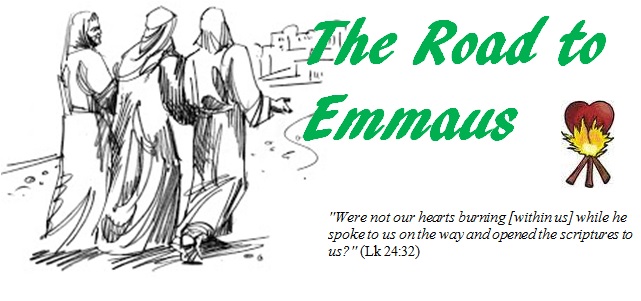
When he was at table with them, he took the bread. He blessed the bread, and broke it, and gave it to them. And their eyes were opened and they recognized him!(Luke 24:13-35)

Monday, September 20, 2021

Homework


As one of my grade-school teachers explained to me a long time ago, homework is important because it’s supposed to get us to dig deeper into a particular subject and gain some confidence in our knowledge and understanding.  The image of homework came to me in my reflection on the scripture readings for the Feast of St. Matthew.  Jesus, the Great Teacher, was assigning the Pharisees some homework when He said to them, “Go and learn the meaning of these words, ‘I desire mercy, not sacrifice’” (Matthew 9:9-13).

This assignment for the Pharisees is our assignment today, as well.  How do we react to this message?  Personally, I feel more comfortable thinking about sacrifice.  Sacrifice is concrete doing; doing something that we know to do.  Mercy seems fuzzy.

Jesus knew that the Pharisees knew the origin of the words.  The words come from Hosea 6:6; God told the people in Hosea that they were getting it all wrong by focusing on animal sacrifice and ritual instead of taking care of people.  Hosea went on to remind the people of how many times they had gone off track.

We can see in our own lives the ways we often go off track and how much we need mercy.  Thankfully we have a God of mercy.  We need mercy from one another too.  Praise God for all those who show us mercy.  When we show mercy to others in healthy ways we feel healing too.  Consider how Jesus stresses this message in His teachings.  The parable of the debtor and the king (Matthew 18:21-35) and the way He taught the disciples to pray (Luke 11:1-13) are just two examples of teachings that stress a message of forgiveness and mercy.

St. Paul’s Letter to the Ephesians provides a picture of what living our calling as Christians means.  He explains how important mercy is to live in this way: bearing with one another, having gentleness and patience, and striving for unity (Ephesians 4:1-13).   

As we honor Saint Matthew today it’s fitting that we see how mercy plays out in his calling.  The details are sparse, but Jesus appears to invite him with little notice and Matthew appears to accept the invitation and the mercy joyfully.  So joyfully, in fact, that he wants to share this calling and this Jesus with his friends.  He doesn’t insist that his friends “clean up their act” first, just as Jesus didn’t appear to require that of Matthew before his calling.  Yet, Matthew does walk away from the position that allowed him to take advantage of others and the gospel of Matthew emphasizes teachings of Jesus that set very high standards for caring for others and serving those who are disadvantaged.

There are times that I can be like the Pharisees.  I’m easily pulled into being skeptical of mercy.  I can miss the awesome and ironic power of mercy to help people (including me) live up to a higher standard. This is particularly the case when the standard that matters most is authentic love.   Receiving mercy helps us get back up again and helps us to do what is required to love others well, not out of a sense of righteousness and powerfulness, but with humility and compassion.  Isn’t love with humility and compassion what we so often see in Jesus?  Isn’t that what St. Paul, in his letter emphasizes in terms of living up to our calling?

May Jesus open our eyes today to the mercy He desires and the mercy He so graciously shows us through His Word, His Eucharist, and those around us.

Sunday, September 19, 2021

Authentic Christianity


It may just be my own personal perception, but in today’s world it seems harder and harder to be a vocal Christian.  To be quite honest, I’m fearful sometimes that voicing my beliefs will offend others and get me into some kind of trouble.  I find myself purposefully avoiding commenting on Facebook, engaging in heated debates with ‘friends’ or inserting my opinion on delicate topics, all because I fear the retribution and attack of others.  This has stifled my eagerness to share the Gospel message, which is obviously not what I want, given that I write a daily blog post of my reflections on Scripture.

The Gospel according to Luke reiterates Jesus’ message to us that we need to put our lamp on a lampstand and be seen, not concealed (Luke 8:16-18).  If I’m an authentic, genuine Christian, my devotion to God will show through my love for others and my heart to serve.  I won’t have to say anything at all!  Not that I should keep quiet, either; I think we have to delicately balance when to be quiet and when to speak, and then ask God to guide our speech when appropriate.  But this is a good reminder to me that as Christians, it’s our love that separates us from others.  I don’t have to engage in aggressive discussions or disagreements with others to get my point across.  All I have to do is love.

Saturday, September 18, 2021

What's our measure?


Do you ever feel like you’re being battered by all the people, issues, or ideas that are demanding your attention?  Whether it’s family activities, work obligations, social expectations, religious and personal values, economic and political pressures, there can be no doubt that all of us are under great pressure to give our attention and commitment to a wide variety of people and issues.  It takes a great deal of stamina and wisdom to evaluate and balance all the demands that are placed upon us.

So, what’s our measure?  How do we decide, among all the clamoring demands, which is worthy of our attention, which will bring life?

James tells us that, "the wisdom from above is first of all pure, then peaceable, gentle, compliant, full of mercy and good fruits, without inconstancy or insincerity.  And the fruit of righteousness is sown in peace for those who cultivate peace." (James 3:16-4:3)

In the book of Wisdom, we’re told that the "wicked" cynically seek to destroy the "just one" (Wisdom 2:12-20).  And in Mark’s gospel, Jesus chides His disciples about their poor choice in pursuing the "first place," reminding them that giving themselves for the sake of others is the best choice (Mark 9:30-37).

Sometimes the beliefs we cherish and the things we pursue fill us with anger and judgment about others.  We become cynical and untrusting of others.  We become hardened to the concerns of others and unwilling to acknowledge their sincerity.  If we find ourselves locked into these feelings, it’s time to reassess our attitudes and commitments.  James reminds us that the wisdom that comes from the Holy Spirit nourishes peace and gentleness within us, mercy toward others, and self-gift so others can thrive.  May the wisdom of that comes from the Holy Spirit guide us all.

Friday, September 17, 2021

Radical changes


It’s good for us to often take a rest from our busy schedules and to reflect on our life, to take stock of what we did during the past weeks, months and years, to assess the directions we’ve been going, and to compare our past, the current directions, and our anticipated future with the values of the Gospel and with our calling as Christians.  

Saint Paul presents powerful images of change his first letter to the Corinthians (1 Corinthians 15:35-49).  First he reminds us that life, as it is, is not the ultimate destination and our goal shouldn’t be to primarily focus on the world and what is important for us today.  He compares our life to a kernel of wheat, which was created to change, which has the potential to grow into something magnificent, that we can’t even imagine, bearing plentiful fruit.  So we shouldn’t hold on to what we treasure and enjoy today but to let go, or, to say it in Paul’s words, to “die”.  This enables us to reach our full potential as individuals, families and church.  Only then will the “corruptible” become “incorruptible,” the “dishonorable” become “glorious,” the “weak” become “strong,” and the “natural” become “spiritual.”

Because these words are abstract, it’s necessary to contemplate what this means for us in concrete terms.  For example, we may be quite content with our work and relationships and other aspects of our life.  St. Paul challenges us to evaluate these aspects and to come up with more appropriate and new ways for our lives that are bringing us a step closer to what we and our life ought to be.  Or maybe our faith communities may be pleased with their liturgies and service ministries.  These may have become dear traditions to us but may be quite imperfect and not addressing important aspects of Christian life and service.  By reflecting over our worship and involvement with the wider community we may identify imperfections and gaps and be able to address these, thus, getting a step closer to reaching our potential.

And such reflection and the resulting steps should be inspired by the Gospel.  Christ uses the parable of the Sower (Luke 8:4-15).  The seed is the Word of God, and we are the more or less receptive ground, the ones who more or less receive and live the Word of God.  Our faith may be weak, without roots, may be choked by anxiety and the pleasures of life.  The Word of God isn’t able to inspire and transform us. Or we may be like the ones “who, when they have heard the word, embrace it with a generous and good heart, and bear fruit through perseverance."  The Word of God encourages reflection and motivates action, bringing us closer to reaching our potential as individuals and as church.

We should never be satisfied with our current faith and life as it is.  Likewise, we should never be content with our church as she is today.  We should be inspired by the Word of God and be open for radical change, willing to “die,” and to come up with concrete steps that bring us closer to reaching our Christian potential as individuals, families, and church.

Thursday, September 16, 2021

Content with a sufficiency


Even though he only had an eighth-grade education, my father was probably the smartest man I’ve ever known.  What he lacked in formal education he more than made up for in common sense and practical advice.  One of the most important lessons I learned from my dad was that “happiness isn’t found so much in what you have as in what you give”.   As I read St. Paul’s first letter to Timothy today, it sounded so much like the advice my dad gave me (1 Timothy 6:2-12).

Through his advice to Timothy, Paul tells us to be “content with a sufficiency” and reminded that if “we have food and clothing we have all that we need.”  Of course, we don’t swallow such advice easily, especially in a culture of consumerism that religiously trains us never to be content but to always want more and more; in a culture of consumerism, to be “content with a sufficiency” seems downright heretical.

It’s so easy to lose our way, to spend hefty portions of our lives sidetracked.  This happens when we let lesser goods (such as wealth and possessions) become more important than greater goods (such as God and other people).  But when we give lesser goods more attention than they deserve we lose all sense of what truly matters, all sense of what is genuinely valuable and good.  Even worse, while we may think money and material things will help us get ahead in life, if we set our hearts on loving them rather than God and our neighbors, we’ll slowly but surely destroy ourselves.  As Saint Paul emphatically reminds us: “Those who want to be rich are falling into temptation, and a trap. They are letting themselves be captured by foolish and harmful desires” which lead not to life and security, but “to ruin and destruction.”

Less is often better than more.  We’re called to embrace the simplicity of life not only because when we do we’re able to apprise the true value of everything, and not only because when some of us live with less the poor and destitute are able to live at all; but also because if we’re willing to be “content with a sufficiency,” we’ll finally discover where true life can be found.  As we’re reminded in the Gospel, it comes in following Jesus, joyfully “proclaiming the good news of the kingdom of God” as we do (Luke 8:1-3).

Wednesday, September 15, 2021

More than we can repay


It’s such a human tendency to rank and compare.  To increase their student bodies, colleges and universities hope for high rankings and publicize their top ratings compared to other schools.  We celebrate high rankings of our sports teams.  Successful businesses use rankings and comparisons and urge competitiveness in motivating their employees for better results.   

The scriptures I reflect on today insert a Jesus-focused perspective on rankings.  St. Paul’s letter to Timothy reminds us not to take a ranking by someone else to heart to our detriment.  Stay vigilant, set a good example, keep teaching and learning.  The letter to Timothy also includes an essential discipline for staying focused and vigilant in trying times – remembering the gifts we’ve been given by our faith community and our loving God.  St. Paul also reminds us that using these gifts and persisting despite how others may rate us, not only saves us, but also saves others around us (1 Timothy 4:12-16).  We inspire one another.  The scriptures repeatedly remind us to encourage one another.  We need encouragement and inspiration from one another.  We need to remind each other of our gifts and of the teaching to love one another and love and serve God above all else.

Then, in Luke’s gospel, Jesus reminds Simon (a “certain Pharisee”, not the Apostle) through a parable that all of us are indebted to God more than we could repay on our own (Luke 7:36-50).  All of us, regardless of how esteemed or how reviled we are by others, have access to mercy.  We all fail—and we all need mercy.  We so easily fall into a pattern of recognizing and commenting on failures – failures of others and our own failures.   I too easily fall into a pattern of continually reciting to myself and to others undone task after undone task.  I rate myself and rate others on completing tasks and bemoan the failures evident in so many undone tasks.  I can get so wrapped up in this focus on these failures that the more important priority of caring for others gets ignored, much like Simon who appears to have ignored basic hospitality care for Jesus.  Worry and focus on failures narrows our vision and our ability to use our gifts to their full effect.

 Jesus calls us to mercy and gratitude that expresses itself in care, teaching, and encouragement.  We’ve all been forgiven more than we can ever repay.  Why then, can’t we be extravagant in our gratitude for mercy, love, and gifts that we’ve experienced?  Why can’t we pour out that gratitude in love and encouragement to one another?

Tuesday, September 14, 2021

A perfect mother's perfect love


Our Blessed Mother, the Mother of the Son of God, loved her Son with a perfect love.  Her love for her Son was a love that was beyond what we could ever imagine.  She conceived Him miraculously, bore Him in her womb, gave birth to Him, nursed Him, raised Him and loved Him throughout His life.  It’s difficult to even imagine the depth and beauty of the love she had for Jesus.  Generally speaking, a mother’s love is powerful, unwavering, deep and filled with tenderness.  Try to imagine the Immaculate Heart of Mother Mary and the amazing depth of love alive in her heart.  I am reminded of a simple, but powerful scene in John’s Gospel: Standing by the cross of Jesus were his mother and his mother’s sister, Mary the wife of Clopas, and Mary Magdalene (John 19:25).

This loving mother stood at the foot of the Cross, gazing upon her crucified Son, continuing to exude every motherly virtue.  And because it’s hard to fathom the depth of her love for her Son, it’s also very hard to imagine the depth of sorrow and interior suffering she endured as she watched the cruelty toward Jesus unfold.  All she could do in that moment was stand by Him and with Him in this moment of extreme agony.  Her love was expressed, in that moment, by her fidelity to Him.

What’s beautiful to know is that love, sorrow, compassion and suffering were united as one within her Immaculate Heart.  Within the beauty of her heart was every human emotion, fueled by God’s grace, enabling her to give to her Son the greatest gift she had: her motherhood.  She was a true mother throughout her life, and, in this moment, as her Son hung on the Cross, her motherhood culminated in a perfect human expression.

We all long to be loved by another. To give and receive love is the greatest gift that we can give and receive.  Love is what we were made for and is the source of our fulfillment in life.  We can be certain that as Mother Mary stood at the foot of the Cross, her human heart experienced the greatest fulfillment ever known.  Her heart was fulfilled because she exercised her motherly love to perfection.

I think the best way to understand her heart of love is through prayerful meditation, asking our Blessed Mother to reveal her heart to us today.  In my opinion, one of the most powerful images of perfect motherly love is the Pieta, a sculpture carved from a single piece of granite by Michelangelo.  I took some time today and sat in silent adoration of this holy image of perfect motherly love.  I came to a couple of conclusions in my reflection.  First, Mother Mary has this same depth of love for each of us, no doubt about it. Her heart burns with compassion as she gazes upon us, even in our sin.  Second, I know that our Blessed Mother’s love must also fill our hearts and overflow into the lives of others.  We all must allow her compassion, concern, fidelity and mercy to flow through our hearts.  We need to ask ourselves, “Who do I need to love with the heart of our Blessed Mother?”  Seek to receive the love in the heart of the Mother of God and seek to give that love.  Receive it in and then allow it to flow forth.  There is truly nothing in this world more beautiful and awe inspiring than the holy image of this love.

Monday, September 13, 2021

Worn out? Look to the Cross!


As I read Scripture today, I came across a familiar story of human frailty.  “With their patience worn out by the journey, the people complained….” (Numbers 21: 4-9).  Often we set out on our daily adventures filled with expectations and hope, only to find barriers have been erected to spoil our plans.  Life is hard sometimes.  Humans are pretty good at adapting and working around these problems that inevitably come our way.  But sometimes we lose our nobility and blow a gasket.  That can happen more easily when we’re tired and hungry.  Our bodies can let us down, and many times perhaps all we need is a little nap and some food and drink to bring us back to our senses.  And if we can just have a friend to encourage us along the way, it’s much easier to be patient and bear up under adversity on the journey.   In this way, we’re really not that different from our young children.

Covid-19 seems to be lingering for what feels like forever.  Hurricanes, earthquakes, floods in most of the country and fires in the West has left a lot of us feeling a little “worn out” from the experience.  It should make us realize that we’re not masters of our destiny.  We do indeed depend on God for our very existence.  Over time, our patience can wear thin, and we wonder if He’s listening to our prayers.  Our elders reassure us, as they know these things happen and they don’t last forever.  But it still wears us out to wait, and we still seek assurance that God knows our needs.

When human undertakings are involved, we may add to our inquiries: “Who’s in charge here?” and “What in the world is going on?”!   That also seemed to be the case with the Israelites.  They began to doubt Moses’ leadership.  Instead of encouraging one another toward hope, they seemed to be encouraging despair and dissension.  They grumbled instead of pursuing something more constructive.  And of course, this wasn’t the first time.  They had been through this behavioral pattern before.  Slow learners, those Israelites.  Unfortunately, that pretty much describes me, too.

We can see the experience as an object lesson, in which the chastening of the Israelites was followed by salvation.  By following God’s command to raise up an instrument which symbolized something they feared (the saraphs), they were restored.   Many years later, that restoration would come in a more lasting and significant way through the wood of the cross.  Jesus, in John’s Gospel, connects up that story for us (John 3:13-17).  The cross of suffering, death, and shame becomes something we must behold if we’re to be restored.

May God help us to get the rest and food we need, and to have friends to encourage us along the way so that we may persevere instead of grumbling.   And may He also open our eyes to see and rejoice in the salvation He has brought for us.  

Sunday, September 12, 2021

In all humility


“Lord, do not trouble yourself, for I am not worthy to have you enter under my roof.  Therefore, I did not consider myself worthy to come to you; but say the word and let my servant be healed.” (Luke 7:1-10)

As I reflect on this gospel today, what I find interesting is that these humble words, spoken by a Roman centurion, weren’t actually spoken by the centurion to Jesus.  This is because the centurion didn’t believe he was even worthy of going to Jesus himself.  Therefore, he sent some of his friends to speak these words to Jesus on his behalf.  In a real way, the friends of this centurion acted as intercessors before Jesus.  Jesus’ response was to express amazement at the centurion’s faith.  Jesus said to the crowd who was with Him, “I tell you, not even in Israel have I found such faith.”  And at that point, the servant was healed by Jesus from a distance.

Most of the time, if we have an important request to make of another, we do so in person.  We go to the person and speak face-to-face.  And though we certainly can go to our Lord in prayer, face-to-face, person to Person, there’s something very humble about bringing our needs to our Lord through the intercession of another.  Specifically, there’s something very humble about asking for the intercession of the saints. 

Seeking the intercession of the saints before our Lord isn’t done because we’re afraid of our Lord or because He would be offended by us going directly to Him.  It’s ideally done as an act of the utmost humility.  By entrusting our prayer to those who are in Heaven, gazing upon the face of God, we do entrust our prayer to God.  But relying upon the intercession of the saints is also a way of acknowledging that we are not worthy, by our own merits, to stand before the Lord and bring Him our request.  This humility can be difficult to understand at times, but it’s important to try.

What is it that you need to pray for in your life right now?  As you call that to mind, pick a saint to act as your friend and intercessor before God.  Turn to that saint in humility and say a prayer to that saint, admitting that you are not worthy of going to our Lord on your own. Then entrust your petition to that saint and ask him or her to present that prayer to our Lord on your behalf.  This is something my mother taught me from a very early age.  My “go to” Saints are Stephen and Gerard (whom I am named after), Saint James (I chose him as a special intercessor at my Confirmation when I was 14 years old), and Saint Joseph (because he is the patron saint of fatherhood) to pray with and for me to God.  And of course, Our Blessed Mother as I pray the Rosary every day. 

Praying to our Lord, through the intercession of a saint, is a way of also saying that we know Jesus’ response to us is pure mercy on His part.  And the good news is that Jesus deeply desires to shower His mercy when we humble ourselves before Him, especially by coming to Him through the mediation of the saints.

It’s a good practice to reflect upon the humility of the well-respected Roman centurion and to try to understand the power of his humble approach by which he sent his friends to Jesus on his behalf.  We can pick a saint or two or three in Heaven and ask them to go to our Lord on our behalf and request that our Lord grant us the same humility and faith as the centurion.  Doing so will likely lead our Lord to be “amazed” at our faith and humility also.

Saturday, September 11, 2021

I just know


I don’t have a memory of the day I was told that God exists.  I’m not even sure anyone did tell me.  In my heart, I just know that He’s always been with me.  The human heart, a person’s deepest self, is where God has written his covenant (Jeremiah 31:31-34).  How else do we know, seemingly by instinct, that there is a God?  And why do we turn to our Creator in times of distress or sadness?  

It's because God has written His names (Father, Son, Holy Spirit) on our hearts since before we were born (Jeremiah 1:5).  Consider a newborn baby.  He (or she) isn’t "taught" to look for his mother's breast when he's hungry.  He just knows that’s the source of his nourishment.  Or how does she know which woman is her mother in a crowd of mothers?  By the special "scent" that is a bond between mother and child.  If you think about these things, you just know they’re true.

It’s the same with knowing that Jesus is the Son of God, and that He’s truly present in each of us.  Even atheist have to make a choice to ignore this instinctive knowledge.  When Jesus was with the Apostles and asked them, "Who do people say that I am?", they replied that some thought He was John the Baptist, others Elijah, still others thought He was one of the other prophets.  But when He asked his friends, who knew Him best, "Who do YOU say that I am?", Peter blurted out "You are the Christ, the Son of the living God!"  This was revealed to Peter by God, according to Jesus. (Luke 9, 18-24).  And it was.  But it’s also been revealed to each of us through Scripture and Tradition.  Even without Scripture and Tradition, as in my own personal experience, if one really searches their heart they know this to be true.  

Do we know Jesus as the Christ?  Do we think Jesus is human?  Divine?  A symbol?  An example?  Might I suggest we all take a moment and imagine that Jesus is asking us, “Who do you say that I am?”

My answer to the question of who Jesus is has been evolving the past few years.  Today, I would say that, primarily, I am in relationship with the Christ within, calling me to transformation and union.  I am being invited to let go of my false self and move to a place of functioning out of my True Self.  Another way to so say this is to turn my whole self toward God, the Christ within.  

Once we can name who we think Jesus is, we can then begin to consider what that means for our lives.  What difference will knowing Jesus make in our life?  Jesus suggested to Peter that it was going to get hard, the journey was going to have moments and times of great suffering.  Peter balked at this (Mark 8:27-35).  How do we balk at times of suffering in our lives?  As we travel our spiritual journey toward the Christ within, it will get hard sometimes.  Our friends and family won’t necessarily be encouraging us to embrace change.  Change itself is difficult.  The world wants us to be of the world and live out of our egos accumulating more money, more things, more friends, more status.  The Christ within calls us to simplicity, less, dependence and union with god, a life of living with and for others.  Will we balk or will we surrender?

Jesus encourages us to persevere, to surrender.  “Whoever wishes to come after me must deny himself, take up his cross, and follow me.  For whoever wishes to save his life will lose it, but whoever loses his life for my sake and that of the gospel will save it.”   He’s asking us to let go of our egotistic desires and to live out of the place of the Christ within, not out of the world. 

Friday, September 10, 2021

Solid foundations, shaky structures


In Saint Paul’s letter to Timothy, we’re reminded of God's saving grace, the hope for sinners (1 Timothy 1:15-17).  In Luke’s Gospel we hear that what we produce is a result of what is in our heart (Luke 6:43-49).

With three different doctor appointments coming in the next two weeks, it wasn’t difficult to find a contemporary analogy to the fickle followers that Jesus railed against in the Gospel.  No matter which doctor I see or what his specialty is, one of the first things each of them tells me is to lose 10 pounds.  Each visit I agree and commit myself to a new diet and/or exercise.  It’s doesn’t take long though, for the tasks at hand take over and I return to my old habits.  My heart and soul aren’t in the effort.  The fervor doesn’t last.

I’d like to say that I have a relationship with God where my heart and soul are always part of the process.  I’d like to say that this always leads me to make the best choice based on how my heart and soul guide me.  However, I need to say honestly this isn’t the case.

I find that in many ways, I relate to God in the same way that my sixteen-year-old relates to me.  There’s a loving relationship, there’s a solid foundation, but some things are the way they are just because we’re not ready to give up our independence.  Sometimes—too often—we choose to do things the hard way.

In the Gospel, there is a man who built his house on the loose soil only to see it swept away.  The point of the story is the man didn’t have the solid foundation on which to build.  I have a different spin on the story.  I can see Jesus lecturing the crowd for having their heart in the wrong place, but for many of us this doesn’t seem to be the problem.  Sometimes we have the solid foundation, but we choose to ignore it.  This isn’t because of evil in our heart, but because of all of the psychological complexities that make us human.  It’s here that God's grace for sinners becomes apparent.  In the same way, parents don’t cast their children aside for not always making the best choice.  Instead we as parents invest the time over the years to see that what really matters becomes second nature to our children.  I trust that my God is sculpting hearts in the same way.

Thursday, September 9, 2021

Abundant Grace


I think one of my biggest faults is that I’m prone to judge others.  I measure myself by what I see in others; often, I do it to make myself feel better.  Well, I tell myself, at least I’m not like that person.  Well, I tell myself, at least I know better than that.  I stand tall in my own righteousness and judgment.  I may not be the best, but at least, I’m better than they are.  We all do it.  But is that moment of satisfaction really satisfactory?  By looking at others, do I stop looking inward at myself?  In His parable, Jesus is blunt: “Why do you notice the splinter in your brother’s eye, but do not perceive the wooden beam in your own?” (Luke 6:39-42)

What am I not seeing in myself and others because of that wooden beam in my own eye?  How can I remove that beam and really see people?  That person who is loud and annoying?  Maybe she’s lonely. I’ve been lonely.  That person who’s grumpy?  Maybe he’s carrying a burden that’s become too heavy. That person who seems to have everything and makes me feel small?  Maybe she’s hiding a deep sorrow.  And it’s not just individuals that I’m judging.  In this COVID-19 ravaged world, my judgements are at an all-time high.  Maskers vs. non-maskers.  Vaccinated vs. Non-vaccinated.  Scientists vs. politicians vs. pundits.  Facts vs. feels.  I’m constantly squirming, trying not to judge.  And yet I do. 

There is a bright side, though.  What my squirming has made me feel is that I’m always grateful for the abundant grace of God to forgive me and to love me as I am (1 Timothy 1:1-14).  I pray today that I really see God in all things and all people, even and especially, the annoying and the grumpy.  I pray that people can see God in me.

Wednesday, September 8, 2021

Could You please repeat that, Lord?


Labor Day was the “traditional” end of Summer.  In about two weeks it will “officially” be Autumn.  I love the change of seasons.  It’s the only change I can think of that I love.  I’m pretty much a stick in the mud, and I always have been.  I don’t like change.  I sometimes can envision myself as the little Dutch boy with his finger in the dike, trying to hold back the flood of change.

Which is why, after reading Luke’s gospel today (Luke 6:27-38), I imagine being one of the disciples listening to Christ.  My friends and I have been following Jesus for some time now.  We know He’s special.  And then He lays this on us?   Love our enemy?  Bless those who curse us?  Turn the other cheek?  Give to people who won’t pay us back?  What?  We must have heard Jesus wrong.  We ask Him, “Could you please repeat that?”  This is so contrary to what we’re used to.  It is the complete opposite of what the world teaches.  These are not easy lessons to accept!

One thing that these powerful lessons teach us is that there’s something far more important in life than the humiliation of being struck on the cheek and having our possessions stolen. What is that more important thing?  It’s the salvation of souls.

If we were to go through life demanding earthly justice and retribution for wrongs received, we wouldn’t be able to focus upon that which is most important.  We wouldn’t be able to focus upon the salvation of those who have wronged us.  It’s easy to love those who are kind to us.  But our love must extend to everyone, and sometimes the form of love we must offer another is the free acceptance of injustices they commit against us.  There’s great power in this act of love.  But we’ll only be able to love another this way if our deep desire is for their eternal salvation.  If all we want is earthly justice and satisfaction for wrongs committed, we may achieve that.  But it may come at the expense of their salvation, and ours.

Sometimes we can fall into the trap of thinking that every wrong must be righted here and now.  But that’s clearly not what Jesus taught.  His wisdom is so much deeper.  He knew that a profound act of mercy and forgiveness to another, especially when they’ve hurt us deeply, is one of the greatest gifts we can give.  And it’s one of the most transformative actions we can also do for our own souls.  When love hurts, in the sense that it costs us our earthly pride, especially by completely letting go of injustice, then our act of love for that person has great power to change them.  And if that act changes them, then this will be the cause of our joy for eternity. 

Tuesday, September 7, 2021

Everybody loves a birthday!


As we get older we may not want to admit it, but my guess is that all of us enjoy celebrating our birthdays.  Children especially love it, but most everyone looks forward to that special day each year when family and friends honor them and celebrate them in a special way.  For that reason, we can be assured that even Mary, the Mother of Jesus and our Blessed Mother (John 19:25-29) loved her birthday while here on earth and continues to enjoy this special celebration in Heaven.  Of course, she didn’t enjoy her birthday because she wanted to be pampered or given special attention.  She, perhaps more than anyone other than her divine Son, rejoiced on her birthday because of the deep spiritual gratitude she had to God for all that He did in her life.

The Blessed Virgin Mary was born into our world without the stain of original sin.  She was preserved from experiencing fallen human nature through the gift of her Immaculate Conception.  Thus, she was the first to be born in the perfection of human nature after the fall, and she continued to experience this grace throughout her life, responding to God with her free will every step of the way (Catechism of the Catholic Church 508-511) .

Try to ponder the heart and soul of our Blessed Mother from her perspective.  She would have been intimately united to each person of the Most Holy Trinity throughout her life.  She would have known God, living in her soul, and would have been in awe of what God had done to her.  She would have pondered these graces with deep humility and exceptional gratitude.  She would have seen her soul and mission from the perspective of God, keenly aware of all that He had done for her.

As we honor the birthday of our Blessed Mother, it’s also an important opportunity for each of us to ponder the incredible blessings that God has bestowed upon each one of us.  No, we’re not Immaculate as Mother Mary was.  We were each born into original sin and have sinned throughout our lives.  But the blessings of grace, given to each one of us, is exceptionally real.  We only need to work to have the eyes to see these graces.  Baptism, for example, bestows upon the soul an eternal transformation.  Though our sin may cloud that transformation at times, the transformation is eternal.  Our souls are changed.  We’re made new.  Grace is poured into our hearts, and we become children of God.  And for the soul who is able to perceive the countless other ways that God bestows blessings, gratitude is the only appropriate response.

So I reflect today upon the glorious celebration of the birthday of the Blessed Virgin Mary, Mother of God. I begin by trying to rejoice in her life through her eyes.  I try to imagine what she saw as she looked into her own graced soul.  From there, I try to rejoice, also, in my own soul.  I’m grateful for all that God has done for me.  I pray that everyone everywhere sees the countless graces God bestows on all of us and that we allow ourselves to rejoice in God’s blessings with our Blessed Mother.

Monday, September 6, 2021

Strange choices


One of the hardest tasks that I had as a General Manager for different companies over four decades was to spend hours poring over resumes and letters of recommendation, looking for the “right” person to hire.  The concept of hiring is simple.  The needs of a position are matched with an applicant’s adequate credentials are the key to a perfect ‘fit.’  I like to think that most of the time I got it right.  But I also made some choices that in hindsight made me question my own skill in proper screening, although more than a few of those initially “iffy” hires turned out to be outstanding performers over time. 

Nobody knows for sure what the conversation was on the night when Jesus spent hours “in communion with God” (Luke 6:12-19), but I look on with amazement at “the Twelve” whom He selected from the disciples to be His most intimate followers and co-laborers.  Of the twelve, here is a sampling of their “job performance”:  one denied knowing Him when questioned about their relationship (Matthew 26:69-75), two others were hot-tempered and rash (“Call down fire from heaven to destroy them!” [Luke 9:54]), one wouldn’t believe without seeing (John 20:24-25), and one, finally, betrayed Him, handing Him over to those who would put Him to death Matthew 26:47-56).  It sounds a lot like my own experience in hiring! 

But something else is being said in this Gospel, as I reflect on it.  With the exception of the last, all underwent remarkable transformations, conversions, leading them to become fearless proclaimers of the Name, even to their own deaths.  What are we to make of this?  A well-known phrase sums it up:  If it’s true that God often calls those who are qualified, it’s also true that He “qualifies” those whom He calls.

There’s encouragement here for all those who have been called, no matter what the “calling” is.  God often provides “on the job” training, drawing out of us whatever we didn’t know was there, transforming us into His instruments in ways we couldn’t possibly imagine.  When faced with their inadequacies, all of the Apostles “with one exception” acknowledged their weakness and professed their faith anew.  Therein is found the seed of conversion and deeper witness.  Peter’s “Lord, you know that I love you” (John 21:15-19) and Thomas’ “My Lord and my God” (John 20:28) show us how to respond in the face of our own inadequacies and failures.

May we, as we discover our shortcomings, allow the Lord to “qualify” us for the task to which He’s called us.

Sunday, September 5, 2021

Labor Day


It’s Labor Day in the US.  There was a time when it was a day that everything closed up so hard-working “stiffs” could take a paid day off to spend more time with their families, and maybe improve the relationships that could be strained by too much work.  

We weren’t the first to realize the importance of a day of rest, though.  In fact, Someone more important than any of us thinks it’s so important that He commands it every Sabbath! 


God recognizes that working endlessly leaves humans spiritually and physically depleted and distorted in our relationship to all creation, especially our relationship to Him.

Today in our Western culture it seems to me that we ignore the Sabbath more than at any time in human history.  Sundays are days, in many people’s lives, for packing in as much activity as possible.  Some work long hours on Sundays out of necessity like medical or security personnel.  But many others see Sunday as just another day to add more hours to their work schedules to make a few more dollars.  Others, driven to accomplish more or craving more entertainment, sports practices and events, fill Sundays with back-to-back activities.


As I reflect on the Biblical meaning of keeping sacred the Lord’s Day, I realize that the commandment is intended to strengthen our dependence on God.  Pausing one day a week, not driven to complete another project or assignment or attend another event, gives us the mental and physical space in our lives to understand in a deeper way how totally dependent we are on God for everything.


Not letting the many external pulls and tugs of the swirling world about us direct us, but letting God direct us on Sundays, happens when we collect ourselves in silence and sit in God’s presence for a spell.  When we add to this silence attendance at the source and summit of our lives, the liturgy, God leads us into a serenity and joy that we can carry into the new week.

Saturday, September 4, 2021

Eyes open!


Be strong, fear not! Here is your God, he comes with vindication; Then will the eyes of the blind be opened… 

(Isaiah 35:4-5)


The LORD gives sight to the blind… (Psalms 146:8)


My brothers and sisters, show no partiality…  (James 2:1)


He makes the deaf hear and the mute speak. (Mark 7:37)


In one way or another, all four of the Scripture I reflected on today speak of sight.


Isaiah tells us to be strong and fear not for the eyes of the blind will be opened.  In Psalm 146 we’re told the Lord will give sight to the blind.  These seem to be both direct references to our physical eyes not functioning and then becoming whole.  But, as the scriptures usually do, I think they’re pointing to a deeper meaning.


St. James the speaks of a different way of seeing.  He talks about how we see others and judge them.  He cautioned us against assigning value or worth to people based on the value and worth of the things they own.  In doing so he reminds us that all of God’s children, the poor and rich alike, have sacred worth and value.  And it’s a danger to our “spiritual eyes” to use only our material eyes to form judgments.


In Mark’s gospel Jesus heals a man who is deaf and unable to speak.  Although not directly connected to sight, hearing is another way of seeing.  I would argue that in many cases, some of us are able to tell the trustworthiness of a person through the sound of their voice.


All of these readings speak of an opening in the way we perceive the world.  It’s so easy for us to go through our lives only seeing the difficulties and challenges that face us.  In Genesis it says that God created the world and saw it was good.  While there are definitely situations we need to correct and work on, God calls us to open our eyes to the good that is around us as well.  This leads to a feeling of gratitude. A long time ago I heard someone say, “If the only prayer you ever say in your entire life is thank you, it will be enough.”


Today my prayer is that I remember, in the midst of all my running around, to open my eyes and see the good world that God has given to us and to be grateful.

Friday, September 3, 2021

God is my helper


I’m reflecting today about how important it is to read the Bible!  There is a real value in listening to and/or reading the Scriptures as a reminder of the hope, joy, confidence and trust that God expresses through His inspired words.

The selections I read today just seem to flow so gently in reminding us to choose to live life in relationship with God.  To trust that, while we will make human errors, God will forgive us if we ask and then strive to correct our errors living joyfully with others.  I hope as I live my life joyfully that, like Saint Paul, I too can be a minister who will “Persevere in the faith; firmly grounded, stable.” (Colossians 1:21-23)

While reading Psalm 54 I thought of my partnership with God, “Hear my prayer; hearken to the words of my mouth.”  (Psalms 54:3-8).  I tend to look at prayer as a joint effort between the Lord and myself, to be open to His plans in my prayer requests. “God is my helper”; I really do trust that, if I open myself up to His words and ask the Lord to be with me I’ll be successful, at peace and will have opportunities, in my life, to be “Christ-like” with others.

The Gospel, reminded me of the idea of doing what’s right because it’s the right thing to do, and not basing actions on “because it’s the law.”  (Luke 6:1-5).  Jesus mentioned David to the Pharisees, and I thought about how important role models are for people.  I know that I choose certain actions over others because of the influence of role models in my life.  I have had so many role models in my life, from my grandparents to my parents to my wife’s parents to bosses and many, many others.  If I had to choose just one, I would have to go with my dad or my father-in-law in most instances, since they were the men who basically prepared me for fatherhood.  Whenever a major decision needs to be made or an action taken as the patriarch of my family, I stop and think, “What would Dad or Frank do in this situation?”

Jesus is certainly a role model for all of us along with the people in our lives that we respect because of their faith and the choices they have made about how to live life day to day.  I am ever grateful to those early Christians who recorded the messages of God.

Thursday, September 2, 2021

Becoming a new creation


A very good friend, confidant, and co-worker and I were having a discussion at lunch several years ago about the haste with which our company made changes.  I was constantly frustrated, while he seemed to keep his cool no matter what changes were made.  I asked him how he was able to do accomplish that.  His answer transformed my whole outlook on the situation.  “Change is the only constant in our business”, he said.  Although I later found out that a variation of this quote can be attributed to dozens of people from Greek philosophers to Buddha to French psychiatrists to Benjamin Franklin to countless preachers, it was the first time I had heard it; from that day on I looked at the changes in my company as inevitable and even necessary for our success, whether I agreed with them or not.  It made some of the more distasteful changes easier to implement and pass on to my subordinates.

I thought about this discussion when I reflected on Jesus’ words to the scribes and Pharisees after they objected to His words and actions and challenged Him while He was dining with tax collectors and sinners at Levi’s (Matthew) home.  In response, Jesus told this parable as a way of explaining that He came to call everyone to change and to experience a new transformation of their life (Luke 5:33-39):

“No one tears a piece from a new cloak to patch an old one.  Otherwise, he will tear the new and the piece from it will not match the old cloak.

Likewise, no one pours new wine into old wineskins.  Otherwise, the new wine will burst the skins, and it will be spilled, and the skins will be ruined. Rather, new wine must be poured into fresh wineskins.

And no one who has been drinking old wine desires new, for he says, ‘The old is good.’”

The “new wine” spoken of in this parable is the grace poured forth from the Cross.  Remember that blood and water sprung forth from Jesus’ side as He hung upon the Cross.  This has been symbolically understood as the grace and mercy given to us from the Cross, which is transmitted today through the Sacraments of Baptism and Holy Communion.  Baptism transforms us into a new creation, and, as a new creation in Christ, we must desire the new wine of the Most Holy Eucharist so as to be daily transformed by our Lord.

Many of the early Church Fathers pointed out that the “old wine” that many prefer is a reference to those who wanted to continue living according to the old law.  This is especially true of the scribes and Pharisees to whom Jesus was speaking this parable.  Jesus was bringing them a new teaching and preparing them for a new grace.  But they rejected it, preferring the old life they were living.

One thing this tells us is that if we’re to receive this new wine of the grace of God, we must be ready and willing to abandon our old selves and become new.  Change can be hard.  Even as evangelized Christians who are already living in the grace of Christ, we’ll be continually called to a deeper and deeper change in our lives.  Too often we can easily become complacent and content with the life we’re living.  When that happens, it will hinder our Lord from pouring the new wine of His grace into our souls in ongoing superabundance.

So my friend’s advice to me that day at lunch was spot on; “Change is the only constant in life”.  If we want to grow in holiness, we have to be certain of that.  We must become new creations each and every day, growing, being more fully transformed, changing our ways, giving up the old and embracing that which is ever new.  This requires a certain amount of courage as we come face-to-face with the daily need to be changed by grace.  It means daily death to our old self and daily becoming a new creation in God.

Wednesday, September 1, 2021

The other side of the boat


I’ve been seriously reading—and reflecting on—Scripture for a little over 12 years now.  So one would think that my reflections would start to repeat themselves.  That’s the funny thing about Scriptures—I can read the same passage five or six times and the Holy Spirit will take my mind to a completely new interpretation each time.  Every once in a while, there’s an interpretation that makes me chuckle.  I found myself amused today as I started to read the fifth chapter of Luke’s Gospel. (Luke 5:1-11).

Jesus: “Put down your nets for a catch.”

Simon Peter: “Master, we have been hard at it all night and have caught nothing.”

Jesus: “Try the other side of the boat.”

Didn’t anybody ever tell the “carpenter” that the two sides of a boat aren’t very far apart?  I know from experience that if you can’t get fish on one side you won’t get them on the other side either.  For all this carpenter knew about fishing, if he made a good catch he’d probably make an “X” on the bottom of the boat, so he’d know just where that spot was! 

My starting point in reflecting on this gospel passage was, “Jesus didn’t seem to know much about catching people either.  Just look at some of the people He invited to do the fishing!”  But the fact is, He absolutely knew who He was calling!  I realized if Jesus wanted it done well, He certainly wouldn’t ask me.  He ‘d find someone better; more loving, more prayerful, more articulate, less selfish, less proud, less attached to a comfortable life, less sinful--certainly someone holier than I am.  “Depart from me, O Lord, for I am a sinner.”

When we say those same words to Jesus that Simon Peter uttered, it just goes in one ear and out the other.  Jesus isn’t after Superman or Wonder Woman.  He’s after you and me.  My sinfulness doesn’t scare Him off or make me untouchable.  In fact, my very sinfulness, my lack of love, my pitiful prayer life--in other words, my humanity--allows me to be compassionate.  When I’m in touch with my own weakness, I tend to be less judgmental about the weakness of others, more welcoming of others in their weakness, and so more able to catch them for Jesus.

And when I know my own sin, I can more easily recognize that any success I have in catching others for Christ is not because I’m so terrific, but because Jesus has done a terrific job of working in me and through me.

Give thanks to the Lord with joyful song; let all the earth sing praise.  (Psalm 98:4)