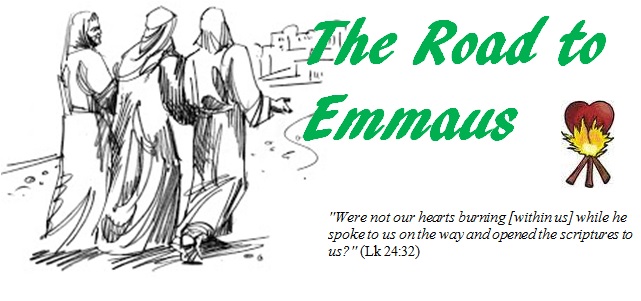
When he was at table with them, he took the bread. He blessed the bread, and broke it, and gave it to them. And their eyes were opened and they recognized him!(Luke 24:13-35)

Sunday, October 13, 2019

Please, Thank You, & I'm Sorry


In the Scripture readings today we are told to give thanks to God in all circumstances. In the first reading Naaman gives thanks and gifts for his cure. In the Gospel the Samaritan leper who thanks Jesus is told that his faith has saved him.

This story reminds me that in this journey called life it is good to return frequently to Him who gives us all good things and thank and praise Him for His wonderful generosity. Our faith, a great spiritual gift, not the physical gifts, is what ultimately brings us to the salvation Who is Jesus Christ.

Every day, every morning when we wake, we should say a prayer of praise for the very act of waking up. We should thank God for His gift of life, even if we aren't feeling like it's very much of a gift at that moment.  We should thank God both for the trials that strengthen, and the consolations that give hope.

As I reflected on this, I was brought back to a story I heard about St. Pope John Paul II, who was delivering his homily during a wedding at which he presided.  It was a very short homily, as homilies should be during these occasions. 

He reminded the couple that they needed only 3 words or phrases to ensure a long and happy life together; “Please”, “Thank you”, and “I’m sorry”.  When we get comfortable with someone, we sometimes start to take them for granted.  We mustn’t do that.  We must make a determined effort to say please when we ask for favors from those we love.  Then we must follow up with a thank you, even if they don’t grant the favor; thank them for letting you ask.  If someone you love asks you for an apology, give it to them.  Don’t quibble over details.  They will deserve your apology sooner or later anyway for something else you will probably do.

Thank those you encounter every day for the simple things:  Making your meals, washing the dishes, walking the pets, going shopping.  Remember, as Christians we believe we see the face of Christ in others, so when we are served by Christ through them, it is only right that we return (like the leper in today’s Gospel) to thank Him and give Him praise and honor. 

Friday, October 11, 2019

Listen for the call of the Lord!


While he was speaking, a woman from the crowd called out and said to him, “Blessed is the womb that carried you and the breasts at which you nursed.” He replied, “Rather, blessed are those who hear the word of God and observe it.”—Luke 11:27-28

I was at a Wal-Mart one day years ago, rushing to buy a few things I need, not paying much attention to the other shoppers when a woman with a small child came up to me and asked, "Would you like to know about Jesus?"  I didn't want to be rude, but I was in kind of a hurry, so I replied, "Thank you!  I do know about Jesus!" and then walked to another aisle for something else I needed.  

I was impressed with her enthusiasm and obvious love for Jesus Christ and the example she was setting for her child as an evangelist.  I'm not sure I have the courage to walk up to complete strangers and ask them if they know about Jesus.  This woman and her child reminded me so much of the woman in Luke’s Gospel!

Although the Gospel reading is brief, it bears a host of conditions. The "Word of God" in Christ's statement refers to Himself, sent into the world to show us that it is obedience to God's Word that conquers evil and achieves true peace on earth.

Peace, however, comes at a cost to "self", because it is based upon love that requires self-denial and self-giving. Love also requires another difficult condition. Since God forgives our many transgressions, He requires us to do the same for others who have sinned against us. Holding grudges and seeking vengeance only prolongs and intensifies a hatred and anger that is as harmful to our own minds and bodies as to our enemies'. Love is the basis of God's law fulfilled by reconciliation and the rebuilding of injured relationships; but better still, by our never doing harm to another.

How sincerely and simply that unknown woman raised her voice to praise the mother of Jesus. I'm sure that from heaven, Mary has become close to her!  And I'm sure that Mary in no way resented the response of her Son--for Mary's whole life was a meditation on the words of the Angel Gabriel, and a living out of the plans of Providence.  Blessed are they who hear the Word of God and keep it!

With our work ethic, we are so intent on measuring success in terms of action, while God measures success in terms of faith, hope and love.  It is far more important for God to see the intentions of our hearts, and to measure the value of our service in terms of His own unconditional love for us.  Without in any way diminishing the greatness of His mother, He greatly increases it by identifying the source of its power--doing always the Will of the Father, even when it seems contradictory to one's vows--in Mary's case, that of virginity.  And God blessed her for her blind trust--and graced her with both virginity and motherhood.

If only we could saturate our hearts with the Word of God, putting His Will before our own plans and ambitions, then we too would be blessed beyond measure with the praise of Jesus and the reward of God the Father.

It may help to recall that the daily prayer of Jews was, and still is, the Shema (“Hear!”), from the first word of Deuteronomy 6:4-5: “Hear, O Israel! The Lord is our God, the Lord alone! Therefore, you shall love the Lord, your God, with all your heart, and with all your soul, and with all your strength.”  So the whole of the life of the covenant could be summarized in the phrase “to hear the word of God and live it out.”  Mary exemplified that kind of deep hearing—a total response to the word of God expressed in the Torah.  It was the readiness of that deep hearing that enabled her to become His mother in the first place.

In the 9th chapter of the Gospel of Luke, we have the vision of the transfiguration, where Peter, James and John first see and hear Moses and Elijah (who represented the Law and the Prophets who mediated the word of God to Israel) speaking with Jesus; then those two disappear and Jesus is standing alone, when the voice of the Father is heard to say, “This is My beloved Son, hear Him!”

For us, Jesus is the word of God.  We imitate Mary by hearing and following Jesus.  That’s what this business of daily reflection (on the word of God about the Word of God) is all about.  Blessed are those who hear the word of God and keep it.

Sometimes we lose our sense of awe for the divine, and we need to “bestir [our]selves” (Joel 4:12) from time to time.  While we may find comfort in our familiar patterns and think that surely God doesn’t mind, some of those patterns are not pleasing.  Our ways fall short of God’s ways; our thoughts fall short of God’s thoughts.

The prophet Joel projects hopeful messages designed to encourage and uplift.  (Joel 4:12-21) First, judgment will set things right.  We who live in the tension of the present age can identify with a desire for relief from evil and injustice that occur all around us.  We can look forward to having God set things right, particularly when we seem unable to do so on our own.

Second, even in the midst of setting things right, we are told that “the Lord is a refuge to his people.”  This is a good thing.  If we are truly honest, we recognize that we are sometimes part of the problem that needs correcting; we need things to be set right in our own relationships and attitudes.  The enduring love of God is a source of great comfort, particularly when we know that we share the infirmity of our fellow humans, who are likewise made of dust. Yet God still chooses us and if we respond to the call, He will even send us, flawed as we are, to convey His love to the world.

Calling down justice to rectify the faults of others may make us feel good for a time, but it is fraught with peril.  Sometimes it may even be like calling an artillery strike on your own position.  Be prepared to hear the Word of the Lord and to observe God's Word. Psalm 97 promises that "light dawns for the just; and gladness, for the upright of heart."

This involves doing, but it also involves contemplating the living Word, who perfectly reflects the Father’s love.  Through doing so, we may be more likely to set things right, both in our own lives and in the world around us that we encounter daily.  Listen for the call of the Lord!

Healing, Forgiveness, Compassion, and Love Starts with Each of Us


Every kingdom divided against itself will be laid waste and house will fall against house (Luke 11:17).

Although Ellen DeGeneres is publicly known for her solid rapport with celebrities, a select few are expressing dismay and disappointment in her for attending a football game in which she sat next to and enjoyed talking with former President George W Bush.  She didn’t apologize; she didn’t have to. Instead, she spoke about the controversy surrounding the ‘incident’ in a monologue on her show in which she urged people to be unconditionally kind to others. She said, "Here's the thing: I'm friends with George Bush. In fact, I'm friends with a lot of people who don't share the same beliefs that I have. We're all different, and I think that we've forgotten that that's okay that we're all different."

One of those celebrities who expressed dismay and disappointment with her labeled DeGeneres "increasingly out of touch with reality" in a Tweet.  "Sorry, until George W. Bush is brought to justice for the crimes of the Iraq War, (including American-lead torture, Iraqi deaths & displacement, and the deep scars—emotional & otherwise—inflicted on our military that served his folly), we can’t even begin to talk about kindness," he wrote.

This reminds me of the crowds who challenged and tested Jesus following His miraculous driving out of demons and evil spirits.  What are Jesus’s motivations, the crowd asks; in whose name does Jesus cast out the evil in the world?  Jesus responds to the crowd, and to us – “every kingdom divided against itself will be laid waste and house will fall against house” (Luke 11:17).  And so it is in our own lives – in our homes, with our families, and in contemporary times and the society in which we live.

How often is it that we allow our interpersonal relationships to become wounded and scarred because one placed their own needs before the other’s?  And how often does the damage in those relationships multiply when Christian values such as grace, charity, and forgiveness elude us?  This reflection affirms to me how important it is for us to discern the stirrings in our own hearts as we navigate the often-turbulent waters of the relationships in our own lives; to seek unity and solidarity at times when it is most difficult.

But Jesus doesn’t stop there.  Rather, He reminds us that “whoever is not with me is against me, and whoever does not gather with me scatters” (Luke, 11:23).  Jesus’s words here should resonate with us because they require of us a courageous commitment to the greater good.  They are a reminder that the goodness inherent in our relationships, and our respective houses, is not for us alone but for something greater.  And through it all, we are called to commit ourselves to the greater glory of God, for there is no middle ground, and no room to waffle.  The message is clear, we cannot be for life with Christ if our actions reveal our hearts to be confused on the matter.

Jesus was sent to proclaim the Good News of the Kingdom of God, the news that God is vanquishing evil and establishing His active rule over His creation.  The Kingdom of Satan is being replaced by the Kingdom of God.  The full establishment of God’s reign lies in the future, but it is already being inaugurated through Jesus.

Jesus is Messiah of word and action.  With His ascension, He now sends us, His disciples, to announce the Good News of the Kingdom through healing, forgiveness, compassion, and in love for one another.  God is doing a new thing in us.  Can we see it?  Can we perceive it?

Wednesday, October 9, 2019

Wants vs Needs

As I’ve matured as a person and in my faith, I realize that God will never give me everything I want, sadly.  Instead, God will give me everything I need.  God will give me patience, strength, peace, wisdom, knowledge, sensitivity, perseverance, faith, and more.  God will give me the Holy Spirit.  When I open myself to pray and allow God to work, God molds me into a better person.  In fact, I often end up surrendering whatever I was so certain I wanted, because God knows what is best anyway, and I can trust that.

Jesus certainly didn’t have everything that someone in His day would want.  But He had the Spirit of God alive within Him, and every time He prayed, He deepened in relationship to the Father who loved Him and sustained Him.  That is what allowed Him to be effective, healing, strong, and prophetic. That is what gave Him what He needed to endure suffering, betrayal and death.

That is what prayer is all about.  It’s not a laundry list of “give-me” requests.  It’s a deepening in relationship so that we can become ever more like Christ.  When we ask for that, we will most surely receive.

Tuesday, October 8, 2019

Persevere; Don't lose hope!


St. Paul gives some very good advice to the Hebrews (Hebrews 10:32-39) and subsequently to us, exhorting all to persevere and not lose hope. That sounds pretty laudable, but what exactly are we to persevere in and not to lose hope of?

It is nothing less than to love God above all things and to love our neighbor as ourselves with the certain hope that such behavior will merit us everlasting life. Loving God above all things seems doable, yet how often do we witness our own slippage and how does it take us away from serving the Almighty and giving Him the praise and thanksgiving that are His due?

If that wasn't enough, we also have the exhortation about loving our neighbor, which we all know is frequently difficult. It simply isn't enough that we merely avoid overtly offending our neighbor, but also, that we don't withhold anything that might assist him on his way to the Kingdom of heaven.

It can be easy to ignore the suffering of those who are in the various prisons where they might find themselves – prisons that are not just physical detention centers, but the prisons of disease, financial challenges, mental anguish, addictions, abusive relationships, workplace stress, persistent unemployment, violence and repression.  And we can be easily seduced to conclude that the bounty of material items, freedom from want, privilege, insulation from conflict and confrontation, and safety from personal harm is a birthright instead of a wonderful gift. 

Those of us who live in western society can easily forget that we generally live at the top of the historical pyramid of human privilege, and the benefits we enjoy are because of our good fortune in being born into this world in this place at this particular point in human history.  Even people in our societies who struggle for the daily means of existence are still in some ways (due to our governmental and private “safety nets”) better off than the poor and downtrodden of 2,000 years ago.

And so when the Hebrews author encourages us to “keep the faith” by not forgetting the ways in which we shared in the sufferings of those in prison, it really reminds us to keep demonstrating our faith by continuing to share in those confinements, however they are created for our sisters and brothers.  And when we are told we have joyfully accepted the confiscation of our property, I think it really means to be mindful of the need to detach our true selves from the wondrous bounty that surrounds us, and to realize that the true gift we have received is not physical things that will fade away, but the salvation we receive from trusting in the Lord.  We keep our faith by keeping our focus, by committing our way to that of the Lord.

Taken all together, it is a big bill to fill and no wonder we need God's grace to accomplish it. Yet, praise be to God, His grace is not lacking for those who seek it and utilize it as the freely given gift that it is.

“Persevere then; don't lose hope.”  It was good advice then and it certainly is now.

Monday, October 7, 2019

Priorities


Poor Martha!  She’s trying to be the good hostess and prepare a nice meal for Christ and her sister; instead she gets criticized or rather ‘gently reminded’ about priorities.  It’s not really about preparing a meal for our friends.  It is about setting our priorities.

For many of us 24 hours in a day is just not enough—or at least we think that it’s not.  We might even deprive ourselves of sleep in order to pack more activities in our day.  Others of us might be procrastinators, in that we know what we should be doing, but we put it off until it is too late.

This Gospel passage (Lk 10:38-42) has such a strong message for us in late 2019 in this world where there are too many ‘smart’ phones, social media apps, and countless other technological advancements that are barriers to each of us being in the moment with the other.  Many of us can instantly visualize the numbers of meetings we attend where professional adults are busy sending or checking their latest email.  We eat in restaurants and watch a table of four people conversing; not with each other but each talking to someone else on their cell phone.  There are occasions when I am so lazy that, rather than walk 50 feet and ask a question of my granddaughter who is in another room in the house, I will text her that I want to speak to her.  And, the list continues of not being present to the other in the moment.

Then there’s Mary, and the greater gift of hospitality she was transmitting.  She was present.  She was in the moment.  She was engaged.  She was being, not doing.  Christ says of Mary, sitting at His feet, that she has chosen the better thing to do.  We can only imagine the flow of their conversation. We too, can have that conversation with Christ in our prayer life.

Where does prayer fit into our usual day?  Could we find time to present ourselves to Christ?  Is there a quiet place in the house, or could we make it so by turning off the T.V. or radio?  How about turning off the car radio on the way to or from work.  Pray aloud with a family member while doing simple chores such as the dishes at night.

Christ is always present to us, just waiting for us to knock and let Him be a more prominent part of our life?  Do we want to knock?

Nurturing a prayer life


Today the Church celebrates the Feast of Our Lady of the Rosary.  What better way to enter into the mysteries of the life of Christ, than to sit at the feet of Mary, Spouse of the Holy Spirit, and let her guide us as we ponder that life as she did?  Each of us is meant to be contemplative, not just those persons living in a cloister!

One of my cousins called my Mom once and told her she sometimes couldn't pray because she "couldn't remember the right words",  but that she often took walks in the country to just "talk to God" as she watched the beauty of the landscape unfold before her.  My mom, who was really good at spiritual direction without knowing it, told my cousin that what she was doing IS prayer!  It's probably the most effective type of personal prayer that one can say!

In Galatians (3:1), St. Paul vents his frustrations—"O stupid Galatians!”—because the people do not yet understand this.  As he tells the Galatians, a person doesn't build a relationship with Christ by only following the law.  Yes, one needs to follow the Church law, but also must nurture their interior life with Christ.

St. Augustine laments this beautifully, "You were within me, but I was outside, and it was there that I searched for you.  In my unloveliness I plunged into the lovely things which you created. You were with me but I was not with you." (Book X, Chapter 27, The Confessions of St. Augustine)

The rosary is great, but sometimes it's a little hard to get started praying it day after day, night after night; it takes a commitment, that's for sure.  It can seem boring or repetitious if you aren’t in the right frame of mind.

While my prayer life is not perfect, I thought it might interest some of you to know my journey in becoming closer to Christ through prayer.

First, I had to commit to prayer. It didn’t have to be fancy or make me feel like I had to memorize or make up some fantastically worded prayers.  It was similar to my cousin’s solution; just a simple one-on-one with Jesus every day as I contemplated His presence in my life.

Second, I had to learn how to make it a true conversation.  In a true conversation, one speaks while the other listens, then vice-versa.  This was probably my biggest hurdle.  I sometimes wouldn't listen long enough for the answer to my prayer before I started speaking again.  This went on for a while, until I understood that prayer is sometimes just "a love letter" to God, when we take a few moments to just say "I love you" and wait for His reply—which, if you think about it, He gave us 2000 years ago on the Cross!

Once I learned how to listen, I heard the Holy Spirit within me exhorting me to pray more. He asked me to start saying the rosary with more regularity. He also taught me how to say it while meditating on the life of Christ, which is one thing I always had trouble with before. The Holy Spirit helped turn it—for me—from a repetitious prayer to a "journey" with the Apostles every time I say it.

My whole prayer life—no, my entire life—changed from that point on.  I began to read the Bible regularly.  I began attending Mass as often as I could and missing it terribly when I couldn’t.  I started seeing life and other people differently.  I am nowhere near as impatient or as untrusting of others as I used to be.  I like to think I have become a better son, husband, father, and brother; and that I have become the "face of Christ" for others just as I really do see Christ in some way in everyone I encounter.

It all begins with seeking God (like my cousin was), then listening for the still, small voice that is calling each of us to more prayer.

Sunday, October 6, 2019

"Increase our faith, Lord" (Luke 17)


Many of us do only the bare minimum necessary to get by. We do this in our work, and with our families.  In my career I managed and led others for years and I must admit I found it very frustrating that some did only the minimum and then thought they were owed some special reward, bonus, or thanks for what they had done.  For a very long time I didn't leave tips for meals that were served to me in restaurants unless the service was extraordinary.  I felt the servers were only doing what they were paid to do (When I found out that many restaurant owners were paying less than a fair minimum wage to the waitstaff and cooks, I changed my practice). Upon self-reflection, I’m no exception to this ideal at home, either.  I sometimes feel like I should get a pat on the back or a favorite meal or dessert because I did ordinary, expected chores like washing the dishes or doing the laundry without having to be asked.  And, sadly, many of us do only the bare minimum in our faith, if we do anything at all. 

In the gospel (Luke 17:7-10), Christ warns us that we can fall into the same trap with God and the reality is we are required to give all we can to God and ask for nothing in return. The fact is God owes us nothing for what we do for Him.

When we have done everything the Lord has asked and we have given all that we have to give, our human reaction is almost always, "See how well I have done."  It’s a natural thing; but Jesus warns us not to be natural.  Much of Christianity is a call to remove oneself from one's natural inclination and to give oneself up to divine inspiration.

Giving the bare minimum to God is not acceptable.  Everything we are and have is due to His divine work and we are obliged to give our all, in return.  Yes, we truly are unprofitable servants, but what great rewards await us for our complete surrender and obedience to Him.

When we do the Lord's work, we do it with the Lord's strength.  St. Thomas Aquinas pointed out that the only thing a human being can do to separate from God is reject Him.  Other than that, all the works we do are done in tandem.  And the One who bears the greater part of the burden of our work is God Himself.

What is there to boast of if we have cleaned our rooms by making the bed, but it is God who picked up the toys, threw away the trash, dusted the furniture, swept the floors, washed and painted the walls and rearranged the furniture?  That is what Jesus is telling us.  If we do everything that we can, we still have done remarkably little and only what is expected, and we should not expect that a shower of gold will fall from Heaven as a reward.  Jesus tells us to regard ourselves as humble and obedient servants.

But God regards us as children who are demonstrating their love in the small ways that a child can. God sees these actions of the servant and laughs with delight at the child who has learned how to wash his hands without throwing the towel on the floor.  God knows our weaknesses and does not ask from us anything that we cannot give.  True, we are servants of the Lord, but we are servants who are also well-loved children.  While we are not promised and should not expect any extraordinary reward, we nevertheless receive one every time we receive Him in the Holy Eucharist; a taste of heaven here on Earth, a moment of recognition by Jesus amid the waste of the world.

Friday, October 4, 2019

A representative of Christ, for Christ


“Whoever listens to you, listens to me. . . .” (Luke 10:13-16)

If others know us as Christian and Catholic, when we speak, we speak representing that faith and God's Church and by extension God Himself.  Every word out of our mouths is a word by which the truth that we live will be weighed.

The entire third chapter of the Letter of James warns us that loose speaking is the enemy of God's work.  If we speak loosely about people, events, or things, people will see that in us.  They will say, “Ah, so this is Christianity”.  It isn't fair, but it is the way that people are.  No, we're not always in good moods; we're not always the best representatives of Jesus.  But when we speak and people listen, they are listening to a representative of Jesus.  For other people we are Jesus, our words are His words.

This is not to say that we shouldn't talk, but only that we should, through prayer and requesting help from the Holy Spirit, speak only what is edifying or helpful to those in need.  We needn't always be mouthing empty pieties, but we also needn't be trash-talking our neighbors, our government (well, maybe just a little bit), or for that matter, anything.  We need to listen with the Spirit within us and respond as He dictates - with counsel and advice or with joy and merriment.  After all, Jesus did attend the festivities at Cana (John 2:1-11), and there's no need to think He's always solemn or somber.  

I remember an encounter I had a few years ago that I think illustrates how our words and actions can reveal who we represent if Jesus is truly within us.  As I was coming out of a restaurant after dinner, I noticed a young man coming straight at me, with that unmistakable demeanor that I knew was going to lead to a request for money.  “Uh-oh”, I thought, “here it comes!”  My standard line for avoiding panhandlers was always, “I’m so sorry, but I don’t carry cash on me, ever since I was robbed at gunpoint.”  It’s a true statement, but the reality is one doesn’t really have to carry cash to get just about anything one needs these days.  Just about everybody takes credit or debit cards, so my excuse to those in need was more self-serving than Christian. 

Anyway, this guy walked up and asked for a few dollars to get something to eat.  I thought to myself, “Why not? I’ll pay for his dinner then leave.  It’s only about 10 bucks.  Maybe he won’t bother anyone else if I help him.”  Again, that was a self-serving excuse to talk myself into doing something I ought to do.  So I turned around and opened the door for him saying, “After you, sir.”  He thanked me and we walked up to the counter to pay for his meal. 

The girl behind the counter smiled at me (she was the same girl who had rung my dinner up earlier), excused herself, and got on the intercom to call the manager.  When the manager arrived, he didn’t greet me but gave me the once-over and said to my guest, “I told you you’re not allowed in here! Please leave!”  Then the manager, without even acknowledging me went back to wherever he was when he was called.

The girl then turned to me and said, “I’m sorry, but he was caught in her just a little while ago trying to steal some food.”  I was very tempted to point out that the reason he was stealing food was probably because he was hungry and broke, but I didn’t.  I don’t know why I didn’t stick up for the guy.  (Yes, I do.  It’s because I was embarrassed at that point).   Jesus would have told a parable or something to make it a teaching moment for the manager.  All I did was to ask the girl, “Is there somewhere else in this shopping center where we can get this young man a meal?”

She shrugged her shoulders apologetically and shook her head no.  I told my new acquaintance that I noticed some fast food establishments on the other side of the shopping center and asked him if he would mind if I bought him a dinner at one of those places.  Obviously, he never heard the expression ‘beggars can’t be choosers’, because he said, “I was hoping for a Mexican meal.”  I replied that we might get lucky, but I was a little pressed for time, so it would have to be whatever we found.  We started walking towards the restaurants.  He asked me, “You want to walk over there?”  I may have felt generous, but not careless.   Giving a car ride to a total stranger who you know has recently tried to steal and has the smell of alcohol on his breath is not a prudent decision.  I said, “Yeah.  I need to walk off my dinner.”  He replied that he understood, although I could tell that he didn’t. 

He asked my name.  I told him my first name.  He introduced himself, but I can’t remember it.  He touched my shoulder and said something about giving me positive energy or something and asking me if I felt it.  I wondered if I had bitten off more than I could chew with this “dinner guest.”  Pun intended. 

He asked if I was religious.  I replied that I am Catholic.  He grew silent for a few minutes until we got into the restaurant.  I don’t remember which one it was, but it was a chain fast-food joint.  He asked the clerk if they had any Mexican food.  “Nope, just hamburgers and chicken sandwiches, french fries and drinks,” came the reply.  He asked me what he should order.  I told him he could get whatever he wanted.  He said, “You’re the only person who has talked to me like a human being or helped me in a long time, and you didn’t hesitate to use your credit card.  God bless you!”  I thanked him and said, “I’m just glad I could help”.  We said our goodbyes and I left him to enjoy what could possibly have been his first real meal in some time.  As I reflected on the episode that evening, I was so filled with gratitude that Christ had let me see Him face to face, and that He had also let the needy young man see Him, as well.

It was a good reminder that we need to let our words and actions reveal our hearts and He who dwells in them.

Thursday, October 3, 2019

The joy of the Lord is your strength


Every Catholic Mass is divided into two distinctive parts, or ‘Liturgies’; the Liturgy of the Word, where we listen to and reflect on Scripture readings, and the Liturgy of the Eucharist, when the priest confects ordinary bread and wine into the actual Body, Blood, Soul and Divinity of Jesus Christ. Just before the Liturgy of the Word is a ‘penitential rite’, where we ask for God’s forgiveness of our sins; at the end of the Liturgy of the Eucharist, we are ‘sent out’ at the dismissal to spread the Gospel through our words and our actions.

The Scripture readings during the Liturgy of the Word are always the Gospel of the day, preceded by a reading from either the Old or New Testaments—except on Sundays and Holy Days, when both the Old and New Testaments are used in addition to the Gospel.  Following the first reading, there is always a ‘Responsorial Psalm’ taken from the book of Psalms.  All the readings usually relate to one another in their tone, or the message that is being presented that day.

Today, we read from the Book of Nehemiah (Neh 8:1-4a, 5-6, 7b-12).  A little bit of backstory may be needed here.  The Israelites have just been freed from their exile in Babylon and a great new temple has been built.  God instructs His prophet Ezra to gather the people and to read the Law of Moses.  As he is reading, those learners and listeners seem to feel overwhelmed by what is proclaimed and prescribed to them by Ezra from the scroll.  “For all the people were weeping as they heard the words of the law.” (v.9)   They were probably feeling shame because they heard about how God had delivered their ancestors from Egypt and quickly seemed to forget what He had done for them, and at the same time they (we) are reminded that God still loves them and will keep His promise to Abraham and Jacob.

In response to their tears and heavy hearts, Ezra reminds them that they are missing the good news; that God is still with them and guiding them to the Kingdom of Heaven.  Ezra instructs the people to go and share a meal together while also sharing with those who had little.  It was through the breaking of bread that joy re-entered their hearts.  Jesus draws from the same playbook in Luke’s Gospel (Lk 10:1-12) when he sends out the 72 “other disciples” ahead of him.  He tells them to take little for the journey other than their trust in the hospitality of others to sustain them and the offering of their peace in return.  Presumably, it is at the meal table where this exchange will take place.

When I heard these two readings this morning, I couldn’t help but think how much it reminds me of the Mass.  People are gathered, they become penitent, they listen to the Word of God, they share a meal, then they are sent out to proclaim the Good News to others.

I heard a story once told of St. Teresa of Calcutta.  She and a few of her Sisters were visiting the United States and staying at a parish in the Southwest.  The pastor had agreed to say a “private” Mass for St. Teresa and her Sisters very early in the morning.  Word traveled fast of the presence of these holy women and so before Mass began there were already crowds of people being held back by police and barricades outside the chapel.  The quiet Mass started and clearly Mother Teresa was agitated.  As the first reading was proclaimed, she was shuffling about in the chapel, whispering to her Sisters to get closer and move forward until their noses were practically touching the altar.  The same went during the Responsorial Psalm.  Then, just before the Gospel was proclaimed, Mother Teresa threw open the chapel door and proclaimed, “Everyone, come inside!”  Well, the police were the first to accept her invitation followed immediately by the crowds.  Then, and only then, was St. Teresa able to find a corner, sink to her knees, and drop into prayer.  She could not rest knowing that people were being held from the table of God’s abundant love.

May we all find ourselves as both hosts and guests at tables of fellowship where we can feast upon the joy and peace for which we all so deeply hunger.

Tuesday, October 1, 2019

Angel of God, My Guardian Dear......


Guardian Angels are traditionally said to have been created for the sole purpose of serving us in our needs.  God could have chosen to care for us directly without the use of angels, but He didn’t.  He chose to create angels as mediators of His grace and care. 

It’s fair to say that our Guardian Angels love us with a perfect love.  They know us, care for us and desire deeply that we become holy.  Their primary purpose is to care for us, get us to Heaven, and to draw us into the heights of sanctity. 

They do it by mediating God’s grace to us.  The word “angel” means messenger.  Thus, our angels play a central role in communicating to us the will and mind of God.  They can speak all that God wants to say to us.  They are also protectors in that they bring grace from God to particular situations in our life to fight against evil and to help us do good. 

Only God knows how often we are helped by angels.  Every day we experience them in little "coincidences" and so-called "hunches" we follow that turn out to be blessings. However, the role of angels is much more important than that.  Angels teach us how to live holy lives. As Psalm 91: 11-13 declares, God “commands his angels with regard to you, to guard you wherever you go.”

Exodus 23:20-23 points out that "guarding us in all our ways" includes giving us messages (guidance) from God, and we had better not rebel against this help. The word "angel" means "messenger from God."

As Jesus said in Matthew 18:10 our angels are not only with us every minute of every day but also face-to-face with God, Himself, presenting our petitions, joys and anxieties to Him. They can influence our thoughts and our actions, but they can’t control them—that’s the purpose of our free will. What the guardian angels will do is remind us of what is good and urge us to follow that. They will also step in and protect us from physical harm, if it is God’s will.

To hear the guidance that our angels give us, we have to ask the Holy Spirit to teach us to be open to their help.  We might never hear them speak in audible voices nor see them appear in physical form, although many Saints have, but our human spirits can become attuned to their holy spirits.

We develop good listening skills by working on improving our friendship with Christ. The better we are at listening to God, the more natural it becomes to be guided by angels. Then, if we ask for their help and it's within God's will, they always rush to the task.  Always!

The first prayer my mom taught each of her children before she even taught us the Rosary was the Prayer to My Guardian Angel:

Angel of God, my guardian dear,

To whom God’s love entrusts me here.

Ever this day (night) be at my side,

To light and guard, to rule and guide.  Amen.


I must admit that even with a daily prayer to my angel, I sometimes forget he’s there. He’s become so much a part of me that I take him for granted sometimes, like I do others in my family who I hold dearest.  But I just know that he’s the one that opens my eyes and ears to the Holy Spirit when I don’t feel like praying or going to Mass every day.

About 10 years ago, I was having a discussion with my mom about our guardian angels.  She said that she had decided hers was named “George” when she was a kid, and that George had helped her in countless small ways over her lifetime.  For instance, if she was in a deep sleep when she should be waking up, she would hear a voice gently rousing her.  Or if she was in a full parking lot looking for a space to open up close to where she was going into, she would ask George for help in finding one.  “Most of the time, he’s pretty good at it”, she said, smiling, “and I always make sure I say ‘Thanks, George!’”  I asked her how she came up with the name, and she said “I just like the name!  I figure if it’s not his name, he answers to it anyway!”  You have to love my mother’s sense of humor.

I told her that I read somewhere if you ask your guardian angel his name just before going to sleep at night, he will let you know when you wake up.  I know it sounds superstitious, but I figured I was not toying with the forces of the supernatural by simply asking my angel his name, so I did it that night.

To my surprise, when I woke up the next morning, the first thought I had was “Lawrence”.  I laughed it off, because Alicia’s boyfriend at the time was Lorenzo, and I thought, “No way!”  Then I thought, “Why not?”  So to this day, when I think of my guardian angel, I call him “Larry”.  I guess I inherited my mother’s sense of humor in these things.

I did a lot of driving as part of my job with U-Haul for 25 years.  There were several times when I was so sleepy, I should not have been driving.  I managed to get to my destination without even realizing how I got there!  I’m sure it was my guardian angel driving!  It’s a good thing I didn’t get pulled over, or there would have been, in the words of Desi Arnaz, “some ‘splainin’ to do, Larry!”

Speak to your angel, today. Holy angels are ready to help us with every sort of need. Praise God who is so good to us that he gives us angels to assist us in all things!

A Beautiful Journey with a Beautiful Woman


The Catholic Church recognizes October as the Month of the Holy Rosary.  I thought it was fitting that my first post of October be devoted to my favorite prayer outside of the Mass.

The rose is said to be the queen of flowers.   The yellow rose is symbolic of joy, a new beginning, and friendship.  The pink rose is a symbol of appreciation, elegance and grace.  In literature, roses often symbolize love and beauty.   From a Christian perspective, a rose is a symbol of heaven and harmony in the world. Furthermore, the rose is considered the flower of the Virgin Mary.

The Rosary is the rose of all devotions and it is, in my opinion and experience, the most important devotion after the Holy Sacrifice of the Mass.  The word Rosary means "Crown of Roses".  Our Lady has revealed to several saints and other holy people that each time they say a Hail Mary they are giving her a beautiful rose and that each complete Rosary makes her a crown of roses.  In every one of her apparitions, the heavenly Mother has invited us to say the Rosary as a powerful weapon against evil, to bring us to true peace.

The Holy Rosary is considered a perfect prayer because within it lies the awesome story of our salvation. When we pray the Rosary, we join Mary in meditating on the mysteries of joy, of light, of sorrow and the glory of Jesus.  It's a simple prayer, and humble; so much like Mary.

It's a prayer we can all say together with her, the Mother of God.  With every Hail Mary we invite her to pray for us.  She joins her prayer to ours.  What Mary asks for she always receives, because Jesus will never say no to anything His Mother asks of Him.

With our prayer made together with our heavenly Mother, we can obtain the great gift of bringing about a change of hearts and conversion. Each day, through prayer we can drive away from ourselves and from our homeland many dangers and many evils.

It can seem a repetitive prayer but instead it is like two sweethearts who many times say to one another the words: "I love you!”

One of my dreams years ago was one in which Our Blessed Mother reached out and took my hand. Then she said, “Come on a journey with me, child.”  As we walked along a path lined with roses, she began telling me a story:

It started with the Angel Gabriel appearing to a young woman to announce the birth of a Savior to all nations.  Then the pregnant young girl visited her cousin, Elizabeth, whose own expected child "leapt in the womb" because he recognized the presence of God Incarnate. You know the rest of the story. It continued with the Blessed Mother telling me the rest of the Joyful Mysteries, then the Luminous, the Sorrowful (in my dream, this is where the path of roses turned to thorns), and the Glorious, ending with the “young woman” mentioned at the beginning of the story being crowned as Queen of Heaven and Earth.  

It was a magnificent dream and a wonderful experience.  I have had that same experience several times since then while meditating on our Savior’s life.  Wouldn’t it be something to hear the story we all know so well from Mary’s own perspective and voice?  I believe that if we are in the right frame of mind when we recite the Rosary, that's exactly what happens.

If you have never prayed the Rosary, or forgotten how, there are all sorts of guides and meditations online to help you start or resume the practice.  Please give it a try!

Monday, September 30, 2019

"The last shall be first"--A Halloween Lesson


An argument arose among the Apostles about which of them was the greatest.  Jesus, who looks into our hearts and knows what our intentions are, simply placed a child in their midst and stated that "whoever receives this child in My name receives Me and whoever receives Me receives the One who sent Me." (Luke 9:48)

I have to wonder if the Apostles weren’t as thick as bricks sometimes!  In this case, it sounds like John doesn’t understand, because he starts up with another question that to me sounds like he’s competing for Jesus’ notice with everybody else.  He says he has seen someone “not a follower like us” who is driving out demons in Jesus’ name, thinking that Jesus will rebuke him, but instead He replies, “Do not prevent him, for whoever is not against you is for you. (Luke 9:46-50)

One must never be deceived by one's status or accomplishments. That is how Satan tried to drive a wedge between Job and God.  Satan failed, even though he went to such great lengths and reduced Job to a state of helplessness.

Often, we seem to forget this very important teaching of Jesus.  We assume that if someone is not Catholic or Christian in a way that we recognize, they cannot help us, or they oppose us.  While this may be true in some cases, in many cases the opposite is true.  Those who do not hinder us, help us in our mission much.  Today we have so many who are ready to bring suit against us for speaking out in faith--so many ready to take offense at our belief—ready to tell us of our foolishness and our naïveté.

But there are a great many whose prayers join with ours.  A great many people support what we do, but do not necessarily have the mission (or perhaps the courage, as it is in my case) to go out in the forefront of the battle.  Nevertheless, they quietly support our efforts with their prayers.

There are others as well; for instance, atheists who oppose the death penalty for the fetus in the womb—perhaps unlikely companions in being a voice for the voiceless.  For this service God blesses them; and even if they do not join us in prayer outside abortion clinics or make no public display at all, they do not oppose us, and they work in their own ways to accomplish the same end.

We should not assume that Protestant, Jewish, Islamic, Buddhist, Taoist, Hindu, or any of our brothers and sisters who do not aid us directly, necessarily oppose us.  Certainly some do, but not all.  And most are looking for the same thing we are.

We should strive to be supporters, not superstars.  Jesus said, "For the one who is least among all of you is the one who is the greatest" (Luke 9:48).  Only then will we be able to do as the Proverbs directs, "Incline your ear to me and listen to my teaching" (Proverbs 22: 17). 

If we are "arguing" about who is the greatest, we are not listening.

I am reminded of a lesson that I learned many, many years ago as a child out trick-or-treating on Halloween night with my brother Tom, my best friend Cal, and 3 or 4 of the other neighborhood kids.  This was in the day when it was still considered safe to let your 10, 11, and 12-year-old kids run around an unknown neighborhood in the dark (as long as you stayed together)!

We were out to get as much candy as we could: which is, incidentally, the whole idea of Halloween!  We all carried pillowcases to put our "stash" into. Our objective was to fill the pillowcases and then go back to the house and sort it out into what we liked and didn't like and trade with one another until everybody was satisfied with the booty.

As happens with kids who are together for any real length of time, some tempers flared and envy over who was getting more candy, who had the better costume, and even who shouted "Trick or Treat" the loudest were the cause of the tantrums.  I'll admit that I was a part of the problem until it came time to knock on the next door.  Then I was "all business" and the arguments had to stop.  After all, who would give candy to kids who were not behaving well?

Some in our "gang" didn't know when to stop however, and when we knocked on the door of one particularly mean-looking guy there was so much arguing going on that no one remembered to yell "Trick or Treat"!

The man asked in a booming voice, "Who's in charge of this group? Who's your leader?"  Everybody else was trying to claim the position, but I was afraid the “leader” would be in some sort of trouble, and I didn’t want that for myself or my brother.  I don’t know where the courage came from, but I only said, "Trick or Treat!" in the smallest voice I could muster, from about 5 feet behind the others.

The guy let out a huge laugh and said to me, "I can see you’re the leader! Only a real leader would stand at the back of the pack and come up with a plan to ACT like one and get the job done!"  He said it was easy to tell, “because ‘For the one who is least among all of you is the one who is the greatest!’", and you were the only one not claiming to be the leader.”    Then he said, "Since you're the leader, I'm going to give you the candy for your group and let you decide how to share it."  Here I was, only trying to see how much candy I could get, wearing a stupid costume I'm sure I was embarrassed to be wearing, trying not to be stand out, and this guy calls me a leader and throws responsibility my way as well! 

I was "taking the lowest place at the table" and I was "invited up to a place of honor" (Luke 14: 7-14).  By doing that, the man at the door that Halloween night taught me that from humility comes strength of character.  

Sunday, September 29, 2019

Archangels to Protect, Announce, and Guide


Angels—messengers from God who help carry out various aspects of God's salvation plan —appear frequently in Scripture, but only Michael, Gabriel and Raphael are named.  Each of the archangels performs a different mission in Scripture: Michael protects; Gabriel announces; Raphael guides.

Michael’s name means “who is like God.”  God gave Michael the responsibility of protecting us as God protects us.  Michael appears in Daniel’s vision as “the great prince” (Daniel 10:13) who defends Israel against its enemies; in the Book of Revelation, he leads God’s armies to final victory over the forces of evil (Revelation 12: 7-9).  

Gabriel’s name means “hero of God.”  Gabriel is God’s hero because he communicates God’s message to people.  Gabriel also makes an appearance in Daniel’s visions, announcing Michael’s role in God’s plan (Daniel 10:10-14).  His best-known appearances are an encounter with a young Jewish girl named Mary, who consents to bear the Messiah (Luke 1: 26-38), and when he announces the birth of John the Baptist to Zechariah and Elizabeth (Luke 1:19).

Raphael’s name means “God has healed.”  Raphael’s activity is confined to the Old Testament story of Tobit, beginning in Chapter Five.  There he appears to guide Tobit’s son Tobiah through a series of fantastic adventures which lead to a threefold happy ending: Tobiah’s marriage to Sarah, the healing of Tobit’s blindness, and the restoration of the family fortune.  

On the feast day of the archangels, we remember that God’s messengers guide us in our journey to everlasting life with our Father.  We can pray to Michael when we face temptation.  We can ask to Gabriel to help us say “yes” to God as Mary did so many years ago.  We can pray to Raphael when we are ill or know someone who is in need of healing.

We honor the archangels as saints. They remind us that God is always with us and that God loves so much about us that he gives us special helpers to light and guide us to him.

In an earlier time of our history, inexplicable events were believed due to the actions of spiritual beings.  But that thought has given way to an increasingly secular and scientific world view and a different sense of cause and effect.  Yet believers still experience God’s protection, communication, and guidance in ways which defy description.  We cannot—no, we MUST NOT—dismiss angels too lightly.

Saturday, September 28, 2019

Love and Fear cannot co-exist


"But they did not understand this saying ..." (Luke 9:43b-45)

Jesus told his Apostles something very important, something they needed to understand and prepare for, something that would change their lives fundamentally, transforming them completely.  But they didn't understand what was said, and they were also too afraid to ask what it meant; they were frightened of its implications.  It reminds me of those situations where we cover our ears and hum or whistle, to drown out any possibility of our hearing something we don’t want to hear.

The Apostles finally came to understand, with the help of the Holy Spirit, that the death of Jesus was for the whole world and would transform it forever.  I wonder if they would have come to realize this sooner if they had not been afraid to ask.

Do you sometimes read something in the Word or listen to a homily that sounds hard, or daunting, or frightening?  I absolutely do!  Do you gloss over it, subduing it with prayer and other reading, rushing to another passage?  Yep, me again!

Instead, rather than being afraid, why not turn to the Author of Life and ask Him to explain it?  You might be surprised at what you hear.

I find that when I come across something while reading my Bible that disturbs me, it's usually the message I most need to hear. I have to learn to stop and listen and ask for an explanation. Who knows? In time the explanation may come and give me cause to rejoice in what God has in store for me!

After all, every word of the Bible tells us of a deep and abiding love and faithfulness on the part of God. And where love exists, fear cannot abide.

Thursday, September 26, 2019

Trying to see Jesus


Herod was ‘perplexed’ about who Jesus ‘really’ was.  He was so concerned, the Gospel says, that he kept trying to see Jesus (Luke 9:9).  

Why did Herod want to see Him?  I think it may have been out of curiosity or more probably fear that it was John the Baptist, or some other prophet that had come back to life that was going to give him a hard time for his sins.  More importantly, where did he look for Him?

We might also ask ourselves why we want to seek Christ.  Is it for understanding, consolation, healing, love, or maybe reparation?  Or are we trying to find Him simply to know where He is, so we can try to hide our sins from Him?  *Spoiler alert:  It’s impossible that He won’t know us and our sins.  That still won’t stop many from trying.

And if we are looking for Christ, where do we look for Him?  Do we seek Him in our government?  In the mainstream media?  Social media?  Most of the time, I submit, these places do their damnedest to hide Jesus at every turn.  If we are not finding Jesus as much as we would like, maybe it is because we are looking for Him in the wrong places.

Admit it or not, we all keep trying to see Him – sometimes with more success than other.  How often do we search and cry out asking where is God?  I firmly believe that throughout my life, throughout all the struggles, disappointments, and losses, God was always there.  My mother set that example for me.  I watched her: always faithful, no matter what, that God was there.  When my Dad died.  When my brothers died.  Any time there was a death or illness in my mother’s ‘circle of influence’, she turned even more to prayer.  She never doubted for an instant that her God was there for her and that her loved ones were in the arms of Jesus.  Her unfailing faith taught me to believe in a God that would always support me and walk with me.  When she passed away at 95 years old, the little prayer book with the daily prayers she always said was on the table by the hospital bed.  She had a rosary collection with over 100 rosaries from all over the world that she requested I give out to anyone who asked after she died.  That image is still so powerful to me 5 years after she passed away!

So, throughout my life in both good times and no so good, I knew (and know) that God is with me.  It fosters an attitude of gratitude in my many blessings – I see that God created a beautiful world that continues to awe me, literally from sea to shining sea.  I see God in the faces of my children and grandchildren.  I see God in all the loving actions of my wife.  I try to find (and see) God in all things.  When I forget this and start seeing the negatives of everything around me, I am gently called back to my loving, all-present God.  A special song will play, a star twinkle more brightly, a person will reach out, a flower bloom at just the right time – I am reminded that God and my BFF Jesus are always there by my side no matter how cloudy things look.   When my heart and mind are in the right place, the world is truly a beautiful place full of good things, good places, and good people.  I am reminded that this loving, all-present God that I long to see is merciful and always sees and accepts me as a beloved sinner.  So . . .  I will keep trying to see Him.