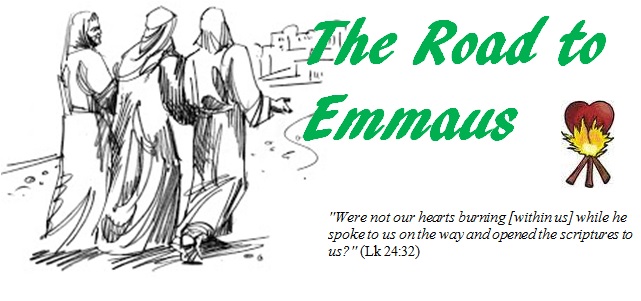
When he was at table with them, he took the bread. He blessed the bread, and broke it, and gave it to them. And their eyes were opened and they recognized him!(Luke 24:13-35)

Monday, December 14, 2020

Lip service and empty words


Lip-service and empty words come to mind in my reflection today—as well as mercy and forgiveness. 

Meditation and reflection on Sacred Scripture helps us to see the consequences of human behavior without the gloss of popular secular psychology, which offers us all kinds of excuses.  Holy Scripture allows us to see that with God there’s a chance to make reparation, to make up for the wrong we’ve done.  True, we might have lost precious opportunities in the realm of temporal things by our faulty decisions, but as long as we have a beating heart, we have the wonderful opportunity to atone to God humbly and contritely for our transgressions.  In return not only are we forgiven, but God offers us, as no human relationships can, the chance to turn even bad choices into an opportunity for good.

God knows the children who love Him.  It’s not the ones who say, “Yes, yes” and never ‘enter the vineyard’, as the second son did in Matthew’s Gospel (Matthew 21:28-32).  It’s those who, despite their protestations, do His will.

In the end the first son demonstrated self-less love while the second son demonstrated empty promises with no heart at all.  It seems easy enough even for the leaders to see this truth.  However, lest we see ourselves as the first son and get too puffed up with vainglory (Philippians 2:3) we would do well to remember the type of love which Jesus taught and demonstrated; “agape”—self-emptying love.

Anyone who ever wonders if God understands our human nature should ponder this Gospel, as well as Psalm 34 and Zephaniah 3:1-13.  They’re about listening, drawing near, acceptance, trust, seeing, changing our minds, and the cry of the poor.  Our God made us, undeniably understands us, and was willing to become man to draw us close to Himself.

Zephaniah warns a people who had become hard-hearted that their failure to listen and to draw near to God would result in a time of purification.  The remnant would be a people who were humble and lowly, people who would turn their hearts towards God.  The psalm is like a theme song to remind us that God hears the “cry of the poor”, a humble reminder.  May we all take to heart the words of the psalm and “let our souls glory in the Lord.” (Psalm 34:3).

It’s of interest in the Gospel that Christ directs His questions not to the common folks, who would be the learners, but rather to the chief priests and elders, who would be recognized as the learned ones, about the ways of God.  Any of us can succumb to pride, or indifference about our relationship towards God, and get caught up in the seemingly important roles of our various states in life.  We can be guilty of placing God on the sidelines of our life.  We’ll pray if we have the time; if it’s convenient.  It’s a blessing for us that God is also a patient God, but for how long?  

The gift of God's grace is evident in the themes of this beautiful season of expectation.  May we be blessed to access God's mercy in this Season of Light.

Sunday, December 13, 2020

A breath of fresh air


Every election year, we find ourselves swamped with the seemingly unending process of campaigning and posturing for what is undeniably one of the most significant positions in our country.  I say “swamped” because it’s as if we’re treading water and not really getting any closer to those elements of truth and clarity that ideally lead us toward a prudent and sound judgment about just who it is that should lead our country.  The only authority that’s being evoked, it seems to me, is the authority that taps into feelings and emotions of anger and mistrust.  Sadly, these won’t lead us to the best end we can hope for in this great country of ours.

In these days of Advent we await the coming of the Lord, a coming that’s pure and simple, not veiled with power and authority, but in the unexpected and amazing birth of a little child.  Isn’t this how the Lord works in our lives?  He catches our attention by drawing us to a newborn babe, vulnerable and innocent, carefully avoiding the mighty and powerful rulers and kings!

Jesus Himself had to face the politics and conflicts of ordinary life.  Interestingly, in the Gospel of Matthew we find the Lord being put into an unusual position by the chief priests and elders.  Only desirous of trapping Jesus and gaining popular appeal, these devious men challenged the authority and truthfulness of His mission and His teachings.  Yet, Jesus refused to give in to the hollow debate and made it abundantly clear that His authority, the truth of all He was about, would one day be revealed without falling into the game of devious words and clever debate.  He asked a simple question, that had the ‘authorities’ tripping all over themselves.

“Where was John’s baptism from? Was it of heavenly or of human origin?” They discussed this among themselves and said, “If we say ‘Of heavenly origin,’ he will say to us, ‘Then why did you not believe him?’ But if we say, ‘Of human origin,’ we fear the crowd, for they all regard John as a prophet.” So they said to Jesus in reply, “We do not know.” (Matthew 21:25–27)

This is a perfect example of how not to live your life.  But, sadly, this is too often an illustration of the way many in authority do live their lives.  The Pharisees were acting just like what we could term “religious politicians.”  A religious politician is one whose religious convictions are decided in a backwards sort of way.  Ideally, we turn our eyes to Christ and all that He’s revealed to us.  This produces the glorious gift of authentic faith, and from that rock foundation of faith, we act.  But the Pharisees allowed their “convictions” to be based on what they perceived would produce the best outcome at the moment.  They chose to say “We do not know” where John’s baptism was from because they thought it was the answer that most safeguarded them from any criticism.

As followers of Christ, we need to be ready and willing to suffer any and all ridicule that comes from living our convictions of faith in an open way.  Faith will lead to charity (love), and charity (love) will always be grounded in the truths of faith. But when we live and proclaim the truth, we’ll be criticized by some and we’ll suffer as a result.

This Gospel offers us all an invitation to reflect upon the difficult truths of our day and age and to decide whether or not we’re willing to publicly profess the truth.  Think, especially, about the many moral truths of our faith that seem to be continually under attack.  Are we willing to speak our faith clearly, with charity (love) and with conviction, even if it means criticism from the world?

The Lord comes to shed His light on the world, to bring truth and goodness that will shine in the darkness and will be known for itself.  If we want to follow Jesus and bring a real breath of fresh air into the popular arena today, perhaps the best course of action we can take is to resist the easy siding with those who appeal to our fears and worries and, instead, embrace regardless of cost, the path that comes from the only one who can claim that “I am the way, the truth, and the light.” (John 14:6).  Perhaps the invitation at this point in Advent waiting is to breathe in a few deep breaths, listen carefully to all that’s said measured by the light of the Gospel and the teachings of Jesus, and then wait even longer until the truth becomes clearer to us.  The Lord will show us the way.  In the meantime, rejoice, because He’s coming soon! 

Saturday, December 12, 2020

A simple recipe


Certainly, amid these COVID days, most of us feel captive in our homes as our landscape has changed dramatically.

“The Spirit of the Lord is upon me” (Isaiah 61:1), offers us a look at a very ancient prophecy during a time when the Hebrew people were liberated from Babylon by Cyrus of Persia.  Upon returning home, they discovered Jerusalem had changed.  It wasn’t how they remembered, and their dream of rebuilding the temple was stalled.  They were still unable to worship God—in essence, they were still captive.  Like the Hebrew people, we wonder if life will ever return to “normal.”  Isaiah is a foreshadow of the coming of the anointed One, the focus of Advent.  In Jesus, our joy, we see all those elements revealed, in Jesus, we see the Father’s Glory.  We’re close to welcoming Jesus among us—once again.  He truly is driven by the Spirit of God.

We see the Spirit of God at work in the humility of John the Baptist by his declarative statements, “I am not the Christ.  I am a voice crying out in the desert.”  Further, John offers that “he is among you, whom you do not recognize” (John 1:6-28).  Catholic teaching is that we’re all fashioned in the image of Christ.  We might ponder, how well do we respond to the Spirit of God at work in our lives? 

Mary understood the promise of liberation in her Magnificat suggesting that “my soul proclaims the greatness of the Lord”.  She recognizes the Spirit of God at work in her life and the life of the community (Luke 1:46-54).  St. Paul challenges us to, “Rejoice always.”  It’s a simple recipe, simply outlined: “Pray without ceasing, give thanks in all circumstances for this is the will of God for you.” (1 Thessalonians 5:16-24)

Especially in this time of virus desolation, we could all use a little bit of joy.  Our call in these Scriptures is to rejoice, pay attention, to be ready, to always give thanks and trust that the “one who calls you is faithful, and he will accomplish it.” (1 Thessalonians 5:24).  Whatever the Spirit of God calls forth in our lives, may we respond in faith so that Jesus may come again—in us.  And may the Spirit of God protect all our healthcare workers and those suffering with COVID and their families.

Friday, December 11, 2020

Sing and rejoice


It's been a very tough year and the troubles in the world around us will continue into the new year.  But Jesus wants to give us joy.  It's a joy that we already have, ready to be released, because of the presence of God's Spirit within us.

Consider the passage in Luke’s Gospel, where we see Elizabeth and her unborn son, John, joyfully reacting to the nearness of the unborn Christ (Luke 1:26-38).  Since Jesus wasn't visibly saving the world yet, how could this happen?

We can guess that Elizabeth was already feeling joyful, since after many infertile years she had become pregnant and, increasing her joy, she knew that she carried a son who was destined to be uniquely special for the kingdom of God.  And no doubt she was happy to see her delightful cousin, Mary.

Surely though, Elizabeth's joy was tested by the difficulties of being pregnant at an old age and even the normal problems of everyday life.  Why didn't she greet Mary with complaints about the extra weight that was making her back ache or about her husband's sin that had struck him mute?

The scripture doesn't say that Elizabeth was filled with "joy" but that she was filled with the Holy Spirit. Her joy, which was evidenced in the greeting she gave to Mary, was a fruit of the Spirit.

There’s a lesson to be learned here.  If we don't experience joy in the difficulties of life, we should work at increasing our relationship with this important Third Person of the Trinity.  It’s the Spirit of the Father, who made Mary pregnant in order to give birth to the Savior.  It’s the Spirit of Jesus, whose joy within Mary's womb pre-existed His earthly human presence—a presence which caused the unborn John to stir in that same spirit of joy

The Spirit's joy is not a feeling like happiness, which depends on outside circumstances.  The Spirit's joy is an awareness that God is taking good care of us despite the outside circumstances.  It's the awareness of the Spirit's inner presence.

Think about the unborn baby in Elizabeth's womb.  He was incapable of understanding anything that was happening outside the womb, yet he leapt for joy.  He's an example of the effect that the Holy Spirit can have on us.  We don't need to see God working before we leap for joy.  We don't even have to understand what God is doing.

Mary, whom we remember today for her appearance in Guadalupe, found her joy in God her savior.  She didn’t say, "My spirit finds joy in my unborn son."  Nor did she say, "My spirit finds joy in becoming the mother of God the savior."  She didn’t yet understand how Jesus would become the savior.

Mary's joy came from the Holy Spirit.  We, too, can "sing and rejoice"—express joy again and again—as we’re told in Zechariah (2:14-17), because He who is joy has come to dwell in us and "stirs forth from His holy dwelling" which is us.

This is one significant way in which we give birth to Jesus in today's world.  When the people around us see joy as a fruit of Christian living, they’re evangelized by it.  Let’s resolve today to keep our eyes on Jesus, the source of joy in troubled times, for our sake and for the sake of others.

Thursday, December 10, 2020

He will lead us


It’s hard not to have questions and concerns in today’s uncertain world.  Everything is made even more difficult with our fast-paced lives.  As Christians, who isn’t confused on how to approach life and all its issues?  Our recent election is just an example of how complex today’s issues are and how challenging it can be to know what’s right and what’s wrong.

To help me understand a little better, I usually turn to the Word of God and reflect on how the Holy Spirit is trying to guide me.   For instance, in Isaiah we hear the "Lord will tell you what is good," and then we hear the Lord telling us "He will lead us on the way to go" (Isaiah 48:17-19).  The Psalms are just as clear, follow the Lord, and have the light of Life (Psalm 1, John 8:12).  The Bible is filled with the Lord telling us to follow Him, that He is the way, the Truth, and the Life (John 14:1-14).

So why do we struggle so?  Are we afraid to follow him?  We shouldn’t be.  Doesn’t He repeatedly remind us, "be not afraid"?  Maybe the truth is, we want to lead, not follow.  We think we have a better understanding of our lives and what we need.  We don’t want to change our viewpoints.  We just need His help.  That’s the way most of my prayers sound.  Here is what I need Lord, please help make it happen.  We’re tempted to think we know what God wants and we end up not really sure what we want or where we’re going.  Like the children in the Gospel (Matthew 11:16-19), not happy with or sure about anything we see.  That’s not following the Lord.  That’s not surrendering to Him.  To follow Him we need to seek Him, to know more about Him, to trust Him.

This Advent, this year of faith, let’s truly seek Him in prayer, in the sacraments, in front of the blessed sacrament, in reading the Bible or other spiritual books.  Let’s listen to Him more by slowing down, taking time out from the rush of life.  Then can we begin to recognize Him, to see where He’s leading us, and what He wants of us.  Then we’ll begin to know the peace and joy that can only come from following Him, and then, maybe our descendants will be as numerous as the grains of sand on the shore of the sea, and we can yield fruit in due season (Isaiah 48:17-19).

Wednesday, December 9, 2020

When all is dark, wait for the light


The writings of the prophets resonate so strongly in our hearts right now.  Just about everyone we know is weary of the coronavirus with its isolation and separation, of the deep polarization that’s tearing our country apart, and with hearing about the cruelty we humans can inflict on one another. As Jesus puts it, “the Kingdom of heaven suffers violence and the violent are taking it by force.” (Matthew 11:11-15).  Of course, the “prosperity preachers” say that if you follow Jesus, God will shower you with wealth, happiness, long life, and all good things.  But Jesus promised peril, persecution, and the sword, with fractured families and loved ones turning against each other (John 16:1-4, Matthew 10).  In these trying times especially, Jesus’ words ring truer than those preachers.

Yet, amid enough suffering and tragedy to lead anyone to despair, the prophets hold out a promise: God will always have the final word.  Even when we go so far astray that God has reason to call us “worm Israel” and “maggot Jacob”, God remains faithful (Isaiah 41:13-20).  That’s the message of Advent. When all is dark, we wait for the light.  When hope seems lost, it’s only obscured from our view.    

The challenge is to change our hearts, attitudes, minds, and actions in ways that make us worthy of a better name and allow us to not only see but to spread that light.  Our task for the remaining two weeks of Advent is to examine whether what we’ve done in the first two weeks has gotten us any closer to that goal.  In what ways have we softened our hearts, truly listened?  How have our actions protected those most vulnerable to COVID-19 so more people can live?  What have we read that has opened our eyes to the pervasive and deepening suffering in our own country, and what have we done about it?  Where have we most closely adhered to the teachings of Pope Francis and the Church that call for mercy, compassion, and inclusion and how can we align ourselves more closely to those teachings?

Christ is waiting to be born in you, in me, in our country, and in our world so the light can shine in the darkness.  We need to change ourselves for that to happen.  So, what are we waiting for?  Time is short. Let’s act.

Tuesday, December 8, 2020

Exiles learning to trust again


Spoiler Alert!  2020 has been a tough year for many of us; the COVID pandemic, needless deaths, sorrows, the economy, as well as wars and threats of wars.  Perhaps even some folks who put on happy faces experience some deep, lingering sort of emotion like an exile, feeling on the outside of it all.

In my reflection on the scriptures today, they seem to address our experience of exile (Isaiah 40:25-31).  This passage characterizes exile as people feeling “disregarded” by God, saying, “Haven’t we suffered enough?”  We’re a people who, unlike God, grow faint, weary, become weak, and faint at different points in our lives.  We all need some sort of vigor, having lost our youthful strength.

The gospel invitation from Jesus is so poignant: “Come to me all who are weary… Learn from me… Take my yoke… Find rest…”  (Matthew 11:28-30)

 Some might read this passage and seem to think that Jesus is promising that things will go well and easily once we turn to Him.  But that isn't at all what is meant here.  Life will continue to be life; there will be hardships, difficulties, turmoil, and every sort of thing that arises from people interacting with people.  There will be no respite from these things.  Think of Our Lady!  She was born without sin and remained without sin and still had to endure escaping to a strange land, losing her Child while on a pilgrimage, and ultimately watching His passion and death on a cross!

The most difficult darn thing for people in exile to do is trust again after disappointment or disillusionment.  But that’s what Jesus invites us to do.  And I think that’s the basic reality that Advent always invites us to face – can we trust after betrayal, after loss, or after diminishment?

At this time in the Church year, it may be just the right time to recall how such experiences might open for us a way of entering the world of refugees, of people facing famine and starvation, of people who make thirty-five cents an hour making clothing or shoes for some multi-national corporation in the third world.  Perhaps our sense of exile might help us form a bond with others who also suffer.

 Come, Lord Jesus!

Monday, December 7, 2020

What a blessing!


December 8 is the day we Catholics celebrate Mary’s immaculate conception.  Mary was chosen by God to bear the Son of God, while free from the stain of original sin, from the moment of her own conception.  Mary was uniquely qualified to carry Jesus in her womb.  Because of Jesus’ life, death, and resurrection, we’re all able to carry Jesus in our hearts.  Mary’s obedience should inspire us to give God our assent to bring Christ to the world.  Bearing Christ to the world is not only the responsibility of Mary, but also every Christian’s responsibility too.  We have an obligation to bear Christ into our lives and witness His life and resurrection and God’s saving plan to everyone we meet.

As Saint Paul wrote, “in him we were also chosen,” destined in accordance with God’s will (Ephesians 1:3-12).  As Christians, we’ve accepted Jesus into our hearts and our lives, and we also receive Him in the Eucharist (John 6).  We’re all called and empowered to bring Christ into our world.  May Mary’s example give us the confidence and courage to accept this call.

As a son, I think about how my mother felt when she bore me into this world.  Did she herald my coming?  I know that she did.  She was so worried that she might have another in a series of miscarriages that she prayed a constant novena to St. Gerard for a healthy pregnancy.   Was she pleased by the life I lived?   I can confidently say that she was, she told me as much often.  Even though my mom went home to God a little more than five years ago, her death quite often leads me to contemplate on the many memories I have of her showing her love for God, for others and for me, and appreciating all that she had done for me in her life here on earth.   A mother’s love is unfailing and forever.  Mary, knowing that she was to bear the Son of God, must have been overwhelmed with grace, disbelief, and honor.  Not knowing what all of this meant, she still said yes, and put her life into the hands of God with faith.

What a blessing to be conceived without original sin. What a blessing to be chosen by God to bear His Son.  What a blessing to be the vessel of Our Lord and Savior.  What a blessing to have a soul that is full of the grace of God (Luke 1:26-38).  Mary didn’t go about saying, look at me.  Mary obeyed God, did everything for His glory, and the good of all mankind. 

Mary was selfless and holy, and it always starts with our parents.  Her mother and father are considered saints also.  They made sure the human part was well taken care of, so God could take care of the divine part.  Jesus was human and at the same time divine.  Saint Ann and Saint Joachim loved Mary first and prepared a perfect vessel for the delivery of a perfect son, in Jesus Christ.

We must too, go out in faith bearing witness to the life of Christ by our words, actions, and deeds, everywhere we go.  We must proclaim God as the Father, Christ as the Son, and the love of the Holy Spirit as one.  We must show everyone we meet what the foot of the cross looks like (John 19:25).

Sunday, December 6, 2020

God always heals


I don’t know why Luke’s telling of the paralytic man and his friends has always been a challenge for me to reflect on in the past, but it has.  That is, until today, when I put myself into the story on a personal level to see what I could come up with (Luke 5:17-26).

I imagined myself as that man, lying miserably on my mat at home.  Suddenly, my friends burst into the house with stories of a miracle healer who could make me walk.  Brimming with excitement, they picked up my mat and started running through the rough stone streets, causing me to hang on for dear life. When we reached the house where Jesus was, there were so many people we couldn’t get in.  Somehow, my determined friends managed to climb up onto the roof, me and my mat in tow!  They started literally ripping the roof apart until they had a big enough hole, and then breathlessly lowered me down until I was face-to-face with Jesus.

I didn’t know what to say, so I just stared at Him, waiting for His words, and wondering how this was all going to happen.  And what did I hear? “Your sins are forgiven.”  I was dumbfounded.  I thought He was going to make me walk!  What did He mean, my sins are forgiven?  I had been paralyzed since birth.  What sin?  I have to admit, it was a momentary let down. 

But then it hit me.  I thought about the sick, dying, and grieving people I’ve met throughout my life, and especially those who lived with disabilities.  Combining their experience with the gospel story, I re-imagined an entirely different possibility.

This time, when Jesus said those words, for the first time in my life, I realized there was someone who looked at me and didn’t see a disability.  I recognized His insightful wisdom that the kind of healing I really needed was not outward and physical, but interior and more deeply rooted.  I needed to be healed of the pain I had caused others when I took my frustration out on them, healed of my lack of acceptance of myself, healed of the guilt I felt when I considered myself little more than a burden, and healed of my distancing from God when I blamed God for my circumstances.  Instead of being angry, my heart was pierced, I felt completely loved just as I was, and I cried for joy.

Of course, that wasn’t enough for the bystanders, who loudly refused to believe that Jesus could forgive sins.  So He acquiesced and said, “Rise, pick up your mat, and go home.”  And that’s exactly what I did.  I didn’t get up and throw a party.  In fact, the story seems almost anti-climactic, and perhaps at that point it was.  Perhaps I had been healed in the most important ways; and being able to walk was just the ‘icing on the cake’– nice, but not so necessary anymore.  So I unceremoniously walked home praising God.

There are many lessons in this story.  One that is often overlooked is exactly the point of my reflection: When we pray for healing, God always heals.  But He heals us in the ways we most need healing, and those may not be physical healings at all.  Sometimes we need a healing of relationships, or healing from hurt and abuse, or spiritual healing, or even healing into a peaceful death.  So when we pray, we need to allow God to act as only God knows how.  We need to allow God to heal us and our loved ones where we most need it, rather than in the very narrow definition of healing that we intend.

A couple of other thoughts also come to mind as I reflect on this story:  What are friends for, if not to risk a danger of falling through the roof or incurring the cost of repairing the same, simply to help another human being know the joy of being whole in God's presence?

In our broken world, filled with hate, division, prejudice, and violence, we need healing more than ever, and I dare say, the type of healing we most need is rarely physical.  In fact, if all those hurting, afraid, broken people who feel justified or compelled in carrying out abuse, exclusion, and violence were healed in their hearts, our society and world would be a much different place.

And which was greater—the cure of the paralytic or the forgiveness of his sins?  What greater love can we show one another than the love of forgiveness?

This Advent, then, as we work to birth Christ in our world, let’s join together to pray that all people may be healed where they most need healing, that they may be made whole and brought into the awareness of God’s love for them and for all people.  Let’s pray and let’s work tirelessly to be instruments of God’s healing and loving power.  If we start with ourselves and work out to encompass our neighborhoods, cities, nation, and globe, we may yet be able to make straight the path and see the glory of God on this earth.

Saturday, December 5, 2020

John the Baptist brought "Breaking News" --and a warning


We’re all weary of the Covid-19 pandemic, yearning for the relief a vaccine promises.

When this scourge ends, most of us can’t wait to hug friends and relatives again, dine together without fear of contagion, travel for vacations and recycle our growing stash of masks.

A similar longing for a better way to live is front and center in the opening lines of Mark’s Gospel (Mark 1:1-8).  The common people of Palestine, at the time of John the Baptist, were weary of imperial propaganda and oppression emanating from Rome.  They wanted it to end and looked to young, charismatic leaders to restore a life they once had; free of cruel foreigners who worshiped emperors and elite Jewish leaders who compromised themselves in order to avoid Rome’s wrath while burdening the poor with trivial rule upon rule.

In these first lines of Mark’s succinct Gospel, the author uses the word “gospel” to shock us to attention.  In Jesus’ time, the word gospel announced military victories and new rulers.  This Gospel is of Jesus Christ the Son of God—not the divine man Caesar.

I like the Gospel of Mark for a few reasons.  Every word, phrase, and anecdote seem charged with meaning.  It’s the shortest of the four Gospels, and it’s unique in its descriptions of the role of Jesus and His message to upend the status quo and inaugurate the Reign of God on the earth.

So, as the Gospel begins, the author alerts us to a radical story about to unfold.  He wants us to be as attentive as when the propaganda machine of Rome announced another conquest or another Caesar.  It’s a news bulletin delivered by a man noticeably outside the establishment, wearing camel hair and a leather belt, living in the wilderness on honey and locust.

John was on serious mission: to get people ready for an amazing transformation of everything familiar.  It’s as if he was saying, “Your old, selfish, self-destructive, fearful ways must cease.  This man, this ‘anointed leader,’ who I’m introducing, will astound you and the world.  So change now!  Ritualize your change with a baptism of water by me, so you can be open to receive His mind-boggling message.  This message is going to be stronger than any other you’ve ever received.  It will radically change everything.  But be warned!  This good news at first might scare you.  And it may well cost you your life!”

In fact, it was a subversive message, aimed directly at Caesar and those abusing power in the Jewish social order.  These opening lines were a declaration of war upon the political culture of the empire.

As Pope Francis encourages repeatedly, Christians must examine our lives in light of our loyalties.  Do I worship idols?  Is any project, achievement, possession, financial portfolio, amusement, drug or alcohol, sport or hobby or organization a false god to whom I devote excessive time and attention, neglecting what God asks of me?

Advent can be the time for the self-examination Pope Francis advises.  Setting a quiet reflection period each day before Christmas can help us excise our idols and rededicate ourselves to living totally as God wants.  This will usher in a joy and energy that withers our weariness, even in the middle of a pandemic. But be warned, it may also cost you your life!

Friday, December 4, 2020

Hope in God gives us courage


As I reflect on the Book of Isaiah (Isaiah 30:19-26), I hear the pealing of the bells of hope in the midst of trying times.  The scripture helps me to remember that despite these dark, gloomy days we’re in, God still looks after us.

The voice of the Lord, spoken through the prophet is a voice which offers hope to people in the times of hopelessness.  How does the voice of hope speak to us today when we are absorbed not only by the exterior darkness of the lack of sunlight, but also the darkness of the uncertainty of our tomorrows?  What gives us courage to move forward when the ground under our feet seems to shift every few weeks?  Is there hope when we are tired of hearing about surges and statistics?  Maybe it isn’t a coincidence that the proclamations of imminent distribution of a vaccine have begun ringing now that Advent is here.  It’s the dangling of a carrot before humanity to give us some kind of hope to reach out towards something beyond us.

Hope is an extremely powerful energy in the human spirit.   When forces pull us down hope sits just beyond our reach and asks us to reach forward, move forward, step forward.  Recall the Gospel story where Jesus is walking on the water toward the disciples in the boat and Jesus calls to Peter to get out of the boat and walk to Him on the water.  As Peter gets out of the boat his eyes are fixed on that before him.  He’s looking outwards beyond the next few steps.  He doesn’t begin sinking until he takes his eyes off Jesus and begins looking down (Matthew 14:22-33).  Hope is that same force.  It’s the looking out beyond ourselves, to something that’s right, true, and attainable.  But we must strive to keep taking another step and reaching to grasp something just beyond our reach.  Isaiah speaks words of hope to keep those in captivity from sinking into the darkness.  And it’s not Isaiah’s words.  He’s speaking from the compassion of God who sees the abyss of darkness in the people who generations before were called the chosen ones. The Old Testament has numerous places where God brings hope to people out of divine compassion.

Too, the New Testament—specifically the incarnation, the birth of Jesus—is about the compassion of God coming among us.  How many times have we heard, “A people who walk in darkness have seen a great light”?  The gospel of Matthew (Matthew 9:35-10:1-8) moves this a significant step further.  It isn’t about us calling out to God to show compassion, it’s about Jesus empowering people to be the compassion of His Father.  For those who have no imagination how to do this, perhaps they can begin taking a lesson from some of the smallest of children.  Have you noticed children have wisdom beyond the common sense of adults?  For example, I’ll never forget the time when I came home after working 3 weeks in another city, and I was feeling exhausted and extremely pessimistic.

As soon as I walked in the door, Marilyn said, "Look, Lily! Oompah's home!"  One-year-old Lily couldn't crawl over to me fast enough, with the biggest grin I've ever seen on her face!  She wanted me to pick her up, and although I didn't want to (I’m kidding), I complied.  She started jabbering away in baby talk, telling me everything she did the weeks I was gone and didn't want to leave any details out.  And she giggled and giggled and giggled.  Though she was a little less than a year old, she ‘knew’ what her “Oompah” needed; the gloominess in my heart melted away, replaced by indescribable joy and hope.

In a time where so many people are saying, “All I want for Christmas is for this year to be over with,” the question we should be asking ourselves is, “How am I bringing hope, joy and the compassion of God into all this darkness?”  It starts by knowing God’s joy and giving it away one person at a time. 

Thursday, December 3, 2020

Eyes of faith


Last spring, I experienced a ‘flash of light’ in my right eye, followed by a complete loss of vision in that eye.  Since it was a holiday weekend, I had to wait several days to see an ophthalmologist.  By the time I saw the doctor, my ‘sight’ had improved a lot, but the ‘vision’ in my right eye was a lot worse.  The doctors are still trying to come up with a cause and course of treatment.

The episode has made me realize that if we had to be deprived of one of our human faculties, most of us would probably be least willing to give up our sight.  To miss out on seeing people, the beauties of nature, movies, television – even this computer text – is so threatening.  We can close our eyes for a while and try to imagine what totally blind people experience, but our experience is limited as we can simply open our eyes and see again.  Trying to see without our glasses or contact lenses is perhaps most challenging for us.

The Scriptures frequently present sinfulness in terms of blindness, and redemption in terms of seeing.  In our baptism our eyes were opened to see the Lord in faith.  That Baptism experience was most likely years ago, and so this Advent Season 2020 (with all of its challenges) asks us:  Are we keeping our eyes open?  Do we see our redemption at hand?

God is present for us everywhere, especially in people.  His joy is in the smile of an infant, His acceptance of us in the affection of a child, His vitality in the energy of an adolescent, His power in the strength of an athlete, His beauty in the loveliness of a human being, His concern in the devotion of a parent, His wisdom in the prudence and insight of the elderly.  What experiences, what "sights"!

This Advent encourages us not to close our eyes to God’s presence, or to live in darkness and gloom.  As did the two blind men in Matthew’s gospel (Matthew 9:27-31), we’re invited to profess our faith in Jesus, to acknowledge His presence and power, and to keep our eyes open and follow Him as 21st century disciples.  "The Lord is my light and my salvation, whom shall I fear? …wait for the Lord with courage; be stouthearted and wait for the Lord." (Psalms 27)

Come, Lord Jesus.  Help us to see with the eyes of faith!

Wednesday, December 2, 2020

The key


The kingdom of God is at hand, and Isaiah describes poetically what that kingdom will be like: a strong city whose ramparts protect us and keep us in peace.  It’s a city where justice reigns, and the peace that flows from justice pervades all those who dwell there (Isaiah 26:1-6).

Psalm 136 calls us to give thanks to the Lord, for he is good, his mercy endures forever.

These are strong images, and they encourage us, as we advance towards this city, to call upon the Lord and bless His name.

But Jesus brings us up short.  "Not everyone who says to me, ‘Lord, Lord,’ will enter the kingdom of heaven." (Matthew 7:21, 24-27)

"Not so fast," Jesus seems to say.  "Knowing me, and calling me Lord, isn’t going to open these gates for you."  What will open them?  Who will go through?  "Not everyone who says, ‘Lord, Lord’…, "but only the one who does the will of my Father in heaven."

Doing the will of the Father, Jesus’s Father and our Father, Father of all – that’s the key that opens the gates.

Jesus gives us the parable of the two "contractors," the one who built his house on rock and the one who built on sand.  In recent years we’ve witnessed, through TV and technology, the terrible devastation, destruction, and ravages of floods, tornadoes, tsunamis, and earthquakes all over the world.  This parable speaks to us today through these powerful images.  Building our spiritual life, for true spiritual growth, the foundation, Jesus is saying, isn’t words but deeds, not speaking but doing – doing the will of God.

And what is the will of God for us?  At the end of his gospel Matthew sums it up clearly in his final picture of the last judgment: those who will enter the kingdom are those who love God in others – who feed the hungry, give drink to the thirsty, clothe the naked – who give of themselves and of all that they have to the poor and the needy.  These, even the ones who may never have known Jesus during their lifetime, will be welcomed by Him and His Father because when they did these things to their fellow human beings, they did them to Jesus. (Matthew 25:31-46)

John Steinbeck wrote in "Of Mice and Men" the well-known quote: "The best laid schemes of mice and men often go awry."  No matter how well we plan something, expect the unexpected.  George and Lennie, characters in Steinbeck’s novel, were always making plans to get out of their hopeless situation, but the plans, whether big or small, seemed to go wrong for them.

We know that Jesus wasn’t actually talking about houses built on sand or rock.  He was speaking about how we set foundations for our lives.  What values guide us; what goals are important to us; what motivates our decisions?  It’s better to build a house on rock rather than sand, but it’s more important to build our lives on lasting values.

If this year has taught us anything at all, it’s that we can have well thought-out plans for our life, the best of advisors and consultants to talk with, but no plan or person can defend us against the unforeseen, the unfairness of life, or a tragedy that we never even imagined could happen.

We must put our trust in Jesus; and make Him the fundamental foundation of our life.  Violent winds can blow away our dreams, surges can quickly destroy our plans and high tides can drown us in fear and anxiety.  Our Advent prayer is, “Maranatha” ("Come, Lord Jesus").  We pray that Jesus blesses our plans and our dreams.  When they fail or are destroyed, we pray that Jesus strengthen us that we not become pessimistic or cynical.  We pray for the encouragement to continue on, to look for a Plan B or a Plan C, never giving up on God’s love for us as expressed in the birth of Jesus Christ.  "Trust in the Lord forever! For the Lord is an eternal Rock."  (Isaiah 26:4)

Tuesday, December 1, 2020

Asked and answered


We read in the Gospel of Matthew that Jesus cured persons who could barely walk, whose eyes didn’t work, whose joints were misshapen, and whose speech was held back.  "They placed them at his feet, and he cured them."  (Matthew 15: 29-37).  In Isaiah, the mortality of the people, the sentence of death under which we all live, is cancelled; "the web that is woven over all nations" and the "reproach of his people will be removed.” (Isaiah 25:6-10)

Our human curiosity and desire to know drive us to ask, "how did Jesus do that?"  How does Jesus bring healing into our lives?  How did Jesus satisfy the hunger of thousands on the Galilean mountainside overlooking the Sea of Galilee?  Surreptitiously, we pass into the skepticism that makes us want to know "how".  Perhaps if we only knew how Jesus performed His saving miracles, then we might be better positioned to share in His healing, in His satisfying of our hungers, in His gift of everlasting life.  Perhaps if we knew "how" Jesus performed these wonders, then we might better believe that He is truly "the Son of God."

Upon reflection, I think both of these Scripture readings show us the desperation that so many people experience, and the questions are asked: “where can we be satisfied?  What or who can satisfy us?”

The answer?  God’s love.

Imagine God’s joy in providing for us. I love the emphasis in Isaiah: “The Lord of hosts will provide for all peoples a feast” - not just food and wine but juicy, rich food and pure, choice wines. God goes all out!

God’s love is inclusive, feeding all even in deserted, empty places.  With leftovers!  No one is left out. Not the poor, not the sinner, not the lukewarm, not the “fallen away,” not the spiritually proud.  No one.

God’s love is real, even practical, feeding us in our hunger until all are satisfied.

God’s love is above all tender, personal, individual, wiping away the tears from all peoples’ faces.

It’s a good thing to remember in this unique year.  Especially in this unique year.

May we all go and do likewise.

Monday, November 30, 2020

A Fresh Beginning


In most years by the time we get to Advent, we’re ready to leave the “ordinary” time of the year and embrace Advent with all of its promises.  But 2020 has been especially challenging for so many – illness and death, isolation, financial concerns, and the list could go on.  Many of us long for peace and serenity, for a sense of security and order, for something predictable.  The prophecies from Isaiah foretelling the rise of a new Davidic king should give us much hope and optimism (Isaiah 11:1-10).  This year the promise of Advent and everything new is more important than ever.  As I wrote about what we long for, I realized that’s exactly what we are promised – predictability – of a Child who will redeem us.  Isaiah creates a picture of peace and serenity –animals who live as enemies in nature are now able to co-exist in peace without threat to each other: “Then the wolf shall be a guest of the lamb, and the leopard shall lie down with the kid; The calf and the young lion shall browse together, with a little child to guide them.”  (Isaiah 11:6).  Our chaotic world offers pitifully little of this these days.  How can we learn from these animals to look beyond our comfort zones and allow that little child to guide us?

Advent reminds us of a fresh beginning – an opportunity to welcome the new and out with the old.  All the feelings of being worn out from this horrendous year and wondering when isolation will come to an end fade when we realize that the very symbol of hope and everything good is coming.  The beginning of the Church year gives us a chance to begin anew and not only leave 2020 behind but also all the stress and uncertainty.  It reminds us that this earth and all of its challenges are just transitory – this is not our forever.  The journey here is not the final goal.  Sometimes, we let this fragile life direct our thoughts and attitude and drag us into unimportant details.  We forget to look at the bigger picture and the eternal life that should be our priority.

The season of Advent is just what this world needs right now to raise our spirits and direct us to the indisputably important aspects of life and preparation for our eternal life.  Advent reminds us to open our hearts as we anticipate and prepare for our greatest Gift.  It’s our Faith and hope of what’s to come that will support us and allow us to see beyond our troubles and this chaos called life.  Most importantly, Advent reveals what Jesus says to the disciples: “Blessed are the eyes that see what you see.  For I say to you, many prophets and kings desired to see what you see, but did not see it, and to hear what you hear, but did not hear it.”  (Luke 10:21-24)

Sunday, November 29, 2020

Just put one foot in front of the other


It’s funny, the way that a few Scripture passages can lead us on a reflection about the most ordinary, yet profound things.  For example, our feet.  They enable us to stand and not fall over.  They make it possible for us to dance, play football, or kick the can.

There are footmen, foot soldiers, and footnotes.  Some people stand in the footlights, get a foothold, or are just footloose.  Sometimes we put our best foot forward, put our foot in our mouth, foot the bill, or live in the foothills.

They’re amazing things, our feet. The most amazing thing about our feet, whether they’re small or big, dainty, or calloused, is that they can be the feet of Christ.

Saint Teresa of Avila said it well when she said, “Christ has no body but yours.  Yours are the feet with which He walks to do good, yours are the hands with which He blesses all the world.”

In his letter to the Romans (Romans 10:9-18), Saint Paul quotes the prophet, Isaiah, “How beautiful upon the mountains are the feet of him who brings good tidings.” (Isaiah 52:7).   Paul is proclaiming how beautiful are the feet of those who decide to follow the Lord. 

In Matthew’s gospel Jesus was simply “walking by the Sea of Galilee” and saw two brothers working hard at their occupation (Matthew 4:18-22).  Jesus called them, and Peter and Andrew decided to follow Him.  Their feet took to them into Jesus’ company where they walked with Him, talked with Him, and watched Him preach the Gospel.  Isaiah’s statement would certainly identify Jesus’ feet as beautiful.  Eventually Peter and Andrew would be sent out to preach the gospel, making their feet become beautiful, too.

When we make any kind of decision, our feet are usually involved.  We decide to get out of bed in the morning and our feet hit the floor.  When we decide to go to somewhere, our feet have to take us there. 

When we choose to walk the way of truth, justice and peace, our feet are beautiful.  When we decide to walk with refugees, the poor, hungry or abandoned, our feet are beautiful.  When we decide to walk beside a person who just needs a listening ear, our feet are beautiful. 

Each day the Lord calls us to follow Him more closely.  Let’s just say, “Yes,” and put our best foot forward.  We can’t go wrong.

Saturday, November 28, 2020

Hope and expectation


God, the Divine Potter, has created us as unique masterpieces (Isaiah 63:16-19; 64:2–7).  We’re the work of His hands throughout our lives.  Through God’s gentle hands, most commonly by placing others in our lives to teach and guide us, He molds and shapes us into the person that we’re supposed to become.

On November 29, 1953 (2 weeks after I was born), I was baptized.  Like today, it was the first Sunday of Advent.  On this date every year, I reflect a little on the supernatural graces that are bestowed through Baptism.  There are six that I can think of off-hand!

The first among them is the removal of the guilt of both Original Sin (the sin imparted to all mankind by the Fall of Adam and Eve in the Garden of Eden) and personal sin (the sins that we’ve committed ourselves).  If only we could remain this way!

Second, the remission of all punishment that we owe because of sin, both temporal (in this world and in Purgatory) and eternal (the punishment that we would suffer in hell). 

Third, the infusion of grace in the form of sanctifying grace (“the life of God within us”); the seven gifts of the Holy Spirit (wisdom, understanding, counsel, fortitude (or courage), knowledge, piety, and fear of the Lord) and the three theological virtues of faith, hope, and charity (or love).

Fourth, we become a part of Christ.

Fifth, we become a part of the Church, which is the Mystical Body of Christ on earth.

And lastly, it enables us to participate in all of the other six sacraments, the priesthood of all believers, and the growth in grace.

Through our baptism we receive the graces we need to be able to ask, “What does my neighbor (mother, father, spouse, son, daughter, friend, co-worker, stranger) need from me today?” and “How can I accommodate that need?” Our “job” as baptized Christians is to become the face of Christ to others.

I thank God for giving me the Spirit of Christ in baptism and I ask God to help me be open to the Spirit so I might truly be Christ’s presence for others.

So, as we begin a new Church year today, with the coming of the First Sunday of Advent, we await with hope and expectation the coming of the Lord within us in a new way.  The experiences of the past year have molded and shaped us into the person we are today.  We’re not the same as we were last year at this time.  Many have lost loved ones and jobs.  Some have experienced more stress than usual whether it be at work or at home.  So much of the manner in which we’re used to living and working has changed over the past ten months due to the pandemic.  We’re ready for something to be different.  We wait in hope and expectation that there’s a vaccine soon.  We wait in hope and expectation that the numbers will be lower so that we can do some of the things we enjoy.  We wait in hope and expectation that as we begin the new year, we can continue to be clay.  To be molded by God into the person that we were created to be with expectation that God will fill us with faith, hope, and love as we move forward towards the coming of Jesus Christ in our hearts once more. 

Friday, November 27, 2020

The "new normal". A "change of seasons"?


It seems that generally this time of year there’s much more focus on the amount of dollars and effort spent on Black Friday shopping rather than how we can be preparing our hearts for the season of Advent.  Jesus warns to not let our hearts become drowsy (Luke 21:34-36).  The sources of anxiety are plentiful as we collectively worry about health, finances, identity, safety, and quality of life.  While these worries are very real and important, they distract us from trusting in God.

The Gospel reminds us of how easy it is to become lazy in our life of faith.  It reminds us that our hearts can become drowsy from “carousing and drunkenness and the anxieties of daily life.”  During my reflection, I broke both of these causes down.

First, we’re warned against carousing and drunkenness.  This certainly applies on a literal level, meaning, we should obviously avoid abusing drugs and alcohol.  But it also applies to numerous other ways that we’re made “drowsy” through a lack of temperance.  Abuse of alcohol is only one way of escaping from the burdens of life, but there are many ways we can do this.  Any time we give in to an excess of one sort or another, we begin to let our hearts become drowsy on a spiritual level.  Whenever we seek momentary escapes from life without turning to God, we allow ourselves to become spiritually drowsy. 

Second, “the anxieties of daily life” is identified as a source of becoming drowsy.  So often we do face anxiety in life.  We can feel overwhelmed and overly burdened by one thing or another.  When we feel burdened by life, we tend to look for a way out.  And far too often, the “way out” is something that makes us spiritually drowsy. 

As I prayed with and reflected on Luke’s Gospel today, I felt a sense of calm come over me.  Although I’ve allowed myself to be distracted by the anxieties of daily life, I’m invited by Jesus to shift my attention away from anxious thoughts and feelings.  This is the time to create a new normal.  The COVID pandemic has provided an opportunity to appreciate what’s important in life, how we can connect with one another in more meaningful ways and what attractions, habits, and behaviors we should turn away from.

The year 2020 has been a year with events that few of us have experienced in our lifetimes.  This reminder from Jesus to be vigilant at all times helps frame my hopes for Advent and for the future.  I pray that we may all stay centered through prayer.  I ask for God to help us quiet our minds when our thoughts are swirling with daily frustrations and worries.  I pray that everyone will look for simple ways to be present to others.  Embracing a quiet, peaceful, prayerful Advent will be a wonderful new normal—a “change of seasons” (Ecclesiastes 3)