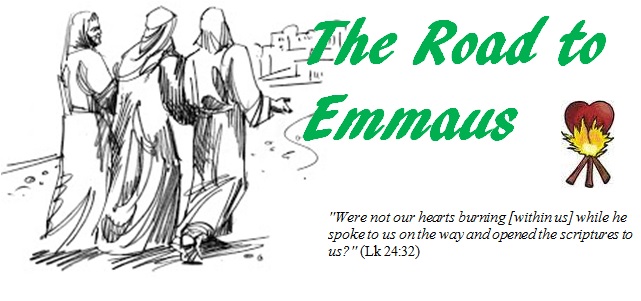
When he was at table with them, he took the bread. He blessed the bread, and broke it, and gave it to them. And their eyes were opened and they recognized him!(Luke 24:13-35)

Wednesday, January 12, 2022

Keep praying


Good grief!  The Israelites prayed and not only lost the battle to the Philistines; they lost the Ark of the Covenant, the "Ark of God." [1 Samuel 4:1-11]

The leper prayed to be healed, "if you will to do so, you can heal me" and Jesus healed him. [Mark 1:40-45]

What do these two scriptures tell us about prayer?  Is it that God only hears some prayers?  Is it that some prayers are more powerful than others?

No, I don’t think so.  The scriptures tell us to keep praying [1 Thessalonians 5:17].  Keep asking God for help.  We’re dependent on God, and He likes to hear from us. But a good thing to remember is that God moves in God's time, not ours.

The answer to the original question, does God hear our prayers, is definitely yes.  God hears us.  Maybe God chooses not to answer as we ask.  Perhaps there’s something that we can’t see that’s much better for us or for the person for whom we pray.  Perhaps our timing is off.

Maybe better prayers than one so specific, like "Please let my brother’s suffering end", is "give him what is for his good.”  Perhaps praying for the GOODNESS of whomever or whatever is most important.

We have to trust that God hears us and will give us an answer sometime—in His time—and look for the lesson in the ache of the need we pray to be healed.


Tuesday, January 11, 2022

Tired of flying blind?


At that time Samuel was not familiar with the LORD. [1 Samuel 3]

Rising very early before dawn, Jesus left and went off to a deserted place, where he prayed. [Mark 1]

It’s not too late to make New Year's resolutions.  But why make resolutions when we know we won’t stick to them?  I heard a therapist on TV answer that question: "We decide that we can be different when we get tired of not being different."  The motivation to change has to come out of some interior reflection, some inner desire.  And often this desire comes from being ready for something different because we’re tired of the way we are.

One of the biggest changes in Samuel's life was to recognize that the Lord spoke to him. For Samuel that meant several things that required change. Samuel had to now become a listener. And, once he heard the Lord's words to him, he needed to obey what he heard [1 Samuel 3:1-10, 19-20].

One of the great resolutions we can make is to listen to the Lord more attentively and to obey what we hear.  For most of us, this will take some real change.  It will take some "tuning in," much like finding a station on a radio.  That reminds me of a personal experience I had years ago.

There are times that I have been complacent in my duties as a Catholic.  There was quite a long period of time that I had not been to confession.  No particular reason, I guess I just didn’t feel the need to.  I was driving to Bakersfield from Stockton one Sunday night and, as was my routine, I was listening to a “news talk” radio station out of San Francisco.  All of a sudden, there was static on the radio in an area I was usually able to get reception in.  I started fiddling with the dial, and the only station that would come in static-free was EWTN radio.  The program was called “Sunday Night Live”, and the host (a priest) and his guests were talking about the Sacrament of Reconciliation.  I thought, “I’ll listen to this stuff until I get around Fresno and get my other familiar talk-radio channel to listen to all the way into Bakersfield.” When I got to Fresno, again the only channel that would come in was EWTN and it was another program talking about the Graces received by going to confession. The next day, all of my familiar channels were available again.  But I have never been one to ignore subtle hints (like being hit over the head with a sledgehammer), so I found the nearest church offering confession on Monday and took advantage of the Sacrament.  I have been going regularly ever since.

Once we practice listening to the Lord, His Word to us comes in "loud and clear."  Then the challenge is to obey what we hear.  Each of us can begin this new year asking, "What could it be that the Lord is trying to say to me that I'm just not listening to?  Or we can ask, "How could I slow down and get myself in a place where I'll be able to figure out what the Lord is saying to me?"  Perhaps we'll ask, "What is my head full of right now (arguments, conflicts, anxiety, fantasies, anger, fear)?"  Letting go of these might allow us to hear what the Lord is saying to us.  His message to me is usually "Peace, I just want to you to live with more peace and to know my love.  Then, I can call you to love others and bring my peace to them."  We can't hear His message if our heads are pre-occupied with all kinds of other stuff.

Just 35 verses into the gospel of Mark, Jesus goes off to pray alone.  Everything was moving quite fast for Him. He is baptized by John.  The heavens open and He’s confirmed by the Father.  He’s led by the Spirit to the desert where he is tempted but survives.  He calls His first disciples.  He confronts and drives out an unclean spirit.  He cures Simon Peter's mother-in-law, and all the people start to bring their sick to Him.  He just had to stop and reflect.

We can only imagine what Jesus talked with His Father about.  How did He thank Him for the experience of the baptism?  How did He "unpack" the experience of being tempted by Satan, so boldly, so blatantly?  How did He tell the Father what it was like to cure Simon's mother-in-law, and to see her get up and serve them?  Did He tell the Father that He learned from her that the gift of healing was to allow us to be free to serve?  It seems at the very least, He had a clearer sense of His mission and what He was called to do, after this time of prayer with the Father.

If we’ve been trying to live a life of integrity and self-sacrificing love without taking time to stop and pray, this is the time to make a new resolution to give ourselves that time.  Without time to step back and reflect upon our experiences and what they’ve meant, and what our Lord might be revealing to us through them, we’re like pilots flying without radar in dense fog.  Even though we’re moving at 500 miles per hour, we can't see where we’re going and we’re likely heading for a crash landing.  With little pauses throughout our day, and periodic times of deeper reflection, we can give ourselves greater clarity and insight.  And, gradually, God's desires will form in our hearts.  This can seem like a big change to make in our busy lives.  But we might just do it this year because we’re tired of flying blind so much.
Monday, January 10, 2022

Listening for the voice of God


Jesus came to Capernaum with his followers, and on the sabbath he entered the synagogue and taught.  The people were astonished at his teaching, for he taught them as one having authority and not as the scribes.  [Mark 1:21-28]

This passage in Mark’s Gospel talks about recognition, or more accurately lack of recognition.  When Jesus came to Capernaum and preached, the people didn’t know what to think.  They were amazed at His knowledge and His apparent authority, but they didn’t know where the authority came from.  They were intrigued by His words, but they didn’t recognize who He is.

The people were perplexed, but the demons recognized Him right away and understood that He was a danger to them.  They knew who He is and that He can command them and destroy them.  The unclean spirit (the “Dark Spirit”) said right away that Jesus is “the Holy One of God who has come to destroy us.”

But even then, the people didn’t recognize Jesus for who He is.  The word spread of this unusual event, but the people still didn’t know what to make of it.  They were expecting the messiah to be a man of might – a king maybe or a military man.  Someone who had great power and prestige.  And this man was from Nazareth, just down the road.  He was the son of a carpenter.  He was just like anyone else.  He didn’t look like anything very special.

But He was.  He was the holy one of God.  He could command even the unclean spirits and they were in fear of His power.  They knew the danger He was bringing them, but those who were seeking salvation didn’t recognize it when it came.

And would we?  Do we recognize God as He walks among us every day?  Do we recognize His voice bringing us wisdom or comfort?  The bad guys know Him and fear Him, but shouldn’t we who seek Him know Him as well, and follow Him?

Before I realize the Dark Spirit has even arrived, it’s telling me lies. “You’re not good enough. You’re not deserving of love.  Who do you even think you are?”  The sneaky work of the Dark Spirit is that these lies can be heard as truths, although we know they’re not.  My relationship with a loving God tells me the truth – I am enough, I am loved, I’m created in the image of God to be in relationship with the one who loves me.

But this happens to all of us, the Dark Spirit arrives, and we don’t have Jesus standing next to us to rebuke it and demand it leaves.  And here’s the hard part, the part that’s so much easier to say than to do.  When the Dark Spirit arrives, I can listen for the truth, for the voice of the Holy Spirit that I know lives within me, that reminds me over and over again: “You are seen and loved, for you are made in the image and likeness of God, who is Love.”  This truth is our life breath. It is our source of purpose and hope.

One thing that can make the doing of this ever more possible is the gift and tool of discernment that we can learn through constant prayer, the guidance of a spiritual director, and reflection.  Discernment of listening for the voice of God, the voice of Love and Truth, and noticing when what we’re hearing is not of God, rather, the lying voice of the Dark Spirit.  Deciphering between the two can be difficult, especially with the Dark Spirit being so sneaky.  However, putting into practice the tool of discernment, we may find it easier to notice when the voice is that of the Dark Spirit and then to rebuke it as we listen more closely for the voice of God.

As we stand in the holy places of our lives, may we be ever more attuned to the voice of Love and Truth as we rebuke the lies of the Dark Spirit with the strength and courage given to us through grace. 

Sunday, January 9, 2022

Trust in the Lord God

After reading the Old Testament story of Hannah [1 Samuel 1:1-28, 2:1-11] anew, I found the theme for my reflection today.  Hannah knew the value of the "holy complaint."  Childless, she was a laughingstock to Peninnah, the other wife of her husband Elkanah.  Even though she was her husband's beloved, Hannah's misery couldn’t be meliorated.  She wept.  She couldn't eat.  Her misery was palpable; she had no children.  She poured out her bitterness and sorrow to the Lord and promised that if the Lord would just bless her with a son, she would dedicate him to the Lord forever!

Elkanah, her husband, couldn’t understand her grief.  "Why do you grieve?  Am I not more to you than ten sons?"  He didn't get it.  Neither did Eli, the priest of God.  He thought Hannah was drunk as she prayed silently before the Lord, pouring out her heartaches, only moving her lips.  Little did Eli know that his own family's line of priest-descendants would be replaced by Hannah's!  Little did Hannah know that new life would issue from her womb, that she would bear not just one, but four sons and two daughters, and that her shame would be turned to profound joy!

Before the Lord, Hannah's prayer of petition was sacred.  Her holy complaint was the beginning of profound "reversals" in Israel's history.  The greatest would be least; the last would be first.  "The bows of the mighty are broken, while the tottering gird on strength.  The well-fed hire themselves out for bread, while the hungry batten on spoil.  The barren wife bears seven sons, while the mother of many languishes." [Hannah's prayer, 1 Samuel 2:4-5]

Hannah's first-born son, Samuel, would be a true servant of God and the greatest of all Israel's judges.  He would warn the Israelites to return to their worship of the one living God, and only he could purify the place of worship so that the Ark of the Lord could be returned to their midst.  He would anoint Saul, from the smallest tribe of Israel, and Saul's successor, David, a shepherd boy, who would become the greatest king in the history of their people, and the forerunner of the promised messiah.  Hannah's boy did all this; he was the first-born son of a woman whose prayer of lament was heard by God.  And in the end, she returned her son to God.

"'I prayed for this child, and the Lord granted my request.  Now I, in turn, give him to the Lord; as long as he lives, he shall be dedicated to the Lord.'  She left him there (in the Temple of the Lord)." [1 Samuel 1:27-28]

As I reflected on Hannah’s story today, five lessons became clear to me: 

1) We are God's beloved.

2) God listens to our cries.

3) We should be open to new life, especially when hopelessness abounds.

4) We must learn to expect the unexpected.

5) We should always return and give thanks to God by sharing our gifts with others.

"How shall I make a return to the Lord for all the good he has done for me?  The cup of salvation I will take up, and I will call upon the name of the Lord." [Psalm 116:12-13] 

Saturday, January 8, 2022

Deeply loved by God

Imagine Jesus leading you down the bank and into the Jordan River to be baptized with Him.  Then picture yourself coming up from the water to hear God’s voice, “This is my beloved son [daughter], with whom I am well pleased.” (Luke 3:15-22)


What a powerful, yet simple message:  I am good.  The truth is that we all are, whether we believe it or not.  We’re good people who sometimes make bad decisions, but we’re good nonetheless.  As sons and daughters of God, we can all meet Jesus on the bank of the Jordan river, we can all sink deeply into those life-giving waters, shed our failures, and re-emerge knowing we are good, we are loved, and we are God’s.


Most importantly we re-emerge, made new and ready again to pursue the mission God has laid before us.  Just as Jesus began His ministry after His baptism, we too are called to share the Gospel message of love and hope with everyone we meet from the moment we’re baptized to every relief-filled moment after we leave the confessional.  But the Baptism of the Lord goes beyond these Catholic sacraments: It’s a message of rebirth and re-missioning for all Christians and every person, whether they know it or not, because we’re all deeply loved by God.

Friday, January 7, 2022

Recognizing the greater glory


For over 20 years I held a position in my company which came with many responsibilities, not the least of which was helping to interview and hire new general managers to run their own facilities.  Since I had over 25 years of general management experience of my own, it also fell to me to teach them policies, programs, and procedures, and make sure they knew what was expected of them.  As these folks adjusted, they needed me less.  However, I sometimes found myself struggling to adjust to the newbies being so self-sufficient.  I would butt in where I wasn’t needed, and this caused some tension on more than one occasion.  Once I realized my error, I backed off and the issue would be resolved.  Unlike John the Baptist, I didn’t know my place [John 3:22-30].

John knew that his job was to lead people to Christ.  He wasn’t concerned with being overlooked or being considered second best, just as the best man is happy for the groom instead of being jealous that it isn't he who is getting married.  The scripture even ends with the powerful statement that he, John, must decrease while Christ must increase.  Imagine the confidence and self-awareness that John had in order to say this.  It’s easier said than done, of course.  Even John must have been tempted by the crowd. They wanted him to be envious of Jesus baptizing people, but John stood firm and reminded them that he was sent before Christ, not to be Christ.

I think that this is a struggle that we all encounter in different ways in our lives today.  It could be beneficial to examine why we do the things we do in work, school, and our community.  Are we doing things for the recognition it will bring us, instead of for the betterment of those around us and the greater glory of God?  While I’d like to hope that my own answer is not the selfish one, that side of me certainly wins occasionally.

Lord, please give me the wisdom to know my role in this world, and the courage to lead others to You.

Thursday, January 6, 2022

Lord, I believe. Help my unbelief!


It happened that there was a man full of leprosy in one of the towns where Jesus was; and when he saw Jesus, he fell prostrate, pleaded with him, and said, “Lord, if you wish, you can make me clean.”

Jesus stretched out his hand, touched him, and said, “I do will it.  Be made clean.”  And the leprosy left him immediately……. [Luke 5:12-16]

As I was reflecting on this Gospel today, I thought that it’s a good thing Jesus lived 2,000 years before TV and the Internet. I imagined this healing story spreading instantly worldwide.

 It would be an absolute nightmare.

Word would first get out via email then spread rapidly to social media and leprosy websites.  From there it’s a short jump to CNN worldwide – and the media frenzy to track down this Jesus and investigate His claims would be on.

When Fox finds the former leper, its exclusive interview with him will become the day’s top story.  This will prompt two or three major newspapers and competing networks to investigate the wild claims.

Frustrated when calls to Jesus’ cell phone are not returned, they’ll stake out Mary’s home in Nazareth but all she knows is that He had withdrawn somewhere to pray, as He usually does.  He didn’t tell her where that was, exactly.  Meanwhile other cure seekers who had heard about the miracle on CNN were besieging her and she couldn’t even go to the well for water.  Why would Jesus do this to his mother?????

Since they couldn’t find Jesus, reporters speculated about why He had gone into hiding.  No one believed Mary’s tale about Him going off to pray.  Was He doing a deal with a competitor?  Had He fabricated the entire episode?  Was He with His advisors (the Apostles) trying to spin the story?  Was He a psychotic in need of care?  Was He a menace to sick people who would abandon scientific treatment for a faith cure that was certainly delusional?

You take it from there.  I can’t even fathom the memes that would be circulated!

This Gospel asks us to ponder root questions which fast-forwarding 2,000 years highlights.  Do we really believe in Jesus?  Would we believe in Him if he were a contemporary?

We live in a skeptical age.  We suspect miracles and distrust anyone who claims to speak or act for God.  We believers walk a fine line between faith and credulity.  When we ponder accounts like the one in Luke’s gospel, we may find ourselves repeating the old prayer: “Lord I believe. Help my unbelief.”  [Mark 9:24] 

Wednesday, January 5, 2022

Anointed and sent


What struck me today as I read Luke’s gospel were the words pointing to the central role of the Holy Spirit in Jesus’ life. “Jesus returned to Galilee in the power of the Spirit…” and as He read from the scroll handed to Him this quotation from Isaiah “The Spirit of the Lord is upon me, because he has anointed me….He has sent me…” [Isaiah 61:1-2] and there follows the wonderful series of blessings: glad tidings to the poor, recovery of sight to the blind, let the oppressed go free, proclaim a year acceptable to the Lord.” [Luke 4:14-22]

It seems Jesus senses the Spirit is intimately one with Him, moving Him to amazingly announce to the assembled: “Today this Scripture passage is fulfilled in your hearing.”

Jesus lives and moves in the power of the Spirit.  This courageous proclamation spells out Jesus’ mission, His life purpose and ultimately will result in His death.  All in the power of the Spirit.  Anointed and sent.

There have been times when I’ve uttered words that seemingly came “out of nowhere,” words of comfort when I volunteered at the hospital as a Eucharistic Minister, words of love or forgiveness that surprised me even as I uttered them…where did that come from??  My hope is that those times when I was better than I expected, more loving than is my custom, more forgiving than my recent ruminations on times of personal slights would seem to allow – that perhaps that was the Spirit nudging me out of the way, showing the Way.  Letting me move in the power of the Spirit.  We can all claim this.  After all, we also are anointed in Baptism and sent in Confirmation.

May we all walk the way Jesus walked, in the power of the Spirit.  Anointed and sent.  All love and healing.

Tuesday, January 4, 2022

God, other people, and me


For me, the beauty of the Scriptures is finding out that no matter how many times I’ve read a certain passage, I can walk away with an entirely different message each time.  Today, I was reflecting on the First Letter of Saint John, and I was drawn to his simple, yet powerful message of love [1 John 4:11-18].

There are only three people in the world: God, other people, and me.  In the manner of Jesus, I present a modern-day parable: A wealthy friend lives in a distant city and yet watches over me with great care and generosity.  When I asked what I could do to show my gratitude and to repay that generosity, my friend said that he already knew how much I depended on him and appreciated his help and that he already had all he could ask for.  But, he said, he had another friend who lived right next door to me, and he would appreciate it if I could care for that other friend.

God has loved us and done all that He can to raise us up to be His healthy, happy, and mature children.  There’s nothing we can really offer Him in return: He doesn't need glory and He already has anything that we could give to Him, but He does want us to love our brothers and sisters living right next to us, imitating His own love.

When we do that, we show that we are truly our Father's children.  We give without asking whether our sister or brother is worthy or not, we love without judging whether our gift is fully appreciated, and we remain faithful to them without counting the cost.  Or at least we try as hard as we can to do so.  It’s only in this way that we can appreciate God's own love for us and grow to its full measure, only thus that we can fully accompany Jesus in His own saving and seemingly often thankless mission.  And it’s the only way that we can really give God the thanks and glory that He deserves for all of His love for us.

God is love, and the one who abides in God abides in love, and God in him.

Monday, January 3, 2022

Trust God in all things


Trust is required of us on many levels.  It’s required on the level of receiving all the spiritual, emotional and psychological strength we need to not only survive each day but also to thrive in many ways.  Trust is also required on the level of God providing for our basic day-to-day needs such as food, shelter and clothing.  For most people, these areas of trust aren’t difficult, but for others it requires a tremendous amount of surrender.

There’s a Gospel situation that provides a context in which Jesus was able to test the trust of His disciples.  At first, they failed the test by panicking and asking Jesus to send the crowds away to obtain food, but in the end they were awe-struck as they saw the providence of God at work.  In the end, Jesus multiplied five loaves of bread and two fish so as to feed over five thousand [Mark 6:34-44].

First of all, this Gospel doesn’t tell us that we can be irresponsible in providing for our own needs and simply trust that Jesus will miraculously provide for us all the time.   It’s not about abandoning our own duty to work and provide for ourselves and our families. 

What this Gospel is about is trust.  In this context, the followers of Jesus were being drawn to put their eyes on our Lord and be with Him.  They were being drawn, spiritually, to abandon all cares in life in that moment so that they could be fed spiritually.  They were being invited into an act of faith, and it’s clear that the crowds were, indeed, trusting in this interior invitation.  It’s clear by the fact that they were still with Him despite their evident physical hunger.

One key message, therefore, is that God sometimes calls us to trust Him in ways that don’t seem to be immediately practical and logical.  The practical thing to do would have been to leave and acquire food for themselves.  But the supernatural call of grace, at that moment, told this group of over five thousand that they should remain with Jesus and trust that all would work out.  And that’s what they did, and it did work out.

God sometimes calls us to follow Him in ways that don’t immediately make sense.  We shouldn’t be surprised if we sense, at times, God calling us to listen more intently to His promise of providence than our own natural deduction of human logic.  God’s ways are far above our ways [Isaiah 55:9].  Sometimes His call is radical, and when we’re deeply convicted in faith that God is calling us to trust Him, then we must do it.  Trust Him in all things and He will always provide for us [Proverbs 3:5-6].

Sunday, January 2, 2022

The importance of loving each other


In the first letter of John, we learn the absolute importance of loving each other [1 John 3:22--4:6].  We can no longer say we only love God; loving God and loving our brothers and sisters go together.  It takes faith to believe in God and also to believe that by loving one another, we’re keeping His great commandment.  He came to teach us this and insisted upon this even to His death.

In Luke’s gospel we see Jesus boldly step to the front of the Synagogue, unroll the scriptures and read a prophesy which tells of the one who is to come healing, liberating and preaching.  In front of the whole assembly Jesus proclaims to His friends and neighbors that He’s the one for whom they and all Israel have been anticipating and longing.  They were all amazed and spoke well of Him [Luke 4:14-22].

 Jesus had heard in His prayer and at His entering into the waters of the Jordan for His baptism, that He was the beloved of His Father [Luke 3:21-22].  The recovery of sight, the captivity from which He was to free people, all the things He was destined to do according to all the prophets [Isaiah 42], centered around His boldly announcing to all that they too were the beloved of the Father.  Believing in Jesus means believing also in all that He came to tell us about ourselves and His sisters and brothers.  Loving in the abstract is very easy.  Loving each of His family and making ourselves part of the family of God is not only bold, but disturbing.

There are certain passages of the teachings of Jesus that we might wish He had never said.  If He had said that we only have to love the attractive ones and that would fulfill the law of God, that would be fine.  If loving God could mean just praying or staying to ourselves, that would have been difficult enough.  Our selfish restrictive love and our patterns of simple human judgments get re-formed, and that process is very uncomfortable.  There He stands telling His neighbors and ourselves that He is going to unblind us about who are to be loved.  He tells us today to be ready for a liberation which will free us to love God by loving that person and those kind of people and persons who differ in many ways from ourselves.

These are hard sayings today and we take our turn marveling at His teaching and pondering what will He ask next of us.  We are the beloved of God, and we’re sent to boldly continue standing up in all kinds of places and live His love.

Saturday, January 1, 2022

Interconnected in a common life


A major theme in Matthew’s gospel is that God’s salvation extends beyond Jesus’ immediate Jewish community to include the Gentiles as well as the Jews.  In other words, God’s love embraces all.  The visit of the Magi is a message of inclusion at the very beginning of Jesus’ life.  We hear this message of inclusion again in Jesus’ final commission: “Go and make disciples of all the nations, baptizing them in the name of the Father and the Son and the Holy Spirit. Teach these new disciples to obey all the commands I have given you”. (Matthew 28: 19-20)

Saint Paul wrote to the Ephesians: “the Gentiles are coheirs, members of the same body, and copartners in the promise in Christ Jesus through the gospel.” [Ephesians 3:2-6] In God’s mind, there are no insiders nor outsiders.  As members of the same body, we’re interconnected in a common life.  So, as we begin 2022, how does the feast of Epiphany’s message of inclusion effect our relationships?  Do we really believe God is calling us to an ever-deepening inclusion, to extend our arms and hearts as Jesus did, to embrace the whole world?

And so, we may ask ourselves:

Are most of our days spent with those who look like us, live like us, worship like us, and think like us? The Magi went way beyond their comfort zones in search of Jesus.  Can we do the same?

Do we trust that we will gain from being with those different from ourselves?  Can we make the commitment to hone our skills in dialog, and in cultural literacy this year?

As citizens, where does the message of Jesus’ Epiphany lead us this year?  Will the public policies we choose to support serve to break down the barriers to inclusion in our own country and around the world?  Will the suffering of those discriminated against because they are “Other” disturb us to action? Will we hear the calls from those on the margins of this world?

May all our travels of the heart and mind and soul this year end as happily as they did for the Magi:

They were overjoyed at seeing the star, and on entering the house they saw the child with Mary his mother. They prostrated themselves and did him homage. [Matthew 2:1-12]

Friday, December 31, 2021

The Mother of God


 Mary, the mother of Jesus, the mother of the Saviour of the World, is properly called the “Mother of God.”  It’s worth reflecting upon this powerful title of our Blessed Mother, especially on the first day of the new year.  And it’s important to understand that this title says just as much about Jesus as it does about His Blessed Mother.  


In calling Mary the “Mother of God,” we especially acknowledge one fact of human life.   A mother isn’t just the source of one’s flesh, she isn’t just the mother of the body of her children, she’s the mother of that person.  Being a mother isn’t just something biological, it’s something sacred and holy and is part of the divine order of God’s creation.  Jesus was her Child and this Child is God.  


Therefore, it’s proper logic to call Mary the “Mother of God.”

It’s an amazing fact to think about.  God has a mother!  He has a particular person who carried Him in her womb, nursed Him, raised Him, taught Him, loved Him, was there for Him, and pondered who He was throughout His life. This last fact is especially beautiful to look at.


The Gospel says, “And Mary kept all these things, reflecting on them in her heart.”  (Luke 2:16-21).  And she did this as a caring mother.  Her love for Jesus was as unique as the love of any mother.  She was a mother in perfection and loved Him with a perfect love, He who was not only her Son, but was also God and was perfect in every way.  The motherly love shared between Mary and Jesus was profound, inspiring, mysterious, glorious and truly sacred!  The mystery of their love is worth reflecting on throughout our lives, keeping it fully alive in our hearts.  She’s an example for every mother and is also an example for all of us who seek to love others with a pure and holy heart.  

Thursday, December 30, 2021

Resolutions for 2022 (and beyond)

Children, it is the final hour.  (1 John 2:18-21)


Here we are, sitting on the last moments of 2021.  Tomorrow is New Year’s Day.   It’s traditionally the day for making resolutions.


For me, I suppose I’d begin by reflecting a bit on these 365 days – the good and the bad – the moments I’ve savored, but also those moments I really just don’t want to taste anymore.  The more I think, the more I’m reminded of all the insanity of these last months – murder, hate, disaster, and also the “Holiday Season” which is chock full of Black Friday fighting, and “I didn’t get what I want for Christmas,” and what seems like a sorrowful loathing and even anger at just anticipating family gatherings.


It really amazes and saddens me how cluttered our lives, as a society, have become with things like selfishness, consumerism, inconsiderate behavior, lack of understanding of other people, rejection, hate – the list goes on and on.  And no matter who we are, we’re all guilty of these things from time to time.  I try hard, but I so often fail to live like the man God wants me to be.  There’s so much cluttering our hearts that we’re just overflowing.  There’s no room for anything else.


Jesus wants to live with us… rather, within us, as we’re reminded in John’s Gospel, “And the Word became flesh, and made his dwelling among us.”  (John 1:14).


To me, it’s like a slap in the face.  “Steve, do you have room?”  Is there space in the inn of my heart?  Is Jesus able to make His dwelling in me?


Thinking about that, I realize I sure have a lot of cleaning to do…  So much so, that perhaps making some resolutions would be the prudent thing.


So, then, here are my resolutions:

    • Lose Weight:  I’m going to drop the weight of hurt and hate and live the lightness of Joy.
    • Clean the House: I’m going to sweep the junk from my mind and soul and make room for love and peace.
    • Stop Smoking: I’m going to stop burning myself up and allow time to rest and pray.
    • Eat Healthier:  I’m going to feed my spirit with the healthy words of life.
    • Be A Better Person: I’m going to treat every person I meet like they are Jesus; with love and mercy.


Wednesday, December 29, 2021

Anticipation and rewards

We look forward to Christmas, to the birth of the Child Jesus, for the feeling of anticipation in awaiting the arrival of the Savior of the world. 


We realize that as we age, we appreciate the joy of seeing others receiving gifts, rather than that anticipation from our youth of receiving. 


Many of us have experienced the feeling of anticipation – whether it’s waiting for Christmas morning, a new birth, a new job, celebrating the vocation of marriage or the religious life. 


My reflection today is about the anticipation and reward of Simeon, who spent his life awaiting the fulfillment of the promise that one day he would see Christ – and the fulfillment of his promise was more than he expected as he not only met Christ but held Him in his arms (Luke 2:25-35)! 


And then there was Anna, a widowed woman who spent her entire life serving as a witness to Christ.  Even though Anna was able to enjoy her marriage for only seven years, and was left childless and alone, she spent the rest of her life living the choice to serve God through her prayer and praise, in never-ending anticipation of His merciful grace.  She specifically moved to Jerusalem so she could be near the temple!  Anna’s sole purpose in life was to please God.  She was a constant presence at the temple, in a state of fast and prayer (Luke 2:36-38).  William Barclay once wrote: She had known sorrow, but she had not grown bitter. She was old, but she had never ceased to hope. She never ceased to worship. She never ceased to pray.


As Simeon received the Christ child and lifted Him up to declare Him as the long-awaited Messiah, Anna was there in the right place (the Temple) at the right time (as Simeon received Christ in his arms).  Anna knew at that very moment that her prayers of seeing Christ had been answered, and she continued her ministry in sharing what she had seen. 


One of the meanings of the name Anna is grace – how very, very appropriate.  May God’s grace fill us as it did Anna, and may we have the dedication to our Lord, as did Anna, in service to the Almighty God in anticipation of His merciful reward.  God bless us all!

Tuesday, December 28, 2021

Simple obedience


The Covid pandemic is nearing two years old, and with it a string of ‘suggestions’ has turned into ‘rules’, ‘regulations’, and even ‘laws’.  Social distancing, getting vaccinated, and wearing masks while indoors have made many in our country question our freedoms.

Rules. Regulations.  Our lives are full of them, and our American sensibilities caution us that we have freedoms, that we don’t have to be guided by so many laws and commandments.

Do I really have to spend so much of my life with rules?  All I want is to make my life a Yes to God and everything God is asking of me.  Sometimes the rules even seem to get in the way of that.  

Then I look at my life and the things that mean the most to me.  Certainly there are laws for protecting my children.  But do I care for them because of those laws, or because I love my daughters and grandchildren so much?  And don’t I love my wife and honor my marriage not only because I took a vow to her but because I want to be faithful to our commitment to each other?

The New Testament readings I chose to reflect on today are not as much about the laws of God or the laws of the Church as they are about being faithful to God, a fidelity that’s lived out every day.  Saint John spells it out clearly.  We can really know Jesus if we live as He did, love as He did, forgive as He did [1 John 2:3-11].

In Luke’s gospel we see Mary and Joseph following the laws, being faithful Jews, and taking their firstborn son to the temple [Luke 2:22-35].  They didn’t go because they had to.  They wanted to because following the law was just another way of being faithful to God and giving thanks for God’s faithfulness in their lives.  This is how they began their lives as parents who raised a son whose whole life was a Yes to God.

Maybe we aren’t really saying Yes to Jesus every day if we’re harboring deep resentments and angers against others or even against laws.  Those can be barriers to our finding God in the darkness and emptiness of the stable.  Somewhere in the dimly lit corner of our hearts, in that painful place we don’t want to go, we can turn to Jesus and ask for the grace to forgive someone.  We can ask for patience to turn a deep suffering into a piece of the Paschal mystery that is so much a part of the Christmas story.

In these quiet days after Christmas, I ask for the ability to see clearly how I can best serve God, how I can be faithful to God.  I ask for the grace to be less arrogant about what’s right and what’s wrong and more faithful to the simple obedience God asks of me.

Monday, December 27, 2021

The threat of Christmas


The threat of Christmas looms in the Gospel I reflected on today [Matthew 2:13-18].  The threat of Christmas...  The words sound awkward.  To be sure, the sentiment they express is wholly unpleasant.  And yet this threat represents the good news of today.

We’re just days away from the Christmas miracle.  We gathered as Christian believers to celebrate the great event of Christ present in our lives.  Our Advent-hearts rejoiced in response to a bold reality; God those many years ago came crashing into our world and our lives in a way entirely new.  We call that day the incarnation: God present in flesh and blood as Jesus the Christ.  Its a promise made good; an Old Testament promise of Gods to His people.  Those prophets were right!  God sent us that savior, a Messiah, our King.  We didnt quite expect the circumstances as they unfolded –a weary, dejected couple and their tiny babybut God came through on that promise of old.

That promise and its manifestation demonstrates Gods love for us . . . a love which provides an only son sacrificed to redeem our lives and offer a gift of salvation eternal.  Its a love that is radical and reckless.  Its abundance engulfed our world that first Christmas morning and continues to do so today.  This love, this care for humankind, this gesture which comes without condition is precisely the Christmas threat of todays Gospel.  Its a threat to affairs corrupt and profane.  Its a threat to relationships immoral and indignant.  Gods love incarnate as Jesus the Christ and the subsequent power of such an influence represents the Christmas threat to injustice at every twist and turn.  It’s this threat which spooked Herod and his reign of domination.

Matthew asks us to remember Herod today and his sad command.  The Church asks us to remember those Holy Innocents and martyrs who died in and of the name of Christ.  God asks us to remember His love for each and every one and to share with Him in such an enterprise.  To do so threatens injustice in its ways both blatant and subtle.

Saint John gives us hope for a world that seems surrounded by darkness [1 John 1:5--2:2].  Hope because there’s light in the world that brightens the darkness.  For all the evil acts that blacken the world around us there is Gods light shining through people who stand for justice, truth and love.  These are regular people like you and me, coming from all faiths and cultures who brighten the dark places of the world.  We brighten the world because we stand-up against injustices, pursue Gods truth, and reflect the love that God has for each one of us.  We’re not saints, but we are people who care, we’ve been touched by Gods love and want to share the gift.  By sharing Gods love we’re lighting up the world.  As we celebrate the Christmas season and the birth of God among us, we can be confident that the light we bring to the world is making a difference.  Even those small daily acts of love, truth, and justice shared with family, friends, and strangers are sending sparks of light into the world.  We cant undo the horrors of yesterday, but we can bring light in the world today.  The world needs us to bring Gods love, hope and light into every situation we encounter.

Sunday, December 26, 2021

"and he saw and believed"


Because today is the feast of St. John the Evangelist, I read John's own account of the visit that he and St. Peter made to the tomb of Jesus on Easter morning [John 20:1-8].  The words of St. John are appropriate for his feast day because they tell us a lot about him.  St. John is presented as a very perceptive person who had listened carefully to the words and teaching of Jesus and had become a faithful follower of the Lord.  This whole section of his gospel reveals St. John in a very favorable light.  He was a person whom I would like to imitate in his faithfulness and devotion to Jesus.

When I read this scripture story my attention was drawn to the last words of the story: "and he saw and believed."  In these simple words St. John tells us a lot.  He tells us that the arrangement of the burial cloths and the head covering that had covered the body of Jesus led him to understand that grave robbers had not been at work here.  It also led him to conclude that the Roman authorities had not moved the body of Jesus.  If either grave robbers or the Romans had moved the body, they wouldn’t have removed the burial cloths and the head covering.  And they wouldn’t have undone the work of Nicodemus and Joseph of Arimathea to embalm the body [John 19:38-42].  All of this John realized as soon as he entered the empty tomb.  This demonstrates St. John's perceptiveness.  Neither St. Peter nor Mary Magdalene was able to draw such a conclusion.  Indeed, Mary speaks as though convinced that someone had moved the body.

St. John listened very carefully to the words and teaching of Jesus.  On this occasion he must have recalled the words of Jesus when He predicted His Resurrection.  He was also a faithful disciple of Jesus who was absolutely convinced that following Jesus was the most important thing in his life.  And so, because of what he saw and what he believed, St. John concluded that Jesus Himself had somehow arranged for the empty tomb, and that He had indeed risen.

The others believed when they saw the risen body of Jesus on that first Easter day.  Mary Magdalene saw Jesus in the garden after Peter and John had left [John 20:11-18].   The disciples on the road to Emmaus saw Jesus that evening [Luke 24:13-35].  St. Peter and the other apostles (except Thomas) saw Jesus that night in Jerusalem [John 20:19-24].  But St. John came to believe when he entered the empty tomb on Easter morning, hours before his first sight of the Risen Lord that night.  For me, there is deep meaning in the words of St. John when he says very simply: "he saw and believed."  During his life St. John gave us an outstanding example of how to follow Jesus.  Today on his feast we can ask St. John to help us to follow his example and to have the kind of faith and devotion to Jesus that he did.

Saturday, December 25, 2021

The journey begins


As I sit at my computer tonight after a long Christmas Day filled with family gift-giving and fun, I’m regretting the practice of discarding all things Christmas so soon after December 25, as if the journey is complete.  Maybe it’s because we begin celebrating the holy day six weeks or more before the feast that, by the time Christmas Day comes and goes, we’re done.  Trees are discarded to the curb, wreaths and stockings are packed away, wrapping paper and creche are stored until next year.

But for me, as I grow older, I cherish the days that take us from the Nativity to the Epiphany, perhaps more so in this unbelievably difficult year.  These are the days that carry the most Christmas meaning precisely because the hype is over and life calms down.  It’s this image of “the journey” that resonates within me.  It’s a journey that can only begin with the birth of Jesus.

Certainly, Mary and Joseph making their way to Bethlehem and the journey of the wise men come to mind, but so too the journey the Holy Family took to Egypt to seek safety.  Less known—but certain nonetheless—is the journey back to the fields of the shepherds where they shared their experience at the manger in Bethlehem.  I recall an old move (perhaps 30 years ago?) movie starring Martin Sheen, The Fourth Wise Man, the story of another wise man whose own journey to Bethlehem was waylaid only to find Jesus, finally, in Jerusalem on the Cross.

“It’s the journey, not the destination” is a familiar saying that urges us not miss what is happening now, not to be blind to the graces in the moment.  Christmas didn’t end yesterday; it only just began.  It’s okay to put away the Christmas decorations, but maybe we can see that as preparing ourselves for our own Christmas journey in the days and year ahead.  What experiences of the birth of Jesus will I share with those I encounter along the way, on my Christmas journey that begins today?