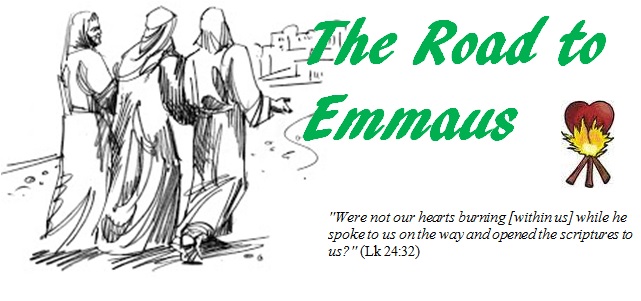
When he was at table with them, he took the bread. He blessed the bread, and broke it, and gave it to them. And their eyes were opened and they recognized him!(Luke 24:13-35)

Monday, January 4, 2021

The Love we need is the Love we give


The Scriptures I’m reflecting on this week prompt us to continue the good feeling we’ve had during this Christmas season, despite the pandemic.  Now that the Lord has come and is manifested to all who believe, they’ll hear His message to hear the cry of the poor.  In this way we join all others in the world in our worship and adoration of the Savior.  Now, in early January after the Epiphany we see that love is like the five loaves and two fishes – there never seems to be enough food to go around until we start giving it away.

Back in the 60’s, the Beatles sang, "All you need is love."  But the “love” that John Lennon wrote about was more of a love borne of relativism, than one of Truth.  Some two thousand years earlier, John, the disciple that Jesus loved, was also saying that all we need is love.  But he had it right—God is love.  And this is the love we truly need (1John 4:7-10).  

Love is the bond that allows us to interact with each other, whether in the workplace, at home, or among friends.  It’s also this sacred connection that allows us to be intimate and to understand our Creator (as much as our finite minds can understand Him).  And in the same way, just as God wants to continuously remind us that we’re truly and uniquely loved by Him, we must also practice this same value with each other.

In Mark’s account of the feeding of the five thousand, Jesus first said to His apostles: "Give the people something to eat" before the miracle occurred (Mark 6:34-44).

It's strange that Jesus would say something like that just to make the point that they (the apostles) could hardly begin to feed such a multitude and to point up that, "Oh, by the way, watch Me and see what I can do."

Obviously, Jesus didn’t mean that. So what did He mean when He told the apostles to give the people something to eat? Of course we don't know for sure, but it seems He was exhorting the apostles to do "something" to help, something to alleviate the problem of the moment.

About the only thing they could do was to search out what little food was available and make it available to the Lord who can do all things. I think that’s the lesson for us, to put our gifts however seemingly small and insignificant at the disposal of the Lord who can multiply beyond our belief what little we thought we had.

Very often, in our own personal circumstances, we despair at the little resources we have, be it time, money, talent, or knowledge.  We think that if only we had "this", or we were like "that", we would achieve our goals.  Yet each day we're called to use what we're given -- even though it may be little -- and God will bless and multiply our efforts according to the purpose He desires.

In the face of daunting and mind-challenging obstacles like most of us are facing in this day and age, we mustn’t stop and despair, but continue to use all the resources that are available to us and just trust in the Lord that He’ll make up for our discrepancies and shortfalls according to His holy will.

How very blessed we are to have a God and Creator that loves us so much that if we remain in love, we remain in Him and He in us (1John 4:13)!  How truly blessed we are that He loves us unconditionally even when we don't deserve it!  How truly blessed we are that He loves us—man and woman, black and white, rich and poor, young and old.  How truly blessed we are that He loves us so much that He gave us His only Son as ransom for us and our sins.

We are not measured by how much we do for one another, but by God’s grace. Wouldn’t it be great if we practiced the same love we’re given by God with our brothers and sisters?  Whether it’s saying 'hi' to an old friend, getting to know your boss a little better, or striking up a conversation with a co-worker that you see sitting by him or herself at lunch, let people know that they’re loved.  And just as Jesus fed over five thousand people with only five loaves of bread and two fish, let’s practice giving to those in need, spiritually or emotionally.  We may be imperfect and flawed, but in every moment of every day we’ll always be deeply loved by the One who knows all things.

Every nation on earth will adore the Lord God when his people follow his teachings to bring peace and justice to all and defend the afflicted and the children of the poor (Psalm 72:1-8).  What a concept! Instead of complaining that someone is “undocumented” and labeling them “illegal” or “criminal” when all they’ve done is come to our country to make a better life for themselves, why not find a way to bring them into the fold of Christ’s mercy and justice?  Like the loaves and fishes, the love we show them can only multiply if the love is given in Jesus’ name.

Sunday, January 3, 2021

True or False?


Every one of us is moved by a single desire or yearning that goes deeper than any of the little things that we use and do to satisfy ourselves.  If we can imagine all our wishes granted—a vaccine for COVID, food, shelter, safety, human love, health, strength, beauty, a return to ‘normalcy’—we find that there’s still an emptiness in our hearts, and that we need to seek a satisfaction there beyond the things of this world.

As I reflect on the beginning of Jesus’ ministry in Matthew’s Gospel (Matthew 4:12-25), I’m reminded of a quote by Saint Augustine, who in the opening words of his Confessions, says, "Lord, you made us for yourself, and our hearts are restless until they rest in you."

To reach that point we need to set aside the things of this world, at least insofar as they are our priorities.  Yes, we need food, health, strength enough to live, and all the rest, but more fundamentally we need to re-form our lives in such a manner that these things are secondary and that knowing, loving, and serving God is primary: that’s the only way that we can truly be at rest, be satisfied, be fulfilled.  It demands a separation from things, an ending to our attachment and even dependence on them that can seem like poverty in the eyes of the world.  We also need a poverty of self, putting our will and our values in the hand of the Father.  This isn’t a quietism but a foundation for the most trustworthy way of being active in our lives.

In the First Letter of John we hear how to know the spirit of Truth and differentiate it from the spirit of deceit.  So that we don't have to struggle, fret, or worry whether we've got it right, the answer is given, simply.  The way we know a spirit of truth is by what it says (1 John 3:22–4:6).  Does it acknowledge Jesus as the Son of God, born of the Virgin Mary?  Jesus, who was crucified, died, buried, and raised up on the third day?  Who ascended into heaven and sits at the right hand of the Father?  If a spirit confesses this, it’s The Spirit of Truth, The Holy Spirit.  It’s the same Spirit Who innervates the Church, gives Her life, preserves Her, protects Her, guides Her.

So how do we know that we’re living this life in the best way?  When we believe that we’re children of a loving Father, that we’re brothers and sisters of the living Lord and Older Brother who is our model for being human and our gentle Shepherd, and that the Blessed Spirit that Jesus has given us guides us with amazing warmth and care if we so desire. 

Saturday, January 2, 2021

Stars abound


“See, darkness covers the earth, and thick clouds cover the peoples; but upon you the LORD shines, and over you appears his glory.”  (Isaiah 60:2)

Sounds like the world today, doesn’t it?  There’s so much darkness in our world –the ongoing pandemic, wars, hunger, homelessness, sex-trafficking, divorce, suicide, child and elder abuse . . .  the list goes on and on.  The news doesn’t help.  Rather than show inspirational stories, they seem to dig up the worst to show us.  I rarely watch the news anymore because it’s so depressing.

Astronomers tell us that there are some 300 billion galaxies in the universe comprised of trillions of stars.  Our closest star, the Sun, provides heat, energy and lights our way.  When I was a kid in the Boy Scouts and ‘sleeping under the stars’, I loved to watch for shooting stars (actually meteors.)  When I saw one, it felt like I was especially blessed.

In addition to these celestial bodies, we also call some of our leading actors and some professional sports figures “stars”.  That’s exactly our role as disciples of Jesus, to be a star.  Like the Sun we’re to be a light in a dark place.  By our attitude and generosity, we can bring blessings to others.  Like the star in Matthew’s Gospel (Matthew 2:1-12), we have the opportunity to use our talents to point people to Jesus.

The Magi represent us all.  I heard a sermon on Epiphany once when the priest asked, "What made the wise men wise?”  He followed that up with his answer, “They looked up!"  In other words, they were looking, watching for their star.  Stars abound.  

God has a way of leading, guiding and speaking to us through the fine arts, poetry, novels, creation, people, and music.  I have always been spellbound by Franco Zeffirelli’s TV mini-series “Jesus of Nazareth”.  The same is true of a new production on the New Testament called “The Chosen”.  Both of those series have helped me grow closer to Jesus.  Stars abound.

We celebrate light on Epiphany.  Even though darkness covers the earth we can rise because our light has come.  Our world is full of stars.  Epiphany tells us that we can expect new stars, new manifestations of God’s grace that will lead us to Jesus.  We live in a world of stars and Epiphany invites us to "look up!"

I’m reminded of Luke’s story about the birth of Jesus.  A slice of Luke’s nativity version describes how God reached out to shepherds to announce the birth of the divine Son.  "And there were shepherds living out in the fields nearby, keeping watch over their flocks at night.  An angel of the Lord appeared to them, and the glory of the Lord shone around them…"  (Luke 2:8-20).  In Matthew’s Gospel, God attracts the attention of astrologers by the movement of a star. "After Jesus was born in Bethlehem in Judea, during the time of King Herod, Magi from the east came to Jerusalem."  Luke’s story reminds us that God’s kingdom included the Jewish poor, the neglected, and those who were not usually welcomed at the local synagogue or at the table where important decisions were decided.  Matthew, in using a different story, reminds us that God’s kingdom includes within its boundaries those even who are outside “my” religion or “my” society or “my” culture.  In God’s Kingdom, revealed by Jesus Christ, all people are included.  “All nations”, according to Isaiah, “will come proclaiming the praises of the Lord." (Isaiah 60:1-6)

God’s love is universal; there are no outsiders, no foreigners; no one is excluded from God’s Kingdom.  We can all pray "Our Father" and claim the same inheritance.  Since God is Father of every single human person, then all people on this planet we call Earth are our brothers and sisters.

Jesus gives us the hope and courage we need to help change the darkness about us.  We’re His hands and feet today.  We can share the good news.  We can let the light shine through us to make a difference.  As 2021 begins, let’s open our hearts once again to the Lord’s will for our lives.  Let’s say “Yes!” to spending time with Jesus each day so that He can direct our steps and we can all help usher in the Kingdom here and now. 

Friday, January 1, 2021

Greatness comes from humility


Deep down we all want to be great. This desire goes hand in hand with our innate desire for happiness. We want our lives to have meaning and purpose, and we want to make a difference. The question is “How?” How do we do this? How do we achieve true greatness?

From a worldly perspective, greatness can often become synonymous with success, riches, power, admiration from others, etc.  But from a divine perspective, greatness is achieved by humbly giving God the greatest glory we can with our lives.

Giving God all the glory has a double effect upon our lives.  First, doing so allows us to live in accord with the truth of life.  The truth is that God and God alone deserve all our praise and glory.  All good things come from God and God alone.  Second, humbly giving God all the glory and pointing to the fact that we are unworthy of Him has the reciprocal effect of God reaching down and elevating us to share in His life and His glory.

That is why the gospel passage I reflected on today has a relevant resonance for us when we reflect on the conversation between John the Baptist and the priests, Levites and Pharisees who come out to challenge him with their questions (John 1:19-28):

"Who are you?  Are you Elijah?  Are you the Prophet?  Who are you, so we can give an answer to those who sent us?

This last question is the one that reveals the hearts of the questioners.  They’re asking not for themselves but for "those who sent us".  They have no commitment to the question; it didn’t arise from their personal desire for the Messiah.

Religious practice and religious practitioners can fall into this depersonalization of what can be a true faith experience.  When religious practice does not express our own personal hunger for Jesus, for a share in the saving grace that emanates from His victory on the Cross, and from the triumph of His Resurrection, then we’re only echoing the questions and concerns of "those who sent us".

When we hunger to know Jesus and His life-giving grace in our life, when we’re drawn to spend time in prayer with Jesus, and when we see the providential love of God working in the events of our life, then we know with certainty the Lord Jesus in our life, and the grace of God will see that we’re growing in age, wisdom, and grace throughout the new year of 2021.

Thursday, December 31, 2020

A Feast Day for the Mother of God is fitting


The eighth day of Christmas traditionally was celebrated as the Circumcision of Jesus—honoring His rite of initiation as a member of God’s people, confirming the essential Jewish roots of Jesus and Christianity itself.  The name of the feast was changed to The Solemnity of Mary, Mother of God in 1969 to honor Mary as the Mother of God.

Both designations recall that Jesus is both truly divine and truly human.  Obviously, the ritual of “circumcision,” still sacred to Judaism, can be experienced only by a human being with an authentic human body.  And Mary’s title of “Mother of God” also affirms the astounding fact of Jesus’ humanity.  In bearing the infant Jesus in her womb, Mary also bore the Divine and Eternal Word.  The divinity and humanity of Christ were not to be separated but, rather, celebrated as an astonishing reality of God’s provident love for humanity.  (Catechism of the Catholic Church, Section 3, Chapter 2, Paragraph 495)

The gospel passage from Luke’s infancy narrative recalls the joys of Christmas.  Guided by a chorus of angels, the shepherds came to the manger to pay homage to a “Savior, who is the Messiah.”  (Luke 2:16-21).  That “savior” is a vulnerable infant in the arms of His mother Mary—what more could the gospel do to emphasize the humanity of Jesus?

Luke presents Mary as pondering these marvels, writing, “she kept all these things, reflecting on them in her heart.” Later she and Joseph would have the infant circumcised, further affirming His place within the people Israel.

There are other Bible passages that reflect the joy of this moment, as well.  The Book of Numbers cites the famous blessing that God instructed Moses to give to the people, a blessing repeated throughout history: “The Lord bless you and keep you! The Lord let his face shine upon you and be gracious to you!  The Lord look upon you kindly and give you peace.” (Numbers 6:22-27).  Psalm 67 praises God’s abiding love and care for Israel—a love that would find its most complete expression in the appearance of Jesus Himself: “May God bless us in his mercy!  May the peoples praise, you, O God; may all the peoples praise you!” (Psalm 67:2-8)

Saint Paul’s Letter to the Galatians contains his only reference to Mary when he notes that Jesus, “God’s Son,” was “born of a woman, born under the law”; a description that captures at once, Jesus’ divine status as God’s Son and His humanity as one “born of a woman” and born Jewish, “under the Law.”  (Galatians 4:4-7).  According to St. Paul, the mission of Jesus was to affirm our own status as children of God.  Now we, too, along with Christ, can pray to God as our “father.”  The Spirit enables us to call God “Abba, Father.”  Abba is a diminutive for “father” (as in “Dad”, or “Papa”), used as an affectionate term by both children and adults to address a beloved parent (Imma is the parallel term in Hebrew for “mother”).  At a moment of great anxiety, Jesus Himself prayed to His Father as Abba in the Garden of Gethsemane (Mark 14:36).

Today we put 2020 behind us and welcome 2021.  I doubt if anyone will think nostalgically about the tragic year just past.  So much loss of life, so many hardships, so much strife, so many divisions in our own country.  But this feast of Mary, Mother of God, and the tender love of God for us that it proclaims, can be a source of hope.  God hasn’t abandoned us and will be with us as we look to a renewed future.

Wednesday, December 30, 2020

The last hour


We stand on the cliff of the end of 2020 — and I think, for most people, it’s a welcome ending, an impetus to take an eraser to our past and resolve to be better people: to repair broken relationships, to restore ourselves emotionally, to refresh ourselves spiritually, to rebuild ourselves physically… an opportunity to just “get it right”, to “sing a new song.” (Psalm 96:1). 

I reflected today on the First Letter of John where he says, "Children, it is the last hour." (1John 2:18-21)

As each year closes, it’s common to look back and see what has transpired; it gives happenings a better perspective and explains many things that previously may have gone unnoticed.  We reflect on what our past year has been like.  For some of our family and friends—in fact, for most of the world, it was a year of grief and sadness and loss.  We weep with them and are glad the year is done, though the grieving will continue.  For some though, it’s still been a year of joy and triumph.  We should celebrate with them.  For most of us, the year has been a combination of ups and downs.  As we end the year and reflect on all that’s happened, there’s a constant.  In time of sorrow and in time of happiness and in that middle time we most often inhabit, there is God.  We can turn to Him for comfort, for thanksgiving, for strength and for guidance.  We mustn’t lose faith.

I believe that no one can “lose” faith.  All of humankind has faith—it’s just that some don’t know where it is at times.  Jesus is the light that tears away the darkness so it can be found.  And when faith is found, there’s a new beginning.

As we continue through John’s letter, he says, “you have the anointing that comes from the Holy One, and you all have knowledge …  and the truth.”  

And John’s Gospel says:

“He was in the beginning with God.

All things came to be through him, and without him nothing came to be.

What came to be through him was life, and this life was the light of the human race; the light shines in the darkness, and the darkness has not overcome it.” (John 1:1-18)

As dark as things get, the light of Jesus shines in the darkness and draws us in.  We have to be open to the light and to become part of the light ourselves.  That’s a resolution worth renewing every day: To be a light when those around you are sad.  To be a light when you would rather cover your head with the blankets and not climb out of bed.  To be a light when you know it’s time to do the right thing, no matter what others are doing.  To be a light by telling (and showing) everyone you encounter, “I love you!”

Let’s extinguish the old year.  We start the year tomorrow with the feast honoring our Blessed Virgin Mary, the Mother of God.  She’s the mother of us all, given to us by Christ from the Cross. (John 19:27)

What better way to conclude the year than the reminder that God always was and always will be and that He loves us eternally.  We place ourselves under His protection and that of our Blessed Virgin Mother, and so we step forward in faith!

It’s time to “sing to the lord a new song.”  To give thanks to God and ask for help in becoming that light in the year ahead.  If we’re serious about being a follower of Jesus, this is the time to start; it might really be the last hour, our last chance.

Less talk, more listening


“There was also a prophetess, Anna, the daughter of Phanuel, of the tribe of Asher. She was advanced in years, having lived seven years with her husband after her marriage, and then as a widow until she was eighty-four. She never left the temple, but worshiped night and day with fasting and prayer. And coming forward at that very time, she gave thanks to God and spoke about the child to all who were awaiting the redemption of Jerusalem.” (Luke 2:36-40)

In Jesus’ time, marriage usually occurred fairly early, certainly by the time a woman was eighteen years old. (Some theologians claim that Mary may have been only fourteen or fifteen years of age when pregnant with Jesus!)  The Gospel says that Anna lived seven years with her husband after marriage.  That means she became a widow at anywhere from the age of 22 to 25.  Then we’re told that she lived that way until she was eighty-four.  She never left the temple, but worshipped night and day with fasting and prayer for 60+ years!

What kind of prayers was Anna saying?  She didn’t have the “Our Father,” or “Hail Mary” prayers.  She didn’t have the rosary or novenas.  Perhaps she prayed the Psalms or used the prophet Isaiah.

It sounds like she “prayed always.”  But she didn’t have much else to do.  St. Paul exhorts us to “pray without ceasing,” (1 Thessalonians 5:17).  But we live busy lives.  How can we pray without ceasing?

In Philippians St. Paul tells us, “Whatever is true, whatever is honorable, whatever is just, whatever is pure, whatever is lovely, whatever is gracious, if there is any excellence, if there is anything worthy of praise, think about these things.” (Philippians 4:8).  That gives us the whole world as the content of our prayer.  And it reminds us that much of prayer is listening.  God speaks to us through creation.

In chapter 17 of John’s Gospel we have Jesus’ prayer to His Father at the Last Supper (John 17:1-26).  I sometimes wonder what His prayer was like when He was ten years old, or twenty. 

Jesus ate and drank, laughed, played, worked, slept, studied, and prayed; He experienced all the ordinary human activities that we experience.  That means that, when we come before our God to ask, to beg, to thank and to praise, we don’t have to explain ourselves.  We can feel confident that our God knows what we’re talking about.  He’s been here before us.  He knows what it’s like to be one of us.  Jesus was like us in all things but sin.  He must have been a master listener in prayer; His adult years were so focused on doing his Father’s will.

If God knows human life so thoroughly, perhaps we should spend less time talking and more time listening when we pray.

The purpose of prayer is union with God.  As St. John tells us, “God is love, and all those who live in love live in God and God in them.” (1 John, 4:16).  It doesn’t get any better than that. 

Monday, December 28, 2020

Love is the way


"This is the way we may know that we are in union with him: whoever claims to abide in him ought to walk just as he walked."  (1 John 2:3-11)

Various men and women, scattered all over the earth, awake every morning, embrace their cross and walk as one with Christ, who upholds them and sustains them when they think they can go no further.

In Luke’s Gospel we see Simeon, a man who has lived his dream.  "Lord, now let your servant go in peace; your word has been fulfilled; my own eyes have seen the salvation which you prepared in the sight of every people, a light to reveal you to the nations and the glory of your people Israel."  (Luke 2:22-35).  What a wonderful feeling Simeon must have enjoyed, living his dream and walking in the light!

The First Letter of John reminds us that we too can "walk in the light" in our relationship with Jesus.  All we have to do is love our brother and not hate anymore.  Pretty simple.  It calls to mind the idealism we celebrated in the 60’s: peace, love, and rock and roll.  In the words of the Beatles, "all we need is love"!  Too bad it’s not that easy, especially in our world of 24-hour hateful comments on the news and in social media, social injustice, poverty, and so on.

Facing all these realities, maybe we must simply begin loving exactly where we are.  We have to love today, right now, the people God places in front of us.  I’m reminded of the song from the musical "Hair" which laments that it’s "easy to be hard" to those who are closest to us while at the same time passionately attacking the dragons of inequity and injustice.  To paraphrase the song, we have to "love the ones we’re with"; and this includes the very next person we see.

If we do love the people God puts in our path today, then loving our brothers and sisters and our relationship with Jesus become a marriage in which God’s light is revealed.  This light then illuminates the injustice and inequity in our world with hope and the glory of God!  Indeed we become with Jesus, "a light of revelation to the Gentiles and glory for your people Israel!" (Luke 2:32)

Just as Jesus is revealed to Simeon in Luke’s Gospel as a sign to be contradicted, so too is the way Christ walked itself a sign of contradiction. It’s not always a pleasant walk.  Realistically there are times when the walk is painful and confusing.  There may even be times when we veer off the path and need that "revealing light" to lead us back to where we belong.

What we celebrate this Christmas season is that we do not walk the path alone. The light is always present if we have the eyes to see it. The light is Emmanuel, which means, "God is with us." The miracle of Christmas focuses on the fact that God became one of us, to share in our life’s journey…all of our life, not just the pleasant parts of the journey, but the unpleasant as well.

Sunday, December 27, 2020

The Light of Christ never grows dim


Today is the Feast of the Holy Innocents, who truly were the first martyrs of the Christian era.  We remember all those innocent baby boys, two years old and younger who were brutally ripped from their mother’s arms and killed.  King Herod, power-driven and jealous man that he was, issued his malicious order upon learning that the magi wouldn’t tell him of the whereabouts of the newborn king. (Matthew 2:13-18)

As the year 2020 comes to an end, it’s a time when we can recount how our lives have been forever changed between the natural disasters, wars, divisions, brutality, violence, and the continuing pandemic.  Times of distress, anxiety, hopelessness, physical, emotional, and spiritual pain have colored our daily lives.  This feast of the Holy Innocents serves to remind us of the pain and suffering experienced by the families of all the murdered children.  Our own pain makes their pain more real to us than in other years.

On the other hand, even though we have and continue to experience a sense of despair and frustration at times, all is not lost!  This is the Christmas season.  We just celebrated the birth of Jesus, the Messiah and Lord a few short days ago!  We’re reminded that our God is a God of light, a merciful God, who’s ready to forgive our sins and continues to be the light that guides us no matter how dark things seem to be.  This is GOOD NEWS! (1 John 1:5-2:2)

God calls us to be faithful and trust in the beautiful hope that the incarnation brings to each one of us!  We’re called to follow the light of Christ that never grows dim.  We’re called to be that light to others who suffer in our families, communities, and world.  May we live into the mystery and hope of that first Christmas and continue to spread the message of joy we feel during this holy and happy season. 

Saturday, December 26, 2020

Still singing joyfully


As I reflect on this past year, I realize that one of the biggest regrets I have is that in addition to not being able to attend Mass on Sundays and receive Communion, I’ve also not been able to go to Confession—two of the five pillars of my prayer life, the other three being daily reading and reflection of Scripture, praying the Rosary, and writing this blog.  But I’m sad, because it’s the Sacraments that are the most powerful means of receiving sanctifying Grace, in my opinion, of the five.  It’s weighed heavily on my conscience every single week.  But until I can get the vaccine against COVID, I don’t want to risk being in close spaces or at highly attended gatherings so as to protect myself and my family from contracting the virus.  It may sound a little paranoid, but as the saying goes, better be safe than sorry.

St. Paul’s letter to the Colossians (Colossians 3:12-21) has provided me with some reassuring words regarding the nagging guilt I’m feeling at not attending Mass or going to Confession for the better part of 2020:

Conscience tells us two things — what’s right and what’s wrong.  If we confess the times that we’ve done something wrong, why not confess, acknowledge, the times we’ve done something right?  I’m sure there are many times when we’ve followed St. Paul’s advice and showed “heartfelt compassion, kindness, humility, gentleness and patience, bearing with one another and forgiving one another”.  And if we’re doing all this, why not acknowledge it in some way?  Give ourselves praise.  “Hey, self, you did a lot of good today.  Keep up the good work.”

What comes after praising ourselves?  For people of faith, gratitude follows.  We know the truth of what St. Paul said to the Corinthians, “What have you that you have not received” (1 Corinthians 4:7).  In acknowledging our good deeds, we acknowledge the author of all good.

When Mary visited her cousin Elizabeth, Elizabeth detected Mary’s good qualities.  And Elizabeth praised Mary. “Blessed are you among women and blessed is the fruit of your womb” (Luke 1:42).  What was Mary’s response?  Gratitude.  “My soul magnifies the Lord; my spirit gives thanks to God my savior.” (Luke 1:46).  Mary had many talents, abilities, and great depth of soul.  And she knew where it all came from.  So she gave thanks.   We can give ourselves praise, as long as we thank God for it all.  “He who is mighty has done great things to me, and holy is his name” (Luke 1:49).

St. Paul tells us, “Sing gratefully to God from your hearts in psalms, hymns and inspired songs”.  That’s what Mary did.  We can, too.  In my case this year, it’s been through diligently continuing my Scripture reading, Rosaries, and writing these reflections.  God willing, I can get back to daily Mass attendance and regular confession sooner, rather than later. 

An (Extra)-ordinary family


"The child grew and became strong, filled with wisdom; and the favor of God was upon him." (Luke 2: 22-40)

The Feast of the Holy Family, coming as it does right after Christmas, reminds us of the total humanity of Christ.  The miracle of Christmas is that Christ was born fully human.  But this belief and the simplicity of the stable are sometimes contradicted by our celebrations as we see the Nativity scene portrayed in great glory and our churches decorated in glorious adornment.  And while it’s fitting that we give great emphasis and glory to the Christmas celebration, the feast of the Holy Family highlights Jesus’ total humanity.

So it’s a great time to reflect on this humble Jewish family.  Picture the Christ Child in Mary’s arms being presented at the temple — an ordinary act of an ordinary family.  It’s easy to identify with Mary and Joseph, as they take their first steps toward raising their child.  As parents ourselves or as our parents’ children, we can empathize with the love, joy, pride, and fear that Mary and Joseph must have felt.

Mary must have held the baby close to her heart and we can imagine Joseph in a protective stance as they hear the words of Simeon.  They must have wondered just what was he saying would happen to their little baby?

Our faith is based on the miracle not of a stable that witnessed Divinity, but of a Divinity that totally embraced humanity, thereby embracing each of us and bringing salvation to all periods of human life. God tells us this by not choosing to suddenly appear on a cloud, or as a mature, wise elder, but rather being born and raised in the loving bosom of an ordinary family–a simple, humble family dealing with many of the same pains and sorrows that every family faces.  Jesus took on not only the form of a man but the emotions, the growth, the learning, and the connectedness that come from being part of a family. 

As I reflect on “ordinary” families, I am reminded of a passage in Matthew’s gospel:  At that time the disciples approached Jesus and said, "Who is the greatest in the kingdom of heaven?" He called a child over, placed it in their midst, and said, "Amen, I say to you, unless you turn and become like children, you will not enter the kingdom of heaven. Whoever humbles himself like this child is the greatest in the kingdom of heaven. (Matthew 18, 1-4)

I remember a Christmas Mass for children that my family and I attended about ten years ago.  The priest was presenting his homily to the children and to keep it interesting, he was asking them questions.  “What makes a holy family?”  The man behind me loudly answered, “Prayer!”   “What kind of prayers?”, Father asked.   Again, the elderly man answered, “The Our Father, the Hail Mary, the Glory Be.”  “What are those prayers all put together?”  His answer was louder this time; “The rosary!”  At this point, I heard a woman whisper in a hushed tone, “Dad, be quiet! The questions are for the children!”  I giggled to myself, then it hit me!

I don’t know if the man was senile, a victim of Alzheimer’s, or simply great faith.  No matter the reason, his child-like responses were right on the money!  His daughter may have thought her father was embarrassing himself, but in my opinion, he was just the oldest child there.  And thus, one of the “greatest in the Kingdom of Heaven.”


Friday, December 25, 2020

Endurance


As Christians, born of the Spirit, we’re taught not only how to live, preach, and witness our faith, but also how to die.  By embracing this faith journey, we move ever closer to our eternal life in Christ.

The Feast of St. Stephen provides us with a holy witness to this mission of death and new life.  St. Stephen was clearly an inspiration to the early Christian community who suffered great persecutions.  While we may not relate to his martyrdom by torture (or so we hope!), we can relate to St. Stephen’s life, mission, and example.  According to the Acts of the Apostles, St. Stephen had been commissioned to take bold action to care for those in need.  He worked wonders, and his proclamation of the Good News was filled with the Holy Spirit (Acts 6:8-59).  Stephen verbally challenged the religious authorities and his prophetic speech got him in great trouble-it cost him his life.

We too must trust that the Holy Spirit will support us as we serve and support our community, and as we boldly speak out—even at the cost of upsetting authorities.  Like Stephen, it’s our call to proclaim in word and actions the hope revealed in Jesus Christ.  St. Stephen was stoned to death for his bold witness.  Despite the cruelty of his brutal murder, St. Stephen prayed to the end for those who tortured him.  As he died, he verbally turned his spirit over to the Lord.  It’s important to note that Paul (then Saul) heard St. Stephen pray to his death.  How could St. Paul ever forget this witness of Stephen?  He too would follow in Stephen’s footsteps.

While we may not be stoned literally, there are times when we’re stoned by others’ harsh words, cruel actions, or unjust accusations.  At these times, how willing are we to forgive our enemies and pray for them?   And, like St. Stephen, wouldn’t it be wonderful to leave this world proclaiming aloud "Lord Jesus, receive my spirit!"  St. Matthew clearly has it right as he writes, "whoever endures to the end will be saved."  (Matthew 10: 17-22).  Let us live in this hope!

St. Stephen, pray for us!

Thursday, December 24, 2020

Glory to God in the Highest! Merry Christmas!


The season of Christmas and particularly Christmas Day is a time of celebration and joy.  We celebrate the eternal Word becoming flesh, God becoming one like us and living with us.

We have numerous Christmas parties, decorate the Christmas tree, indulge in giving gifts and so on.  This year these celebrations will be dampened because of the pandemic.  Healthcare workers are exhausted, hospitals are overcrowded, jobs and lives have been lost.  There is fear and anxiety all around.  Public health officials warn against small gatherings.  Attending an in-person Eucharist in some places will not be possible.  Even the Vatican has cancelled many of its Christmas events.

In the midst of the gloominess brought about by the pandemic, we read in Isaiah “upon those who dwelt in the land of gloom, a light has shone.” (Isaiah 9:1-6).  Pope Francis after his December 6 Angelus reminded us that no pandemic or crisis can extinguish the light of Christmas, the light that is Jesus who reveals to us God’s love and who makes infinite goodness shine on the world.  As we grapple with our fears and anxieties, the gospel tells us to not be afraid for unto us has been born a savior who is Christ the Lord (Luke 2:1-14).

So today we’re given much needed hope to help us deal with the difficulties and challenges of this pandemic.  But we’re also invited to be channels of hope to those who most need it as we strive to overcome the numerous inequalities and injustices that exist in our world and that the pandemic has revealed.  Perhaps this pandemic Christmas might be a good time for us to truly allow the meaning of Christmas to enter our hearts and transform our lives.

And behold, God is born anew in and among us.  And a multitude of the heavenly host sing “Glory to God in the highest.”

Wednesday, December 23, 2020

The greatness and nearness of God is at the heart of Christmas!


The people who walk in darkness will see a great light.  (Isaiah 9:2)

Ancient astronomers were in awe of the greatness of the stars and planets but now with our telescopes we’re overwhelmed by the size of the cosmos!  Today’s astronomers aided by all of their state-of-the-art instruments, have looked into the depths of the astonishing greatness of the universe.  This really gives us an extra jolt to our understanding of the Almighty “Who fills heaven and earth”! (Jeremiah 23:24).  There are more than 200 billion galaxies in the universe.  To get to the closest one (Canis Major Dwarf Galaxy) which is only 25, 000 light years away, it would take (at our present Voyager’s speed at 35,000 MPH) approximately 749 million years!

To fully appreciate the great feast of the Nativity we have to reflect on the shocking truth that God cares so much about us that He would send His Only Begotten Son to share our humanity (John 3:16).   Despite their wonderful understanding of God none of the early prophets or seers had a clear depiction of the incarnation that the Lord, “emptied Himself, taking the form of a bond-servant, and being made in the likeness of men.” (Philippians 2:7)

Christmas is a startling reality that so great a God, Creator of the universe, would “empty” Himself to get close to us!   “What is man that You take thought of him, and the son of man that You care (“visit”) for him?” (Psalm 8:4).  Until we realize how incredibly great God is, we’ll never really comprehend how mind-boggling Jesus’s incarnation really is.

Can we really grasp at all how tremendous God is?   “O Lord my God, you are very great;” (Ps 104:1).  Such an amazing God would scare most of us to death.  That’s why He came to us “born of a woman” (Matthew 11:11).  He’s as human as any of us except sin without the slightest diminishment of His Divinity (Hebrews 4:15).  Jesus called Himself the “Son of Man” over 80 times in the New Testament!  He wanted to befriend us and be utterly close to us!  He even shared our grief and suffering!  Even now and forever His glorious body carries the wounds of the cross.  He is truly one of us.

Tuesday, December 22, 2020

What, then, will WE be?


Here we are, just a few days away from our celebration of the birth of the Son of God, and the Scriptures tell us the account of the birth of John the Baptist, which is remarkable in its own right.

Rejoicing with her that she has given birth, Elizabeth’s neighbors and relatives are prepared to call the baby Zechariah, but she tells them the baby’s name is to be John.  Not understanding this, they turn to Zechariah the father.  Zechariah, who was struck mute by the angel Gabriel because he couldn’t bring himself to believe what the angel said about Elizabeth conceiving a child, has to write on a tablet that the baby’s name is John.  When Zechariah does that, he’s able to speak, and begins to praise God.  When the people there see all these things, they begin to wonder about the baby and ask, "What, then, will this child be?" and then Luke adds, “For surely the hand of the Lord was with him.” (Luke 1:57-66)

If we were to imagine names associated with all the children of the world, perhaps especially those who have been affected by the pandemic, those living in poverty, those living as refugees, as immigrants, those who are being exploited, and even those considered part of “them,” we might find ourselves wondering, “What will happen to them?”  Surely God loves them as God loves the children closest to us.

The “Black Lives Matter” movement is controversial for many people, but another phrase that’s common these days seems apropos here: “Remember their names.”  If we can remember the humanity of those considered the “other,” especially the children, and seek not only relief for those who are hurting, but justice for us all, maybe that’s a way in which we, like Zechariah when his tongue was freed, can give praise to God, and we’ll be ready when Jesus comes again.

We know what John the Baptist turned out to be: the herald of Jesus. He is seen as the fulfillment of all those prophecies that foretold of a messenger sent ahead of the Messiah to prepare His way.  But the same question that was asked about John could be asked about us.

As we near the end of this Advent season, what, then, will we be?  Are we willing to be heralds of the Good News?  Are we willing to prepare the way for others to welcome Jesus, not only in these last days before Christmas, but for the months and years ahead?  It may be hard to see ourselves in that role, but we shouldn’t let that strike us mute. Instead, like Elizabeth who was filled with the Holy Spirit when she greeted Mary, and like Zechariah whose tongue was loosed after the naming of his son, and like John the Baptist himself, we are to witness to the wonders God has done for us in Jesus Christ.

Monday, December 21, 2020

Proclaiming the greatness of the Lord


My soul proclaims the greatness of the Lord;

my spirit rejoices in God my savior,

for he has looked with favor upon his lowly servant.  (Luke 1:46-56)


This is so true. Hasn't God looked down from heaven and bestowed on us many, many favors?

In this season of Advent, we’ve been awaiting the coming of Jesus in Bethlehem.  Among the images that come to mind for me as I ponder the absolute wonder of what we await is a picture of a mother - and father-to-be. I imagine them, carrying in their hearts the uncertainty and exceptionality of what had entered into their lives. 

My Advent reflections are a departure for me from what I typically envision when I think of Jesus. Usually, I imagine Him as a man.  I am sitting with Him, listening to Him, and seeing Him in His ministry.  I imagine myself as His companion.  The Gospel of Luke gospel reminds me that Jesus’ mother Mary was His first companion.  As Mary proclaims God's greatness to Elizabeth, Jesus is there.  Though still carrying Him in her womb, Mary has already been transformed by Jesus' presence within her.  Invoking God's promise, her trust is complete.

Such unwavering trust in God can be difficult, especially during challenging times.  In this, Mary is my model.  But to be a companion of Jesus is to have such trust in both good times and in bad.  Mary would need such trust, especially as Jesus fulfilled His mission here on earth in His final hours.  I give thanks for her example and for the many ways Jesus left us whereby we’re invited to build and demonstrate this trust in Him.  In baptism, we place our trust in Him.  In confession, we place our trust in Him.  In the Eucharist, we place our trust in Him and, like Mary, can also be transformed by Jesus' presence within us.

To prepare for Alicia’s baptism when she was a baby, the deacon who was going to perform the ceremony asked us to write down the reasons we wanted her baptized in the Catholic faith.   We wrote that God blessed us with the gift of a child that we call our own, but she really belongs to the One who created her.  As her parents, Marilyn and I were given the responsibility to see that she learned to know and love the Father of us all.  The only way I knew was to teach her by the example of my own faith, hope and love of God the Father, God the Son, and God the Holy Spirit. 

Our children don’t belong to us.  We help God in the creating of their lives, but they’re a gift from Him and He only loans them to us for a short while.  At some point in their lives, we give them back to God.  We don’t have to leave them at the church like Hannah left Samuel at the temple (1 Samuel 1:24-28), but I think it’s so important to remember that He created them for a purpose, and we can dedicate ourselves to helping them find it.  We need to want God’s plan for their lives more than we want our own for them and we can encourage them to use their gifts and talents to help build the kingdom.

Raising kids can be overwhelming at times and I don’t see how anyone does it without God’s help!  If you let yourself consider all that’s wrong with the world, and all of the scary things that could happen to them, you can start to feel pretty helpless to protect them.   And of course the question of whether or not they’ll choose Christ for themselves looms large sometimes.  One day I prayed for my children.  I prayed, "I give them back to you Lord.  Please do whatever You need to in each of their lives to draw them to Yourself."  It was a very freeing prayer for me – not only because we aren’t supposed to worry and fret (although I still do), but also because they’re ultimately His kids and entrusting them to Him is the best place they can be.  He loves them more than we ever could.  Thank you, Lord, for the gift of children.  Help us to steer them toward You and to release them to your perfect plan for their lives.

As we await Jesus' coming at Christmas, let’s pray that such trust enters into our hearts as it did for Mary.  Let’s also pray, that we demonstrate and share the joy that this trust brings to those we meet, just as Mary shared with Elizabeth.  Let’s share this joy with one another.

Sunday, December 20, 2020

Be joyful!


The Covid-19 virus continues to dominate our lives and it is getting worse. The daily death rate is now over 3,000 persons. The nightly news is depressing except for the fact we now have a vaccine.  Despite all this, the scriptures for these last few days of Advent proclaim we should be joyful.

For instance, the Prophet Zephaniah is excited about God’s forgiving love and pardoning Israel for its faults.  “Shout for joy, O daughter Zion! Sing Joyfully, O Israel! Be glad and exult with all your heart, O daughter Jerusalem!” (Zephaniah 33:14).  Zephaniah calls the people to be joyful by shouting, singing, being glad and exultant (Zephaniah 3:14-18).

Psalm 33 was written to encourage and celebrate those Israelites who were living their right relationship with God. “Exult, you just, in the Lord! Sing to him a new song.” (Psalm 33:1).  Take out your harp and lyre and make joyful music to the Lord.

In Luke’s gospel, after learning from the angel Gabriel that Mary will give birth to God’s son, she hastens to the hill country to visit her pregnant relative Elizabeth.  Elizabeth greets Mary, an unmarried pregnant woman, with loving kindness and joy, not the social ostracism that was customary in those days. Elizabeth showers Mary with honor, love, and blessings (Luke 1:39-45).

The challenge all of us is to daily be grateful, appreciative, and joyful for God’s forgiving love and mercy and show loving kindness to all we meet.  In gratitude we should shout, sing, be glad and exult.  Despite all that we’re going through in the world. 

Saturday, December 19, 2020

Think of the possibilities


A.A. Milne had a quote in his book “Winnie the Pooh” that came to mind as I reflected on the Annunciation of Gabriel to Mary that that she would be the mother of the Savior of the world: “People say nothing is impossible, but I do nothing every day.”  I’m a big fan of Winnie the Pooh.  The subtle humor is what we need in today’s world. 

A quick search on Google comes up with lots of quotes and phrases about the word impossible, but none could better illustrate its meaning than the words in Luke’s Gospel with which the angel Gabriel comforted a distraught Mary: “For nothing will be impossible with God.” (Luke 1:26-38)

How powerful those words must have been for Mary!  And the relief she must have felt knowing that God was in control, and that with God, nothing is impossible.

We, too, need comfort and reassurance in these most troubling of times.  The virus continues, and while we are hopeful for the vaccine, its efficacy remains to be seen. So, meditating on Gabriel’s words of wisdom can, likewise, give us hope and strengthen our faith to face each day anew, knowing that with our God, nothing is impossible.

Many of us can think back to when we were younger when somebody we looked up to told us, “Well, that’s just impossible.  You better get that out of your head.”  But now, with our faith much stronger, we know better.  We know that with God at our side, our potential is unlimited, and whatever we focus our attention on can become reality.

That reality isn’t limited to personal growth or gaining control over our lives.  It includes our potential to love others and to serve those in need; two actions which know no bounds.  If we really want to do more for others and demonstrate our love and concern for them, we can, “For nothing will be impossible with God.”

As we light the fourth candle on the Advent wreath and prepare for the joy of Christmas and the birth of our Savior that’s soon to be upon us, let’s realize the gift we received even before the birth of Jesus through the words of Gabriel: the gift of our unlimited potential as Christians to change the world and make it, and all who dwell in it, better.

“For nothing will be impossible with God.” 

Friday, December 18, 2020

Ordinary miracles


Most of our attention in the Christmas story goes to Mary and Joseph and Jesus, but my reflection today was on the lives of two other families who experienced the wonderful gift of new life.  In the Book of Judges the parents of Samson received the surprise announcement from an angel (Judges 13:2-25) that’s repeated twice in the Gospel of Luke.  Elizabeth and Zechariah met the same Angel Gabriel who carried the same good news.  “You are chosen by God!  You will bear a child!” (Luke 1:5-25).  Then, of course, Gabriel visited Mary (Luke 1:29).

Advent and Christmas are God’s ways of sending a powerful signal of hope to remind us that life is stronger than death.  Light is more powerful than darkness.  Good is more powerful than evil.  God’s blessings will replace barrenness in the Kingdom that’s coming.  That’s the message of Christmas—God proves to us once again that nothing is impossible with God.

When we begin to reflect in a prayerful way upon our lives, we begin to see that God sends us so many people who prepare us for the coming of the Lord, Jesus.  Some of us are so focused on looking for the big "miracle," the extraordinary events that we think are God’s signs of Love and Life, that we miss the ordinary miracles of everyday, the daily signs of God’s Love and Life.  Some of us are like Zachariah, John’s father, so full of questions and doubts, that we miss the true miracles that God keeps sending us as preparation for the coming of Jesus in our lives.

The people who prepare us for the coming of Jesus are all of the ordinary people who call us to live faithfully, a life of faith, hope and love.  Sometimes, these messengers come in the midst of our darkness and they pull us out of the doldrums of hopelessness and depression.  Sometimes, these messengers confirm our deepest convictions and longings, to be united with God and with one another as we make our way through life.  God never tires of sending us messengers who prepares us to walk the Way of the Lord and guide our feet into the way of Peace.

As we prepare of the Feast of Christmas, the Miracle of the Incarnation, the Birth of the Baby Jesus, let’s be attentive to all of the many messengers that God sends us to prepare for that most Wonderful Gift of All, God’s Incarnate Love!

These are the days to look around and see the wonders of the Lord.  They’re told in song and story; in the Scriptures, on the evening news, in family gatherings, and if we take the time, in the quiet reflections of our hearts.