When he was at table with them, he took the bread. He blessed the bread, and broke it, and gave it to them. And their eyes were opened and they recognized him!(Luke 24:13-35)

Monday, April 25, 2011

"Cut to the Heart"

The readings right after Easter season show us different pictures of human chaos and confusion. Over and over again some revelation about Jesus in the midst of this chaos and confusion transforms people. The stories today fall into this familiar pattern. In Acts many people are moved to repentance and a new identity after coming to a new understanding of Jesus after hearing Peter speak. Mary Magdalene has messages from angels and a personal visit – but it takes Jesus calling her name for her to move from confusion to a new level of understanding, hope, and action.

Still today, after years and years of learning and reflection collectively and individually, Jesus still reveals Himself in new ways to provide hope and meaning amidst chaos and confusion.  If we spend time with the story in Acts we may find ourselves “cut to the heart” in some new way.  We may see how we’ve been going with the crowd or staying in our comfort zone and need to repent. We may feel empty in this post-Easter weekday and need to hear Jesus calling our name and be assured again that He is always with us.

The verses in Acts and in John both remind us that Jesus reveals Himself and the Father through our sharing of our experiences with one another also. The crowds were “cut to the heart” because Peter shared the message revealed to him about who Jesus was. Jesus specifically instructs Mary Magdalene to go and tell the others what she has seen. In the body of Christ graces from new insights are meant to be shared. Consider how often a new insight comes from hearing or reading about reflections that others have shared. We see the goodness of the Lord and His love for us as we see how He keeps revealing Himself to us and calling us to encourage and challenge one another. Someone “waiting on the Lord” may be waiting now for hope or justice through words or actions of a transformed person who has just seen the Risen Lord. Who is Jesus to us today? How does our transformation and gratitude move us to action?

Sunday, April 24, 2011

Fulfillment is a real reason for joy and hope

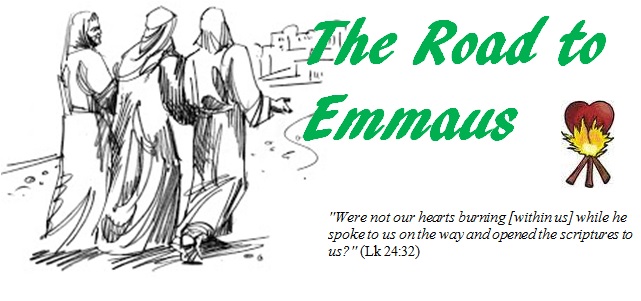
I took pretty much all of last week to meditate on Christ’s Passion, Death, and Resurrection.  There were plenty of EWTN and TBN programs to help me, especially Saturday when 3 different movies were played to help me meditate.  Of course, Mel Gibson’s Passion of the Christ was one of them. I watched that one twice and found something new to focus on each time.   Another was, “The Final Inquiry”, about a Roman soldier’s quest to find the truth (or expose a lie) about Christ’s Resurrection.  It was pretty good, if not a little corny in spots.  The third short movie that kept me spellbound for an hour was called, “The Messiah Prophecy Fulfilled”.  Actor Nick Mancuso plays a skeptic who comes to believe Jesus is the Christ after a Jewish rabbi shows him that Jesus fulfilled all the Old Testament prophecies concerning the Messiah.  It turns out that the Jewish rabbi is one of the men who encountered the Risen Christ on the road to Emmaus.  No wonder I found it interesting, huh?


Before Holy Week though, I was beginning to meditate on the difference (I think) between how we look at Christmas and Easter Sunday.  What got me thinking about it again today was when I had to go shopping for a few things for Mom.  I didn’t have a problem going anywhere today, because everything was open for business as usual!  Try to find that on Christmas Day—you can’t.  And yet, Easter is the reason Christ came into the world on Christmas Day!  We had to wait 33 years after the first Christmas to receive the greatest gift in the history of the world, our salvation from death!
So why do some businesses that are usually closed on Christmas Day stay open on Easter Sunday?  My guess—and I hope I’m wrong—is that Christmas Day has become more of a secular holiday than a religious Holy Day, and we can’t have any celebrations of Holy Days in  America any more, can we?


I think there is another subtle difference to Christmas and Easter that most of us miss.  I admit I’ve been as guilty as anyone of this, and I’m sorry for it.  I’ve been guilty of putting a different emphasis or meaning to the words “joy” and “hope” for each Holy Day, usually putting the greater emphasis on the words during Christmas.  In my “inner retreats” this Lent, though, I came to realize that while Christmas is indeed a reason for hope and joy, Easter Sunday makes the HOPE and JOY both present and eternal.     
“Cast all your worries upon him because he cares for you.” - 1 Peter 5:7
This is one of my favorite verses in the Bible. It always has a calming effect on me, reminding me that I don’t have to worry (though I often do) about anything because God can and will take away all of my fears and my sorrow. It’s so comforting to know that God loves us so much.


There is a passage from the Psalms (Ps 16:1-2a and 5, 7-8, 9-10, 11)—“Keep me safe, O God; you are my hopethat seems to fit very well with my current mood and I also find it uplifting and encouraging when life seems to be swirling around me, to know that God “will not abandon me to the grave.” This passage reminds me of how amazing God is and how he truly does fill me with joy.

This passage talks about how we should praise God because he will always be there for us and take care of us. “Lord, you have assigned me my portion and my cup.” God takes such good care of us. He comforts us and shelters us and, more than that, he gave us the greatest gift of all through the sacrifice of his Son. What an amazing gift. This brings me back to the current mood of Easter. Christ suffered so much on the cross, as did his Father in heaven, watching his Son die in such a way. We did nothing to deserve this gift and we will never be deserving of it, yet we have been given it freely, and all we have to do is love and trust God. It is so amazing to think about that. I think that, while this incredible gift of everlasting life is fresh in our minds, we should remember to thank God for it and to lift Jesus higher and higher.

Friday, April 22, 2011

The Mystical Mystery Tour

Never been to an Easter Vigil Mass?  Sometimes called a "midnight Mass" for Easter?  Let me take you on a tour:
Darkness.
The Easter Vigil begins with darkness. The darkness itself is the first movement of the liturgy, so we begin our preparations with that darkness. It represents all darkness, and all the meanings of darkness - devoid of light; evil thoughts, motivations, deeds; all that is hidden and secret, deceitful and dishonest, divisive and abusive, immoral and sinful. It's the darkness of our world, and the darkness in my heart. If I come to the vigil and restlessly and impatiently fidget in the dark "until something happens," I miss the power of what is about to happen. So, we prepare by readying ourselves to experience the darkness. It is distasteful and reprehensible, embarrassing and humbling, fearful and despairing.

Then a light is struck. It breaks into the darkness.
"Make this new fire holy, and inflame us with new hope."
"May the light of Christ, rising in glory, dispel the darkness of our hearts and minds."


The Light of Christ.
The candle lit from the new fire is then processed into the community, and we receive its light and experience the power of that light as it grows. When the candle is brought front and center, we celebrate the Easter Proclamation. This prayer sounds like a Eucharistic Prayer. We give thanks and praise over this symbol of the Light of Christ in our midst and "consecrate" it as Christ's presence among us. Reading this proclamation carefully and letting its joyful song into our hearts is a wonderful way to prepare to feel its exultant praise at the Vigil.

"Dear friends in Christ, we have begun our solemn vigil. Let us now listen attentively to the word of God, recalling how God saved his people throughout history and, in the fullness of time, sent his own Son to be our Redeemer."

The Word of Our Salvation History.
There are nine readings and eight psalms or songs that have been prepared to help us with our night's vigil. Each reading is followed by an invitation to pray in silence, which is followed by a special prayer designed for that reading. (The help that comes with the liturgy says this: "The number of readings from the Old Testament may be reduced for pastoral reasons, but it must always be borne in mind that the reading of the word of God is the fundamental element of the Easter Vigil.") If we have time on Saturday, a wonderful way to prepare for the Vigil would be to read the readings and psalms and then articulate prayer to the Lord, expressing gratitude to God for an extraordinary story of fidelity and love for us.

After the last reading from the Old Testament, the candles are lit and the bells ring as we sing our Glory to God. Now we are ready to hear the New Testament word in the light of Christ, and the good news, "He has been raised!" Powerful religious experience is prepared for. At this point in the liturgy, we want to be prepared to be exultant with joy at the resurrection of Jesus - the victory of our God over sin and death - for us.

The Liturgy of Baptism.
The Presiders and ministers go to the font of baptism, thereby drawing us together there. (The ritual says that if the font can't be seen by the congregation, then "water is placed in the sanctuary.") Those who are to be baptized are called forward, along with their sponsors. In our excitement for them, we realize that this is very much about the renewal of our whole community. Initiation and revitalization become one this night.

"Dear friends in Christ, as our brothers and sisters approach the waters of rebirth, let us help them by our prayers and ask God, our almighty Father, to support them with his mercy and love."

The Litany
We turn to the community of saints in glory to ask for their help. We remember that we do this same litany before the ordination of priests. As we turn to each of these saints we recall how these very special women and men journeyed in situations very much like ours and let God transform their lives, and that they are now in glory interceding for us. In our hearts we might also turn to the saints we have known, who are not part of this list, whose love we have known and to whom we can turn tonight to intercede for these candidates for baptism and for our whole community.

"Give new life to these chosen ones by the grace of baptism."

The Blessing of the Water
The Presider now blesses the water. These wonderful prayers are like a mini lesson, both for those about to be baptized, and for us. We can prepare by praying this prayer before the Vigil, at the link to the right. When the priest inserts the candle in the water and pull it out and lifts it up, we experience the ritual that announces the meaning of our baptism into these waters - one with him in dying that we might be one with him in rising.

The Profession of Faith and Renunciation of Evil
We have renewed our baptismal promises many times. We can prepare to make the Easter Vigil a powerful experience of grace if we make each of the renunciations and professions with a meaning that is personal to us.
"Do you reject sin, so as to live in the freedom of God's children?"
That question begs me to spontaneously say, "YES! Of course!" But, reflection tells me that I long to be free at the same time that I cling to some of my unfreedoms. So the next question takes me deeper.
"Do you reject the glamor of evil, and refuse to be mastered by sin?"
There really is a glamor to evil and it does claim a mastery over me. The renunciation that is asked of me is about freedom, so I am asked if I will personally choose to be free and reject the rules the sin and darkness.
"Do you reject Satan, father of sin and prince of darkness?"
Now I am ready to profess the faith of the Church, choosing to believe in the One who gives me life.

Baptism and the Rites Explaining Baptism.
The candidates are baptized. Even if our church isn't able to immerse the baptized into the water, the ritual of pouring water over their heads is meant to be a sign of their entry into the waters of baptism. We should feel the power of this moment and open our hearts to its joy, for them and for ourselves.

The newly baptized are anointed, with the same oil used to anoint priests.
"He now anoints you with the chrism of salvation, so that, united with his people, you may remain forever a member of Christ who is Priest, Prophet, and King."

They are then clothed in a white garment.
"You have become a new creation and have clothed yourselves in Christ. Receive this baptismal garment and bring it unstained to the judgment seat of our Lord Jesus Christ, so that you may have everlasting life."

Finally, they receive a candle lit from the Easter fire.
"You have been enlightened by Christ. Walk always as children of the light and keep the flame of faith alive in your hearts. When the Lord comes, may you go out to meet him with all the saints in the heavenly kingdom."

The Celebration of Confirmation
The newly baptized and those who are about to be received into full communion are ready to "share in the outpouring of the Holy Spirit." We all pray in silence, and feel the power of God's Spirit among us. And in silence, the Presider lays hands on each person, the same sign used in ordination to the priesthood. As they are anointed, we can imagine the gifts of the Spirit that we have received and can let ourselves feel the grace offered us to be strong witnesses to the union with Jesus in mission that we are offered. The newly confirmed take their places in the assembly of the faithful, ready to join us for the first time at the table of the Lord.

The Eucharist.
All our preparations, all the power of this night's rituals and sacraments, lead us to celebrate the Eucharist, to "give God thanks and praise." As the newly confirmed receive the final Sacrament of Initiation, the Body and Blood of Jesus, we are ready to celebrate Easter.

The tomb is empty. There is Light in the midst of our darkness. We've been fed by the Word and given new life in the waters of baptism. Now we eat his Body and drink his Blood and receive the life in him that he promises.

Alleluia, Alleluia!

Thursday, April 21, 2011

Good Friday Rosary

Imagine what might happen if every Christian in the world would pray a Rosary on
the same day! We have an example in October of 1571 when Europe was saved from
the invasion of the mighty Turkish fleet, by the praying of the Rosary by all
Christians!

There is a "crusade" of sorts (no pun intended) to get every  Catholic in the world to say the Rosary tomorrow, Good Friday, between 12:00 pm and 3:00 pm.  Pray for the return of moral pro-life values in the world.  Pray for the Pope's intention for April,  "That through its compelling preaching of the Gospel, the Church may give young people new reasons for life and hope".  Pray for your own intentions.  Just pray, period.


Wednesday, April 20, 2011

The difference between the sheep and the goats

The other day, Marilyn was singing "Old MacDonald Had a Farm" with Lily and one of the animal sounds she made was a sheep--"baa baa".  The song went on and on, and pretty soon 'Old MacDonald' had a goat.  Marilyn was stumped.  What sound does a goat make?  I chimed in with 'baa baa', just like I had with the sheep.  Marilyn corrected me and said, "That's what the sheep says!  What do goats say?"  I said, "There is no difference!", and laughed. You see, I was so sure that goats and sheep are the same animal that I told Marilyn as much with all the authority I could muster.
  
Then today, I was reading Exodus (12:1-8, 11-14) where the Lord tells Moses and Aaron how to celebrate the Passover feast; "The lamb must be a year-old male and without blemish. You may take it from either the sheep or the goats."  What?  They aren't the same?  They can't be, if our Lord tells us there is a difference.  Why didn't I catch this before?  I've heard the Scripture verses about sheep and goats my entire life, but for some reason the difference just didn't "click".  At worst, I thought that goats were simply "black sheep", since their fate is not as good as the 'sheep' of the Good Shepherd.

Thank God for the Internet.  I 'googled' "the difference between sheep and goats" and found out more than I needed to.  One of the sites I visited gave me the most basic difference--(tongue in cheek)--sheep say, "baa baa" while goats say, "maa maa".

How's THAT for theology?


Monday, April 18, 2011

Now is the Son of Man glorified, and God is glorified in him.

Reclining at table with his disciples, Jesus was deeply troubled and testified,

“Amen, amen, I say to you, one of you will betray me.”
The disciples looked at one another, at a loss as to whom he meant.
One of his disciples, the one whom Jesus loved,
was reclining at Jesus’ side.
So Simon Peter nodded to him to find out whom he meant.
He leaned back against Jesus’ chest and said to him,
“Master, who is it?”
Jesus answered,
“It is the one to whom I hand the morsel after I have dipped it.”
So he dipped the morsel and took it and handed it to Judas,
son of Simon the Iscariot.


After Judas took the morsel, Satan entered him.
So Jesus said to him, “What you are going to do, do quickly.”
Now none of those reclining at table realized why he said this to him.
Some thought that since Judas kept the money bag, Jesus had told him,
“Buy what we need for the feast,”
or to give something to the poor.
So Judas took the morsel and left at once. And it was night.


When he had left, Jesus said,
“Now is the Son of Man glorified, and God is glorified in him.
If God is glorified in him, God will also glorify him in himself,
and he will glorify him at once.


My children, I will be with you only a little while longer.
You will look for me, and as I told the Jews,
‘Where I go you cannot come,’ so now I say it to you.”
Simon Peter said to him, “Master, where are you going?”
Jesus answered him,
“Where I am going, you cannot follow me now,
though you will follow later.”


Peter said to him,
“Master, why can I not follow you now?
I will lay down my life for you.”
Jesus answered, “Will you lay down your life for me?
Amen, amen, I say to you, the cock will not crow
before you deny me three times.”

When I meditated on this reading (Jn 13:21-33, 36-38), I couldn’t help but marvel at the way Jesus used the betrayal of Judas and Peter’s denial of Him to get the same result—to “glorify the Son of Man, and glorify God within Him”.

While Judas is the big betrayal, there’s Peter to deal with as well. When Jesus says He is going where His friends cannot follow, Peter says he wants to go too, and he wants to go with Him now. Jesus tells Peter he will go, but just not now. It’s hard for Peter to understand that he has to deny Jesus and has to stay because there are still things he has to do. Peter tells Jesus, “I will lay down my life for you.” And he will, but not just yet. And Jesus knows this too. He knows that Peter will deny Him—MUST deny Him--so he can finish what he needs to do here. And when the time is right Peter will die for Him, as Jesus died for all of us.

If Judas hadn’t made his horrific decision, none of this could have been set in motion. If Peter hadn’t made his decision, the church wouldn’t have been established. These decisions seem selfish, but they are necessary for the necessary outcome. If Jesus hadn’t made the hardest decision of all, we wouldn’t have Easter. Jesus had to be betrayed by His friends, and His friends had to betray Him in order for the Son of Man to be glorified. And God knew before they were born who they all were and what they all were capable of, just as He knows all of us and our capabilities.

All of this means we don't have to be perfect to follow Christ. We are called to follow Him as we are, in all of our imperfections. In turn, we shouldn’t expect others to be perfect, including the leaders in our Church. We are called to look at everyone in the world, including ourselves, and see past the imperfections, the moments when we just don’t get it, and see the Christ in them. That is what Jesus did. He saw past Peter’s blemishes and denials and saw a man who would take the Church (with guidance from the Holy Spirit) from a small group of disciples to a worldwide following. He saw the beauty beneath Peter’s outer shell, and He sees beyond our shells too. He sees us for the beautiful children we are and He loves us. Shouldn’t we share that same love for one another?

Saturday, April 16, 2011

Trust in Infinite Mercy Leads to Stronger Faith

Palm Sunday is the day that we hear what I submit is the most important, yet difficult Gospel reading of the entire year. We will hear of the mocking, crucifixion, and death of Jesus.


Jesus’ Passion is all about His forgiveness. He knows what the final outcome will be yet He still, somehow, finds the strength to carry through with God’s plan. First, Jesus enters Jerusalem with much fanfare from the crowds that have been following Him during His public ministry, but those in Jerusalem are not so impressed. Within days of first encountering Him, the city turns so against Him, they are willing to kill Him.

Then He knows that all of His closest friends, those He had hand-chosen to follow Him, will abandon Him. It is almost a defeatist attitude Jesus shows when He tells the apostles He knows they will all fold under the pressure of staying with Him that fateful night. Who could blame Jesus if He had that attitude? How much must it have pained Jesus to hear Peter’s bravado, how the apostles would all stay with Jesus even to the point of dying themselves? He knew they would disperse. Then Peter, James, and John couldn’t even stay awake with Jesus for one hour in the garden. To top it off, Judas finally comes with soldiers to take Jesus away. But after all of this, how does Jesus refer to Judas? He calls Judas “Friend.”

I find so much of myself in the Palm Sunday Gospel. Like Peter, I have “talked the talk”, professing my unshakable faith that will help me sum up the strength necessary to back it up with action. When the time comes, though, when I am truly tested, I fall.
What I thought was conviction, was really a hopeful prediction. I have a great prayerful experience, a time of fulfillment at Mass, and I think I am ready for the test. To make matters worse, sometimes this test comes quickly after what I thought was a “life-changing experience.” The result? Failure. Not only could I not stick to my beliefs with actions, I turned my back on Jesus and betrayed Him through sin. And yet Jesus knew this would happen. He knew about each of my failures, even before His crucifixion. He knew I would falter.

But Jesus still did what was necessary. He went all the way. Even though He must have been deeply discouraged, to put it mildly, He still found the strength to do God’s will. And after all of this, He still turns to us, after we betray Him through sin, and calls us “Friend.” How is that possible? It’s possible because Jesus believes in us. It’s possible because He never fails to forgive us. But it’s up to us to seek that forgiveness and receive His mercy.

If we can commit to seeking God’s mercy, we will have the strength to back up our faith. Then when Jesus turns to look at us, we won’t feel the need to flee into the night as Peter did during that first Holy Thursday. No, Jesus will turn to us and say, “Well done, my good and faithful servant, enter into the joy of your master’s house”.

Thursday, April 14, 2011

Whatever happened to common sense and compassionate legislation?

My daughter Sarah wrote the following on her Facebook page today, understandably upset about an apparent screw up in our immigration "system" (if you want to call it that--IMO, "system" means a well-functioning, well-thought-out process for getting a productive result that doesn't hurt anybody.--but I digress).

I asked her if I could post in on my blog, and she agreed as long as I also preface it with a disclaimer:
"Please put in a giant disclaimer that it was written in haste and should not be construed as legal advice or even a correct statement of the law (outside of the 9th circuit it's different. Small changes in facts could drastically change the outcome of this scenario).


Part 1 of many responses to the question "what part of illegal don't you understand"

by Sarah on Thursday, April 14, 2011 at 12:57pm

A few days ago I posted a link to a case that I was really upset about. It’s a super complicated issue but really highlights how arbitrary and unfair immigration laws can be. I’ll try to explain it here.

Two brothers, around 20 years old, cross the border from Mexico (or any country, really) to the United States in let’s say the year 2000. Their dad is a lawful permanent resident, or heck even a U.S. Citizen. Dad files a petition to sponsor his sons for lawful permanent resident status that same year. Because of the backlog in cases, they know they will have to wait around 15-20 years for their green cards. (As of April 2011, CIS is processing cases filed back in 1992 – an almost 20 year wait)

While they are waiting, the brothers live and work in the United States. They pay taxes. They don’t commit any crimes. They learn English.

At some point, their mother, who is still living in Mexico, dies. Brother #1, for whatever reason, can’t go to Mexico for the funeral, so he stays in the U.S. Brother #2 decides to go to Mexico for the funeral. He’s gone for less than a week and then comes back to the U.S. to resume his life.

At some point, the brothers get married and have children. Their wives and kids are U.S. citizens. Now that the brothers have U.S. citizen wives, they can apply for their green cards right away instead of having to wait for their dad’s petition to be ready.

If they visit my office today, in 2011, I will tell Brother #1 that he and his wife need to submit a bunch of documents and forms, pay nearly $1500 in application fees, plus a $1,000 penalty fee for crossing the border illegally (those are just government fees. That doesn’t include what I would charge him). Assuming CIS belives that his marriage is valid and that a background and medical check clear, he will have his green card and be a lawful permanent resident in 4-6 months.

I will tell Brother #2 that the only way he can get his green card is if he returns to Mexico for at least 10 years. There is no other option.

Why the difference? It’s that little trip to Mexico for mom’s funeral that screwed him.

Had he not left, the petition that his dad filed for him back before 2001 plus a $1,000 penalty fee would have excused the first illegal entry, and the petition through his wife would make him immediately eligible for a green card, just like his brother. But because he left, he triggered a 10-year bar to reentry. Because he came back, that 10 year bar cannot be waived.

A few years back the 9th circuit (a federal court) looked at this law. There’s a bit of complicated legal analysis and background that went into the decision, but basically the court decided that the father’s old petition, which acts as an amnesty for one entry, should also act as an amnesty for the second. In other words, the court decided that Brother #1 and Brother #2 should be treated the same.

Relying on this case, which was binding federal law, thousands of people in Brother #2’s position applied for their green cards. Under the law at the time they applied, they were all entitled to green cards. The federal circuit court said so.

CIS was pissed. They did not want to grant these cases, even though the law said they had to. They couldn’t outright deny these cases, so instead they just sat on them. They took all these applications and didn’t make decisions. They just kept people in limbo, waiting for the law to change, so that they could later deny them.

A few years later, the Board of Immigration Appeals came out with a case that interpreted the law differently than the Ninth Circuit did. The BIA, an administrative court, is a lower court than the 9th and normally should defer to the 9th, but there are some complicated legal reasons why, in some cases, what it says can trump what the higher federal court says.

As soon as this opposing BIA decision case came out, CIS started adjudicating the cases they’d put on hold for years. They denied all of the cases under the BIA decision.

When someone applies for a green card and are denied, they don’t just get to go back to their lives. They get placed into deportation proceedings.

So all of tese people, relying on valid, binding law, applied to become legal. Under the law as it was when they applied, they qualified to do so. They paid the penalty fee, they met all the requirements. They should have gotten their green cards in 4-6 months. But CIS refused to decide their cases until they had a way to deny them. Once they did, they denied all of them and put everyone in a far worse situation than they had been in before.

We immigration lawyers have been scrambling to save all our Brother #2 clients. If someone in Brother #2’s position comes into our office now, and has never applied for a green card, we tell him to just hang out, or go home, or do anything but apply for a green card. But if he has already applied for a green card, he’s screwed. He’s going to be deported – even though he has a U.S. citizen father, wife, and kids. Even though he’s been in line for a green card since 2000. Even though he’s never committed a crime and has always paid his taxes. Even though he did what the courts told him to do to become legal.

The only thing we can do for him now is argue that the law is wrong, and hope that the 9th circuit tells the BIA that its decision is wrong, and tells CIS that they can’t follow it.

We have presented two arguments to the 9th circuit. The first is a complicated statutory interpretation and judicial deference argument, the details of which I will spare you. Our second argument is that, even if we lose on our statotory interpretation argument and the BIA case becomes binding law, the people who applied under the 9th circuit law should not be punished now over the BIA law. To apply the BIA law retroactively would just be unfair.

The 9th circuit heard these arguments recently. They rejected both of them.

As to the first argument, the 9th circuit basically said that when they initially said people could apply for green cards under the law, they were wrong. They say that the BIA set them straight and now they have to follow the BIA. Ok fine. I disagree, but I understand how they came to that conclusion. But then they go on further to reject the second argument and say that it’s perfectly fine to apply this interpretation of the law retroactively to people who applied relying on the first interpretation of the law. They’re basically saying that what CIS did was ok.

How can they think it’s ok to tell people they qualify and invite them to apply, then refuse to give them what the law entitles them to, then wait until the law changes back, then punish them for applying? Even if I thought the underlying law as it stands now (Brother #2 can’t get green card, while Brother #1 can) was fair, I don’t see how it’s fair to tell Brother #2 that he can, then not only refuse to give it to him, but deport him for trying.

=========================================================================

I appreciate Sarah's breaking down this particular case for me.  I agree with her analysis and her conclusion 100%.  Anyone with any common sense (and lacking that--compassion, for heaven's sake!) also has to agree.

I know the post is a little long, but it really describes just one of the many injustices prevalent in our immigration laws.  Why is it that immigration laws seem to overlook the fact that our country would not be the world leader it is without all of its different ethnicities and cultures?  And why do they tend to punish the many for the evils of a very few?  Justice will only prevail, I fear, when the world comes to truly understand the 2nd Commandment that Christ gave us, "to love one another".
Wednesday, April 13, 2011

Freedom, and Using the Holy Spirit's gift within us

Freedom is far more than being able to do what we want when we want. Being governed by each urge and temptation of the day is no freedom at all; rather we become slaves to these desires. God calls us to look deeper than our own desires, practicing the Spirit’s gifts of temperance and fortitude, in order to transcend our own desires. It is in mastering temptation that true freedom lies.


This is so different from the philosophy that we are sold each day, especially that taught to our children by all of the technology and “things” of the world. To give in to these urges is a temptation in itself; made even more challenging by the fact that so many people around us believe this philosophy to be correct. It has been a fact of the world since the fall of man in Eden that we are constantly bombarded by temptation each day.

Lent is the opportunity we take each year to fight these ideas. It is a time of discipline and renewal. As we each take a chance to give up something we enjoy, the reward is self-control and a command over one’s desires. In doing so, we can break the bonds of sin that bind us as slaves to the world and be welcomed into the Lord’s house as sons or daughters.

As the angel of the Lord saved Shadrach, Meshach, and Abednego from the fire (Daniel 3:95), may the rest of this Lent be a time for us to let God free us from our desires.

Monday, April 11, 2011

Homily 4-9-2011 - Fr. Anthony Mary, MFVA - Lenten Weekday

I was waiting all weekend for this homily to post!  I kept thinking about Mom every time I listened to or watched this video!  Most of these MFVA fathers have good sermons now and then, but Father Anthony is probably the most consistent with his humor/profundity ratio.

A "teaser" and a thought for the day.....

Here's something to think about--It's held my attention all day!

CHRISTMAS--The birth of Christ-- is all about HOPE.
EASTER--The resurrection of Christ-- is all about ASSURANCE.

More to come...........(This wll take a few days to explain, so I'm waiting until Holy Week to unfold it)
==========================================================================
Jesus explains to the Jews, “The one who sent me is with me. He has not left me alone.” (John 8:29). No matter how far out we go in life, no matter how much we are able to achieve with our two bare hands,we need to remember that God is always with us. He gives us the necessary strength to rise above our challenges and will never give us a task we can't conquer. He does this on a personal level, so that we may always remember that he is a kind and loving God.

Sunday, April 10, 2011

Lazarus

We had a long Gospel today with several important aspects. I found a lot of things to reflect on, but I don’t have the time or the energy to write at length about any of them. So instead, I’ll list a few of the ideas I came up with:

1. The story is about death and resurrection.

2. The story is how personal Jesus is with His love.

3. The story is about Jesus’ calling us out of our personal tombs.

4. The story concerns Jesus’ being The Light and The Life.

5. The story is about the role of “signs” or “works” for the Jews to believe in Jesus.

6. The story underscores the difference between Martha’s and Mary’s approach to their faith. (Martha is concerned with the practical, while Mary is concerned with prayer). I think the goal should be to have a little of each in us—As Jesus said in another Gospel passage, “Mary has chosen the better part”, but he doesn’t discount Martha’s faith based on attending to practical matters.
7. The story is about Jesus’ patience with the Apostles, who never seem to understand what He’s talking about until He explains it in almost childish terms.

Does anyone have any other ideas what this passage may contain?

Thursday, April 7, 2011

Watching

Two weeks to Good Friday. I’ve always thought Good Friday was a misnomer, until I heard a priest give a really good explanation once during a homily. What’s good about the day Jesus was crucified? Two words: Easter Sunday!

=======================================================================

"When the just cry out, the Lord hears them, and from all their distress he rescues them." –Psalm 34:17

Alicia sends me pictures of herself and Lily often during the week that I can look at so I don’t get too sad at not being with the family every night. It’s a real help. I worry about my family when I’m not there. Being old-fashioned, I tend to think it’s my duty to protect them. I don’t sleep well until I know everyone is in and asleep for the night. Obviously, when I’m out of town, I can’t very well know this, but it still concerns me.

Have you ever watched a baby sleep—especially one of your own? Your heart fills up with an overwhelming love that makes you want to laugh and cry at the same time because this child is just too perfect and beautiful. At any sign of distress, you’re there in a heartbeat to soothe and comfort the tears. You would do anything and everything to make sure this baby was protected and happy and cherished. Have you ever thought about how God watches over you the same way, but with an even more intense love?

I wonder if God watches me while I sleep? The answer is, yes, of course He does. What does God think about while He watches us? Does He marvel at how much He loves us? Does He look at us and think of our potential or things we may do? Does God plant seeds in our hearts as we sleep to guide us or steer us in a specific direction?

Scripture points out one thing that is for certain. Life can bring all sorts of crosses to bear—pain and heartache, loneliness and shame, loss and isolation. Trials can be the heaviest and hardest low points to bear and get through, and sometimes it feels impossible for our hearts to handle it alone. It would be easy to become bitter and lose faith; to wonder, is God really seeing this? We can draw from Psalm 34 scripture readings that, yes, God is watching.

In trying times where God seems distant and injustice seems to reign, we have a choice. We can distance ourselves from God or move closer to God. It always seems to come down to faith and trust. As we move towards Easter this is a time to think about Christ and His sacrifice. The Lenten season offers us an opportunity to spend more time with God. My prayer today is for each of us to know the Lord is watching over us and to deepen our relationship with God.

The beautiful thing, though, is that we don’t have to be able to do it on our own. Those times when an unexpected trial finds its way into our lives, Jesus is there to endure the unhappy news with us. He is close and waiting to comfort and strengthen our wounded hearts. We must seek Christ when it’s the most difficult to do so, because that’s when He is the closest.

“The Lord is close to the brokenhearted, and saves those who are crushed in spirit.” -Psalm 34:18

Like I NEED a reminder of how stiff-necked I can be!

Since I have no television in my Fresno apartment (and quite frankly don't want one!), I watch the "live stream" of EWTN on my computer.  Most nights I fall asleep without remembering to turn it off.  I've become used to waking up when I hear the church bells go off at the start of Mass, which is 5AM on the West Coast.  Then I lay on the bed and listen to or sit up at the computer and watch at least through the homily, when I get ready for work, hopefully early enough that I'll have time to attend Mass in person in 6:45AM.  It sounds like it wouldn't be hard to do, but I am really slow to get going in the morning--it's probably age. (Yeah, it can't be that I'm just lazy! lol).  When I do miss the morning Mass, chances are I'll go in the evening if I can get my work done by 5pm, which is usually the case.

Anyway, this morning I stirred at the sound of the church bells then dozed for a couple of minutes only to awaken again when the lector was reading the Old Testament reading where God is referring to the Israelites as  a "stiff-necked" people.  I propped up my head to check the time and ---you guessed it---I had a stiff neck!  I must have slept wrong somehow.  It's going away, but I thought it was funny enough to post about this morning.  Now I'll probably be meditating all day on how stiff-necked I can be sometimes when it comes to following His commandments.

Wednesday, April 6, 2011

A word worth keeping

There is a tendency in our society to not believe in what we cannot see. If something is not right there in front of us, society has taught us to believe that it isn’t real. We as Christians must be cautious of this idea. Many non-believers tend to use this argument against us in questioning us on how we could believe in something that we cannot see, touch, or hear. It is a difficult task for us to believe in the divine, but it is not impossible. We can take the small hints around us like the beauty of Mother Nature and use them to help us believe in the Lord. While these hints can help us believe more, they are not enough to fully convince ourselves. We must have the courage and strength to take a leap of faith.


The leap of faith we take is not easy. We put our total trust and faith into the unknown. We must trust in what we cannot see to be our guidance towards everlasting life. Once we’ve taken this leap of faith we should never look back. Continue on at full force and don’t ever let another being convince you that you’ve made a mistake. God is all-loving and he rewards those who take a chance on him and believe with all their hearts.
Jesus says, "Whoever keeps my word will never see death." (John 5:31-47). What does it mean to "keep His word"?

Jesus teaches by means of His words, which are a gift to us. Like any gift, we can choose to accept it or reject it. When we "keep His word," we accept His teaching.

When someone gives us a valuable gift, we open it, don't we? Then we may "Ooo" and "Ahh" over it and admire it. We may try it out, or try it on. And, knowing its value and usefulness, of course we "keep" it. And hopefully use it as intended.
Sounds simple enough, but it's not always easy to do. Sometimes we accept something Jesus says, and then later forget all about it! In the same way, when we decide that a particular "word" or demand of His is too hard for us, or too inconvenient, that's not "keeping His word."

Although it can be difficult to do, when we "keep His word," there is a payoff, big time: Jesus says, "Whoever keeps my word will never see death." Wow! What a deal! But wait a minute! That means "never see death" in the eternal sense. It means we will see and experience eternal life!

The Jews, as usual, took Jesus' words on their earthly, human level of understanding, to mean literal human death, as many people do today. Meanwhile, He, as usual, was talking on a whole different plane, telling them about eternal truths.

When we accept Jesus' words and "keep" them, we keep them in our hearts, we meditate on them, "ruminate" upon them in a way. We reflect on His word, we ponder what it means. A good example of how to "keep" His word is His mother, Mary. She "kept all these things, reflecting on them in her heart," after the shepherds visited her Newborn with the angels' message that Jesus was Messiah and Lord (Luke 2:19).

You can be sure Mary didn't just jot those precious words down and file them away someplace and forget about them! No, she must have thought about them often, prayerfully considering this Son of hers and who He was.

Jesus' word, which leads to eternal life, is a word worth "keeping."

Tuesday, April 5, 2011

He thirsts for us as we thirst for Him!

Many of us often reflect on our relationship with Christ from the standpoint of our seeking Him. Sometimes we forget that He is always seeking us. He is present to us as is described in Psalm 145: The Lord is "near to all who call upon Him."

A couple of Sundays ago, we read of the encounter of Christ with the Samaritan woman at the well. Christ told her that He was thirsty. Undoubtedly He thirsted for water, but it seemed obvious that He was reaching out to this woman in love.

Two of Christ's last words to us from the Cross were "I thirst." (John 19:38) Yes, He was dehydrated, but He reminded us for all time that He thirsts for us. In our prayer life, it is reassuring to lean back into Christ's love that is always there for us

Monday, April 4, 2011

Night and Day

Late one night, a Teacher sat around a blazing fire with a small number of adolescent disciples. Their conversation was broken by periods of silence as they gazed at the stars or stared into the glowing embers. Suddenly the Teacher posed a question: “How can we know when the night has ended and the day has begun?” Eagerly a young man answered, “You know the night is over when you look off in the distance and can tell which animal is a dog and which is a sheep. Is that the right answer Teacher?” “It is a good answer,” the Teacher replied, “but isn’t quite the answer I seek.” A second disciple ventured a guess. “You know the night is over when the light falls on the leaves and you can tell whether it is an olive tree or a fig tree,” he said. Once again the Teacher shook his head. “That was a fine answer; still, it is not the answer I seek,” he said gently. Immediately the disciples began to argue with one another. Finally, one of them begged the teacher, “Answer your own question, sir, for we cannot think of another response.” The Teacher looked intently at the eager faces before he spoke. “When you look into the eyes of another human being and see a brother or a sister, you will know it is morning. If you cannot see a brother or a sister, you will know that no matter what time it is, for you it will always be night. And you will always be in the dark.


The spark that makes life worth living and that truly distinguishes our night from day, is that genuine dimension of love that we see in the faces of every brother and sister God has entrusted to us. May we not only love God but love like God who knows us and calls us each by name.

Sunday, April 3, 2011

A little bit of history

After Mass today, I spent the afternoon with Mom.  We were talking about a man who had approached my brother Dick asking if he was related to Alonzo Lafayette Farnsworth.  When he replied that yes, Alonzo was his great-grandfather, the other guy said that they were probably related! 

While we were conversing, I thought I would use the "Bing" search engine to search for Great-grandpa.  That's when I found the link, above.  Then, after reading about him (although I had heard the story about a thousand times before), I searched for my grandfather's name and found this biography of my grandfather, in his own words.  I am proud of my Grandfather's bravery, leadership and faith.  Although I don't share his belief in the Mormon religion, I respect his adherence to his beliefs through all the hardships he and my Grandmother had to endure.

Of further interest to my readers may be the story of  my Aunt Ruth, who was murdered on the Island of Guam in December of 1948.

Thursday, March 31, 2011

Just follow the plan

OK, it has to be a test.  But it's a test with a study session.  I couldn't wait to get to Our Lady of Mount Carmel church to go to confession tonight.  And even though I wrote early this morning that I was sure the Holy Spirit wouldn't let me down tonight, I wasn't able to completely trust in His providence, so I drove down early to make sure someone would be there.  I felt much better after finding out they are doing a complete face-lift to the outside of the church and that there was a team of painters there who were setting up lights to work by.  This told me that they would be working into the night. 

I went back to the apartment to grab a bite to eat and clean up before returning for confession.  My soul lit up at the sight of about 20 cars outside the church.  This was a good indication that everything was going as I planned it.  Did you get that?   I said as I planned it!  This is where I think the Holy Spirit nudged me in the side tonight.  When I entered the church, there was a wedding rehearsal going on!  This is really not unusual, so I didn't think anything of it.  I found a pew and decided to say my rosary in this (beautiful, by the way) church where I was baptized while waiting for Father to show up.  A few more families trickled in until there were about 30 people waiting for confession.   I appeared to be the only non-Hispanic in the building and no one was speaking English.  I have been to enough Spanish services lately that this doesn't bother or intimidate me.  In fact, I marvel at how the Mexican people bring even their very small children with them to church no matter what the occasion.  It is very heart-warming to me.  It shows a devotion I'll probably never get close to. 

Anyway, I waited until 8pm and tried to participate in what I finally figured out was the Divine Mercy Chaplet, Stations of the Cross, and the holy Rosary in Spanish before it dawned on me that Father was not going to show up for some reason.  Again, while I understand that priests are often called away at the last minute to attend to the sick and dying, I was disappointed that I wasn't going to be able to confess and do penance again!

I was even a little "put out" that MY plans were thwarted again, until it hit me--I think our Lord wanted me to spend even more time on my examination of concience, because if I think the world is going to revolve around MY plans, maybe I'm not ready to receive His graces yet.  So I'll wait until Saturday and go when I'm better prepared and a lot more disposed to make a GOOD confession to my regular confessor, not after working all day and in a state of exhaustion.

Imagine my shame again at my reaction to my change of plans when I got back to the apartment and reflected on tomorrow's gospel!

In the gospel of Mark (12:28-34) a young man asks Jesus which is the first of the commandments. It’s kind of a double-edged question. He is asking first, which is the most important of the commandments and secondly, from which commandment do the rest flow in proper order and sequence.

The first commandment, Jesus answers, is to love God with everything that you are. And the second commandment, which springs from the first, is to love your neighbor as yourself. You cannot accomplish the second of these without doing the first. And you will know that you are properly loving God when love of neighbor flows as naturally as milk from a carton. Loving your neighbor is the second of the commandments because it is so much a sign and a part of the first.

Loving God with all that you are, however, always begins with asking God for the strength to love Him. We accomplish little by ourselves and being human, our love of God quickly fades away if it is not renewed by the supernatural strength of God Himself.

So, in a very few words, Jesus instructs us on how to make heaven on Earth: (1) love God with all that you are, and (2) love your neighbor as you love yourself. Obey these two commandments and all that is required of us is fulfilled. It’s easy enough, if you count on God, not yourself, as your strength, your song, your authority – otherwise it’s impossible. God alone suffices.  You don't need to make the plans, you just need to work with the plan He's already laid out for us.

I hope it's a lesson I learn sooner rather than later.

The time must be right

After several attempts, it appears I will finally get to see the inside of Our Lady of Mount Carmel Catholic Church in Fresno this evening!  I've been trying to get to confession for about 3 months now, and every time I make plans, work gets in the way.  I AM going to make it tonight!  OLMC has the Sacrament of Penance on Thursday evenings at 7PM. (According to the diocesan website--I also tried to attend a Mass there once based on the same website and when I showed up, there was no Mass--but I trust the Holy Spirit will not let me down tonight!)  God knows I need forgiveness and the grace to keep going on the best I can. 

While I always feel better and more in touch with Jesus after confession, it will be especially cool to actually partake of a SECOND Sacrament in the church about 57 years since my first one! (I was baptized at OLMC in late1953 or early 1954--Knowing Mom, it was probably not long after my November '53 birth!--but I'll have to look it up when I get back home on the weekend.)