When he was at table with them, he took the bread. He blessed the bread, and broke it, and gave it to them. And their eyes were opened and they recognized him!(Luke 24:13-35)

Tuesday, May 8, 2012

Called to the extraordinary

The Gospel of John (Jn 15:1-8) presents a familiar image of Jesus as the vine, and we are the branches, and we must remain connected to Him if we desire to bear fruit.  One of the most important questions we can ask ourselves is what sort of fruit we are bearing.

First, there are those branches which bear good fruit.  These are the ones that remain in Christ and draw near to Him in times of trouble.  Second, there are the branches that bear bad fruit.  These branches represent those individuals who are following things other than God in life.  They pursue worldly power, glory, riches, and fame.  They surround themselves with things that are passing by, and in doing so, they are cut off from a personal relationship with Christ Jesus.  Finally, there are branches that produce no fruit at all.  These branches are those people who dedicate themselves to nothing and who pursue nothing in life.  They feel apathetic towards God and have no desire to unite with Him, and neither do they associate themselves with worldly things.  I think this is a good definition of agnostics or skeptics, and that perhaps Jesus is addressing them in this beautiful image.

In the battle between good and evil, there is no “middle ground.”  We are either fighting on the side of Christ or against Him.  Picture man in the middle between God and nothingness; he must choose between the two.  If we do not choose God, we are no better off than those who choose nothing.  We can’t remain in the middle and still follow God because turning towards Jesus is turning away from something else.  We must either produce good fruit or bad fruit.  We must either be for God or else we are against Him.  Many of us don’t like to make commitments and we pray, “God, I will follow You, as long as You don’t ask too much of me,” or “Jesus, I love You, but don’t ask me to do something I am uncomfortable with.”

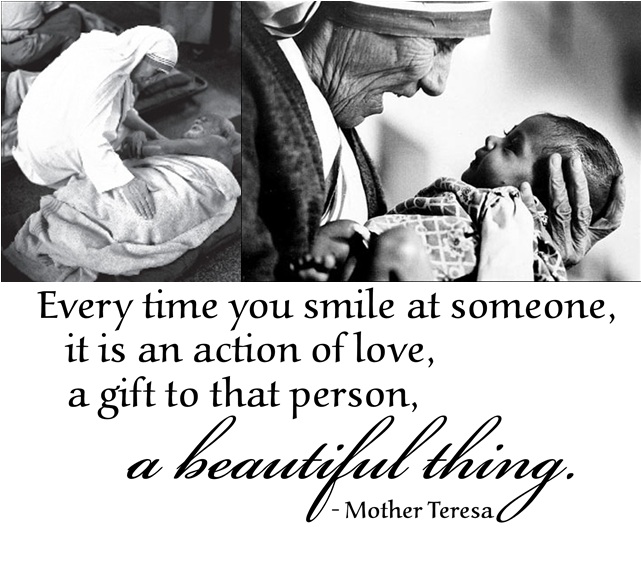
Christ is not calling us to live ordinary lives, but rather extraordinary ones.  He is calling us to be uncomfortable because in our discomfort, we will depend on Him even more.  I think that is what it means to be holy and a hero.  The saints and all the holy men and women who have gone before us are the heroes of our Faith.  They each overcame their discomfort.  Mother Teresa moved halfway around the world and began caring for the sick and dying in the poorest area of the world, but we don’t need to move to Calcutta, India to be uncomfortable.  We need only to examine those areas in our own lives that we fear.   Perhaps we fear standing up for our faith because others might see.  Perhaps we fear talking about our faith because we don’t think we know it well enough.  Perhaps we fear praying grace before eating our meals in the restaurant or at our desk simply because no one else is.  Jesus, we ask You to give us the strength to follow where you lead, to overcome our fears, and to learn to bear good fruit so, one day, we will live forever with You.

Monday, May 7, 2012

Peace! (One act at a time)

In John 14:27 Jesus says, “Peace I leave with you; my peace I give to you. Not as the world gives do I give it to you.”

In today’s world, it seems that peace is an often neglected, yet much needed, component.  In my own life, I so often find myself stressed with the small and large details of life that I forget what it means, and even feels like, to be at peace. Perhaps what is even more tragic is when Jesus is calling my name softly, freely extending His peace and love and grace to me, but I instead choose to continue on in my day focusing on myself: what I need to accomplish, and what I need to fix.  At times, my mind and body become so used to this way of life that I tend to embrace and seek it out simply because it is familiar to me and because I think that through controlling every detail I somehow am in control (I am not).

What I hope I can realize on a more consistent basis is that Jesus’ gift of peace is one that is freely given (not as the world gives) and one that simply requires me to accept it and to pass it along.  For me, accepting this gift means taking a few more moments in the morning to pause and be thankful for the simple things in life, to spend more moments in prayer and less moments in worry, and to allow the truth that God “works all things for the good of those who love him” (Romans 8:28) to be more powerful in my life.  My prayer is that we would be able to accept this gift of peace today and that it would be a much needed reprieve for our mind, body and spirits today and always.
Peace starts with each of us individually, then spreads outward to the whole world.  The sooner we extend our peace to one another, the sooner our conflicts will disappear!  There is a very simple way to extend some of Christ’s peace to a fellow human being who is in need of that peace right now.  Please visit this web site  TODAY (time is critical and running out!) and sign the petition.  You’ll feel much better…I know I do!

Friday, May 4, 2012

Treasures

Mom has been cleaning and organizing for the past few months in anticipation of a move, in case it becomes necessary.  In one of the storage areas, she came across “The Family Rosary Edition of the Holy Bible”.  It had a copyright date of 1950, 1952, 1953, and 1954.  Ours was the 1954 edition.  Mom told me that Dad bought it and several other prayer books as a set from a door to door salesman shortly after the loss of my sister at birth.  She asked me if I would like to have it, and of course I said yes.  It is the first bible I ever read!   I have been carrying it around in my car for a couple of weeks, hoping to find someone who can repair the tattered cover.  I brought it up to my apartment tonight to get it out of the weather and to do some old-fashioned (not electronic) Scripture reading and hopefully get some inspiration for a blog entry tonight. 
I didn’t get much Scripture reading in, because there was a lot of family history and important Sacramental milestones recorded within the pages of the book that caught my attention; a family tree, dates of baptisms, first Holy Communions, Confirmations, Confessions, deaths, and so on.  But that wasn’t the only treasure I found in the family bible. 

The book is filled with pictures of artwork that is found in the Vatican.  There were some familiar famous paintings, but most I have never seen (or should I say remembered?) before.  More treasures.

Also within the pages was an old, worn list titled, “Biblical Passages for Daily Living”.   It was written in script font on a typewriter (which goes to show how old the list is).   I remember hunting for this list a few years back, thinking it was in my own family Bible.  Here is the list:
Thanks, Mom, I really appreciate the gift.  I hope to pass it on to my kids and their kids.  I will get it mended, first.  What a treasure!

Wednesday, May 2, 2012

The Way, the Truth and the Life

The founder of the Jesuits, Saint Ignatius of Loyola, encourages us to find God in all things.  For Philip, the Son of God was right in front of him and he did not see that.  (John 14: 6-14) We need to take the time to find and to see God in all things.  First, we need to see God within ourselves.  We have within us always, but especially through the Holy Eucharist, the Divine Presence.  For me, that is such a reminder of God within me.  Or, in the midst of a chaotic day, with God’s grace, I can find an oasis of peacefulness within me by taking the time to pray, to be quiet, and to listen—most often in front of the Tabernacle or in Adoration.
Jesus is the way.  


He showed us His total, unrelenting, sacrificial love.  It’s the vocation of a priest to his flock; it’s the vocation of a parent to his child; it is the vocation of all Christians to the world. Our love will transform it.

Jesus is the truth.  

He showed us that the greatest power is the power of love.  Loving God first means loving each other with everything that is within us.  We must pray with the Jewish people the Shema (“Sh’ma”), "Hear O Israel, the Lord our God, the Lord is One," and then add, "Love Him with all of your heart, all of your soul, all of your mind, and all of your strength and love your neighbor as yourself." John reminds us (1 John 4:20), "If a man says, ‘I love God’, and hates his brother, he is a liar: for he that loves not his brother whom he has seen, how can he love God whom he has not seen?"

Jesus is the Life.

His body brings us life. His blood brings us life. His word brings us life. Without Him nothing that is would be. Jesus is the light of life. In that life we grow and bloom and become. But John (1 John 2:9) also reminds us that this life and this light come with a duty - "Anyone who claims to be in the light but hates his brother is still in the darkness."  We can’t live the life that Jesus brings us if we harbor a single thought that is not love.  Jesus was of a single, simple, unique nature. He was incarnate love, and the life to which He calls us is the life that He showed us.  It (HE) is Love.

Saints Philip and James, pray for us.

Tuesday, April 24, 2012

I've got a long way to go!

I started the day today listening to a meditation on the martyrdom of St. Stephen.  One of the points the mediator made was that even though Stephen was killed violently, he still died a “happy death”.   He was so attentive to the spiritual side of his life and his relationship with the Risen Lord that he was just plain unconcerned about the loss of his earthly life.  He was able to forgive his killers as they were stoning him and he continued to evangelize to them at the same time!   It made me realize just how far I still have to go to reach the level of attention to my spiritual life that Stephen had.      
I can only pray that God gives me the grace and the time to attain it:

O Lord Jesus, help me pay attention to the spiritual side of this life, resisting evil whenever I find it.
Increase my faith in You!  And Lord, please help my brothers and sisters who are on our side everywhere in this world to “See the Heavens open and see You standing at the right hand of the Father!”

We all fight - and pray - in Your name, Lord Jesus, for You are Lord, now and forever!

Amen.

Wednesday, April 18, 2012

Super Suits

Alicia made an entry on Facebook today that cracked me up:
Lily: “mommyyyyyy? Where's my super suit? I said, where's my super suit????”   Yah, she's kind of into the Incredibles right now.   

For those of you who haven’t seen it, The Incredibles is an animated film about superheroes.  Lily apparently loves it.  The line, “Honey, where’s my super suit?” happens when one of the heroes needs to get into his “super-identity” to fight an evil, but it’s not where it’s supposed to be. His wife says, “What?” and he repeats his question slower and more deliberately—“I said, where is my super suit?”  His wife has hidden it because they have dinner party plans and she doesn’t want him “running off to save the world”.  It’s a pretty funny exchange.

But the line also got me thinking about another member of my family that I’m excited for this week; my grand-niece (and my grandmother’s namesake) Sylveen.  You see, she’s receiving the Sacrament of Confirmation this week—in other words she’s donning a “Super Suit” of her own,  or “putting on the armor of God”:

Therefore put on the full armor of God, so that when the day of evil comes, you may be able to stand your ground, and after you have done everything, to stand. Stand firm then, with the belt of truth buckled around your waist, with the breastplate of righteousness in place, and with your feet fitted with the readiness that comes from the gospel of peace. In addition to all this, take up the shield of faith, with which you can extinguish all the flaming arrows of the evil one. Take the helmet of salvation and the sword of the Spirit, which is the word of God. And pray in the Spirit on all occasions with all kinds of prayers and requests. (Ephesians 6:11-18)   

Congratulations on your Confirmation, Sylveen!  Welcome to the battle!  Stay strong!  Stay alert!  We’re all so proud of you! 


The Annunciation to Mary and the Gift of the Fear of the Lord

The Visitation of Mary and the Gift of Piety

The Presentation in the Temple and the Gift of Knowledge

Finding in the Temple and the Gift of Fortitude

The Wedding Feast at Cana and the Gift of Counsel

“Who is my Mother?” –The Gift of Understanding

The Passion, Pentecost and the Gift of Wisdom


It is remarkable to me that God the Father—through His Son—would endow us with the same grace of the Holy Spirit He gave to Mary.  It goes to show just how special each and every one of us is to Him.

Tuesday, April 10, 2012

A good time to reflect on the title of this blog

This is the time of year when the gospel of Luke relates the story of the disciples on the road to Emmaus.  It’s a good time to renew my reflections on why I chose this episode of the Bible as the title of my blog.

Jesus appears to us in mysterious ways. 

He appears to us subtly, in other people.  He can choose to appear in others through a smile, or a kind word or action.  For example when my mother’s neighbors cooked her a Thanksgiving Day dinner when I had to work and couldn’t be there with her.  He was certainly there.  When those same neighbors planted pretty flowers in the flowerbox outside her window, and then took the time to maintain them, it was an act of pure charity, in the example of Jesus.

Then there are times when Christ appears more clearly, as when Mom’s neighbor Rose stops by just to watch a little TV (EWTN, of course!) or simply chat to keep her from getting too lonely. 

And other times, we see Him outside of us in all creation, in the silence of a forest or the majestic beauty of the sky, when dawn breaks or when the sun sets.


While it is a great feeling to see Jesus at work in others, the most mysterious way is in the Holy Eucharist. Oh, how I love the Eucharist! Every time I receive Him in Holy Communion, my heart is bursting at the seams with love for Him! When Jesus appears inside of us, there is an immediate comfort, a sensation of love, a feeling of exuberant joy, from which we can finally become one of those through whom others recognize Jesus.

But then, there are the moments when we feel like we can’t recognize Jesus, when He “disappears from our sight.”  Just because we cannot see Him does not mean that He isn’t there. It’s just like on the road to Emmaus. In fact, it probably means that our eyes are closed, for some mysterious reason (most likely blinded by even the most venal of sins).  And when we can’t see, that is when we turn to hearing. When we can’t hear, we turn to feeling. When none of our senses work, we often turn to loving. And He is always there, waiting for the right moment to open our eyes and reveal Himself to us. He always helps us, coaxing and encouraging, until finally we wake up and see Him, and know that everything is okay. There are many ways to recognize the ones we love most; let our eyes be opened, and recognize Jesus!

Wednesday, April 4, 2012

His life conquers all death!

The events of Holy Thursday night occurred once in time. They were real. They were real joy and real sorrow. They were a real sharing between friends and a real betraying of friends.
Sometimes we forget,however, that the events of that one day are eternal. The actions and words of that day echo throughout all of time. What Jesus did that day comes down through all of time and takes in everyone and everything. When it says that Jesus loved His own in the world (John 13:1-15), it does not mean only those people who were alive then, only those people who were close by Jesus. Certainly it does mean them, but all the people in the world who belonged to Jesus at that time, in the time before Jesus was born and in the time after Jesus walked the earth. That is what an action in eternity means. What happens then fills up all of time.

Jesus loved each of us then. He loved us into the love of the Father. He loved us into salvation. The love Jesus shows is limited neither by time or space - it cannot be, because that love is Eternal even though it appeared on Earth in a moment of time. Time and eternity came together on that night - time and eternity were sandwiched together in the events of Holy Week. His love knows no boundaries.

As these last few days of Holy Week unfold for us once again, we are drawn into the silence of the Upper Room, where Jesus speaks carefully chosen words to His chosen friends.  In view of the events to follow on Good Friday, He teaches them (us) to look after one another by washing their feet.  Then He offers them a gift—a gift that is at the same time both ancient and completely new.  He celebrates this meal with them, recalling the ancient covenant which gave the Jewish people their identity as the “chosen.”  But now He infuses this ritual with new life and mysterious meaning:  Over the chalice He says, “This is the new covenant in My blood.” (Luke 22: 14-20)

To His hearers, the words “blood” and “covenant” would have had a familiar ring.  The Jewish mind was trained to know that “where there is blood, there is life.”  But here Jesus shapes the meaning of this ancient connection so that this blood communicates His life, divine life; no longer the blood of goats and calves (Heb. 9, 12), but His own blood, the fruit of His sacrificial love, given as the New Covenant.

We want to allow ourselves to be drawn by the awe of hearing those words from the altar, day after day.  Jesus’ blood, His sacrificial love, offered again and again.  We are invited to place in the cup all that threatens to divide us from this Holy Communion:  our fears, our desire to live life on our own terms, our unforgiveness, our doubts.  His death means death to all that separates us from Him; His life conquers all death.  Drink, be cleansed, and be renewed!  In this blood, there is new life!
This is purported to be the actual chalice Our Lord used on Holy Thursday in the upper room. (just the top "cup" part).  Read more about it here

Tuesday, April 3, 2012

There's a little Judas in all of us

Judas Iscariot is usually portrayed as a dark and murky figure, one who represents evil and betrayal. It's easier to keep him in that caricature, because it's more comfortable if we think that Judas is completely different from us. If he is that evil and that traitorous, we can move him to a different level and never have to face the ways we have betrayed Jesus in our own lives.   But, was he really that different from the rest of us?

If you really think about it, there are times all of us betray Jesus. We don't have lives that are as honest as we want. We gossip and spread stories, stories that “won't really hurt anyone.” We spend too many minutes in church evaluating the dress or beliefs of others. We refuse to forgive those who have wronged us, and we carry our un-forgiving anger like a badge of honor. We speak to our spouses and family members sharply and without the extra love and care that their role in our lives deserves.

Judas' worst decision was in believing he could not be forgiven. All of us are forgiven, always. Jesus loves us with our full range of sins. We forget because we focus on ourselves and our sins, rather than on Jesus. We can get wrapped up in our own guilt and our own sense of the importance of our sins. We become blind to Jesus kneeling next to us, washing our feet and loving us from the deepest part of His Sacred Heart.

Sunday, March 25, 2012

God's Will

“Here I am, Lord; I come to do your will.”  The first part of Psalm 40 relates a thanksgiving to God, who has saved the psalmist (and us) from death and put a new song of gratitude on our lips.  It then is followed by the verses which emphasize the difference between animal sacrifices and obedience to God’s call as a proper response to God’s generosity.  During Lent, as we prepare ourselves for our annual Holy Week reminder of the sacrifice of Jesus, all predicated on His generous response and obedience to the call of God, this first part of Psalm 40 can resonate.
It must have been a game changer for the people of the psalm times as they realized that animal sacrifice was not a proper means of expressing gratitude to the Almighty.  That shift from ritual sacrifice to informed obedience recognized that our relationship with God evolves as we mature in our spirituality.  It calls for a deeper discernment of God’s will, and a deeper personal connection to the meaning of that call.  The psalmist prays “Here I am,” not here “we” are, and “I” come, not “we” to do “your will.”  The psalm response calls each of us to talk directly with God, and to surrender ourselves to God’s will, as did Mary in the Annunciation. (Luke 1:26-38)

This seems difficult on so many levels – how do we know we are hearing an authentic call from God?  Can someone else, and their experience, inform us what the will of God is for us?  What exactly is God calling us to do?  What does it mean for us to surrender ourselves to God’s will?  Are we really ready, willing and able to respond affirmatively to all that God’s call means, to the “do” part and not just to understanding what God’s will might be?   Do we understand that responding as did Mary with “yes” is a commitment to a life-long journey?

This may be the hardest part of my own spiritual journey – recognizing what God’s will is for me personally, and then the doing.  I can intellectually appreciate that God calls us – but I have difficulty always feeling confident in acting on what that call is.  And it seems that we use the expression “God’s will” to express the inexpressible as well as to describe the pull we feel to do the “right thing.”  I find it frustrating that some (including myself) will retreat into resignation when confronted with the vagaries of life’s fortunes by repeating “It’s the will of God” as a mantra to bad news or tragedy, as if God intentionally willed that this misfortune fall specifically on them.  Is it “God’s will” that a young mother dies while giving birth to her daughter?  Or is it "God’s will” that people are starving in the Horn of Africa?  Is it “God’s will” that Syrians are being slaughtered by their own government? 

Well, yes, in one sense.  Part of human life is the existence of death and disease and horrendous acts committed by people against people.  Part of human life also is the beauty of a sunrise, the smile on a toddler’s face, and the warmth of a lover’s hand.  Certainly God willed all these experiences for us by creating life.  As we come to this realization, people may say “It is God’s will” to somehow try to make sense of the incomprehensible, to explain away the sadness and pain.  And it can seem like we are personally being picked on at times.  There is a great line from “The Fiddler on the Roof” in which Tevye prays to God as the pogrom takes place in his village “I know we are your chosen people, but just once in a while couldn’t you choose someone else?”  As an aside, it is curious that we don’t seem to use the same expression “It is God’s will” as frequently for events of wonder and awe as we do for sudden death and disease.

For me, this seems to make sense if I accept that life is life, that what happens is beyond my control.  I can’t stop death, or disease, or discrimination.  I can’t change people’s hearts.  But I can open my eyes to what life is sending my way and respond – I can say “Here I am, Lord; I come to do your will.”  I can forgive the drunk driver who has caused so much pain.  I can comfort the bereaved father and motherless child.  I can take steps to reduce the famine in Africa by financial contributions or personal actions.  I can attempt to minimize human suffering from ruthless dictators by supporting political pressure to reduce their power.  And I can always pray that God support these suffering people in their times of need.

One of my favorite readings in scripture is 1 Kings19:11-13, where Elijah seeks guidance from the Lord.  Only when he is able to quiet himself, and be at inner peace, only when he listens to the tiny whispering sound, does he understand God’s will.  And so my prayer today is for the grace to be still and quiet, to hear and feel God’s call, and for the strength to act, so I can confidently and reverently say “Here I am, Lord; I come to do your will.”

Marilyn and I had a great weekend!  Just the two of us (for the first time in a long time) took a trip to see my brothers and their wives for a reunion.   I wish I had scheduled more time off, but it’s pretty difficult to do this time of year when my business starts really picking up.  But it was great nonetheless to spend some really quality time with my wife, my siblings, and their wives.  It was a weekend filled with laughs, memories, a few gentle needles, and most of all love. 

It almost didn’t happen, though. 

The idea for our reunion started when our oldest brother (who is 83 years old) thought it would be great to see his “little” brothers “maybe for the last time” (God’s will?).   Because his health has been poor of late and his ability to travel has been negated by his ill health, we agreed to meet in his “neck of the woods” this last weekend. 

We were going to meet at a hotel in Laughlin, NV on Friday night, and have a full day of reminiscing and catching up on Saturday.  Then Marilyn and I would have to leave on Sunday and go back to our jobs.  All of my older brothers have retired (I can hardly wait!) and so have more flexibility for these types of trips.  Anyway, on Thursday evening, we got a call around 9 PM telling us Les, the brother we were planning to see, had been admitted to the hospital in Prescott, AZ for complications and wouldn’t be able to attend the reunion in Laughlin.  Remember the original purpose for the trip was for us to visit Les!  Without any second thoughts, we three remaining brothers decided to meet anyway—we would just have to alter our plans a bit.  We still met in Laughlin on Friday.  We rented a van so the six of us could drive to Prescott (a 3 hour drive one way) for a surprise—albeit a short—visit. 

I hadn’t seen Les and his wife for well over 7 years, I think.  When he saw me, he said “I didn’t think you would come out here to see me.”  I told him (borrowing from my brother Dick’s sentiment, but shared by all of us) “That’s what brothers do when one of them is sick”.  After the initial shock of our surprise visit wore off, we spent a few hours in a hospital waiting room viewing pictures of bygone days and telling a few stories, most of which were true (remember that we are brothers, after all!). 

It was great to see my brothers. It was a little bittersweet that Bob and Tom weren’t with us, though.  I only hope I don’t get so caught up in myself and my work that I let opportunities to see them more often slip by.  I didn’t realize how much I missed having them around!  Who knew they were that fun to be with? 
Monday, March 19, 2012

Let the light of Christ shine through you

Most people do not like to wait. I see that in the reviews that we ask our customers to give us after they have used our services.  It’s got to be the #1 complaint, hands down.  So we’ve come up with several different ways to speed up our processes, and some people are STILL not happy!  Other businesses have recognized this trait in their customers as well and as a result we can now buy food, medicine, and even do our banking from our cars. Even then we get impatient if the lines don’t move fast enough for us.

If this waiting seems hard, picture the poor man who had been sick for thirty-eight years and had no one to help him get into the pool of Bethesda for healing. Christ recognized his situation and healed him, not by the water, but by His words. (John 5:1-16)

How many people are there around us every day who are waiting for someone to reach out to them for healing? We don’t expect that we can ask a crippled person to get up and walk, but we can heal their distress a little bit through showing interest by listening to another, through a smile, a sign of recognition, or any act of kindness.

Indifference to those around us and their problems can be as damaging as a blatant, mean act. Throughout His public life Christ demonstrated that He cared about those around Him.

At the end of each day, it would be nice to look back and say "Yes, I really demonstrated that I cared for those I encountered today".  It would be better if we could add, “And I did it to let the light of Christ shine through me”.


The Catholic Church assigns one date out of the year for each and every canonized saint — known as the saint’s feast day. The saints are remembered on their individual feast days with special mention, prayers, and possibly a scripture reading.
A saint’s feast day can be the day of their actual death or a day assigned by the Church. Typically, the Church only assigns a day when the day of death is unknown or if several other saints are already assigned to that day. The number of canonized saints, however, is greater than the number of days in a calendar year. So two or more saints often share the same feast day. Because overlap often occurs, and the Church isn’t sure of the date of death of some saints, other calendar dates are sometimes chosen — such as the day that the saint was canonized.

For example, St. Patrick’s Day, March 17, is a big occasion and a solemnity (hey, Mom, you were right!) a full-blown liturgical feast.

Another example is St. Joseph’s Day, March 19,   and his day is also a full solemnity. The reason is obvious due to the belief about Joseph’s role in the early life of Jesus: As the husband of Mary and foster father of Jesus, he took care of Mary and Jesus.  He’s the patron of the universal Church and the head of the holy family, which refers to Jesus, Mary, and Joseph during the first 30 years of Jesus’ life.

Because I have hope eternal in the mercies of God through His Son Jesus Christ, I tend to think of the dates that my loved ones pass on as their "feast days."  Today is my grandfather's "feast day", as he was called home to Christ on the Solemnity of St. Joseph in 1970. 

I was only 16 years old when he died.  Mom and Dad took us (my brother and me) to visit him and Grandma pretty frequently as I was growing up, but I was never one to "visit".  Most of my memories of going to Grandma and Grandpa's house are sketchy at best.  As I prayed for him today, I was trying to remember any experiences that stuck in my mind. 

The more I thought about it, the more I think it was Grandpa who introduced me to the "funny papers" in the Sunday newspaper.  Since most of our visits were on Sunday (or so it seemed, anyway), I can see in my mind's eye Grandpa sitting on his sofa as we entered his house reading the Sunday paper, starting with the comics.  To this day, the first section I reach for on Sunday is the "funnies".

In fact, the only memories that come to me about my visits to Grandpa's house involve reading.  I don't know if it was Grandma or Grandpa who bought them, but I remember reading a lot of comic books at their house.  Not Superman or Batman or any of the "cool" comics I collected at home, but "Classic Comics" (I think that's what they were called)--comics that were condensed, illustrated versions of classic novels.  I read "Last of the Mohicans", "Moby Dick", and several other "novels" for the first time in this format, all while sitting or lying prone on the floor at my grandfather's feet while he and my parents held their conversations in the living room.

I remember my grandpa as a quiet, gentle man who showed nothing but love and respect for everyone he came in contact with. I never heard him raise his voice or speak with anger. He was a great role model, just like my Dad. 

I thought I would post a few links to some memories my mom put on her blog a couple of years ago that will give my readers some more insight into my grandfather's life.  Life was sure a lot more interesting back then, I think.

My father

Today's feast day

More on Dad on St. Joseph Day

God Bless you and keep you, Grandpa.  I'm keeping you in my prayers today. 

Saturday, March 17, 2012

It's half-time!


Years ago, Catholics fasted from midnight before receiving Holy Communion, and "giving up" candy and movies for Lent was a lot more common. Today we would add TV, the internet, texting, and Facebook, etc. If we've given up some of that, then we too have reason to rejoice today at Lent’s half-time!


Few of us, however, feel exhausted from all the extra hours of vigilant prayer! Rather, we're more likely to feel that we'd better get going, or Lent will be over! As usual, we find many insights from the scriptures for this 4th Sunday in Lent that point the way to some prayer and activity for the week ahead.

 In the first reading (2 Chronicles 36:14-16, 19-23), we hear of the deplorable conditions and the laxity of faith among the Jewish people of the sixth and fifth centuries, B.C. Princes, priests and people had "added infidelity to infidelity" by mistreating the prophets and ridiculing God's message. This sounds a lot like the moral corruption in the society of our own day.

Enraged, God had sent them into exile in Babylon for seventy years. But in His great mercy, He uses a pagan, King Cyrus, who had conquered the Babylonians, to release the enslaved Israelites, sending them back to Jerusalem loaded with gold and other materials for rebuilding the Temple, the center and soul of their worship.  Wouldn’t it be great if He would use the current leaders of this country (some of whom claim to be Catholic) to lead us out of our slavery to abortion and sexual “freedom”? 

By this time, most Catholics in this country are aware of the attempts of our government to intrude on the precious rights of conscience and religious freedom through the proposed new healthcare laws. While one religion cannot impose its beliefs on others, we must never be forced to act against our conscience in operating our hospitals, nursing homes, and other charitable institutions. We can and should stand up for our rights. Otherwise, we may become isolated and helpless to live our faith right in our own country!

A reason for courage and hope, however, is found in the Gospel (John 3:14-21). There, we find one of the most consoling texts in all Scripture: "For God so loved the world that He gave His only Son, so that everyone who believes in Him might not perish, but might have eternal life."

What follows is Jesus' plea that we shun the darkness. "For whoever lives the truth comes to the light, so that his works may be clearly seen as done in God." Our reason to rejoice, then, lies in our resolution to live and act in the light of God's truth, and to stir up our faith in His incredible and ever-present love and mercy. Then, we need to act on that conviction!

Thursday, March 15, 2012

Everything for the Glory of God!

We all have a calling.  I’m not talking vocations, but callings.  God is calling each and every one of us in different ways, but no matter where God is calling you, he is calling you to love.  “You shall love the Lord your God with all your heart, with all your soul, with all your mind, and with all your strength.” (Mk 12:28-34)

Sound difficult?  Well it surely isn’t easy, but it is definitely possible.  Think through your day. When you’re studying for a big test or even doing an everyday task like washing dishes, are you doing it with your entire mind or is your mind wandering elsewhere?  When you’re exercising are you doing it with all your strength?  When you are praying are you doing it with all your soul?  When you are expressing love are you doing it with all your heart?  When I ask myself these questions, unfortunately the answer is no.  To completely focus our minds, hearts, souls, and strength on one task is especially difficult when many other tasks are running through our heads.  Even as I write this reflection my mind is wandering to other things I have yet to do at work and at home.

How then, you might ask, are we to love God with all our heart, soul, mind, and strength when we have difficulty staying focused on one thing?   
Try the “Little Way” of St. Therese of Lisieux!  We don’t have to trap ourselves in the Church all day and force our minds to do nothing but pray and be holy in order to fulfill God’s command.  In fact this is not what many of us are called to do.  We are called to give our lives to God and to in everything we do give glory and praise to God.  Even the smallest tasks can be given to God.  Love God through your daily tasks and it will become evident to those around you; it will spread.  If we first follow this command, the second commandment of “Love your neighbor as yourself,” will come easily.

When we are studying for a big exam, let’s do it for God.  When we’re exercising, let's do it for God.  When we’re driving down the road, let's do it for God.  Let’s dedicate every task in our entire day to God and we “shall blossom like the lily,” (Hosea 14:6) filled with God’s radiance and love.


Wednesday, March 14, 2012

The Kingdom of Heaven is upon us

The trouble with being in a customer service oriented industry is that on some days, no matter what you do, it’s either not enough or you did it the wrong way.  Forget about results—they don’t matter.  What matters is that you must do it the way “they” would have done it, or you haven’t done it at all.  On those days, it takes all the patience I can muster to remain silent, much less try to explain my efforts.  So Thursday’s Gospel hits home for me. (Luke 11:14-23)
Nothing Jesus could do was right for the people around Him. He healed cripples, so He violated the Sabbath; He drove out demons, so naturally He did this by the power of Satan. But Jesus responded to these criticisms calmly. What kingdom, divided against itself could stand? And yet, Satan's kingdom had a clear stronghold in the world around them; they all could see it. But then Jesus told them something surprising. The Kingdom of God had already come upon them.

  It came upon them on a cool winter's night when a child was born to a virgin. It came upon them time and again in the actions Jesus took in the world.

The Kingdom of God comes upon us as well: every time we take a moment out to turn toward God and acknowledge His power and sovereignty in our lives - every time we enter the Church to partake of His body and blood. 
Every time we forget ourselves for a few minutes to help one of our less fortunate brothers or sisters, whether in a big or small way.

The Kingdom of God is here for us - right now - this minute.  We need only claim it for our own and join the joyous company that has God always at the center of their lives, their attention, and their souls. 
I know that I am making it sound simple.  It will be for some, but for others it won't be easy to give up the temptations of the world--not easy at all.  But then again, seldom is anything worthwhile easy.

Tuesday, March 13, 2012

Focusing our hearts on the "law of the Lord"

Our Scripture readings for today, Wednesday of the third week of Lent, focus our hearts on the “law of the Lord.”  When we hear about these laws, we often think in legalistic terms where questions such as, “What do I need to do to fulfill the criteria?” enter our hearts.  Although the observances of such laws are a part of our Christian lives, I would like to suggest that what God calls us to is much more radical.
God is calling us today-- as in everyday-- to trust His providential care by entrusting our lives into the law of love that He has “planted in our hearts.”  Far from giving us a set of rules to measure up to, our tender God has implanted His law, His life, deep within.  Our choice each day is to say “yes” to this law of love which urges us to die to self and to receive and act out of the love and mercy that our Father lavishly bestows on us.  Ironically in observing the commandments and in resting in the beauty of the beatitudes as a map for our Christian life, God has given us not rules to fulfill but the path to receive His Love and His fullness of life, which is far beyond our understanding.

The path of life is deepened through daily prayer.  One of the best definitions of prayer I’ve heard is Prayer is permitting God to love me.

I invite us into taking time today, and each day, for “prayer”—time to permit God to love us.  Here we can rest in gratitude to God for giving us the law of love that leads us along the path of His life dwelling deep within our own hearts.

Monday, March 12, 2012

Happy Birthday, little brother!


Happy Birthday, Tom!  I love you and miss you!


March 13th is my brother Tom’s birthday.  He would have been 56 years old today.  He would also be so proud of his daughters, who have grown into beautiful young women.  His daughter Katie just got engaged to be married.  I can see Tom smiling now!

Please remember to keep him in your prayers this week.  I have written about him quite a few times in this blog.  I think my favorite entry is The Man in theBoat.  Or, you can just put “Tom” in the search bar above and find the other entries.


It's not so much what we do, as why we do it!

Here we are in the middle of the season of Lent.  As we look back a couple of weeks, we scan the various resolutions that we made. Some of them we have kept and others we haven’t. That may be a source of concern for us, but we can correct ourselves in mid-stream (as it were).  
However, the real truth isn’t whether we did or didn’t keep our Lenten do’s and don’ts.  The deepest level of the matter is expressed in Daniel 3:25, 34-43.  Azariah “stood up” in midst of the fire and prayed: “with contrite heart and humble spirit let us be received.”

I just said above that it doesn’t matter whether or not we have been faithful to what we wanted to sacrifice or what we wanted to do positively for Lent. That’s not exactly accurate, because they are relatively important. But, what we really need to look at with a discerning eye is the attitude with which we either do something in imitation of Christ or we abstain from something to link ourselves with Christ.

It’s our focus on Christ that is the key element in our Lenten journey.  It’s not so much what WE do (or don’t do); the important thing is are we humbly and with contrite heart approaching Christ, as Daniel counsels us.

I can get so judgmental and wrongly focused when I set out to do something that is good, or that leads me in the right direction.  Have you ever said after a prayer session (as I have), “that wasn’t a very good prayer” or something like that in respect to my prayer, fasting, or good resolutions? The problem with judgments like this is that they can lead us to cease our attempts to pray, fast, get resolved, etc., and that is certainly not a good thing. I may be distracted, but at least I am trying to pray; and I need to trust that God sees it that way.

Humbly and with contrite heart, then, let us continue to approach Jesus in this Lenten season. This time provides us the opportunity to make such an approach to the Lord. It gives us the chance to be invited and coaxed once again into solidarity with Christ. That is so much more important than checking on ourselves to see if we’ve been good persons because of our Lenten sacrifices or our acts of kindness that we proposed on or before Ash Wednesday.
Here's a pretty good reflection on Daniel 3:25, 34-43.

Saturday, March 10, 2012

It's THE moment of Truth for our age.....

This ad ran in the NY Times this week.
 The complete text is here, at the Creative Minority Report. 
I’m not surprised, but it sure helps to underscore my understanding that the readings for this Third Sunday in Lent provide much to help us shape our prayer, our fasting, and our almsgiving this year.  

Lent is a time for Catholics to bring their faith into the public square—faithful Catholics, that is.  Our readings for this Sunday are heavy with righteous anger calling us to justice.
In the first reading, we have Moses coming down the mountain bearing the ten commandments of a new covenant. They had been fused in fire and smoke on two stone tablets. Moses broke those tablets in his anger when he found the people worshipping a golden calf!

Only when he had "cooled down," and the people had repented, did he make two more tablets, writing down God's words from memory. The first three commandments told the people that there is only one God, and Him alone should they worship every seventh day. If they were faithful to God, then the other seven commandments, commanding right relationships with their neighbor, would be easy. (Exodus 20:1-17)
Just as Moses had displayed righteous anger because of the people's injustice, so we witness the righteous anger of Jesus toward their lack of respect for His Father's house. What a scene He creates, overturning tables, driving people and animals helter-skelter in all directions! Once He has "cleaned house", He Himself takes possession of the temple, and begins to teach the people. Of course, the Pharisees object at once, demanding a sign that He has authority to do these things. What a sign He gave! "Destroy this temple (meaning His Body), and I will rebuild it in three days." Only when He broke through the rock of His tomb on Easter Sunday, did even His apostles understand what He meant. (John 2:13-25)

There is a place for "righteous anger" in this year's Lenten journey. The U.S. Bishops are angry with the attempt of our government to force Catholic hospitals and charitable organizations to violate their consciences by paying for contraception and medications leading to abortion for workers that they must insure. The government has no business forcing Catholics, or any other religion, to act against their conscience. Do we share their anger enough to speak and act with our bishops? Are we angry with our legislators for failing to treat immigrants justly in regards to their human dignity and aspirations for education, health, and security as persons? Are we angry enough to protest most loudly? Are we angry at the poverty of so many of our citizens because of their inability to find work or pay for transportation to get to work?
It’s time to get serious with our prayer, our fasting and our almsgiving. It’s a moment of Truth for mankind.

Sunday, March 4, 2012

Love doesn't have room for resentment or anger

When someone hurts us, most of the time our initial reaction is anger. We get upset by the fact that something bad happened to us because of another person’s action(s). Usually, if it was a complete stranger that hurt us, it’s easy to let go and move on. We vent about it to our friends and family, sometimes allowing it to bring us down for the day (or longer), and then move on.
But what happens when the person that has hurt you is someone you are close to? What happens when this person is someone you trusted? What happens when this person is someone you care about? Then what--then how do you react?
Often our initial response is anger.  However, the anger that is attributed to this situation, unlike the first scenario, is anger that is a result from the feeling of having been betrayed. We’re no longer upset about the objective portion of the situation; we’re upset at the trust that has been severed. Sometimes we allow this anger to take hold of us. If this happens, resentment and hatred for the individual who hurt us usually occurs.

In Luke’s gospel (Luke 6: 36-38), Jesus tells us to be merciful and loving like our Father in heaven.  Mercy doesn’t have room for hatred or resentment; neither does love. Mercy asks us to forgive, even when we believe the person doesn’t 'deserve' to be forgiven, and love asks us to love, not because someone has ‘earned’ our love, but because we’re dedicated to making love a part of our character. This means to love even when someone is difficult to love. To be merciful and loving is often difficult to understand and even harder to put into action.
During this Lenten season, let’s each take a serious look into our lives. Are there people in our lives we have not truly forgiven? If so, let us ask God to take these relationships in our lives to reshape our hearts into hearts of love and mercy.  Let’s also ask ourselves this question: Have we hurt someone and not asked for forgiveness? Although we’re called to show mercy and forgiveness toward even those who have not asked for forgiveness, saying 'I'm sorry' never hurts.  It’s never too late to apologize.