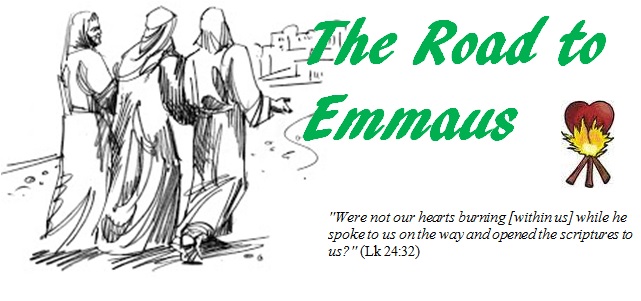
When he was at table with them, he took the bread. He blessed the bread, and broke it, and gave it to them. And their eyes were opened and they recognized him!(Luke 24:13-35)

Sunday, April 20, 2014

Happy Easter

Happy Easter! He is risen! Truly He is risen!

Here's a couple of reflections and lessons I've learned today:

Leave much earlier for mass on Easter Sunday
I was only 1 mile from the church, so I left 30 minutes before mass was to start, thinking that would be plenty of time for the traffic from the previous mass to clear out. Traffic from the 7AM mass was cleared out alright! But the parking lot was already full for the 8AM mass and I had to park on a side street a block away. I thought “Uh oh. I hope I at least get a pew. I'm too old and too sore to stand for an entire mass.” I didn't get a pew, but they did have folding chairs sitting along the walls and I was able to get one at the very back of the church. One thing I can say for Bakersfield is that the Catholic community is large and for the most part, faithful. When I am able to go to daily mass occasionally, the attendance is better in Bakersfield than I've seen in Stockton or Fresno and the reverence seems more sincere, as well—I hope that doesn't come across as judgmental—it's just a subjective observation.

Easter Sunday mass is a different experience—not better, not worse, just different
From the entrance hymns to the Liturgy to the closing blessings, Easter Sunday mass is anything but ordinary. The music is more upbeat than usual (we are exclaiming the Truth of the resurrection, after all), there is more pomp in the rituals, and it always last longer than an hour. I'm not complaining. I love the Catholic mass, no matter what day or how long it runs. As long as I get to hear the Word of God proclaimed and receive Christ in the Eucharist, I'm a happy camper.

I was surprised that I knew the refrain by heart to the hymn “Rain Down”. I don't know if I particularly care for the song, but it was good that the music director chose a song I could participate in without a song sheet. They were provided in the pews, but not to those of us sitting along the wall.

Of course there are no kneelers when one is in temporary seating, so when the Eucharistic Prayer was being said I could only kneel on one knee. (Otherwise, getting up would have been too big a chore! Grunting during mass can be embarrassing!) I'm not overly pious (I think) but I feel less reverent when I can't kneel on both knees when the rubrics of the mass say to kneel. At the same time, (and in retrospect I know I was wrong and judgmental here) I felt somehow more reverent than most of the others in the temporary seating who remained seated for the most important prayer of the mass. Mea Culpa.

On Easter Sunday there are a couple of rites performed that are supposed to remind us of our baptisms. At the beginning of mass, the celebrant blesses some water, then walks up and down each aisle sprinkling the congregation with it while say a blessing. At this morning's mass, he hit every aisle except the one I was in. I was feeling kind of left out. I know that I am still blessed even though no water actually touches me and there's no special “magic” if I'm missed, but I felt sad for some reason. The 2nd reminder of our baptism comes after the homily, when the Nicene or Apostles Creed is omitted and our baptismal vows are repeated instead. I think over the last few years I have become more and more adamant (read that: “emotive”)when I answer “I DO!” to the questions asked by the priest.

Never doubt Jesus. He knows what you need when you need it.
When Holy Communion is distributed, there can sometimes be chaos—especially when mass is attended by so many people who only go at Christmas and Easter. The Holy Spirit gave me a little taste of humility today during Communion. As I said, I was a bit bummed out by the fact I didn't get sprinkled with the holy water at the beginning of mass. When Communion was being distributed, I was sure to be one of last to receive. That was also a bit of sadness for me. The row of people in the pews next to me stood up to start their procession and I was going to follow them. But just then, a Eucharistic minister came walking up to me and I was able to receive without leaving my place. The feeling that went over me was one of great humility. My first thought was “Wow. Who am I that the Lord would come to me? I should be going to receive HIM.” Then I mentally kicked myself for feeling slighted at the sprinkling rite and the fact that I would be one of the last to receive Him at Communion. My second thought was “Thank You, Jesus.” I know I had my priorities backward, but I'm only human, right?

I had some meditation on the 1st and 2nd readings and the Gospel reading today as well that tie into today's experience, but I think that's enough for now. Maybe later today I'll write some more. I probably shouldn't have take the time to write this reflection—I'm supposed to be working. Forgive me, Lord.


Sunday, March 23, 2014

A perfect number

I must admit that many times I “zone out” during Sunday homilies, especially if the homilist is prone to use the same formula week after week.  In this case, the pastor of the church I’ve been attending of late starts every homily with a (poorly told) joke and tries to tie the readings into the punch line of the joke.  He is from India and has an accent, but not so bad that one can’t understand him.  His biggest problem comes from trying to speak too fast and he will either mispronounce words or leave them out entirely….usually.  I found myself fascinated by his take on the Gospel today.  It was an angle I felt the Holy Spirit was telling me to share in my blog.

Permeating through today's readings is a substance essential to life: water. Living in the Central Valley of California where it gets quite arid throughout the summer, I can relate with the people grumbling to Moses of their thirst. We all can relate to being parched for water, and we know the cool and refreshing feeling of water hitting our dried lips and quenching our thirst.  Amid our fasting and sacrificing during this season of Lent, we are reminded of the ways in which our souls thirst for God.  Whether it is longing for a juicy steak on a Friday, or craving those sweets we gave up, we realize the desires of the flesh and the spirit are real.  These moments during Lent are opportunities that remind us of our need for God, which is far greater than our need for any of these earthly things we fast from.

Jesus, in the Gospel of John, encounters a Samaritan woman; the encounter occurs, significantly, at a watering hole, at Jacob’s Well.  Jesus asks her for a drink. She hesitates incredulous that a Jew—and male—would ask her a Samaritan—and a female—for a drink.   Jews typically despised and shunned Samaritans.  Jesus assures her that He will give her “living water”:  “Everyone who drinks this water will be thirsty again; but whoever drinks the water I shall give will never thirst; the water I shall give will become in him a spring of water welling up to eternal life.”

Jesus tells the woman “Go call your husband and come back.” The woman answered and said to him, “I do not have a husband.” Jesus answered her, “You are right in saying, ‘I do not have a husband.’ For you have had five husbands, and the one you have now is not your husband. What you have said is true.”

Here is where my pastor caught my attention.  He pointed out that this exchange was, for him, a definition of our thirst for Jesus.  The woman has had 6 failed attempts at finding love and fulfillment, so she is wary of ANY man who tries to strike up a conversation with her.  Jesus is the seventh man who comes into her life and it is at a point when she is in sin and thirsting for spiritual fulfillment.  In the Bible, and in theology, the number seven pops up a lot; the seven gifts of the Holy Spirit, the seven days of Creation, the seven Sacraments.  Hence, the number seven is usually defined in theology as the number of perfection. Who could satisfy the woman’s thirst and need for God more perfectly than Jesus?


Touched deeply by Jesus, the woman spreads the word to her fellow Samaritans.  And the gospel tells us that many Samaritans came to believe in him.  Let us use this season of Lent to allow God to quench the deepest thirsts of our heart and soul, as we continue our journey towards the Resurrection.

Thursday, March 13, 2014

A great gift

If you bring your gift to the altar, and there recall that your brother has anything against you, leave your gift there at the altar, go first and be reconciled with your brother, and then come and offer your gift. (Matt 5:20-26)

Earlier today, I lost my temper at work. There was no excuse, and no reason. I was feeling sorry for myself and frustrated that my plans for a light day at work were being subverted by everything and anything. My back hurt, my head ached, and I needed to be somewhere else when a very small inconvenience set me off. I was so abusive verbally to two different co-workers who I respect greatly.

One of them understandably called me out for disrespect, but I wouldn't hear of it. I stormed off to do my task and let them handle the problem that as a matter of fact only I could handle.

As soon as I walked off in anger, I regretted it. I actually felt sick to my stomach and I couldn't organize my thoughts enough to handle the task at hand. I said to God “I'm sorry! I don't know what came over me!” As plain as day, He put the thought in my mind “If you recall that your brother has anything against you, go first and be reconciled with your brother, and them come and offer your gift.”

I knew that I had to apologize to both of my co-workers (one of whom was still crying at the harshness of my words). It was a very hard apology to make, but I knew I was wrong and I have been trying to go to Mass as much as I can during Lent, and I didn't want to have to face Jesus in the Eucharist after abusing Him so much in my treatment of my neighbors.

Both of them accepted my apology immediately when they realized it was heartfelt and sincere. I think they appreciated that I offered no excuses, only an apology. By the end of the day we were all laughing and working well with one another as if nothing had happened. In fact, I ended up promoting one of them to a higher position with the company, which has been the reason I've been working so hard the last 3 weeks training her for the new position.

So when I got back to the apartment tonight and read the readings for tomorrow in preparation for Mass, imagine my surprise and gratitude that God, through His Church chose to remind me that forgiveness is probably the greatest gift we can receive from one another.


Tuesday, January 14, 2014

Don't just listen---RESPOND!

For me, telling others my New Year’s resolutions are usually the kiss of death to them.  I hope it’s not going to happen this year because I’m going to share one of mine with you.  I let myself get lax this past year in daily Mass attendance, so I resolved I am going to go to Mass every day that I am able to and if there is a Mass offered.  So far, it’s going well.  I haven’t gone on Saturday’s because I have either been working or traveling for work, but I have been able to go every other day.
 
I love the Mass.  It doesn’t matter which language it’s being celebrated in—it is so comforting to pray with a community, and then to participate in the Holy Sacrifice that prepares us to receive Jesus’ body, blood, soul and divinity.   The Liturgy of the Eucharist is my favorite part of the Mass.

My second favorite part of the Mass is the Liturgy of the Word.  The reasons it takes second place to the Eucharist are two-fold:  First, how can anything compare to a physical union with God?  Secondly—and I hate to admit this—is that I sometimes find some of the readings either confusing or vague.  The days those readings are chosen are when I hope the priest is a good homilist who can tie everything together for me.

With all of that being said, this week’s readings are beautifully tied together by Mother Church and most of the homilies write themselves, so even a poor preacher can make sense of them!
 
The unifying message I see in this week’s readings is that we need to listen and to respond to God’s promptings in our lives. Sometimes they are direct messages from God and sometimes they come through other people (1 Samuel 3:1-10, 19-20, Psalm 40:2-5, 7-8, 8-9, 10 and Mark 1:29-39). But just listening isn’t enough, although it is an important first step.

Lily is at the age (5-years-old) when she has to be asked over and over again, “Did you hear what I said?” Her usual reply is, “I hear you,” to which we have to say, “I need you to listen AND respond.” It’s almost a mantra around our house.

Samuel was listening and he was trying to respond, but he wasn’t listening closely enough to realize it was the Lord speaking to him. He needed Eli to counsel him. That’s OK…we all need the wisdom of elders and those more spiritually in touch than ourselves. Once he learned that God was truly speaking to him, he responded appropriately and developed a deep relationship with the Lord.

The responsorial psalm echoes Samuel’s sentiments: “Here am I, Lord, I come to do your will.” There is special mention of having “ears open” and then acting.

In Mark’s gospel, Jesus listens to His friends’ entreaty to help Simon’s mother-in-law, even if they may have not made a direct request. Just telling Jesus about her plight was enough for Him to immediately respond, reaching out and healing her instantly.

The next day, after a full evening of dealing with crowds gathered at the door and curing as many as possible, He rose early and “went off to a deserted place” to pray. I can just imagine the prayers He offered, probably discussing with His Father the fatigue He may have felt, concerns for others, His hopes for the future, and quietly listening as He absorbed strength from the Holy Spirit.

When His friends found him, He had a response ready for them. He wanted to go to nearby villages and preach, saying, “For this purpose have I come.” Through listening to God’s call through prayer, He was able to focus in on what He was to do. He shows us the way to discover what we are to do: listen to God’s whispers in our hearts and then act on them. We may not always have the extreme clarity to say, “For this purpose have I come,” but sometimes we will, and other times we will know at least what direction we should go and what direction we should avoid.


That’s why I resolved this year to go to Mass as often as I can.  I want to hear the Lord’s voice and respond to His call as best I can.

Saturday, January 11, 2014

Can you imagine?


Imagine Jesus leading you down the bank and into the Jordan River to be baptized with Him.  Then picture yourself coming up from the water to hear God’s voice, “This is my beloved son [daughter], with whom I am well pleased.”

What a powerful, yet simple message:  I am good.  The truth is that we all are, whether we believe it or not.  We are good people who sometimes make bad decisions, but we are good nonetheless.  As sons and daughters of God, we can all meet Jesus on the bank of the Jordan river, we can all sink deeply into those life-giving waters, shed our failures, and re-emerge knowing we are good, we are loved, and we are God’s.

Most importantly we re-emerge, made new and ready again to pursue the mission God has laid before us.  Just as Jesus began His ministry after His baptism, we too are called to share the Gospel message of love and hope with everyone we meet from the moment we are baptized to every relief-filled moment after we leave the confessional.  But the Baptism of the Lord goes beyond these Catholic sacraments: It is a message of rebirth and re-missioning for all Christians and every person, whether they know it or not, because we are all deeply loved by God.

Friday, January 10, 2014

You're here, I'm here, there's water. Why not?

In the Gospel of John (John 3:22-30), what initially caught my attention was the phrase describing why (the ‘other’) John was baptizing.  …“because there was an abundance of water there and the people came to be baptized…”.  That struck me as funny.  “Hey! I’m here, you’re here.  There’s a lot of water.  Let’s do this!”
 
Seriously though, St. John [the Baptist] summarizes the role he has had in regard to Christ.  He clarifies that he himself is not the Messiah, but that "he was sent before Him."  He speaks of the joy that this role has given him and that He must increase, and I must decrease.

Our role as baptized Christians has some of the characteristics of St. John the Baptist in that we also are to prepare the way for Christ, not only in our own lives, but in that of others. We do this by the example of how we live our own lives and by teaching informally when the occasion arises.

If we are doing this, we can ask ourselves, "Does this role bring us joy as it did St. John the Baptist? Is this joy evident to others?" Joy prepares a path for Christ. When we step back and decrease, as did St. John the Baptist, we too are making room for Christ as opposed to taking on the glory for ourselves. We prepare the way, but Christ does the rest!

Thursday, January 9, 2014

No! Really! I've got something in my eye!

I related a couple of weeks ago that I cried during Mass when, during the annual Christmas children’s play, the “baby Jesus” (usually portrayed by a newborn baby of the parish) is placed in the arms of the girl playing the part of Mary.  I felt as though I was there in that stable those many, many years ago witnessing the humanity of Jesus.
 
This morning at Mass I cried again!  (I hope this isn’t going to be a pattern—I have an image to uphold, you know).  As the Gospel was being read, I placed myself in the synagogue as Jesus was reading the scroll with the passage from Isaiah.  I was as rapt as His audience was then and amazed at His knowledge and teaching.  When He said “Today, in your hearing this Scripture is fulfilled”, I lost it.  My eyes filled with tears and I felt so unworthy to be in His presence, witnessing the divinity of Jesus.

It’s not the first time I’ve realized it, but these last two incidents brought home to me that I really, really believe in Jesus Christ and His Good News!  I felt so blessed!  I was elated when the Holy Spirit reinforced what that can mean for me (and anyone else who believes) in 1John 5:5-13.

To paraphrase John (I hope I got it right!):
  

Faith is our best measure of success. The successful person is the one who believes in Jesus. Jesus was actually born. He is our Savior by blood through His birth in human form and by His death.  Jesus is fully human, born as a baby from a human woman, and fully God. Those who acknowledge His humanity and His divinity are the winners and their prize is eternal life.  Those who believe in God and Jesus and praise Him are blessed, and their children are blessed, and they are blessed with life everlasting.   When we believe in God, when we believe in Jesus, we win.  And our prize is the blessing of our faith, healing, and life everlasting.

Sunday, January 5, 2014

Lighten up!

The priest at Mass this morning opened his homily with the following joke.  I’ve been chuckling about it all day.  I couldn’t remember the exact words of the joke, so I googled it for accuracy.  I found it on another person’s blog and copied it.  Before I did though, I also perused the comments in the blog about the post.  First, here’s the joke:

A little girl asked her father, "How did the human race appear?"  The father answered, "God made Adam and Eve and they had children and so was all mankind made.”
Two days later the girl asked her mother the same question. The mother answered, "Many years ago there were monkeys from which the human race evolved."
The confused girl returned to her father and said, "Dad, how is it possible that you told me the human race was created by God, and Mama said they developed from monkeys?"
The father answered, "Well, dear, it is very simple. I told you about my side of the family and your Mama told you about hers."


A couple of the comments took the joke for what it is—humor.  But the “atheism at any cost” types were vehement in denouncing any theory about the creation of the human race other than simply the science of evolution.  When will they realize that seemingly opposing viewpoints in regard to science and faith are almost never “either/or”, but most often they are “both/and”?  

To get the real explanation of what the Catholic Church teaches about the beginning of the human race, read the Catechism of the Catholic Church Paragraphs 282-289.
 

In the meantime, lighten up.

Wednesday, January 1, 2014

The wondrous deeds of God

The wondrous deeds of God are known to anyone who takes the time to look for them and to reflect on what they see, or hear, or sense in any way.   Who doesn’t appreciate a beautiful sunrise or sunset?   Who isn’t impressed by the sight of untarnished natural surroundings?  My cousin Amy frequently posts on Facebook photos she has taken.  She always gives the credit to God for the wonders she sees.  


How can anyone who has witnessed the birth of a child not be overwhelmed with gratitude to God by the miracle of life?


What about the technological advances of the last 100 years or so?  Although some may argue that these are the works of men, I counter that without our God-given intellect, we would not have these wonders.  

These are all given to us by a generous God.  How can one be aware of and respond to these wonders without singing joyfully to the Lord?! (Psalm 67:4)

This time of year we are reminded of the wonders of people caring for each other.  While people are homeless and hungry and ill-clothed throughout the year, something about Advent and Christmas reminds us that this is a special time to care for our sisters and brothers.  Toy drives, food collections, fuel subsidies, and other programs unite givers and receivers during this time of year more than any other.  We mirror God’s wondrous generosity with our own.

And yet, it’s so easy to take all this for granted, to demand and expect wonders because they have become part of our lives and so mundane.  These wonders become ingrained in our short memory horizons, and so we expect that we will always be comfortable in our needs, that “someone” will certainly develop a new something to fix this or that problem.  It’s amazing that the marvel of new things has a short life of public interest because something new is coming soon.  If we stop to think we might appreciate the wondrous things about us, but too often we are lulled by complacency.  We forget that what we know today is the culmination of all our prior human understanding of the mysteries that God has created.

One of the most wondrous things that God has done is to give us children and grandchildren, because as they grow they remind us by their exuberance to truly appreciate the wonders we encounter.  Since their memories are short, children see with the new eyes of one who is not jaded.  Lily, who just turned 5 years old a couple of weeks ago, greets me with a great big hug and “OOMPAH, you’re home!” every time I walk in the door after a few days absence as if it has been years since we last saw each other.  It melts my heart every time.  It doesn’t matter what kind of a day or week I’ve been having.  Once I feel that unconditional love nothing else matters.


And so my prayer today as I start this new year—and  my wish for you—is for the grace to be like a child, discovering with joy every minute of every day the wonders the Lord has done, and for the freedom to break into songs of praise for the God who loves us.

Tuesday, December 31, 2013

We need this Woman!

Other feast days celebrate Mary in the liturgical year, but today we begin our year by venerating her as Mother of God.  Her Motherhood is the heart and reason for all our attention to and claims on Mary through the centuries.  

We need this woman throughout the year!   Just think of all the honor and prayers offered to Mary through the two millennia of Christian faith, the images, the titles, the pious practices, the special doctrinal pronouncements in the last two centuries in Roman Catholicism that she is the Immaculate Conception and was Assumed into Heaven.  Sinless (but otherwise entirely human like us) and Queen of Heaven, she hears our prayers; though she does not judge or save or heal herself, she prays for us.  She is Advocate, Mediator, Guide, Role Model, Comforter, and always a real Woman, and even Sister and Friend to us, throughout our lives, and—as the “Hail Mary” says—“at the hour of our death.”
  
We need this woman!  A few weeks ago, in conversation about TIME’s selection of Pope Francis as “Person of the Year,” a young woman of feminist leanings remarked, “We should have a WOMAN as head of the church ABOVE the Pope.”  We have her!  Mary, the Mother of God is above the Pope in the Church!   Further, our human nature needs a womanly figure to honor and pray to.  I heard Timothy Cardinal Dolan of New York say that the first place Pope Francis visited after his election was to a shrine of our Blessed Mother, as have the previous 3 popes, to ask for her help and guidance in their pontificates.

 
As Mary’s child is obviously different from any other hero in history and literature, so she transcends as well as fulfills our need for Mother, Mediator, or Queen – and also for a real woman who is personal, intimate Mother, guide, model, and friend.  Now celebrating the Mother of the Word, I notice the words of our readings for today, and particularly that “Mary kept all these things, reflecting on them in her heart.”   I want to follow her example, reflecting on the Gospel narrative, St. Paul’s teaching, the blessing that the Lord taught Moses, and the prayer sung in the Psalm.  (Numbers 6: 22-27,  Psalm 67: 2-3, 5, 6, 8, Galatians 4: 4-7 & Luke 2: 16-21)

And I notice, as if new in this New Year, the exact words of the most obvious “Hail Mary” prayer.  I’m noticing that first we “hail” her then we praise her, stating the obvious: that she is “blessed” and so is her child.   Then we ask her to pray for us sinners – and not only in this moment of reciting the prayer, but at the time of our death.   Death -- the usually not noticed part of life!   We need this woman now, each day, and to the certain end of “now.”

“Holy Mary, Mother of God, Pray for us sinners, NOW” – in all of 2014 – “and at the hour of our death.”


Happy New Year!

Monday, December 30, 2013

Looking back, moving forward

At the closing of the year it's a good thing to look back, even as we continue to move forward.  It’s good to look in our rear-view mirror to see our experiences of God in our lives during the year we are closing and to reflect on them. Yes, even as we keep on driving and looking to the road ahead.

I look to 3 very specific experiences this past year for which I am extremely grateful to God; Tim (and Dottie’s) successful back surgeries and recoveries and (in my opinion) the “wedding of the year”.  Congratulations again, Sarah and Tony!

I think it’s interesting that at the end of the year the gospel reading (John 1:1-18) brings us back to the absolute beginning: In the beginning... As the year’s end invites us to look back on the completed year with gratitude, the prologue of John’s gospel invites us to look back as far as “back” goes: In the beginning... (the beginning of creation of course, since God and the Word have no beginning).  And, looking at the beginning, the reading gives us a capsule summary of the mystery of Christ, the Word.

The Word was in the beginning, but the Word did not stay there statically. The Word is now. The Word, who became flesh and (literally) pitched His tent among us, as we have just celebrated at Christmas, remains with us: I will be with you to the end of time [Mt. 28:20]


We glance at the past year in our rear-view mirror, but keeping our sight on the present, as we keep moving into our future to be made of an uninterrupted sequence of presents.  It’s a moment of both gratitude and hope.  Gratitude even as we recognize experiences we regret and hope even as we  perhaps fear possible experiences that could hurt us, knowing all along that we are never alone, because the Word became flesh and pitched His tent among us, the Word who gave us His word that “I will be with you to the end of time.”

Saturday, December 28, 2013

My first "Best Of"


Whenever radio personalities go on vacation, they often leave their listeners with "Best Of" broadcasts.  That's what I'm going to do today.  Sarah and Tony have spent a few days with us.  Sarah was looking for some nostalgic newspaper articles and such and I found an old journal (not a "diary"--because I'M A MAN! lol)entry written on the same date (12/28/07.  I hope you enjoy.
=======================================
 
In the priestly prayer of Christ in St. John's Gospel, Christ says, "Father, may they be one in us as you are in me and I am in you; With me in them and you in me, may they be so completely one..." (Jn. 17:21-23).

I am not a great scholar, or even a great thinker.  But I am doing a lot more soul searching these days and trying to get closer to God by really looking for Him through prayer in my everyday life.  It’s amazing to me how many times every single day that I find proof of His existence and confirm, as St. Paul says, that we are all part of the Mystical Body of Christ, whether we want to acknowledge it or not. 

While meditating on the Feast of the Holy Innocents (December 28), I began to cry for the poor children who were slaughtered by Herod simply because he wanted to hold on to his throne and was jealous of anyone holding more power than he had.  I wonder why I cried.  It happened over 2000 years ago, and I didn’t know any of those children personally!  But I felt true, deep sorrow over the loss of innocent life.  I think it is the same sorrow that I feel for the slaughtered unborn (aborted) children of today.  And for those killed in unnecessary wars (aren’t they all?).  It was and is such a waste of potential souls who can join with mine in glorifying God.  But why do I cry real tears?    

Then my thoughts turned to something completely inane—the television show “Extreme Makeover—Home Edition.”  I cry every week while watching this show.  I cry at the tragic events that befall these families.  It is a deep, profound sorrow that reaches down to the depths of my heart.  I feel as though their troubles are my own.  I don’t know these people personally, but my grief for them is as sincere as if they were my own family.  And at the end of each show, I cry with tears of real joy as they (almost always) praise God for the intervention of the designers and builders.  Another thing that impresses me about the show is the compassion of the families’ friends and neighbors in helping get the homes built in 7 days.  This show is a testament to faith and works in action.  But, why do I cry?   And why is my grief so severe? And why are my tears of joy so overwhelming, almost to the point of embarrassment?

Could it be that we truly are the Body of Christ?  That we are all somehow joined mystically to one another through Jesus Christ by our baptism?  It seems so simple to me sometimes, but I know that it is much more complex than this.  I think the key to understanding some of these principles is using the free will and the gifts of intelligence and reasoning that God gave us to recognize when the Holy Spirit is speaking to us and listening prayerfully to His advice.

Romans 12: 5 - 16

so we, though many, are one body in Christ, and individually members one of another.  Having gifts that differ according to the grace given to us, let us use them: if prophecy, in proportion to our faith; if service, in our serving; he who teaches, in his teaching; he who exhorts, in his exhortation; he who contributes, in liberality; he who gives aid, with zeal; he who does acts of mercy, with cheerfulness.  Let love be genuine; hate what is evil, hold fast to what is good;  love one another with brotherly affection; outdo one another in showing honor.  Never flag in zeal, be aglow with the Spirit, serve the Lord.  Rejoice in your hope, be patient in tribulation, be constant in prayer.  Contribute to the needs of the saints, practice hospitality.  Bless those who persecute you; bless and do not curse them.  Rejoice with those who rejoice, weep with those who weep.  Live in harmony with one another; do not be haughty, but associate with the lowly; never be conceited.

Wednesday, December 25, 2013

The excitement of children

For the past week, since her 5th birthday, Lily has been counting the number of “sleeps” until Christmas.   Last year she knew about Christmas, but not about the excitement of Christmas.  It’s been really amusing, and an opportunity for me to reflect.  As I watched Lily’s excitement grow each day, I realized it was because she would be getting presents more than the excitement that we should all feel at the impending birth of a Savior.   I am attributing this attitude to her maturity.  I am sure that from this year on, she will grow in knowledge and understanding of Christ.
 
What I really reflected on though was the actual excitement of a 5 year old child.  When Jesus was 5 years old, did He feel this child-like excitement about His role as our Savior?  Was He as excited about being born among His creation as we are excited about it?  I’m talking about His human nature here, not His divine nature.  Obviously, His love for us can’t be matched, but I often like to think about what Jesus might have felt and thought as He “grew in wisdom and stature”.  (Luke 2:52)

One thing I appreciate during the Christmas Season is the traditions that we keep.  One in particular that we’ve kept since our girls were small (which is close to 30 years now!) is attending the children’s Mass at St. Luke’s parish.  The children present the same production of the Nativity story every year.  One year, Alicia played the part of Mary and was able to hold the “newborn Jesus” while the Gospel of Luke was read.  Another year, Sarah played the part of the angel who appeared to the shepherds in the field and told them of the Good News of Jesus’ birth.  The Infant Jesus is always “played” by a real newborn of the parish and his presentation to “Mary” by an “angel” always elicits an “OOOOOOhhhhh” from some in the congregation.


 But for me, this simple re-enactment brings tears to my eyes because the presence of that little baby really brings home the grace of God becoming man. Despite the hardship and the pain, there is such joy at any birth. The act of God becoming man in a humble, all-too-human way can give us all hope in the rebirth of goodwill and peace. We are people who have walked in darkness and now have seen a great light. We can sing a new song, be glad and rejoice. The grace of God is here to help us learn to live temperately, justly and devoutly in this age. We should take this story and the good news of great joy into our hearts and let the joy and peace flourish. We should be thankful for this great light. We should keep the light burning brightly in our hearts and in our lives.  We should hold this simple story in our hearts throughout the year.

Sunday, December 22, 2013

Making room for our Father's Will

In lieu of my own meditation today, I read a homily by Father Jim Chern that I thought was touching enough and provocative enough to share.  You can find the homily here.  I was almost brought to tears by the sermon.  How often are we asked to change our own plans and bend to the will of the Father, but not willing to because we are comfortable where we are in our lives, or simply afraid of change? 

Saturday, December 21, 2013

I know God exists because of the prayers of my mother


December 20, 2013===


I couldn't let the day end (well technically I did—since the clock just struck 12 midnight) without giving a shout out to my mom and dad. Today (yesterday) was Dad's 106th birthday. I hope I turned out the way he would want me to.


It was also Mom and Dad's Anniversary. They were married on December 20, 1941 after a whirlwind courtship and doted on one another until Dad passed away in 1970. Mom sent out an email to all of her children today assuring us that she still thinks of Dad every day and prays for him as well. She included a short prayer for him that I repeated several times during my own rosary this evening.


I thought I would take the occasion to thank Mom and Dad for my faith. Let me clarify that—God blesses us with Faith. But He most often offers it to us then nurtures it through our parents. Think about that. I did today. I was having trouble finding the words to describe how I arrived at my faith, when the Holy Spirit sent me the words and the inspiration for this blog entry through the words of a radio personality (who just happens to be Catholic) I was listening to today.


He said “I know God exists because of Mom's unwavering faith and prayers.” I thought “That's exactly the way I feel!” Mom's example of uncompromising faith and prayers are the “insulin shot” I need when my faith grows “diabetic”.


So as a (late) Birthday present to Dad and Anniversary present to both Mom and Dad I offer the following prayer:


Heavenly Father, I thank You for my parents. I am confident that You chose my parents for me knowing that they would introduce me to You through their example of love and devotion to one another. Their example is the cornerstone upon which I have tried to lead my own family to You. I trust that through Your Son's mercy I will be able to spend eternity with my parents and the rest of my family in praising You. I present this prayer to You through Your son, our Lord Jesus Christ. Amen.

Tuesday, December 17, 2013

An example of joy

In his latest Exhortation, “The Joy of the Gospel,” Pope Francis writes about a “practical relativism” in which we act, in our day to day life, like God doesn’t really exist.

He said that this can result in – in a heart that believes all the doctrine and teachings – “a lifestyle which leads to an attachment to financial security or to a desire for power or human glory at all cost.”  Francis calls us to “say no to selfishness and spiritual sloth.”  He talks about the dangers of “acedia,” which is an emptiness or listlessness that results in not really caring about anything.  He warns of a “gray pragmatism,” transforming us into “mummies.” “Disillusioned with reality, with the Church and with themselves, they experience a constant temptation to cling to a faint melancholy, lacking in hope which seizes the heart.”  He asks us to “say no to a sterile pessimism.”  He said, “Our faith is challenged to discern how wine can come from water and how wheat can grow in the midst of weeds.”  He writes about a “defeatism” which can turn us into “disillusioned pessimists, ‘sourpusses.’”  He warns that we can, in discouragement, be tempted to “build without God.”  He urges us to “say yes to a new relationship with Jesus.”


This is what Advent is for.  It’s an opportunity to open our hearts to Jesus’ coming today, in the midst of our darkness.  This is not something abstract or intellectual.  It’s personal.  If I let Him love me, forgive me, tell me I’m precious, that I’m not alone, then I can face any challenge with hope.  This is what real joy is all about.  And, even when our union with Jesus leads us to the Cross, we are with Him on the path to eternal life.

Let us all pray, “Come, Lord Jesus,” with deeper, more personal meaning today, and each day in the days ahead.  And, let us let him come into those places of our lives where he so wants to come with tenderness, comfort, healing and life.

Happy 77th Birthday, Holy Father!


Friday, December 13, 2013

Recognizing the signs

What an amazing and vibrant image we have of Elijah!  (Sirach 48:1-4, 9-11) His words are on fire! He actually brought down fire from the heavens by the power of God.  His zeal was inspiring.  He was destined to put an end to wrath and enmity so people could accept Jesus when He came.  He was a harbinger of the Lord and a necessary step in the coming.  Elijah was taken up to heaven in a chariot of fire.  How could anyone fail to recognize his importance, especially with all that fire surrounding him?

But later, in the gospel (Matthew 17:9a, 10-13), we find out that people did not recognize him.  Despite all the fire, the people did not recognize him or his importance.  When the disciples say it is written that Elijah must come first, Jesus says Elijah has already come, but was not recognized.  Elijah was destined to restore all things in preparation for Jesus, and came in all his fire and glory, but was not recognized as the harbinger he was.  John the Baptist came to prepare the way, but the people didn’t recognize his importance or heed his words.  And when Jesus did come, the harbingers were not recognized and not heeded, and Jesus Himself was not recognized, despite His glory.  And He will suffer at the hands of men who did not recognize the signs, did not heed the harbingers, and do not recognize the Lord in their midst.


Psalm 80 begs, “Lord, let us see your face and we shall be saved”.   But when we saw Elijah, we didn’t recognize him. When we saw John the Baptist, we didn’t recognize him. When we saw Jesus, we didn’t recognize Him.  Jesus says that Elijah has come in John the Baptist, and was not recognized, and the importance of his words was not heeded, so the men will not recognize Jesus or realize His importance.

We’re in Advent now, preparing for the arrival of the Lord.  And what will happen when He comes again? Is Elijah already here, speaking fire, preparing the way, but unheeded and unrecognized? Will we recognize the signs? Will we recognize Jesus when he comes?  If we’re looking with the eyes of our confident faith, the answer is YES.


While I’m on the subject of recognizing people important to our salvation, Mark Hart (“the Bible Geek) reminded us via Twitter the other day:  God wore diapers….and Mary changed them.  Don’t tell me she isn’t important!

Thursday, December 12, 2013

Am I a member of the "Do Nothing" Party?

No matter what we do or say, we can’t make everyone happy.  One look at politics in America is enough to demonstrate this.  It seems that no matter what one political party does, it’s never enough (or it’s too much!) for the liking of the other party.  Jesus really drives this point home when He says that John was called possessed by a demon for his meager diet and hermit ways, while Jesus Himself is called a drunkard and glutton because He eats and drinks at the table of sinners.

Sometimes I have to remind myself of this reality. Even Jesus, Son of God and Lord of the universe did not make everyone happy all the time.  In fact, some of the things He did made a lot of people really upset most of the time! As Christians, we’re called to serve our brothers and sisters and to strive to lead all souls to heaven, but sometimes there are those people in our lives that we can’t seem to make happy, no matter what we do. How do we deal with these frustrating moments where we are called to love, but to what seems to be no effect?


We get our answer in Isaiah. “I, the LORD, your God, teach you what is for your good, and lead you on the way you should go” (Is. 48:17). Jesus teaches us how to live rightly, even when that right living upsets and even angers those around us. There are some things we do and believe as Christians that unfortunately will always make certain people upset.  Jesus knew this, and rather than trying to bend away from what was right, He preached and lived the Father’s will, and through His infinite love, converted sinners to His heart. It can be the same for us today. When we see people that are seemingly never satisfied with Christianity, do we sacrifice our Christian life for their “happiness”? Or, do we instead love them all the more and try to bring them to Jesus?

Courage grows when we remember to keep our faith in Jesus

In this Second Week of Advent, we continue to hear the promise. It’s a promise of the coming of one who will rescue the Israel of Isaiah’s day from the terrible troubles they‘re in. But, in the context of our Advent journey, it’s a comforting message for us as well: "Fear not, I will help you.”

If only we could hear and receive that comfort today! Fear takes so much away from us. It isolates us. What we see and experience gets distorted. It is so very debilitating. When we are afraid, we are often in a defensive mode. Too often our fear is real.  We've been hurt. We have reason to fear being hurt again. We might be on the edge of losing our job, our livelihood, our security. Someone we love may be very sick or dying. The outcome isn't clear. We may have had a health scare ourselves. Members of our family might not be getting along or may not be making wise choices. Maybe some of our children or grandchildren have lost their zeal for Christ.  Maybe a marriage may have come to a very difficult and terribly frustrating or painful time.

The worst part of fear is that it can distort us. We’re not our best selves when we’re afraid or defended. Sometimes we live with anger and resentment as well. We’re tired, because it’s like carrying around a huge burden on our backs. What is missing is the ability to see goodness and trust it. It’s often not even in our grasp to enjoy and delight in small things. We can find ourselves no longer open to being touched by what is beautiful or promising or loving. So it’s not easy to hear good news, particularly the good news in the symbols, signs and comfort of Advent.

Sometimes we just hide our fears. “The best defense is a good offense.” Dogs tend to bark when they are afraid. We often do the same. If I’m aggressive enough, people just might not hurt me. It can appear to be a good approach to staying in control of my life.

All these different ways of coping with our challenges can become deep patterns, and, even if I recognize them, they are not easy to change.

This week of Advent is a great time to ask—if  only with a small, timid voice—“Lord, you know how fearful I am. You know my story. You know me. Please let me surrender, at least step out of, my fear for a while today. Let me trust that you will help me, that you want to comfort me. I fear to take the risk, but something is warming my heart to you and your care for me.”


This is a time to let our relationship with Jesus grow – to be attracted to Him, to be drawn to Him, to appreciate Him, to thank Him, and to begin to be caught up in His ways, His courage,His way of loving. His coming into a messy history, into a human journey, into an embarrassing stable, can give us hope. And, Isaiah’s promises can come alive for us, today.

Tuesday, December 10, 2013

My To Do list rarely contains the words "slow down and listen"

Not to get into details (those have been covered in my Facebook posts), the last 3 days have been very trying for me.  First, the travel fiasco (I prefer to think of it as an “adventure”) of Sunday.  Then two very long work-days.  I still managed to post all but last night because of a screwy internet connection.  Sorry about that.  When I read the readings for tomorrow’s Mass I couldn’t help but meditate on our Lord’s presence in our lives even in adversity.

 My To Do list is filled – always.  I revise it, add to it and proudly cross things off of it.  I have perfected a system that combines my list on my smart phone and allows me to change priorities if I need to.

But it was only recently, as I prayed with my To Do list, that I realized that if the mythical day came when I finally finished every item on my list  … I would think of more things to add.  I work in a whirl and do too many things.  What suffers, in my quest to be ever more productive, is contemplation.  Appreciating.  Gratefulness.

Isaiah’s words call us to pay attention.  We are all busy and our lives are full.  But Isaiah’s beautiful words this Advent remind us that God really does call each one of us by name.  God is there for us in our distress, offering “strength to the fainting” and vigor for the weak.

We are asked to lift up our eyes to pay attention to the world around us – the people around us and the joy of nature.  It is in such moments of quietness that we will be restored with hope.  But hope can’t arrive if we don’t take the time to open our eyes, listen and ask God for the healing and hope that is offered to us with such love.


In the gospel, Jesus invites us to come if we are weary and discouraged.  Come if we think we are too busy to stop; if our To Do list seems endless.  The readings remind us to slow down and hear Jesus offer us “rest. For my yoke is easy, and my burden light.”