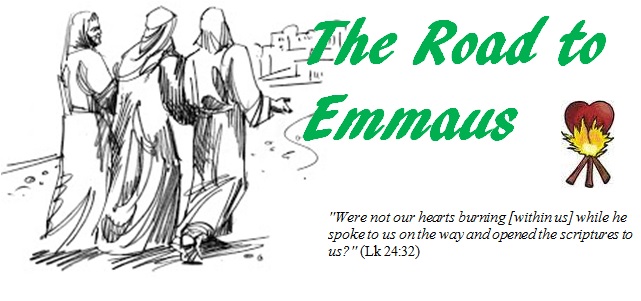
When he was at table with them, he took the bread. He blessed the bread, and broke it, and gave it to them. And their eyes were opened and they recognized him!(Luke 24:13-35)

Friday, December 31, 2010

Count your blessings, and "Behold your Mother!"

January the first is a very special day. It marks the beginning of a New Year (we’ll have to remember to put 2011 on those things requiring a date instead of 2010!). It is also the Octave of Christmas during which we have been challenged to “remember” the good things that God has freely given to us. The “remembering” that we do is so much more than a nostalgic look back. Memory in the context of a feast like today is a deeply spiritual activity that grows within us as people of faith, hope and love. We remember how we are blessed by God. At Christmas the blessing is purely and simply the fulfillment of the promise of God to enter fully into our lives to be healer, merciful and forgiving God. God enters us personally in Christ Jesus, born of Mary as the God-man to take from us the bonds of sin, injustice, fear and harm that afflict us because of Adam’s sin.
This is the Solemnity of Mary, the Mother of God.

All the other titles of the Blessed Virgin Mary, and the beliefs taught about her, rest on this singular and profound reality. To be the Mother of my Lord, she had to be conceived without sin (Immaculate Conception); to be the Mother of Jesus, she needed to say "yes" (the Annunciation). About her, Jesus tells her, "Behold your son," and her divinely given maternity of Jesus, becomes a maternity for the Church, for priests, for God's people, often depicted as hiding in her mantel for she is the refuge of sinners, and a sorrowing world is gazed upon with sorrow by the Queen of Peace.

Her power as an intercessor exists because she is the Mother of God. She is Our Lady of Lourdes, Our Lady of Fatima, and Our Lady of Good Help, along with many other titles representing how she leads us in prayers of adoration, praise and intercession. The comfort she offered to her Son is the comfort she offers to each one of us. This is the solemn day of recognition of the identity of the Woman Clothed with the Son. She is the Mother of God. Rightly, I am to accept what Jesus has said, "Behold, your mother," because she will always lead me to Jesus.

The first reading from the Hebrew Bible’s Book of Numbers sets the tone for today’s celebration. It recounts the words that God spoke to Moses: “This is how you are to bless the Israelites. Say to them:

The Lord bless you and keep you!
The Lord let his face shine upon
You and be gracious to you!
The Lord look upon you kindly and
Give you peace!
So shall they invoke my name upon the Israelites
And I will bless them.”

This blessing reaches into our everyday experiences right at the center of our lives where we meet God-Who-Blesses. New Year’s Day can be highlighted for the resolutions that we take upon ourselves (losing weight, curbing our appetites for food and drink, caring for others, and on and on and on). We might want to resolve this year to remember the concrete ways that we are blessed each day. I think if I am able to do this I might become at a deeper level of my life a Eucharistic servant – called into service by the many blessings that come my way. Can we habitually count the blessings that are ours and thus give ourselves over to God as Jesus Himself did through his life, death and resurrection?

Today’s feast invites us there under the marvelous gaze of Mary, the Mother of God (and our Mother) to remember and to act as Jesus acted in obedience to his Father. Mary’s motherhood is a beacon showing us the way to live our lives and to focus ourselves on her Son, Jesus.

Lord, help us to be blessings-counters as we begin this New Year and to keep our gaze constantly on The Christ who continues to call us into life and service. Help us to keep open to our loving, forgiving, merciful God in the person of Christ Jesus. Amen.

Thanks!

Well, it was bound to happen sooner or later!  I got my first comment about this entry in a foreign (to me) language! It reads, "Il semble que vous soyez un expert dans ce domaine, vos remarques sont tres interessantes, merci".  And although I took five semesters of French in high school, I can't remember anything more than "bonjour" and "crepes".  [Not entirely true-- I have my moments....Comment allez vous?  I think that means "What is your name? And je m'appelle Etienne.  (My name is Stephen).]  In any event, I couldn't make heads or tails of the comment a reader posted.  I didn't know if he (or she) was a spammer, or a critic (they are welcome, too!) but curiosity got the best of me, so I used the translator I found on my search engine and was pleasantly surprised that the comment in English is, "It seems that you are an expert in this field, your comments are very interesting, thank you" [Automatically translated by Microsoft® Translator].

While I appreciate the comment, I must reply that I give all credit to the Holy Spirit.  I am by no means an expert in anything I write.  These posts are simply my reflections and meditations on the readings of the day as they are given to me by the Holy Spirit.  He guides me to read other sources or listen to theologians who are experts when I want to be sure my theology is in line with the Catholic Church.   Even my abilities to use a keyboard and spell words correctly were given to me by God to help spread His Holy Word.

So, Glory be to the Father, the Son, and the Holy Spirit.  As it was in the beginning, is now and ever shall be.  Amen.

PS:  After I published this post the first time, I LMAO!  There was an "ad" on my "new post" page from Blogger that said, "Learn to Speak Fluent French!"  How do they know this stuff?  It's eerie.

Thursday, December 30, 2010

The power to become a child

The Word, Jesus Christ, is coeternal with the Father. Indeed, He has an earthly beginning and end, a life we can track and understand. This is one of the ways that the Lord has blessed us - He became like us so that we could understand Him in a way like no other.

But more important, with His birth came the birth of salvation - this salvation rang throughout eternity and redeemed all of those who were faithful to God from the beginning of human time until its end. It was an event anchored in time, which echoes out of human reckoning and time. Indeed, "What came to be through Him was life" itself. He gave eternity to the soul. His birth wrought this miracle and made for us a home with God.

It is really incomprehensible. We can speak the words over and over and never really take in the impact of them. However, we don't really need to. What we need to do is accept the truth that the incarnation of Christ brought eternity into time and time into eternity. We are made whole, made alive, made eternal by the mystery of the incarnation. We are redeemed and made acceptable to God through the mystery of salvation and redemption. These two echoes resound through our lives, in our minds and in our hearts.

So, what do we hold onto when trying to comprehend this mystery? Try to see Jesus in Mary's arms and you can see us in God's arms. It is a mirror image - the perishable holding the eternal, and the eternal holding the perishable - but now, because it is so embraced, no longer subject to the reign of destruction and death. The perishable becomes eternal. As Mary gave Birth to Jesus, so Jesus gave birth to Mary's eternal life. He does the same for all of us who accept Him.

As the days of the Christmas Octave and 2010 draw to a close, we are privileged to hear the moving Prologue of the Gospel of John. Among the many phrases that pour out one after the other, I am intrigued by the following: “But to those who did accept him he gave power to become children of God.”


Smiley Face
What a curious phrase—having the power to become a child. Unless there is a two-year-old in the house, we normally don’t associate the words “power” and “child.” 


Yet, it’s the heart of the Christian mystery. Incapable of saving ourselves, we need a savior. But the path to salvation is not “upward mobility,” but rather “downward humility.” Christian maturity consists in “growing up” enough to become a child, dependent on and totally confident in God. To be “saved,” is to become a child.

And this must come from a power that does not originate within us. The power comes through the choice to “accept him” – to say “yes” to being saved, rescued, by the Word made flesh, the One who is the Way, the Truth and the Life. We must be born “of God.”

The point driven home by the readings on Friday is that we must readily accept Jesus so that when He comes in His glory, we might be saved. What does it mean to readily accept Jesus in our lives? What are some of the lies that are “alien to the truth"? When applying Friday’s readings to my life, I feel as though I need to start over. This is the perfect time to make a New Year’s resolution: I need to let go of the lies of sin: busyness, gossiping, materialism, pride, and so many others of which I am horribly guilty.

Tuesday, December 28, 2010

Work toward the light

By our choices and by our actions we can give darkness power over us. We can make choices that drown out the light. John tells us, "The man who hates his brother is in darkness." (1John2: 11) But how can that be if Jesus has come to wipe it out?


It can be, because Jesus only removes the darkness when we invite Him in. He does not take away our choices; we can still choose to turn our backs on good. We can turn out the light, if we wish. This is why Paul always talks about "working out my salvation in fear and trembling." (Philippians 2:12) That is, always working toward the light, and making choices that increase the light.


We can choose to hang up thick curtains around ourselves, or we can choose to open the curtains, throw open the windows, and let light stream in. This is the most glorious Christmas present of all. It is the present that all the lights, packages and bows serve to remind us of! Christ is light; in Him there is no darkness. If we choose to dwell in Him, then we cannot also choose to live in the dark.

Pilgrimage update

I was able to "put another notch" on my "pilrimage belt" today.  I went to Mass at St. Aloysius church in Tulare.  Beautiful, recently built church with lots of children.  I know this because they were having some sort of a school function when I arrived about an hour early so I could say my rosary and meditate in front of the Blessed Sacrament.  It's a little tough to concentrate on meditation when children are speaking loudly and basically "being children".  But I managed.  When I got back to the hotel, I thought I would see how I'm doing, so I made the chart on the left:  That's 128 parishes in two dioceses (Fresno and Stockton) that I made the objective of my pilgrimage.  I have visited 59!  Almost halfway there in a little over 2 years.  At this pace, I should be able to visit every church on my list by 2014! 

Please pray for me that I can complete it.

Here's a little bit on the patron saint of the church I visited today:

St Aloysius Gonzaga

Due to his short lifespan, a look at the life of Saint Aloysius Gonzaga deals mainly with his childhood and seminarial life. He was born Luigi Gonzaga, the eldest son of Farrante, the Marquis of Castiglione, on the 9th of March, 1568. From the earliest age, the young saint was given to prayer, including the Office of the Blessed Virgin Mary, the seven Penitential Psalms and other devotions.

Being eldest son, Aloysius was expected to carry on the family name, and would fulfill this by his father's wish for him to become a soldier. The hand of God would not allow this fate.

In 1577, his father took Luigi and his brother to Florence to study and improve their Latin and Italian. As it would happen, young man would develop an affinity for study of the saints even more than his regular studies. In 1579, he father moved the brothers into the court of the Duke of Mantua. There the Saint decided to abjure his claim to his father's title and place, passing it to his brother Ridolpho. The Saint then suffered a malady that allowed him to stay out of the public eye, withdrawn in prayer and study of the Saints.

At this time Aloysius read of the Jesuit missionaries in India, and he resolved to join the Society of Jesus. He began this direction in life by instructing the boys of Castiglione in the catechism. At Casale-Monferat, where he spent winters, he assumed the discipline of a monk, fasting three days a week, scourging himself, and praying at midnight on the stone floor of his unheated room.

Over the next two years, Aloysius would fight with his father, mother, regals and delegates over his impending Jesuit vocation. They disagreed with it adamently on the grounds he should follow in his father's stead. Finally, they relented after most of the family title and responsibilities fell to his younger brother Ridolpho, thus allowing Aloysius to enter his novitiate in November, 1585.

In the third year of study, he came to the revelation he would not live long. The plague struck in 1591, and he was sent to aid the ill in the Jesuit hospital of Rome. He performed the lowliest of duties, but contracted the disease in time. He was sure this was the cause of his eventual demise, and once asked his confessor, St. Robert Bellarmine, if it was poosible to avoid Purgatory after death. St. Robert assured it was possible, and Aloysius aspired to this end.

Aloysius' health was so poor that he received Holy Viaticum and Extreme Unction on several occasions. It was revealed to him that he would pass on the Octave of Corpus Christi, and though he appeared much better in the days preceeding the Feast, Saint Aloysius Gonzaga did in fact turn and die on the Octave of Corpus Christi, June 21st, 1591.

Saint Aloysius Gonzaga is the Patron of Catholic youth.

Monday, December 27, 2010

The greatest in the Kingdom of Heaven

At that time the disciples approached Jesus and said, "Who is the greatest in the kingdom of heaven?" He called a child over, placed it in their midst, and said, "Amen, I say to you, unless you turn and become like children, you will not enter the kingdom of heaven. Whoever humbles himself like this child is the greatest in the kingdom of heaven. (Matthew 18, 1-4)


For the last 30-something years (except last year) my family and I have attended the children’s vigil Mass on Christmas Eve at St. Luke’s. When the girls were small, they were in the “Nativity Play”. Over the years it has remained essentially the same—only the “actors” have changed. I appreciate the children’s Mass for a number of reasons, but the biggest reason is the children themselves. I love children, always have.

This last Friday, the words of St. Matthew had me close to tears when during the homily, an elderly man seated behind me kept answering out loud the questions that Father Matt was asking the children: “What makes a holy family?” The man’s answer: Prayer. “What kind of prayers?” The Our Father, the Hail Mary, the Glory Be. “What are those prayers all put together?” His answer was almost shouted out—“The rosary!” At this point, a woman said in a hushed tone, “Dad, be quiet! The questions are for the children!”

I don’t know if the man was senile, or a victim of Alzheimer’s. No matter the reason, his child-like responses were right on the money! His daughter may have thought her father was embarrassing himself, but in my opinion he was just the oldest child there. And, like I said, I love children, because they are the greatest in the Kingdom of Heaven.

Sin never works!

Herod was not a nice man. But one thing I find interesting about Herod, for all his crime, terror and violations of God's laws, he still recognized the truth in prophetic scripture which foretold the coming of the Messiah.

However, Herod's killing of the children, in an attempt to destroy the new king and protect his reign and that of his sons, did not change a thing. Had Herod lived to see Jesus during His ministry (Herod died shortly after Christ's birth), he would not have felt any threat at all, and while he may have received some sharp words from the Lord concerning his sins and brutality toward his subjects, his earthly reign would have not been threatened.

Herod's decision to murder innocent people to protect himself shows the futility of sin. Sin never works regardless of the reasons for which we choose to use it. 

God came to earth 2000 years ago in His only son, as a naked, poor baby to bridge the gap between our physical, temporal world and the kingdom of God. One of the first responses to this was a horrible sin against innocent children. Sin stands as a barrier to the bridge Jesus built for us to the Almighty. However, His death on the cross gave us the ability to be reconciled to God and to each other and to be forgiven for our sins. It is my hope and prayer that all Christians may be called to reconciliation with the Lord and with each other during this holy time of year.

Sunday, December 26, 2010

"....and he saw and believed"

In the celebration of the feast of St. John the Evangelist we read John's own account of the visit that he and St. Peter made to the tomb of Jesus on Easter morning. These words of St. John are appropriate for his feast day because they tell us a lot about him. St. John is presented as a very perceptive person who had listened carefully to the words and teaching of Jesus and had become a faithful follower of the Lord. This whole section of his gospel reveals St. John in a very favorable light. I find him the sort of person whom I would like to imitate in his faithfulness and devotion to Jesus.


Whenever I read this scripture story my attention is drawn to the last words of the story: "and he saw and believed." In these simple words St. John tells us a lot. He tells us that the arrangement of the burial cloths and the head covering that had covered the body of Jesus led him to understand that grave robbers had not been at work here. It also led him to conclude that the Roman authorities had not moved the body of Jesus. If either grave robbers or the Romans had moved the body they would not have removed the burial cloths and the head covering. And they would not have undone the work of Nicodemus and Joseph of Arimathea to embalm the body. All of this John realized as soon as he entered the empty tomb. This demonstrates St. John's perceptiveness. Neither St. Peter nor Mary Magdalene was able to draw such a conclusion. Indeed, Mary speaks as though convinced that someone had moved the body.

St. John listened very carefully to the words and teaching of Jesus. On this occasion he must have recalled the words of Jesus when he predicted his Resurrection. He was also a faithful disciple of Jesus who was absolutely convinced that following Jesus was the most important thing in his life. And so because of what he saw and what he believed, St. John came to the conclusion that Jesus himself had somehow arranged for the empty tomb, and that he had indeed risen.

The others believed when they saw the risen body of Jesus on that first Easter day. Mary Magdalene saw Jesus in the garden after Peter and John had left. The disciples on the road to Emmaus saw Jesus that evening. St. Peter and the other apostles (except Thomas) saw Jesus that night in Jerusalem. But St. John came to believe when he entered the empty tomb on Easter morning, hours before his first sight of the Risen Lord that night. For me, there is deep meaning in the words of St. John when he says very simply: "he saw and believed." During his life St. John gave us a very simple and perfect example of how to follow Jesus. Today on his feast we ask St. John to help us to follow his example and to have the kind of faith and devotion to Jesus that he did.

Saturday, December 25, 2010

Holy Family Sunday

This year, we have two great feasts on one weekend. Christmas, celebrated on Friday night and Saturday, melts into the Feast of the Holy Family celebrated Sunday. It's as though the Church wants us to see right away the "flip" side of family life, both its joys and its sorrows.


How do we define "family" in modern terms? Is it just Mom, Dad and four kids living in the same place for years?

That definition fits fewer and fewer families in our world. Many children are members of broken families, and so-called dysfunctional families. Pictures of refugees escaping from the conflict of war have become familiar images in the media. Terrified families in Iraq, Somalia, Pakistan and Haiti stir our pity. Families on the run with a few possessions loaded onto a tractor and cart, or on foot, move out of their native land to seek refuge wherever they will be tolerated. Most homes are abandoned and will probably be looted and vandalized. It may never be possible for these people to return to their homelands. They're part of our definition of family, too. It all comes under the umbrella of the "nuclear" family.

Only yesterday, we celebrated the birth of a tiny Baby, surrounded by an angelic choir, greeted with awe and adoration. Today, we commemorate a family in deep stress. Because their two-year-old is seen as a threat, Joseph and Mary are running for their lives from Herod the Great. This tyrant, having deceived the Magi who had unwittingly informed the King of the child's presence nearby, was enraged to the point of massacring all newborn babies in his kingdom.

Joseph is informed of this in a dream by an angel who instructs him to take the child and His mother, and escape to Egypt. This flight into Egypt, as told us in today's Gospel, is a reminder that many centuries before their journey, Moses, also a child of danger, had led the Jewish people from slavery to freedom in what we call the Exodus. Now, Jesus, the new and greater Moses, will free His people from their slavery to sin in a new Exodus, and secure eternal life to all who will follow Him, in the Promised Land of heaven.

Tradition says that after three years in exile, another angel informed Joseph that Herod the Great was dead. The Holy Family then returned to their homeland, but not to Bethlehem, since the new King Archelaus who reigned in his father's place was also a cruel and barbaric ruler.

So, Joseph brought Mary and Jesus to His native town of Nazareth in Galilee. There, they lived a simple ordinary life, Joseph as a carpenter, and Mary as a housewife and mother. Jesus grew in holiness and in knowledge of God's will in the same ordinary ways that we do.

What extraordinary wisdom we find in both the first and second readings this Sunday for family life! Sirach, a second-century B.C. writer, gives us the fruit of constant reading of Scriptures. First, he reminds us that parents' authority is given them by God Himself. When a child obeys, his parents will have their sins forgiven, their prayers heard, and will themselves be blessed with children. Sirach counsels us to be good to our parents in their old age, even when their minds fail!

St. Paul, in Colossians, gives families, both our own individual families and the wider family of the Church, a sure-fire formula for success. We are to act with "heartfelt compassion, kindness, humility, gentleness and patience, bearing with one another and forgiving one another." Who would ever want to escape – whether Dad, Mom, or teenager – from such a happy home? Or, who would ever want to leave that kind of parish family to seek Christ elsewhere?

Friday, December 24, 2010

A message for Christmas Eve

Just the mere thought of Christmas can bring visions of joy, excitement, family, friends, shopping and gifts. Or, it can bring visions of endless waiting and loneliness, overwhelming sorrow and separation and ongoing fear and darkness.

Have you ever stayed up all night just to experience the dawn – the gradual dimming of the stars as light gently pushes back the darkness revealing the now? Somehow all is refreshed, brilliant – light has come.

Christmas is just this – Light blessing the now. Christmas is not the end of the Advent waiting and journeying. It is the dawn of Advent. It is Light blessing and sanctifying the journey, the waiting itself.

Who waits for whom? Who blesses whom? Parents, siblings, buddies and lovers pensively wait for those who are engaged in the military or the ministry, on a mission or in service to others to come home. Parents eager with anticipation wait for the infant soon to be born. Parents, friends and strangers compassionately journey with the lost and forsaken. Longingly families and friends wait for the estranged; the outcasts in yearning wait for welcome. The hungry in trust wait for the cook. The homeless in hope wait for the host. The jobless in faith wait for the employers. The imprisoned desiring freedom waits for the visitor. And children everywhere joyfully wait for the anticipated delight.

And so I walk, and I knock, and I wait. At times I sleep. At times I awake. At times I am cold. At times I am warmed. At times I am hungry. At times I am nourished and nurtured. But in the hush of Christmas I am invited to witness the gift of the Light that shines in the now. I am invited to notice and to receive the sanctifying presence within my journey, my waiting. I am invited to sing Alleluias to the Christ in my life. To Jesus, Who walks with me in the now – wherever and however that is.

And the good news: Christmas is for all of God’s children. Alleluia, Alleluia!

My family and I want to wish all of you—our friends and family—a most Blessed Christmas and the happiest of new years!

Thursday, December 23, 2010

On-the-road evangelizing

As has happened so often before, I was driving 3 other guys to Modesto from Fresno on a truck transfer (we needed trucks in Fresno and Modesto had more than they need).  About 1/2 way there, one of the guys in the back seat noticed my rosary on the rear-view mirror and said, "I see that cross on your mirror.  Maybe you can answer a question for me."  I said I could try.  He asked me if I had read the Bible.  I said yes.  He asked me if I could quote Genesis 1:1.  I started out, "In the beginning was God...." He cut me off and asked if on the first day God created the heavens and the Earth, or Heaven and the Earth.  Before I could answer THAT question, he said he was searching for answers and wanted to know if that is when God created Hell, as well.  I

explained that God didn't create Hell--Hell exists because of the sins we commit.  I told him that Hell is essentially a separation from God for all eternity.  I gave him an example of what it would feel like, in my opinion.  I told him it was like loving someone else so bad all you can think of is that person, but at the same time realizing that you will never ever be with the one you love.  He was trying to wrap his mind around eternal flames and pain.  I explained that no matter how hard any of us try, we don't have any concept of them, just as we can't fully understand the joys and glory in Heaven--"That eye has not seen, nor ear heard, neither has it entered into the heart of man, what things God has prepared for them that love Him." (1 Cor 2:9)

He left that topic for a while.  He then said what he really wanted to know was "Who created God?"  I told him that no one created God.  God is the Great "I AM".  The Alpha and the Omega.  The Beginning and the End.  As it was in the beginning, is now and ever shall be.  He couldn't seem to understand that.  I tried to explain it this way: We humans have a finite mind.  God is infinite.  He does not live in "time".  He lives in an "eternal now".  He sees everything that has happened, is happening and will happen all at once.  My passenger seemed to understand. 

One of the other guys in the back seat asked me about statues in our cathedrals and churches.  I asked him if he carried a picture of his children around with him--he said, "Yes, on my phone!" (Ah, the brave new world).  I asked him what he thought about when he looked at the pictures.  His reply was how much he loved them and wanted to be with them.  I told him it's the same thing with us Catholics and our statues--they remind us of those who have figured out the way to Heaven, and we look to them to show us the way.

The first guy had some other questions, but I'm not very good at pop quizzes, so I said, "Hey, if you're really interested in what I believe and in the Truth, read the Catechism of the Catholic Church.  I think you'll find the answers to all your questions there."  Then I said, "If you want to know my personal observations on what I believe and how I try to apply them to my life every day, maybe you'd like to read my blog."  Both he and the other guy wrote the address down and seemed very interested.  I'm hoping they read this blog tomorrow and recognize themselves.  If you guys are reading this, Merry Christmas and God Bless you in the new year.  I know we talked about other things, but I'm trying to keep this entry relatively short.  If you have specific questions that I may be able to help you with (one at a time though, please) you know how to find me. 

After I dropped the guys off, I went home and read the readings for tomorrow.  The Spirit sure moves in funny ways!

 In today's gospel, we hear Zechariah refer to the oft-prayed verse from Psalm 72:18, "Blessed be the Lord, the God of Israel, who alone does wonderful things." In Psalm 41:14 we read, "Blessed be the Lord, the God of Israel, from eternity to eternity." In 1 Chronicles 16:36, we read the same again, "Blessed be the Lord, the God of Israel, from eternity to eternity."


This litany throughout time invokes God's eternal nature - no beginning, no end. And though Jesus had a human beginning as a baby in the arms of His mother, when Zechariah speaks these words, we are reminded of at least two things: this is a wonder God has wrought and it is God Himself Who is the wonder AND Eternity, the All in All, Who has consented to become one of those whom He loves to bring them home to His love.

There is, sometimes, a tendency to sentimentalize the Babe in His mother's arms. But at the same time, when we place the Christ Child in His manger this evening, we should recall that this was the moment that Eternity touched us and we learned, truly learned, what love meant. This child would go through many changes and suffer much for us - but this truly is the beginning of knowledge and of our salvation - more than two thousand years ago, the moment stays with us as we participate in it year after year.

I really had no idea that my conversation earlier in the evening with my passengers would be reiterated later to me as I read these Scripture passages.  God truly is with us every day, not just at Christmas.
 
While I was on my "evangelization tour", the family went to a local farm that sets up christmas lights and lets people drive through the farm for a fee.  It's really quite spectacular, and it gets bigger every year!  When I looked at this picture, I thought, "Wow!  Gloria in Excelcis Deo!"

THE DIGITAL STORY OF THE NATIVITY

Wednesday, December 22, 2010

His name is JOHN

When I woke up this morning, I was not feeling very well.  But I'm in Bakersfield, and I didn't want to waste the company's time, so I worked until about 2pm. Then I drove to Simi Valley this afternoon to take Mom some of her mail and some other things she asked me for.  As I was leaving there, Mom mentioned that she thought I was feeling "warm" and asked if I had a fever.  I told her I might, but I didn't think so.  When I got back to Bakersfield this evening, I was still not feeling well.  To satisfy my curiosity, I took my temperature.  It's 101 degrees.  I'm going to take it in stride, though.  In the past I would just "hole up" and feel miserable.  I think because of all of the reflections I've been writing this Advent, I have so much joy in anticipation of Christmas that I'm just not going to let it get me down.  In fact, I was making up a song on my way home to the hotel after getting the thermometer.  It was "I'll be sick for Christmas".  Sung to the tune of "I'll Be Home for Christmas".  I guess you had to be there.  lol.  But it's a good thing I will be going home tomorrow afternoon and have Friday off to recover before the actual Holy Day. 

I also had plenty of time on the drive back to Bakersfield to meditate on tomorrows readings.  It's short, because I think it's best if I get to bed early tonight:

Malachi speaks about how God will send a messenger to prepare the way before Him. This messenger is John the Baptist, who was to prepare us for the coming of Jesus. Just as John the Baptist was to prepare the way of the Lord, we are called to prepare for the coming of Jesus at Christmas. We must prepare ourselves in all we do so that God does not “come and strike the land with doom.” Today, it means to me that we mustn’t forget the true meaning of Christmas: the coming of Christ. We can’t get caught up with making humongous wish lists for presents. We need to examine the way we live our lives and ask ourselves: Is this how I want to celebrate the coming of Jesus Christ? Our focus needs to be on opening ourselves up to God during this season, rather than on opening presents.

Luke speaks of the naming ceremony for John the Baptist, born to Elizabeth and Zechariah. Previously, Zechariah believed it not to be possible for Elizabeth to be gifted with pregnancy due to her age, doubting God’s power for such a miracle; he was muted for such disbelief. But as Elizabeth was trying to name the baby John, a name not part of the family, Zechariah agreed (to everyone’s disbelief). As Zechariah allowed God to work through him, God was pleased and granted Zechariah the ability to speak again. We all need to do what Zechariah did and allow God to work through us.

As we reflect on the coming birth of Jesus, may we each be prophets of the Word of God both by mouth and action. May each of us allow God to work in our lives and listen to His call. May we become messengers and prophets to those around us. As this Advent season draws to a close, may we not forget the purpose of the Christmas season.

Magnificat!

Happy Birthday, Dad!
Today (Tuesday) was a pretty special day, especially for my mom.  It was 60 years ago today (December 21, 1941) that she and my dad got married.  It is also Dad's 103th birthday!  I've given glimpses of Dad before in this blog, here, and here.  I've never told his life's story, as remarkable as it is, because quite frankly, I couldn't do him justice.  I prefer to remember him has a humble, unassuming, perfect example of fatherhood.  And speaking of births........

As we get so near to Christmas, we are often drawn into the mystery of Christ’s birth. It’s a wonderful and glorious celebration of our Lord, but with just three days to go before Jesus is laid in the manger we are reminded of His mother and her commitment. In Wednesday’s Gospel, just before the birth of Jesus, we hear the Magnificat, or Canticle of Mary. Many have become familiar with this prayer through the Liturgy of the Hours, which the consecrated religious and many lay people participate in throughout the day, where it is read during Vespers each evening.

In examining Mary’s prayer and the readings from Samuel, there is a connection between the Old and New Testaments. We witness two mothers singing to the Father. Hannah, after a passionate prayer to the Lord, is granted a son. In her joy, she holds true to the promise that she made and offers Samuel to God at the Temple to stay with the priests in service of God forever. What immediately follows this story is the passage we see in the responsorial psalm. She praises the Lord for His power and strength, for He conquers evil and rewards the humble. I struggle to imagine the devotion that would be necessary to give up her only son, for whom she so desperately pleaded with the Lord to receive. Such a faith is what we strive for; to offer the Lord what we hold most dear and to be joyful in our sacrifice.

Mary’s response to Elizabeth echoes Hannah’s praise as she too exalts the Lord for His power and might. She thanks Him with great humility for the gifts that He bestowed on her. “My soul proclaims the greatness of the Lord; my spirit rejoices in God my savior” (Luke 1:46). We can feel the joy she has for the Lord. It’s the joy that we are reminded of each Christmas. More than excitement for presents or even the family that will be happily making my life much less quiet on Christmas day; it’s an excitement that “He has remembered his promise of mercy, the promise he made to our fathers, to Abraham and his children forever” (Luke 1:54,55)—The promise of a savior.

I pray that this Christmas we can find a greater joy for our faith. Reflecting on the past months, I know there is much room for improvement in my spiritual life. But the times where I found myself trying to surrender to the power of the Lord and rejoicing in His love were also the times where I became more devoted to prayer and excited about each opportunity I have to receive His Son in the Eucharist.

Monday, December 20, 2010

Joy to the world!

As humans we are very prone to succumbing to everyday stress and anxiety. Did I do okay on that last test? Does my hair look good today? How am I going to pay all of my bills? These everyday things stress us out so much that we don’t feel like we have a single moment to ourselves, never mind time to spend with God every day.

We probably use the word “joy” more times during this season than any other time of the year. We are all probably feeling a little more joyful, with having days off from work and school, seeing family for the holidays, and enjoying all of the delicious food that goes along with Christmas. There are still some “worriers and fretters” that dread holidays because they feel obligated to put on the best dinner, or be the best host or hostess, or maybe there is family friction they wish to avoid. For the most part though, the word during the Christmas season is “joy”.

But what is joy, and why do we have it at this time of year? I know that personally, I should take time everyday to praise God for something He has given me and be joyful about it. The Lord finds joy in each and every one of us every day, so I’m sure that we could all take a moment a day to express our joy for Him. And is it joy for the right reasons? And do we really feel joy?

Joy is not an absence of fear—although that’s a part of it. As one of today’s readings proclaims, “The King of Israel, the Lord, is in your midst, you have no further misfortune to fear.” If we have nothing further to fear, then we should have all the time in the world to spend praising God.

Joy is an emotion of great happiness. We can experience happiness for many reasons – a commitment to another in a relationship, a promotion at work, a significant accomplishment by a loved one, or the birth (or birthday) of a child (or grandchild, as happened in our household a couple of days ago!). But these events can and do happen throughout the year. They are not the “joy of the season” that is upon us.

But WHY should we feel joy at Christmas? We have this event in which we believe the Son of God is born as a human being in our midst. Our God, the God of Abraham, of Isaac, of Jacob, the God of the prophets, the one, true God, sent His Son to be one of us, to be human, to experience what we experience, to live as we live, and to die as we die. What does it say of the love God must have for each one of us that God would send His Son to live this life of ours and to give it up so freely for our salvation? How can we doubt God’s love once we understand this priceless gift?

But knowing is not the same as feeling. We might believe that Jesus is the Son of God, but how does that make us feel? Do we really feel joy at this time of year, the joy of knowing that God is in our midst? Or are we so distracted by the trappings of celebration, by the bustling of buying, by the hurrying about to get to this or that event, to shut down business activity for year end, to balance the books, to make year-end resolutions for next year, to relax with family and friends, that we don’t give ourselves the opportunity to feel the wonder, the awe, the incredible joy of knowing that this baby, Jesus, is the most unique baby in the history of humankind, because this baby, Jesus, is the Son of God. That this baby, Jesus, IS “God with us”.

Our challenge this season, then, is to go off by ourselves for a small piece of time to reflect on the awe of God in our midst in the form of the baby Jesus. My hope is that by being separate for a time from all that makes this season so special for us as humans, I can feel the divine in my life that is the baby Jesus.

And so my prayer today is for the grace to look beyond the pleasant distractions of this season of celebration, however wonderful they are, so I can feel the true joy of knowing that Jesus has come into the world for me.

Sunday, December 19, 2010

Trust the loving embrace of God

Sunday comics are sometimes pretty poignant. Take today’s “For Better or For Worse” by Lynne Johnston:
Throughout this week we will again hear the angel of God delivering messages of joy, of unbelievable events, and of ordinary people being surprised and then growing into acceptance of God’s presence among them. It is a very well-known story for all of us...perhaps so familiar that, like Michael in the cartoon above, we zone in and out as we hear and/or read it: the announcement to Mary of her pregnancy, of Mary and Elizabeth ministering to one another in their extended visit, of the birth of John and Zachary’s unbelief turned into joy as he announces his son’s name, and then the story of the humble birth of Jesus.
Yet, these words and happenings, God’s caressing words of presence, “Do not be afraid,” can awaken us to God’s call in the midst of our lives today.
As I ponder these words this year, they are a comfort to me following the recent death of my brother. This year’s Christmas season brings an emptiness and a ‘letting go’.... a call to celebrate Bob and yet to acknowledge the loss of him in our midst. As Bob said quite often to several of us in his last few months, he was not afraid, but ready to ‘lift up his spirit’ with God. But it is we, who he left behind, who are in need of those words of assurance, “ Do not be afraid”—“I am with you.” Our faith and belief is that God is with us and with Bob...but our hearts have not yet caught up to KNOWING it.
How often do we find ourselves in day-to-day struggles and ‘have to do’s’ - not wishing to continue, perhaps unsure of ourselves or the project or the challenge of the day? It is times like these that we may very well experience raw fear - the unknown lurks and we are unsure of ourselves. Yet, it is in trying to do this ourselves – to find the courage within us to face our fears that we stumble...it is these times that God is present, whispering, “DO NOT BE AFRAID”.
Mary’s questions, “How can this be?” are very real. She found herself in the midst of an incredibly strange experience of being told something very frightening and awe-filled - that she was to be with child...who was to be God’s son!
Mary had tremendous faith in herself AND in her God to believe the angel’s message.... with all the questions of the future lurking.... that she was only betrothed (and not married) to Joseph...what would happen? What did it mean that her child was to be the Son of the Most High?
Mary was willing to be open to God with her questions, her fears, and her consternation. AND, Mary was willing to trust the angel’s assurance of God’s presence, in the midst of the questions, fears and unknown future.... and to move forward - “Let it be done according to your word.”
As we face our futures of unknown beginnings, or daily humdrum moments or a closing of life’s chapter, this is my prayer this season: May we allow God in ... open with our fears, longings, emptiness and emotional roller coasters.... to trust the loving embrace of God and be open to what may be revealed in these days, weeks and months ahead ...according to God’s word and promise.

Saturday, December 18, 2010

Exchanging gifts

Christmas is fast approaching, and it’s now only a week away. Christian tradition is to exchange gifts. This idea led me to today’s meditation:

As a Catholic, I see Christmas as the anniversary of Jesus’ birth; the beginning of what has become God’s greatest gift to humanity: our salvation. How can any of us ever hope to give back a gift to God in comparison? We can’t, really. But we do have something to offer that He can take and use for as great a purpose as His Gift to us.

The readings on Sunday have the common theme of giving, which fits right into the Christmas spirit. They focus on those who gave as an offering to the Lord as well as those who didn’t. In the first reading, Isaiah tries to convince Ahaz—the king of Judah—to give his trust to the Lord to protect Judah from being overrun by the Assyrians. Ahaz refuses to do so, resulting in the eventual overrun of Judah. Isaiah then prophesizes to Ahaz of the coming Immanuel who will give everything He has to save Israel. The Psalms first give praise to the Lord for being our Benevolent Creator. Then they remind us of how much God has given to us, and why He deserves our praise. In the second reading, Paul reminds us what we have been given through the death and resurrection of Jesus, telling us to offer our obedience and faith in return. Finally, in the Gospel of Matthew, Joseph has a dream in which an angel tells him not to be afraid to accept Mary as a wife. Joseph takes Mary and the child in, giving her his protection and, most importantly, giving himself as a father to Jesus.

Each of these readings uses the idea of giving to present to us the Christ, who gave all of us His very life and much, much more than that. By His death and resurrection, He gave us the gift of salvation. He took on the burden of every sin ever committed before, since, and to come—He suffered under their weight, and bore them to death. I can’t even imagine the burden of just my sins alone, let alone the sins of the entire world. He gave this gift freely, expecting nothing in return. However, it is possible to give back to God! We can offer and unite our suffering to Him. Every day, we can wake up and say, “God, I offer you all the frustrations, stresses, and sufferings of this day. I lay them down at the foot of your cross. Work through them to bring me closer to you.” If God can offer His suffering for our sake, we can offer Him our own sufferings. Even the small ones can be given back to Him so He can work through them to help us grow in faith and obedience. If we think of Jesus every time we suffer, we are bound to grow in Him and suffering will seem so trivial compared to His love. Giving often bears greater reward than receiving.

Friday, December 17, 2010

Looking for concrete ways to proclaim "Emmanuel"

In this time of holiday hustle and bustle, it’s not easy to think about the people who are afflicted with injustices, poverty, and pitiful circumstances and anticipate their rescue. Conversely, it isn’t easy for the afflicted to be comforted by the good news that God is in their midst when they read it and hear it. Their experiences shape for them quite a different reality. It would seem that the lessons for today and the story of the birth of Jesus are irrelevant for the world in which we live. It’s a lot easier to reduce it all to a shopping adventure and family festivities—something concrete that we can relate to.

But it is more fitting at this time of Advent that we take out time to reflect on the message of peace and justice God sent in the birth of Jesus and to make our selves ready for it to be a concrete reality. Our preparation for Christmas should be anticipation that God will rescue us from all the sin and suffering in this world that separates us from God and from each other. That rescue is for all of us, regardless of our afflictions. We should all be anticipating the celebration of God’s justice and peace and how it fills our hearts and lives. And we should share that peace in some very concrete way with the poor and the afflicted so that they too will feel the presence of Emmanuel and experience a sense of the peace and justice God wills for us all.

As I grow older, I find myself anticipating more and more that peace and justice that the Psalmist says will flourish in fullness forever. The world is often a very cruel and unjust place. But the Christmas season is a special time when I can recognize that God is with us in the midst of it all. It’s a time to celebrate God’s glory and peace here on this earth. It is also a time to commit ourselves to more fully participate in helping to bring justice to the afflicted in very concrete ways.

There are several issues before Congress that will help promote peace and goodwill—the “Dream Act” and the ratification of the “START” Treaty are two such issues. I sent letters to my representatives today in support of this legislation. In my opinion (and that of the USCCB) these two issues are definitely geared to what Christ asks of all of us—that is, to love one another.

Want to do something even more concrete? How about serving meals at the Salvation Army on Christmas Day? What if you were to buy several blankets (they’re pretty inexpensive, usually less than $10 each) and hand them out to residents of the homeless shelter? Why not ask your pastor if there is a family in the parish who could use some groceries and take them shopping? Not all of us have the resources for this type of prayer in action, but they are good ideas that I have seen or heard about. We can also pray, pray, pray for those who have offended us in some way and ask Jesus to soften our hearts with the grace of forgiveness.

We usually get more blessings out of the advent season if we anticipate the coming of the Christ with peace and justice than if we anticipate the gathering of friends and family with food and gifts. We also feel that presence more when we center our anticipation in the midst of poverty and pain. While parties, presents and laughter are also gifts from God, we should not lose sight that only a privileged few enjoy them in this world. It bears repeating that the true gifts of Christmas are peace, justice, and love for everyone. It is my prayer that during this advent season, the anticipation that God rescues, renews, restores, and redeems us through the birth of Jesus is my heartfelt focus. I also pray that this time of anticipation will lead me to more concrete ways to share God’s peace and justice on earth.

Thursday, December 16, 2010

MORE

In the readings for Friday we see the genealogy of Jesus. Jesus was not with us just for a particular moment in history! He is the Messiah longed for all through the ages. God sent many people to prepare the path for Jesus and their presence gave Jesus to the world.

Advent, especially, is the time of year we should ask ourselves, “How am I working to make Jesus present to the world around me?” As Saint Francis of Assisi is quoted, “Preach the Gospel always. When necessary, use words.” I find myself asking, “Do people in my workplace know my faith by the way I act?” Am I impatient with others? I need to have more patience to make Jesus present. Do I judge others without knowing the full story? I need to have more openness. Do I sometimes forget to treat people the way I should, the way I want to be treated? I need to have more love. I need to strive for “More”. When we have more patience, more openness, more love, we proclaim our Savior’s incarnation and make Jesus present to the world around us.

During this and every Advent season we are all called to look at how we are creating a path for Jesus in our world. We are called to question whether or not our actions bring Jesus’ presence in our community. We are called to “More”. More love. More kindness. More faith. More penance. More sacrifice. More prayer.

Feeling insignificant? Not to God, you're not!

NASA's Hubble Space Telescope snapped this panoramic view of a colorful assortment of 100,000 stars residing in the crowded core of a giant star cluster

I am the LORD, there is no other;
I form the light, and create the darkness,
I make well-being and create woe;
I, the LORD, do all these things.

Let justice descend, O heavens, like dew from above,
like gentle rain let the skies drop it down.
Let the earth open and salvation bud forth;
let justice also spring up!
I, the LORD, have created this.

For thus says the LORD,
The creator of the heavens,
who is God,
The designer and maker of the earth
who established it,
Not creating it to be a waste,
but designing it be lived in:
I am the LORD, and there is no other
Is 45:6c-8, 18, 21c-25


When I started to meditate on this today, I was really struck by how much God must love us. God created EVERYTHING! I saw a program on television the other day about the Hubble space telescope. Scientists have now “discovered” millions of galaxies even larger than our own Milky Way! Remember that galaxies are made up of millions of stars each. It completely overwhelms my imagination when I think about this. God has always known they were there—He created them! When you think about how He has known each one of us by name since before He created the heavens and the Earth, how can we even begin to fathom His love for us?

With this in mind, why is it so easy to feel alone or abandoned? Why does so much needless suffering and heartache occur in a world that God loves? Why do children die? Why are people oppressed? Those questions cannot be answered in a scientific or deductive manner, and it would really be a pity if they could. Faith would have no role in our lives if we could simply reason through the muddle and confusion that life often brings, finding the answers with our logic. Like Saint Ignatius at Montserrat, we must learn to lay down our swords and set off deeper into our personal faith journeys. That is where we can start learning to find Christ at work in this world and allow Him to work through us.

When we acknowledge our own powerlessness, our own inadequacies, we stand to gain something remarkable—a sense of wonder at God’s love, an appreciation for grace. This world is not perfect, we cannot explain why (although we do know that sin is the culprit), but we can work to improve it. We can do our best to make a difference everyday in whatever ways we can. To do that, though, to truly live in such a way, requires a level of faith that we must be actively pursuing: faith in action, faith driving us to action. If we can just stop trying to go through life without God and allow Him to help us work on simply being His servants, amazing things can happen. We become aware of Christ, and we yearn to be Christ for others. Every day is a chance to renew that surrender.

In rescuing us, God grants us power beyond even the stars, solar systems and galaxies—He grants us the power of love.